the most dangerous place in ecom is to be revenue rich and profit poor.
i know 2 brands that made $1m in the same month.
one guy was stressed about making payroll.
the other just paid himself $200k.
i don't think people realize how much MORE revenue you can make with google and still lose money.
there are so many brands out there putting up big numbers going into bfcm, but when you check the bank it's a different story.
usually it's because they're not looking at 3 things:
> profit per order, with every cost counted.
cogs, shipping, fees, discounts.
roas counts none of it.
> their real breakeven roas.
most current targets are wrong.
> which products make the money.
your bestseller might not be your most profitable one, so you could spend all of q4 scaling the wrong thing.
you know your roas.
do you know your profit per order?
storehero's breaking this down with us tomorrow, in a free live session.
10am et / 3pm uk.
grab your spot here:
https://t.co/qxGIHovNQg
just dropped a video on how we’re scaling on google with advertorials
- how to build advertorials for google traffic
- which campaigns to run
- campaign setup
- creative strategy
search "Jackson Blackledge" on youtube to watch it
just cracked $100k/mo spend for another one of our clients with this funnel:
ai yapper ads to advertorial
the ad is a long-form talking head video yapping about a problem people are dealing with.
could be an expert, customer, or creator.
you start by challenging what people think is causing the issue
then bring up the underlying cause they probably haven't considered.
from there, walk them through:
- why the usual solutions fall short
- what needs to happen to fix it
- your product and how it addresses that cause
this works really well when you pair it with an advertorial
we usually go deeper into everything covered in the ad there.
just with a few more things added in:
> include diagrams, illustrations, or animations to make the explanation easier to understand
> back up your claims with research, studies, and expert opinions
> add customer testimonials, before-and-afters, and other social proof
> break down your product's ingredients, features, or technology
> address common objections and questions
> lay out the offer, guarantee, scarcity, urgency, etc
basically, the ad gets people interested in understanding the problem and how to fix it.
the advertorial gives them all the details and proof they need to buy.
then you send them to a PDP to purchase.
highly recommend testing this on Demand Gen right now.
knowing how to sell to cold traffic on google puts you ahead of everyone in your industry
not long ago, the "expert" was the guy who could build a massive keyword list and milk bof traffic.
that alone isn't going to cut it anymore.
the advantage you get now comes from funnels built for people who've never heard of you.
we've got one that took an account from zero to $10k/day on demand gen, with $460k spent from aug to oct and $1.06m in conversion value.
there's no offer in the ad, the page barely asks for the sale, and the sale comes last.
it's all built for people who've never heard of the brand.
want to see the funnel?
it's a free live session with storehero this thursday, 10am et / 3pm uk.
grab your spot here:
https://t.co/qxGIHovNQg
how to find new angles for your product and scale them on google:
pull the last 90 days of reviews and search terms for your best-selling SKU, along with your post purchase survey data
feed them to chatgpt with this prompt
"identify 5 unexpected buyer personas for [product], rank by novelty and potential"
open Keyword Planner and check monthly search volume for each angle
duplicate your product feed in merchant center
rewrite title and description to include the new angle keyword
run a basic shopping campaign at a small test budget
if sales come through, you've got some validation
launch dedicated search and pmax campaigns around it
then create dedicated landing pages built for that angle and customer avatar
find the next angle and repeat
the most dangerous place in ecom is to be revenue rich and profit poor.
i know 2 brands that made $1m in the same month.
one guy was stressed about making payroll.
the other just paid himself $200k.
i don't think people realize how much MORE revenue you can make with google and still lose money.
there are so many brands out there putting up big numbers going into bfcm, but when you check the bank it's a different story.
usually it's because they're not looking at 3 things:
> profit per order, with every cost counted.
cogs, shipping, fees, discounts.
roas counts none of it.
> their real breakeven roas.
most current targets are wrong.
> which products make the money.
your bestseller might not be your most profitable one, so you could spend all of q4 scaling the wrong thing.
you know your roas.
do you know your profit per order?
storehero's breaking this down with us tomorrow, in a free live session.
10am et / 3pm uk.
grab your spot here:
https://t.co/qxGIHovNQg
most brands have no idea you can reverse engineer a competitor’s entire google ads strategy in 10 minutes.
we do it weekly.
here’s exactly how:
step 1: auction insights
forget what you THINK your competitors are doing.
open auction insights in your top campaigns and ad groups.
you'll see the exact domains bidding against you for your most valuable keywords
who's outranking you, overlap rate, who's gaining impression share
this is who you need to watch
step 2: google ads transparency center
head to the transparency center and plug in your competitor's domain
you'll see the ads they're running right now:
display ads
video ads
shopping ads
search ads
look at their messaging, offers, creative strategy
you're doing this not to copy but to look at HOW they're saying things
are they using generic ads? (opportunity for you to be more targeted)
or polished targeted messaging? (they have a clear strategy you need to match)
step 3: semrush for abandoned keywords (paid but worth it)
people only look at what competitors are targeting right now.
but there’s a big opportunity in the keywords they stopped bidding on.
open Semrush → Advertising Research → Position Changes → click 'Lost’
these are keywords they used to bid on but pulled back from
could be a few reasons:
> not profitable for their model (you just saved time/money)
> shifted budget elsewhere (opportunity to capture that market share)
> did it by mistake (happens more than you'd think.)
also check which landing pages get most paid traffic
are they sending to homepage? collection pages? specific PDPs? quiz funnels?
you're seeing their customer acquisition funnel. where can you be better?
step 4: geographic gaps
competitors run different strategies in different cities/countries
back to google ads transparency center
use the location filter. check different countries, states, cities.
example: a competitor might run an aggressive free gift offer in NZ but passive ads in AU.
find where they're NOT showing up strong. that's your opening.
the main thing is every competitor has gaps.
once you've gone through all four steps, put everything together.
stack all the insights: competitors, ads, keywords, funnels, regions.
then ask yourself: what are they not doing?
if they have no video/image ads → test demand gen + pmax.
generic white background product shots → use lifestyle images
weak titles → rewrite with better keywords
here's what i'd recommend that you do today:
- pick ONE competitor from auction insights
- run them through this process
- document what you find
- use it to launch better campaigns
- repeat with the next competitor
how to find new angles for your product and scale them on google:
pull the last 90 days of reviews and search terms for your best-selling SKU, along with your post purchase survey data
feed them to chatgpt with this prompt
"identify 5 unexpected buyer personas for [product], rank by novelty and potential"
open Keyword Planner and check monthly search volume for each angle
duplicate your product feed in merchant center
rewrite title and description to include the new angle keyword
run a basic shopping campaign at a small test budget
if sales come through, you've got some validation
launch dedicated search and pmax campaigns around it
then create dedicated landing pages built for that angle and customer avatar
find the next angle and repeat
most brands have no idea you can reverse engineer a competitor’s entire google ads strategy in 10 minutes.
we do it weekly.
here’s exactly how:
step 1: auction insights
forget what you THINK your competitors are doing.
open auction insights in your top campaigns and ad groups.
you'll see the exact domains bidding against you for your most valuable keywords
who's outranking you, overlap rate, who's gaining impression share
this is who you need to watch
step 2: google ads transparency center
head to the transparency center and plug in your competitor's domain
you'll see the ads they're running right now:
display ads
video ads
shopping ads
search ads
look at their messaging, offers, creative strategy
you're doing this not to copy but to look at HOW they're saying things
are they using generic ads? (opportunity for you to be more targeted)
or polished targeted messaging? (they have a clear strategy you need to match)
step 3: semrush for abandoned keywords (paid but worth it)
people only look at what competitors are targeting right now.
but there’s a big opportunity in the keywords they stopped bidding on.
open Semrush → Advertising Research → Position Changes → click 'Lost’
these are keywords they used to bid on but pulled back from
could be a few reasons:
> not profitable for their model (you just saved time/money)
> shifted budget elsewhere (opportunity to capture that market share)
> did it by mistake (happens more than you'd think.)
also check which landing pages get most paid traffic
are they sending to homepage? collection pages? specific PDPs? quiz funnels?
you're seeing their customer acquisition funnel. where can you be better?
step 4: geographic gaps
competitors run different strategies in different cities/countries
back to google ads transparency center
use the location filter. check different countries, states, cities.
example: a competitor might run an aggressive free gift offer in NZ but passive ads in AU.
find where they're NOT showing up strong. that's your opening.
the main thing is every competitor has gaps.
once you've gone through all four steps, put everything together.
stack all the insights: competitors, ads, keywords, funnels, regions.
then ask yourself: what are they not doing?
if they have no video/image ads → test demand gen + pmax.
generic white background product shots → use lifestyle images
weak titles → rewrite with better keywords
here's what i'd recommend that you do today:
- pick ONE competitor from auction insights
- run them through this process
- document what you find
- use it to launch better campaigns
- repeat with the next competitor
just dropped a video on how we’re scaling on google with advertorials
- how to build advertorials for google traffic
- which campaigns to run
- campaign setup
- creative strategy
search "Jackson Blackledge" on youtube to watch it
just cracked $100k/mo spend for another one of our clients with this funnel:
ai yapper ads to advertorial
the ad is a long-form talking head video yapping about a problem people are dealing with.
could be an expert, customer, or creator.
you start by challenging what people think is causing the issue
then bring up the underlying cause they probably haven't considered.
from there, walk them through:
- why the usual solutions fall short
- what needs to happen to fix it
- your product and how it addresses that cause
this works really well when you pair it with an advertorial
we usually go deeper into everything covered in the ad there.
just with a few more things added in:
> include diagrams, illustrations, or animations to make the explanation easier to understand
> back up your claims with research, studies, and expert opinions
> add customer testimonials, before-and-afters, and other social proof
> break down your product's ingredients, features, or technology
> address common objections and questions
> lay out the offer, guarantee, scarcity, urgency, etc
basically, the ad gets people interested in understanding the problem and how to fix it.
the advertorial gives them all the details and proof they need to buy.
then you send them to a PDP to purchase.
highly recommend testing this on Demand Gen right now.
knowing how to sell to cold traffic on google puts you ahead of everyone in your industry
not long ago, the "expert" was the guy who could build a massive keyword list and milk bof traffic.
that alone isn't going to cut it anymore.
the advantage you get now comes from funnels built for people who've never heard of you.
we've got one that took an account from zero to $10k/day on demand gen, with $460k spent from aug to oct and $1.06m in conversion value.
there's no offer in the ad, the page barely asks for the sale, and the sale comes last.
it's all built for people who've never heard of the brand.
want to see the funnel?
it's a free live session with storehero this thursday, 10am et / 3pm uk.
grab your spot here:
https://t.co/qxGIHovNQg
trend research should be a part of your google ads strategy
there's huge upside in being early to new trends before your competitors catch on.
especially on google search
when something starts trending, people immediately go to Google to search for it.
if you're early, you can get in while CPCs are cheap, and people are actively looking to buy.
this is why you should be spending time on TikTok, Reddit, Google Trends, and anywhere your customers hang out.
then take those insights, check search volume, and start testing campaigns around them.
when you're starting out, you should be finding keywords around your products.
but as you scale, you need to start looking at how you can position your products around new trending keywords.
i’ve cut a few projects i spent five figures on.
when the business was smaller, it used to really bother me. now i know it’s just a part of business. you make a bad call. you learn from it and move to the next thing.
this is something i learned to be more comfortable doing over time.
sometimes you just gotta take the L and move on.
$7m for this brand last q4
this year, we’re building on the strategies that got us there, with a few additions to push them further
a few non-negotiables we’re taking into this bfcm:
> finish testing BFCM creatives and landing pages 2-3 weeks before the sale
> schedule search ads copy to update for each phase of the event
> prepare new pmax asset groups for bfcm
> for shopping campaigns: set up sale price, price drops, promotions and add bfcm references to your product feeds
> plan budget increases ahead of time
> keep your evergreen campaigns running
> have a post-BFCM plan ready so you don’t mess up the algo when sales drop
pretty insane how well voiceover VSLs can perform on youtube ads
just had a single ad scale to $142k/mo in spend shortly after launch
you don't even need a complicated script.
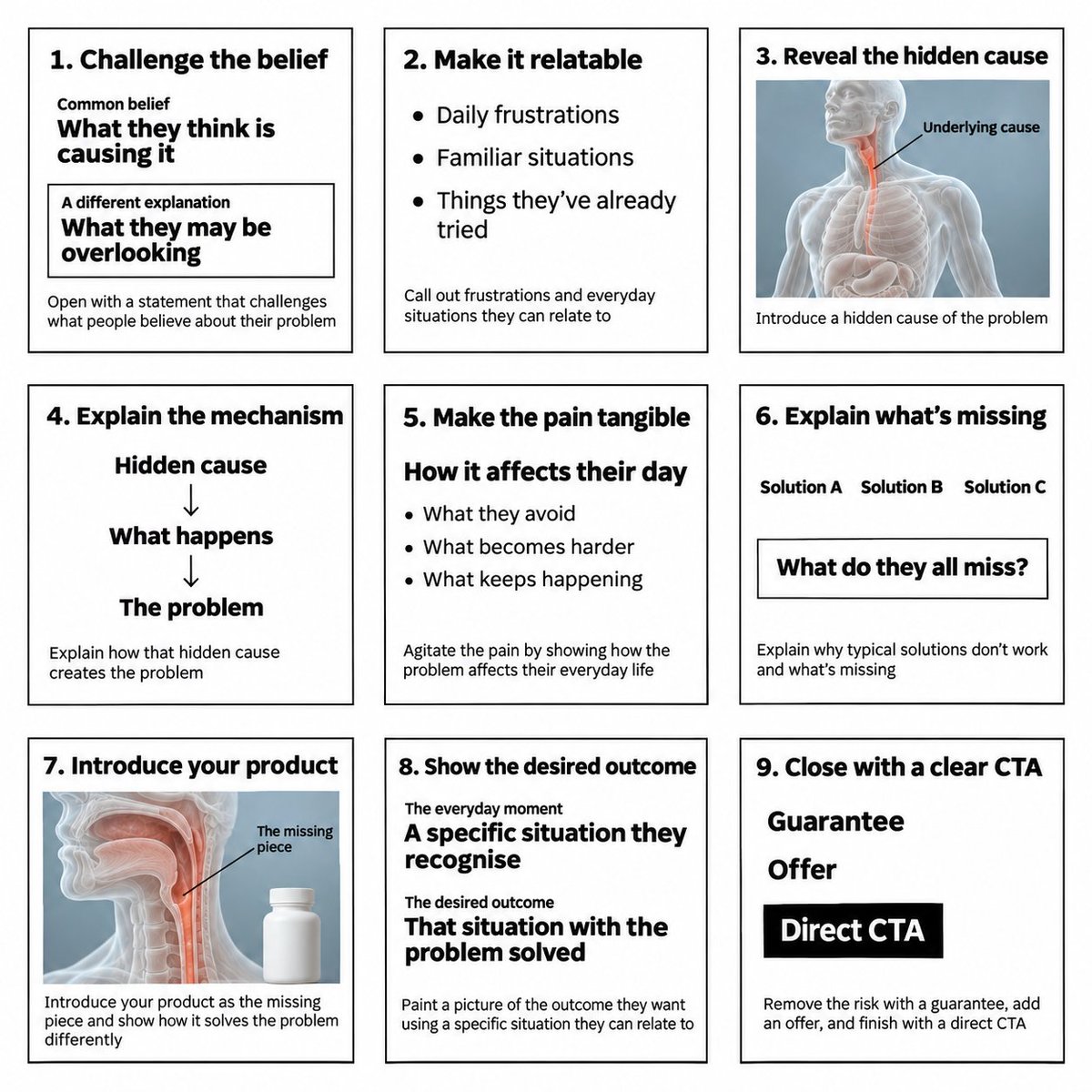
a simple one like this is more than enough:
1. open with a statement that challenges what people believe about their problem
2. call out frustrations and everyday situations they can relate to
3. introduce a hidden cause of the problem
4. educate on how that hidden cause creates the problem
5. agitate the pain by showing how the problem affects their everyday life
6. explain why typical solutions don't work and what's missing
7. introduce your product as the missing piece & show how it solves the problem differently
8. paint a picture of the outcome they want, using a specific situation they can relate to
9. remove the risk with a guarantee, add an offer, and finish with a direct CTA
traffic got directed to a dedicated pdp, quiz funnel or sale page
a few things to get right with the visuals:
> switch between animations, real-world scenes, and close-ups to hold attention
> make the problem feel more real with dramatic or uncomfortable visuals
> match the visuals to the voiceover. every scene should help explain or reinforce the point you're making
> traffic here is cold, so layer in proof everywhere you can: testimonials, studies, experts, research, etc
we’ve audited hundreds of accounts, and 90% either aren’t running youtube ads or aren’t testing formats like this.