🚨 *PI NETWORK: THE TRUTH ABOUT BLOCKCHAIN, $314,159 GCV, AND PI ON EXCHANGES!*
The cryptocurrency community needs to understand how blockchain technology works and the economic realities behind Pi Network's much-publicised $314,159 Global Consensus Value (GCV).
🔗 1. HOW DOES BLOCKCHAIN TECHNOLOGY WORK?
Blockchain is a decentralised digital ledger that records and verifies transactions using cryptography and a consensus mechanism. It allows participants to transfer digital assets according to established network rules without relying entirely on a central authority.
However, blockchain technology does not automatically determine the market price of a cryptocurrency. A coin's value depends on factors such as supply, demand, utility, liquidity, and market confidence.
💰 2. WHY IS $314,159 GCV NOT A GUARANTEED PRICE FOR PI?
The $314,159 GCV is a valuation promoted by some members of the Pi community. It represents an aspiration, not a guaranteed exchange price established by universal market demand.
Let's examine the mathematics.
If Pi trades at an illustrative price of $0.08, reaching $314,159 would require its price to increase approximately 3.93 million times, equivalent to a rise of about 392.7 million percent.
Such a valuation would have extraordinary economic implications. For example, if 10 billion Pi were valued at $314,159 each, the implied market capitalisation would be approximately $3.14 quadrillion.
Remember, market capitalisation is not the same as the amount of cash invested, nor does it guarantee that holders can sell their coins at the quoted price.
A community can agree on a reference price for exchanging goods and services, but that agreement alone cannot compel independent buyers and cryptocurrency exchanges to pay the same price.
A desired price is not the same as a price the market can actually sustain.
📱 3. IS PI ON AN EXCHANGE DIFFERENT FROM PI IN THE PI WALLET?
No! Native Pi on a supported exchange and native Pi in the official Pi Wallet are the same underlying cryptocurrency when both represent Pi on the same Mainnet.
The difference lies primarily in custody and access.
✅ Pi Wallet: You control your assets through your wallet's private credentials, and transactions are recorded on the blockchain.
✅ Exchange: The exchange generally holds deposited Pi and credits your account through its internal accounting system. Your exchange balance is therefore managed under the exchange's custody arrangements.
When native Pi moves between a compatible wallet and a supported exchange, its identity does not change.
However, be careful: an IOU, derivative, or token bearing the Pi name on another blockchain is not automatically equivalent to native Pi on Pi Mainnet.
🌍 4. WHAT CAN GIVE PI REAL ECONOMIC VALUE?
Pi's long-term prospects depend on more than community enthusiasm. Important factors include:
- Real-world utility: People and businesses using Pi for legitimate transactions.
- Supply and demand: The relationship between available Pi and the number of willing buyers.
- Liquidity: The ability to buy and sell meaningful amounts without dramatically moving the price.
- Adoption: More useful applications, merchants, and economic activity.
- Trust and accessibility: Secure wallets, reliable transactions, and legitimate markets.
The stronger these fundamentals become, the better the basis for assessing Pi's potential. Nevertheless, no particular future price is guaranteed.
🎯 FINAL MESSAGE TO ALL PIONEERS
GCV may represent a community aspiration, but it is not a guaranteed global cash price. Pi's real economic strength must ultimately be demonstrated through utility, adoption, demand, and functioning markets.
Remember: The same native Pi does not become a different coin simply because it moves from your wallet to an exchange. What changes is where it is held, how it is accessed, and potentially the price offered in a particular marketplace.
Stay informed. Verify claims. Protect your asset
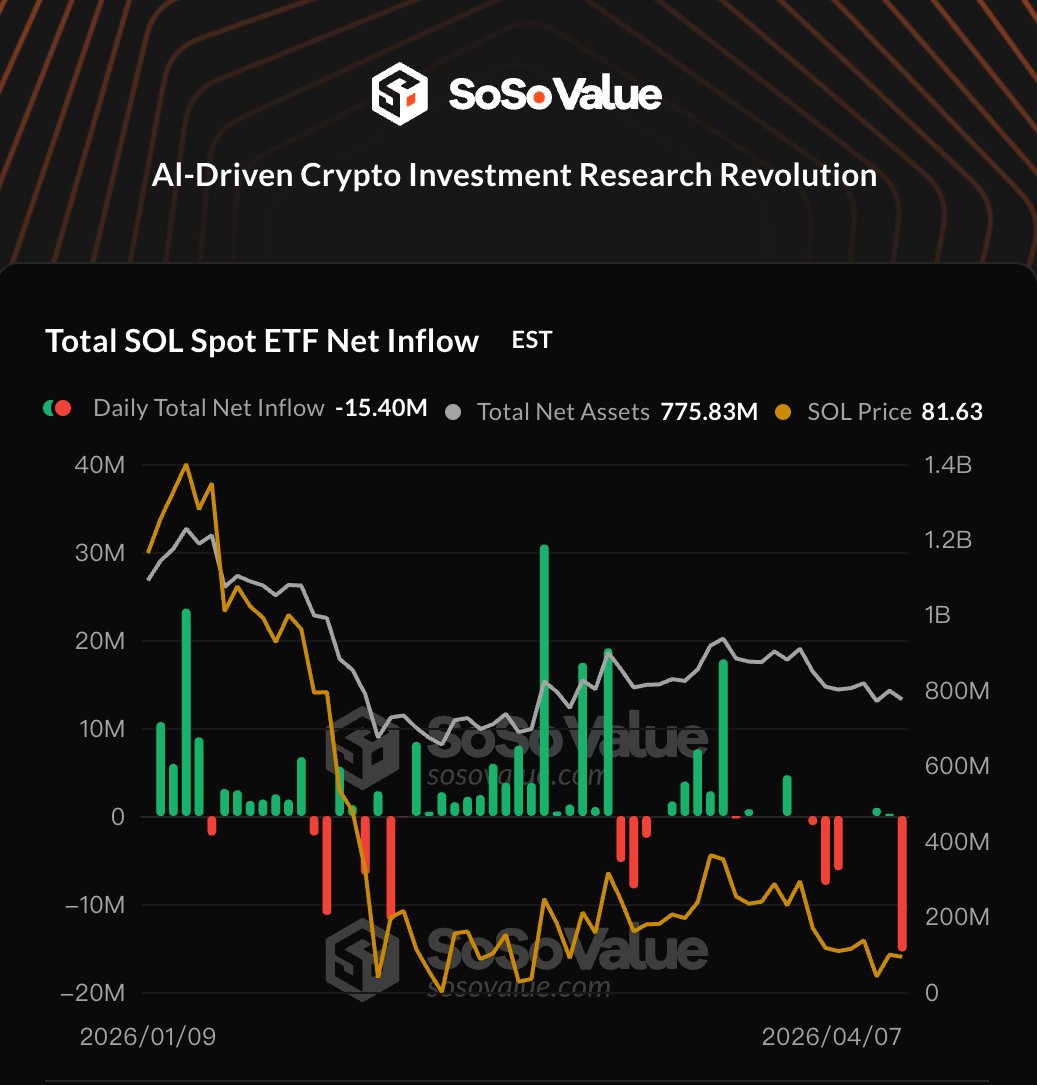
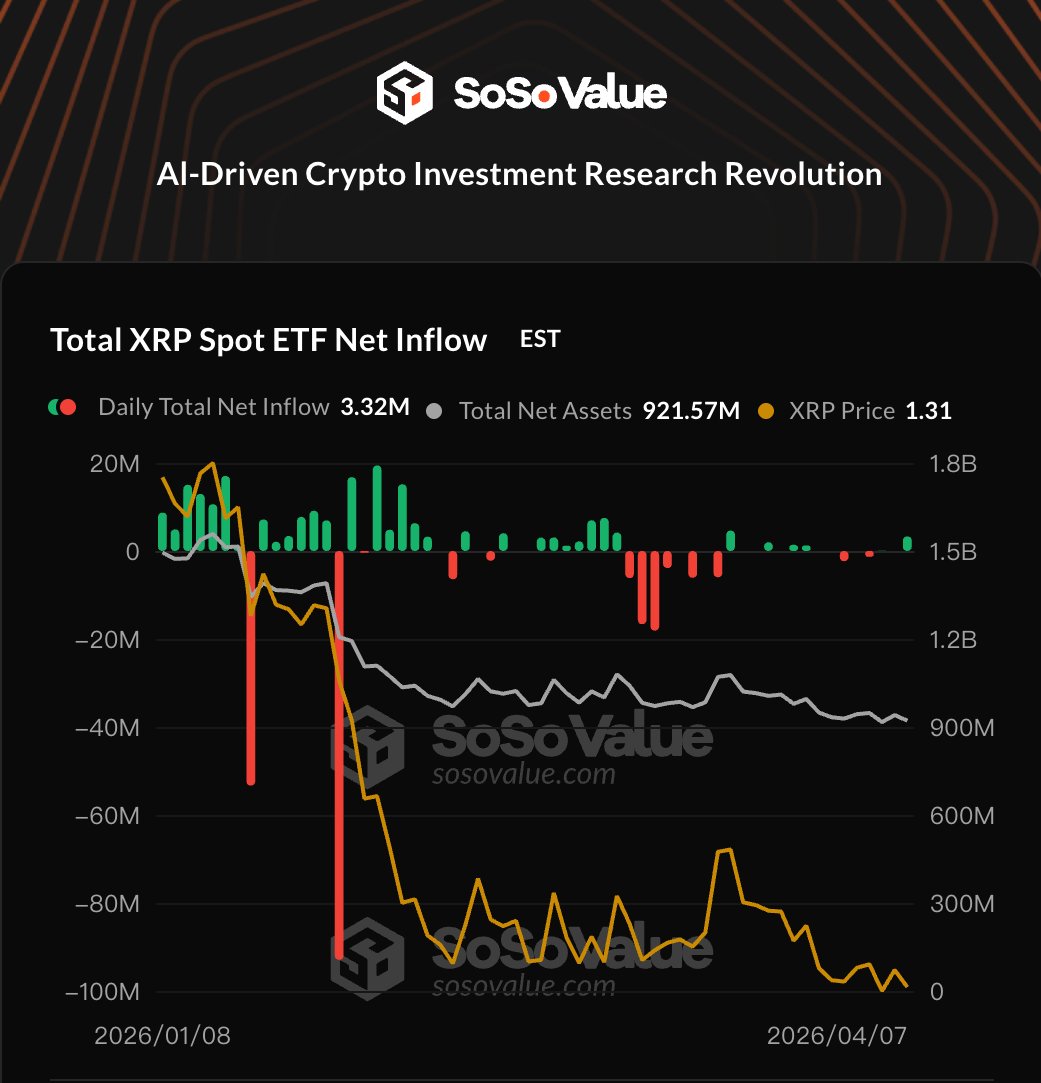
XRP is attracting capital, while SOL is bleeding flows.
April 7: XRP ETFs pulled in $3.32M — the biggest single-day inflow since March 26. Same day: SOL ETFs bled $15.40M in outflows. with no sign of stabilization in flows.
One attracting capital. One losing it. Same market, same day.
The market may not be fully risk-on yet, but capital is already starting to vote with its feet.
#XRP #SOL #ETF #Crypto #SoSoValue
🚨SoSoValue Flash: Ultimatum Nears as Inflation Fears Spread to Services
💥 Core Catalyst: The Tuesday Evening DeadlineTrump has reaffirmed Tuesday evening as the final negotiation cutoff, threatening to destroy Iran’s bridges and power plants within a 4-hour window. Iran has formally rejected the interim framework, insisting on a permanent end to the war. Markets are in "wait-and-see" mode, with Monday's equity volume hitting a YTD low.
🔍 Key Logic Shifts:
1️⃣ Hormuz "Thaw" Amidst Stalemate: Despite the political deadlock, field reports show actual shipping volume is recovering. 20 ships transited in the past 24 hours (including a Turkish tanker). France, Japan, and Greece are actively negotiating navigation rights directly with Tehran—shifting the Strait from "blockade" to "orderly checkpoints."
2️⃣ Inflation Contagion: The March ISM Services PMI confirms that oil-driven inflation is now infecting the services sector. Market anxiety is shifting toward Friday’s (April 10) CPI release.
3️⃣ Market Desensitization: If the Strait remains open and oil prices stabilize, the conflict may enter a "Russia-Ukraine style" phase where its direct impact on risk assets gradually diminishes.
📊 Trade Setup (SoDEX Assets to Watch):
Watchlist: $USTECH-100 | $XAUT | $BTC
Key Variable: The intensity of US strikes tonight vs. the scale of Iranian retaliation.
The Bottom Line: While risk-off sentiment persists, the recovery of Hormuz transit may dampen inflation fears even before a formal peace deal is signed.
#Geopolitics #Trump #SoSoValue #CPI #Inflation #HormuzStrait #TradingSignals
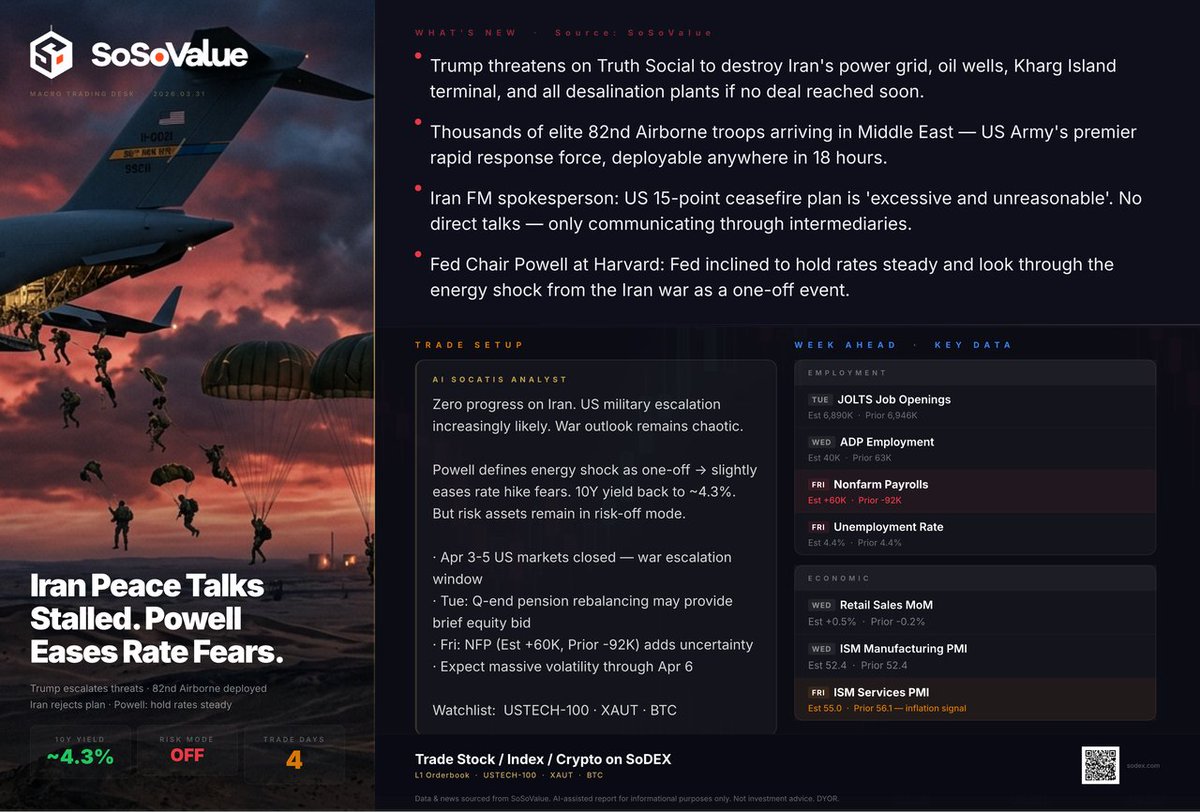
🚨 Macro & Geopolitical Alert: War, The Fed, and a High-Volatility Week
💥 Geopolitical Escalation:
The Threat: Trump (via Truth Social) threatens to destroy Iran's power grid, oil wells, Kharg Island terminal, and desalination plants if no deal is reached soon.
Military Move: Thousands of elite 82nd Airborne troops (US Army's rapid response force) are arriving in the Middle East.
Stalemate: Iran labels the US 15-point plan "unreasonable" and refuses direct talks. Peace prospects look grim.
🦅 The Fed & Macro:
Powell’s Pivot: At Harvard, Powell signals a "hold" on rates, choosing to look through the energy shock as a "one-off event." * Market Reaction: 10Y yields have retreated to ~4.3%, but the broader market remains firmly in Risk-Off mode.
📊 Trade Setup & Key Windows:
1️⃣ Escalation Window: Apr 3–5 (US markets closed). This is a high-risk "blind spot" for geopolitical shifts.
2️⃣ Pension Rebalancing: Watch Tuesday for a potential brief equity bid due to Q-end rebalancing.
3️⃣ NFP Uncertainty: Friday’s Non-Farm Payrolls (Est +60K) adds another layer of chaos.
🔥 Watchlist: $USTECH-100 (Tech under pressure); $XAUT (Gold/Safe haven); $BTC (High volatility)
Expect massive swings through April 6. Stay hedged. 📉🛡️
#Trading #Macro #Geopolitics #Fed #NFP #SoSoValue
Just mined 22.878999999999998 $BYTE on my phone! 🎉
Join the ByteBlockchain movement!🌐 Fast. Easy. 100% free. 🚀
Start mining now with @ByteBlockchainX ⛏️
👉 Download ByteBlockchain APP: https://t.co/8DcBy12Nzw