Movies still come on Blu-ray, music is still pressed on vinyl and books still fill store shelves. But as Sony moves to phase out physical PlayStation releases, many gamers are asking why video games should be the first major entertainment medium to go all digital. https://t.co/FagoUG3JVU
'SK Hynix says 2027 will be the 'worst year' for memory shortage, forecasts crunch to last until 2030 — CEO shares grim outlook on the day SK Hynix gets listed on Nasdaq' https://t.co/5D8JMEDwyv
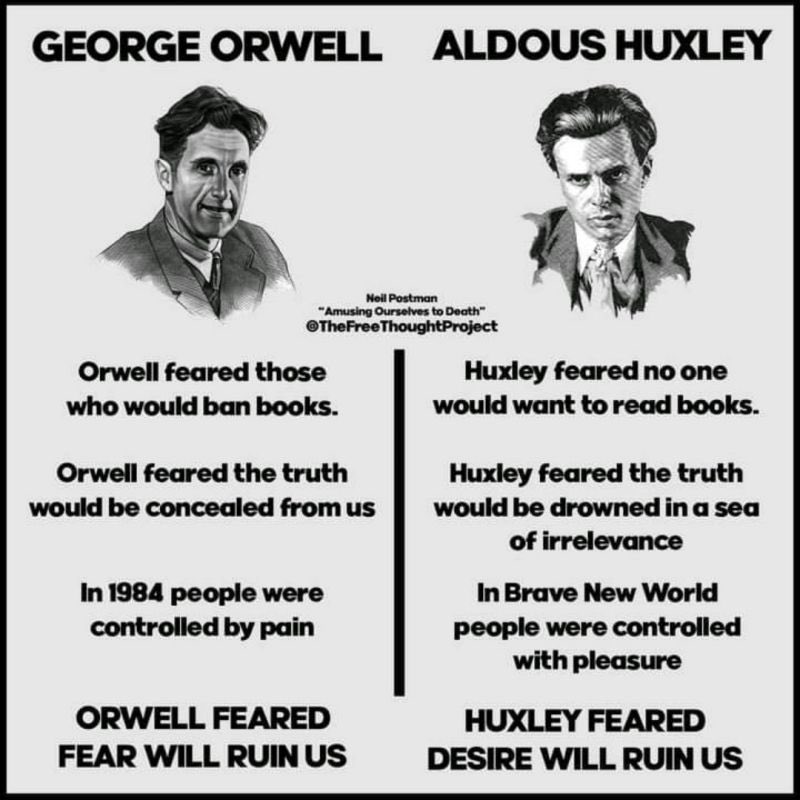
One of my longest-standing arguments is that we are not living in Orwell’s 1984, where truth is centrally suppressed and censored by force (that’s former communist societies, modern-day China, Russia, North Korea).
We are living in something much closer to Huxley’s Brave New World.
The truth is not hidden - it is almost always readily available. But it is buried beneath an industrial quantity of noise: propaganda, outrage, half-truths, conspiracy theories, influencer theatre, algorithmic rage bait and an endless stream of content designed not to inform us, but to keep us emotionally stimulated.
The modern information system does not need to censor the truth when it can simply drown it in noise.
A fact no longer has to be disproven - it only has to be surrounded by a hundred competing claims, stripped of context and nuance, turned into partisan ammunition and pushed into the same feed as celebrity gossip, memes and 15 second videos engineered to deliver the fastest possible dopamine hit. By the time the truth reaches us, it appears as just another piece of content competing for our attention.
That is the more sophisticated form of control: not preventing people from knowing, but exhausting their capacity to care.
Orwell feared a world in which people would be deprived of information. Huxley feared a world in which they would be given so much distraction, stimulation and triviality that they would lose the desire to seek it.
The defining struggle of our age is therefore not simply between truth and censorship, but between truth and indifference.
One of the most important and frequently misunderstood aspects of the fall of the Western Roman Empire is that it was not, for most people who lived through it, a recognizable event in the way that modern historical narratives suggest.
The date 476 AD — September 4, the day Romulus Augustulus handed over his crown to Odoacer — was not recorded at the time as the end of an empire. Most Romans living in Italy, Gaul, Spain, or North Africa in late 476 AD continued their daily lives without experiencing any dramatic visible change in governance, law, or material conditions. The same Roman law codes remained in use. The same roads carried the same traffic. The same administrative structures, now simply commanded by Germanic leaders rather than Roman emperors, collected the same taxes and adjudicated the same disputes.
The Roman Senate in Rome continued to function for decades after 476 AD. The Roman consul — the traditional highest civilian magistracy of Rome, dating back to the early Republic — continued to be appointed annually until 534 AD, nearly sixty years after the date conventionally marked as Rome's fall. Roman administrative titles, Roman legal terminology, and Roman cultural institutions persisted in various forms across the former Western Empire for generations.
What actually ended in 476 AD was the specific political institution of a Roman emperor recognized as ruling in the West — a role that had been increasingly nominal, contested, and militarily dependent for decades before Odoacer decided to stop bothering to maintain the fiction of a civilian emperor above him.
The concept of 476 AD as the fall of Rome was largely established by later historians — most significantly the 18th century historian Edward Gibbon in his monumental "Decline and Fall of the Roman Empire" — who identified this specific date as a convenient and meaningful watershed in a process of change that had been unfolding across several centuries and would continue to unfold for several centuries more.
What most Romans experienced in 476 AD was not a fall but a continuation — a continuation that would gradually, over generations, become something different enough from what had come before that historians looking back would reach for the word "ended."
#archaeohistories
Hab ein wenig die Befürchtung, sollte Belgien die USA aus dem Turnier werfen, dass Trump dann Deutschland mit Sanktionen bestraft, weil er zu dämlich ist, die Flaggen auseinanderzuhalten.
Hab ein wenig die Befürchtung, sollte Belgien die USA aus dem Turnier werfen, dass Trump dann Deutschland mit Sanktionen bestraft, weil er zu dämlich ist, die Flaggen auseinanderzuhalten.
FWIW this is Sony and other companies following and implementing an EU data protection law (GDPR) in regard to inactive accounts / personal data storage
But yes, it’s a risk with digital games
E.G. Ubisoft inactive accounts were deleted a few years ago
https://t.co/4NoA2lvKyP
Very cool animated #history map of #Europe. One frame for every year starting in 400 BC. The link goes through to YouTube. Be aware the video is 11 minutes long. Utterly fascinating though! Link: https://t.co/FKXs1tSqRY
Reformkanzler Merz und die Kunst, immer nach unten mutig zu sein
Friedrich Merz wundert sich über Nörgler.
Vielleicht sollte ihm jemand sagen: Menschen nörgeln manchmal nicht, weil sie Deutschland hassen. Manchmal merken sie einfach, wenn ihnen ein Kanzler ein Reformpaket verkauft, das vor allem dort hart wird, wo sich Menschen ohnehin kaum wehren können.
Bei Kranken wird er mutig.
Attestpflicht ab Tag eins, weg mit der telefonischen Krankschreibung, mehr Misstrauen, mehr Arztbesuche, mehr Bürokratie. Weil der Arbeitnehmer morgens offenbar nicht krank wird, sondern auf der Bettkante eine staatsgefährdende Sabotageentscheidung trifft.
Bei Bürgergeldempfängern wird er mutig.
Mehr Druck, mehr Sanktionen, mehr Verdacht. Der Sozialstaat wird nicht reformiert, er wird durchsucht. Irgendwo muss der große Betrug ja liegen. Und wenn nicht, sucht man eben gründlicher.
Bei Arbeitnehmern wird er mutig.
Flexibler sollen sie werden. Belastbarer. Weniger krank. Länger verfügbar. Am besten dankbar dafür, dass man ihnen erklärt, wie Reform aussieht, wenn man sie von oben auf den Alltag anderer Leute fallen lässt.
Bei Rentnern wird er mutig.
Kommission hier, Beitragssorge da, Arbeitsanreiz dort. Man weiß zwar noch nicht genau, wie die Rente langfristig stabil werden soll, aber Hauptsache, das Wort Reform steht schon mal auf der Verpackung.
Aber bei sehr großen Vermögen?
Plötzlich wird der Reformkanzler ganz vorsichtig.
Bei Erbschaften?
Ganz behutsam.
Bei Superreichen?
Da wird abgewogen, geprüft, gewarnt, erklärt, vertagt und ganz staatsmännisch verstanden, dass man da ja nichts überstürzen darf.
Nach unten reicht Verdacht.
Nach oben braucht es Fingerspitzengefühl.
Und genau das merken die Menschen.
Sie merken, dass Arbeitseinkommen diskutiert werden, Sozialleistungen kontrolliert werden, Krankheit misstrauisch betrachtet wird und normale Bürger immer neue Zumutungen als Reform verkauft bekommen.
Aber die eigentliche Vermögensfrage bleibt höflich draußen vor der Tür.
Dann stellt sich Merz hin und ruft Kritikern „Wegtreten!“ zu.
Nein, Herr Merz.
Kritik tritt nicht weg.
Kritik bleibt stehen.
Vor allem dann, wenn ein Kanzler Zuversicht wie eine Dienstanweisung verteilt und Reform immer genau dort beginnt, wo nicht die Villen stehen.