Really enjoyed this conversation with Dr. @albertmohler. Was honored to join his In the Library. I had no idea what we would talk about, but we covered quite a bit of territory! I hope it is of service to some.
First Things, in partnership with the Center for Christian Studies, is pleased to announce Carl R. Trueman will present this year’s 2026 Austin Lecture “Prometheus Ashamed: Technological Humiliation and the Human Condition” on Thursday, December 10 at 7 p.m. at the University Avenue Church of Christ.
Man’s exceptional technological ability has at its heart a strange paradox: the greater his achievements, the smaller he becomes in his own eyes. Indeed, his Promethean aspirations promise to make him into a god and yet have in the last century served to make him often less powerful, less exceptional—perhaps less human—than he has ever been. This strange phenomenon, dubbed “Promethean shame,” now looks set to reach its apex in the advent of AI. How should we understand this and is it an unavoidable part of the technological human condition?
Carl R. Trueman is a graduate of the Universities of Cambridge (MA, Classics) and Aberdeen (PhD, Church History). He has taught at the Universities of Nottingham, Aberdeen, and Westminster Theological Seminary. In 2017–18 he was the William E. Simon Visiting Fellow in Religion and Public Life in the James Madison Program at Princeton University. Since 2018, he has served as a professor at Grove City College in the Calderwood School of Arts and Humanities. He is a contributing editor at First Things and Touchstone, an opinion columnist at WORLD magazine, and a Fellow at the Ethics and Public Policy Center.
His most recent books are The Desecration of Man: How the Rejection of God Degrades Our Humanity (Sentinel) and Crisis of Confidence: Reclaiming the Historic Faith in a Culture Consumed with Individualism and Identity (Crossway). His writing has appeared in Deseret Journal, the Wall Street Journal, National Review, American Mind, Claremont Review of Books, and Public Discourse. He and his wife Catriona have two adult sons and one granddaughter.
Register at https://t.co/LaWzX74TJH
For the New Christian Right, ethnic identitarianism, not ecclesial communion or common doctrine, is the norm that norms theology itself. Despite all the chants of “Christ is King,” it’s hard to imagine a more godless political vision.
https://t.co/EQXOrsO0bQ
My essay on Paul Kingsnorth and S. L. Frank is now live online:
"Must we choose sides? Are we either against the Machine or for it? No."
https://t.co/4B6fAHlqrJ
@ActonInstitute
The average American has zero idea how truly small many religious groups are.
People were asked what share of Americans are Jewish?
They guessed 25%.
Not even 25% of Americans are Catholic!
Jews are 1.5%-2% of America.
Muslims aren't 20% of the country.
They are ~1%.
Call for proposals for The Academy of Philosophy & Letters conference: “To Build and Renew: The Good, the True, and the Beautiful”https://t.co/4LxZ8lApHz
@lsheahan
When Hebrews exhorts us to offer a continuous “sacrifice of praise” (Hebrews 13:15), we instinctively think “sacrifice” is a metaphor. Real sacrifice, we assume, needs blood, flesh, altars, and smoke.
That instinct gets things exactly backwards. Think about Jesus. Jesus offers the true, human sacrifice that atones for sin once-for-all. His blood does what the blood of bulls and goats could never do.
We should apply the same logic to our liturgical “sacrifices.” According to Scripture, the old sacrifices were shadows, faint images of true. What we do is the reality that Israel’s symbolic sacrifices pointed to. In worship, we offer ourselves as living sacrifices in Jesus.
Everything that happened symbolically in Old Testament sacrifice happens in Spirit and truth in Christian song.
Israelite sacrifice was a rite of ascent. Animals ascended as a soothing aroma in Yahweh’s nostrils, as a memorial of His promises. As we sing in the Spirit, we ascend as a sweet-sounding song in His ears, a musical memorial of His promises.
Sacrifice is a ritual of transformation. Animals were translated into sacrificial fire and smoke. In the new covenant, the Spirit fills us so that we sing and make melody in our hearts (Ephesians 5:18-19). Those who are transformed by the Spirit sing, and the Spirit transforms us by song.
Sacrifice is a rite of division and reunion. Animals were dismembered in order to be reconstituted in smoke and fire. In the new covenant, music reunites the cosmos. Song crosses the boundary of the firmament to reunite heaven and earth, as we join with angels and archangels and all the company of heaven (cf. Hebrews 12:18-24).
Song also binds us as one body, each voice making its unique contribution to the complex but united sound of the choir of Christ’s body. Song is a real-world sonic anticipation of the perfect harmony of new Jerusalem. Wherever two or three sing in the Spirit: Behold, there is new creation!
Sacrificial animals re-entered the symbolic Paradise of the temple, passing by the priests with their cherubic swords and fire. Through Jesus, we gain access to the heavenly sanctuary, and as we sing in the Spirit we enter the heavenly courts of Yahweh.
None of this is mere metaphor. We truly ascend to join the heavenly liturgy. We are truly transformed by the Spirit and song. We really are united, physically, as our voices sound through one another’s bodies. Animal sacrifices look solid and real. But they’re mere shadows compared to what happens every Sunday when we sing.
We don’t have the luxury of delegating our sacrifice of praise to professionals. Yes, each member of the church has unique gifts to serve the body. Some lead and exercise authority; some teach; some are shepherds; some are gifted musicians.
But we’re all priests, and that means we all offer the sacrifice of praise. If you sing badly, sing badly, or learn to sing better. Silence isn’t an option. You’re a priest, every last one of you. Singing is your job. It’s one of your main jobs.
– Peter Leithart
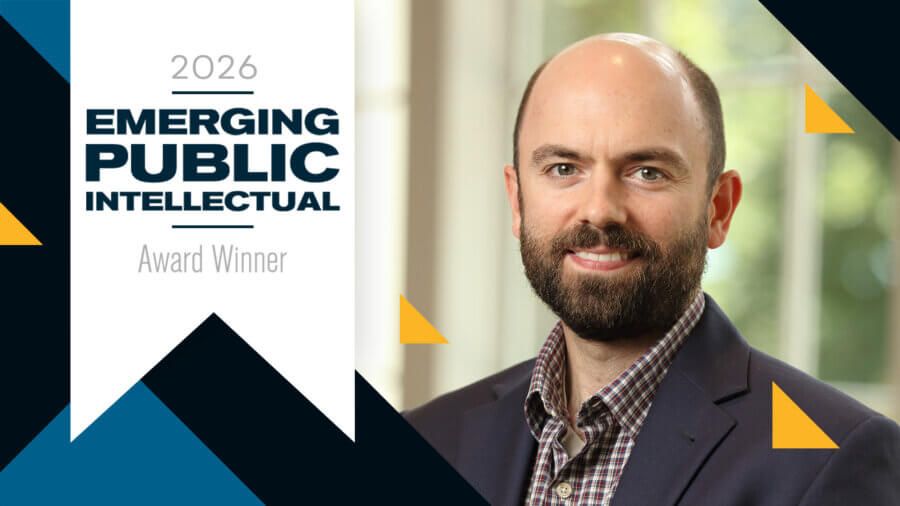
Congratulations to former Wilbur Fellow, and now "2026 Emerging Public Intellectual" Ben Peterson https://t.co/ZHgzq7Zlno
Ben and has published a new book as a result of his Fellowship at the Russell Kirk Center.
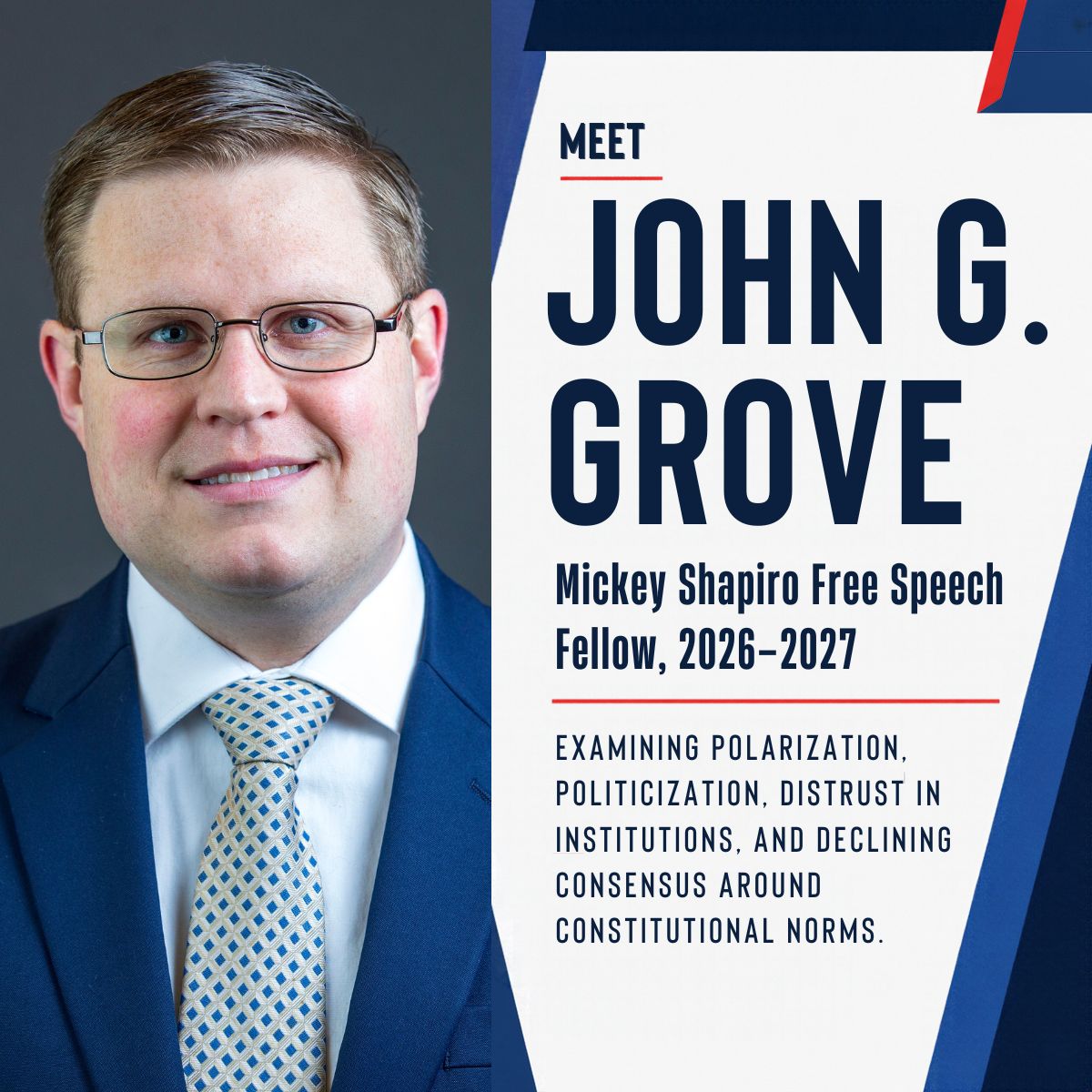
Join us in congratulating John G. Grove for receiving a Mickey Shapiro Free Speech Fellowship for 2026-2027!
John currently serves as editor-in-chief of @LawLiberty, and you find more of his recent work here: https://t.co/MeQsmjP5J1
Religious affiliation remains a key predictor of human flourishing.
Men and women from almost every religious group report significantly higher flourishing overall.
They also report greater flourishing on every single life domain except financial and material stability.
Revisiting some of the Reedy Creek debates. This is one of the more thoughtful analyses of the largest issues involved. By @ben_2_long
https://t.co/QjNuJtY3rd
Nice piece by @JBStonestreet and @Andrew_Carico today. Maybe a little too sanguine about broken windows policing (depending on how defined), but right on target about moral order and civil harmony:
https://t.co/RBjMivg2zQ
It’s out! Anthony Braga of @UniversityofP and @DavidKennedyNYC of @Jjcommencement win the 2027 Stockholm Prize in Criminology, for the work in designing, implementing and evaluating strategies of “focused deterrence” to prevent lethal violence in criminal networks.🇺🇸🇸🇪
Grateful and delighted to talk with @PLeithart and @jamesrwoodtheo on the Civitas podcast! They characteristically raise excellent questions and points. Many thanks for the serious engagement!
The Civitas Podcast
Episode 48
Sanctuaries of Order, with Ben Peterson
Peter Leithart and James Wood sit down with Ben Peterson for a conversation on social disorder, the limits of law, and the role of churches, families, and neighborhoods in cultivating community and character.
https://t.co/GCZjvgtok1