📢Come work with us at EMBL Rome!
If you're a student looking to get hands-on experience in epigenetics / CRISPR / oocytes, we've got you covered!
✉️Email or DM me or @hackettlab
To control transposable elements, fruit flies rely on piRNA clusters. Here, van Lopik et al. identify new piRNA clusters across Drosophila species with a specialised role in the control of endogenous retroviruses.
@CRUK_CI@sus_bo@Ben_C_Nicholson
https://t.co/oUGhsUveki
We are hiring TWO core-funded group leaders!
Each position comes with a flexible start-up package:
👩🔬2 postdocs and a technician
🧑🎓2 PhD students
🔬budgets for our state-of-the-art core facilities.
Ready to join our community of exceptional researchers?
https://t.co/PVf235zauY
Excited about epigenetics, small RNAs and transposons? Join the Hannon lab piRNA team @Cambridge_Uni and @CRUK_CI ! We are looking to recruit postdocs and staff scientists interested in studying the molecular mechanisms of small RNA-mediated chromatin silencing.
🚨New preprint🚨
Here we reveal rapid promoter evolution and divergent expression of germline piRNA factors, likely affecting transposon silencing for fast-tracked speciation!
Check it out here: https://t.co/exrncGVrIv
#evobio#piRNA@BCGB_UoB@Impact_Aim_Mrc@UoBbiosciences
🚨x2: We are also 👀 for a #bioinformagician to drive our #PDAC#CAF projects! Extensive bioinformatics expertise in RNAseq, scRNAseq and/or spatial transcriptomics + an interest in our research are a must. Being nice also a must!
Please RT 🤩
👇🏼👇🏼👇🏼
https://t.co/7imdoKXieg
📢 Work with me @Cambridge_Uni@CRUK_CI 📢
Comparative genomics and bioinformatics (postdoc)
https://t.co/DdnyjMR5rx
🪰💻🧑🔬
Ideally a mixed wet- and dry-lab position, but please apply regardless if the project suits you!
Closing Date 19 October
Please RT
I would like to thank Greg Hannon and Ben Nicholson and everyone else that has been supporting me in the application process. If you want to learn more, please reach out or visit my new website: https://t.co/vg42gpCWjU 3/3
Scanning all genomes for regions enriched in LTR transposons with strong strand bias, we found at least four additional non-syntenic flam-like clusters (flamlike2-flamlike5) in widely different species. These all appear to control Gypsy-family transposons with an env gene. 5/7
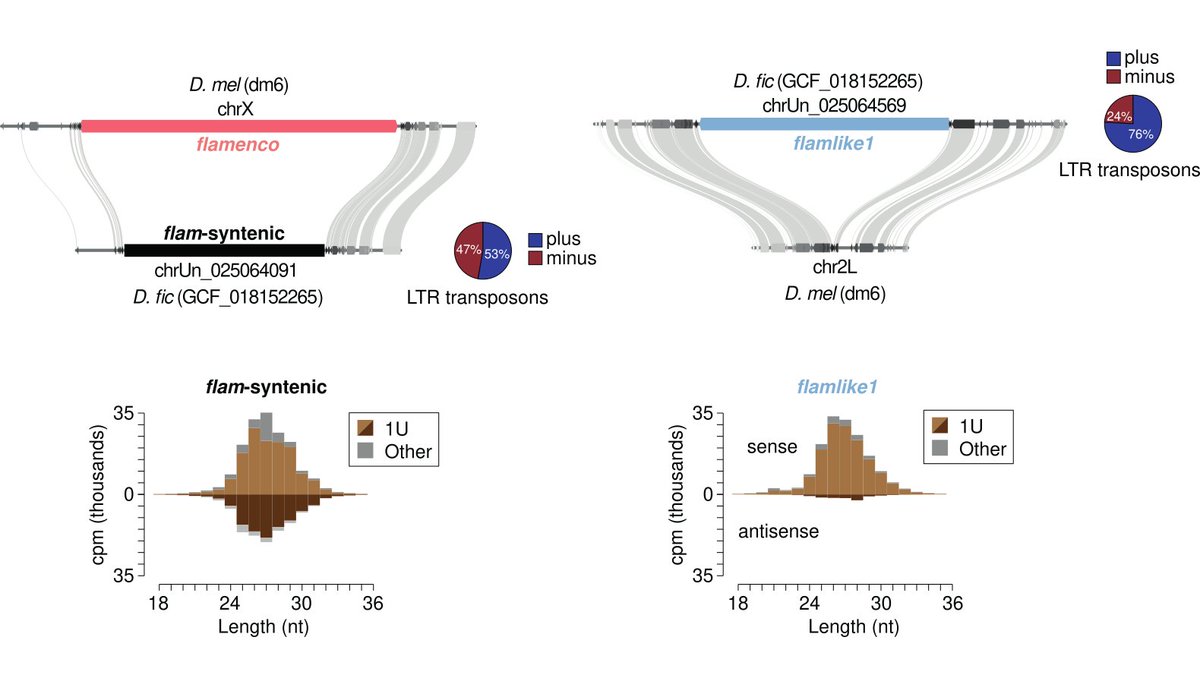
Unexpectedly, we found a dual-strand cluster at the flam-syntenic region in D ficusphila and a 575 kb flam-like unistrand cluster (flamlike1) elsewhere in the genome. This supports the idea that unistrand piRNA clusters have emerged repeatedly and independently. 4/7
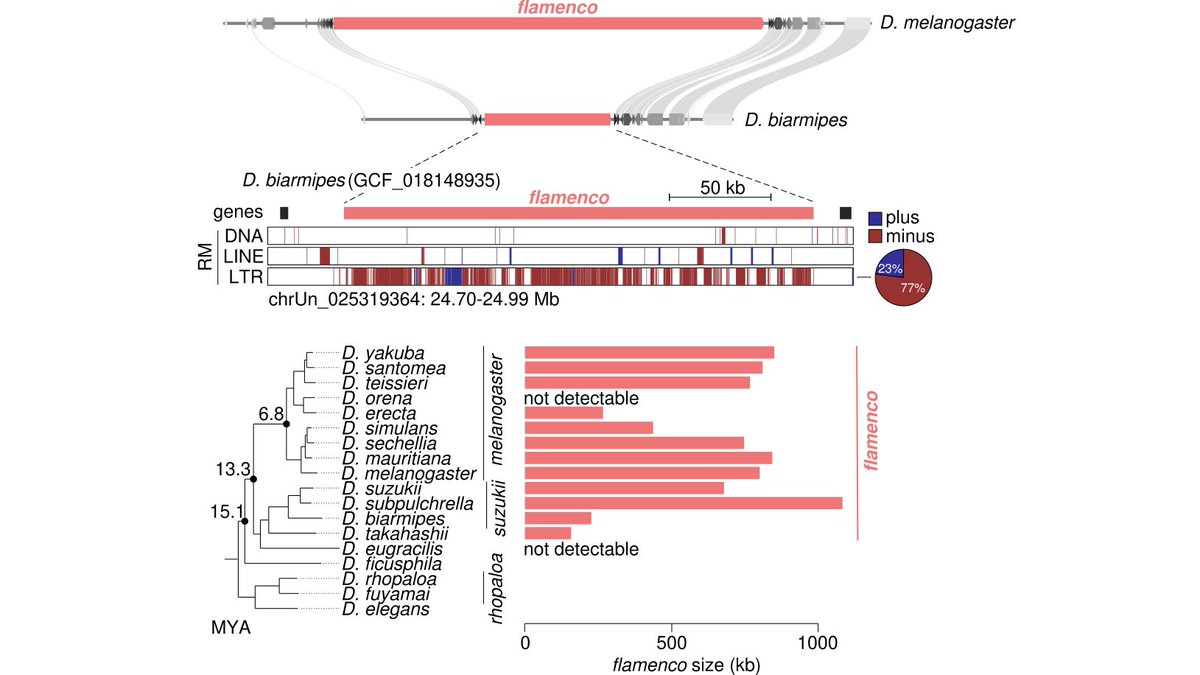
Using synteny analysis, we found that flam conservation extends into the suzukii and takahashii subgroups (diverged 13.3 million years ago). However, flam is clearly absent in D ficusphila, as well as in the elegans and rhopaloa subgroups (15.1 MYA). 3/7
We studied 193 genomes (massive thanks to @Bernard_Y_Kim and others for releasing these) spanning 119 Drosophilid species and found that Gypsy transposons are present across all Drosophila species and likely kept their ability to mobilise from ovarian somatic follicle cells. 2/7
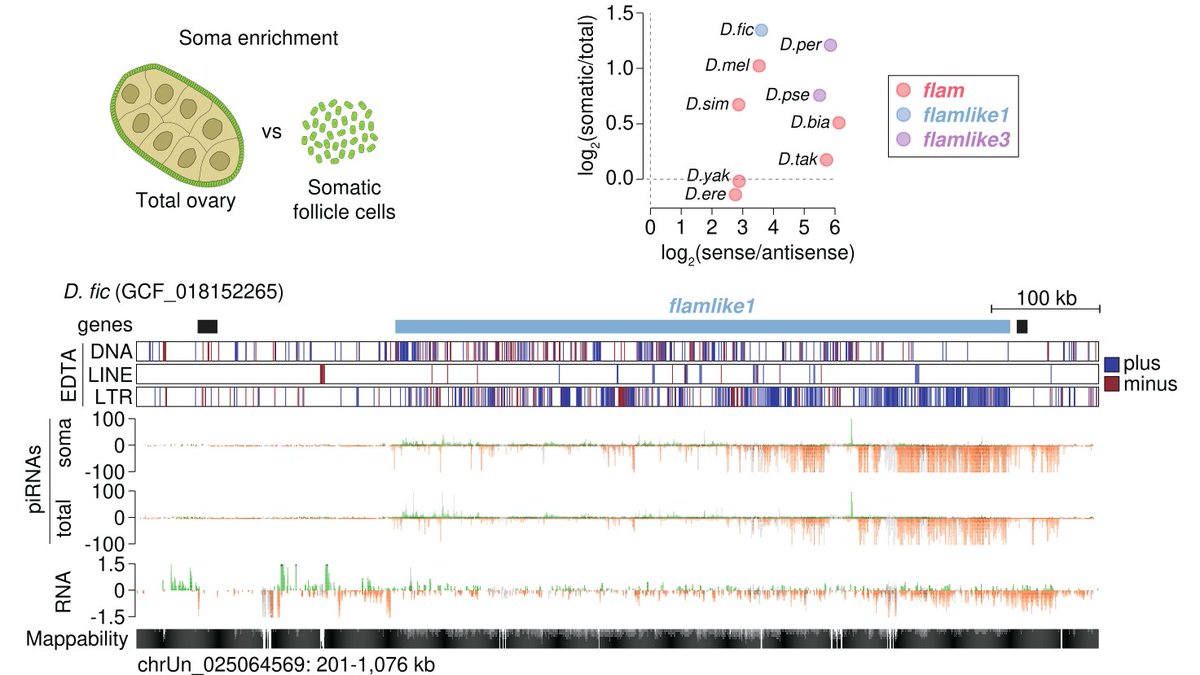
For several species, we profiled soma-enriched and total ovary piRNAs. Our data confirm that these clusters produce highly abundant piRNAs against Gypsy-family transposons in somatic cells. Thus, this somatic function of the piRNA pathway is widely conserved in Drosophila. 6/7