@ClareCraigPath Do you think is perhaps to accelerate cancers following mRNA deployment? Perhaps that’s connecting too widely. But this seems like a drastic action to take to protect a (relatively)small at expense of a large group.
When mRNA enters any cell the intention is that it will express spike protein and the cell will be killed by the immune system.
The virus kills respiratory epithelial cells which are easily replaced.
If mRNA ends up in heart or brain cells you lose them forever.
Aussie news just dropped shocking figures on exploding cancer rates in young people
Ovarian cancer up 30%
Breast cancer up 50%
Bowel cancer up 71%
Prostate, pancreatic, and liver cancers also surging.
They’ll blame everything except the obvious. Wake up.
UK begins trials of Ebola vaccine developed in just eight weeks!
Please ‘count me out’ I have taken enough of their ‘safe and effective’ so called ‘vaccines’.
https://t.co/uA5zTlUHTL
YouTuber Dan Schaeffer says he “completely cleared” his sinuses by combining DMSO, purified water, and colloidal silver into a nasal spray.
One squirt up each nose twice a day, and the results were “amazing.”
“No pressure, no nothing.”
Dan’s experience is not an isolated one.
In 1992, Russian researchers found that treating children with sinusitis using a 10% DMSO solution followed by local oxygenation provided complete relief in 49 of 52 cases.
DMSO is a cheap substance you can typically find online for under $30.
Turns out it can do much more for your respiratory system than just clear your sinuses. 🧵
When do we get the patient information leaflets for each loaf of bread?
When do we get one for 'organic' sausages?
Sign and share the petition making sure you click the email to confirm your signature:
https://t.co/XzpiIGIzT7
Mass medication of food is simply unethical no matter what your political views.
For the majortiy the risk by definition will outweigh the benefit as there is no benefit!
Sign the petition https://t.co/FrnG9pS5rP
Not a single Russian missile has hit Europe during these five years. Not a single Russian tank has been sent to Europe during these five years. Not a single Russian combat aircraft has been flown to Europe during these five years.
And during all this time, THOUSANDS of European missiles, tanks, and aircraft have been sent into Russia and have hit Russia. And after all that, we are being lectured on Russian responsibility.
Watch full here: https://t.co/wxkCX3neHE
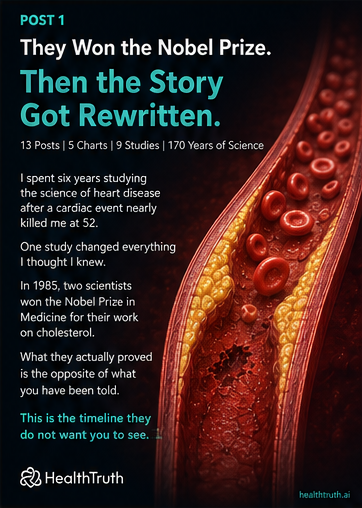
Two Nobel Prize winners proved that normal LDL does not cause heart disease.
Every medical student is taught this.
Then the guidelines buried it.
In 1985, Brown and Goldstein won the Nobel Prize in Physiology or Medicine.
They proved that macrophages, the immune cells that build arterial plaque, cannot recognize normal LDL. Only oxidized, damaged LDL triggers the disease.
This should have changed everything.
Instead, the pharmaceutical industry built a $26 billion drug around lowering the molecule that the Nobel Prize proved was not the problem.
This is the 170-year timeline they do not want you to see.
Back in the early 2000’s when I was Dx’d with breast cancer I did the whole ‘green drink’ ‘nothing acidic’ and don’t forget: “meat is evil & it gives you cancer” thing. I was 100% onboard. I did herbs, antiparasiticals,ozone therapy & many many other things. But it took me TWO
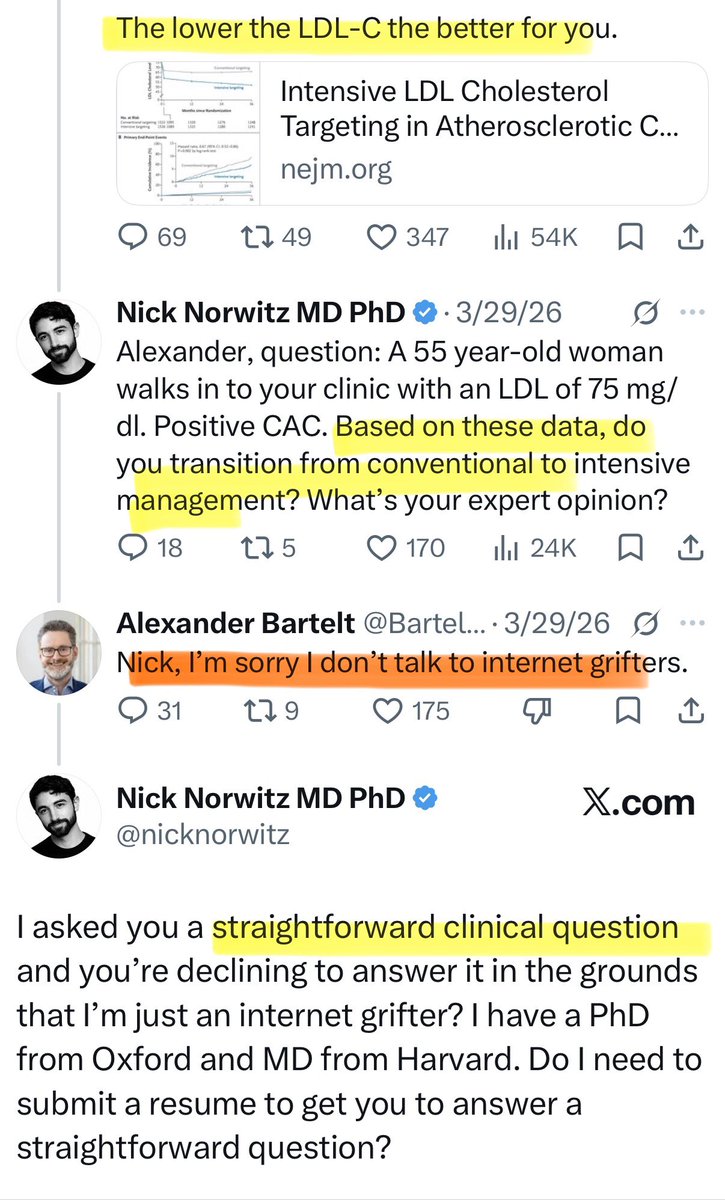
Here’s a cautionary tale—and one reason so many patients have lost trust in conventional medicine. 🙈 (Read to the end)
👉 Them: “I’m the expert. Lower LDL is always better.”
👉 You (or me): Politely ask a direct question to explore the nuances or the underlying evidence.
👉 Response: A personal attack.
That’s not expertise. It’s defensiveness and a transparent signal that the person’s claim exceeds the depth of their understanding.
👉 Them: The same “experts” complain that patients are turning to “influencers” instead of trusting experts.
🚨The worst part?
There are countless brilliant, thoughtful clinicians who genuinely deserve the public’s trust. They acknowledge uncertainty, engage with evidence, and answer difficult questions with curiosity rather than contempt.
Unfortunately, many of those people aren’t the loudest voices among the self-appointed “experts.”
Instead, trust in the medical profession is undermined by a vocal minority who mistake credentials for arguments and résumé lines for evidence.
Patients lose trust when sincere questions are met with arrogance instead of answers.
Trust me — I’ve been that patient
🔄 Repost to agree
In 2012, the FDA ordered a new warning onto every statin label in America. The subject: memory loss and confusion. Not a footnote, not a rare-events appendix. A mandated warning on the packet of the most prescribed drug on earth.
To understand why it takes something that serious to move a regulator, meet the man the medical world couldn't wave away.
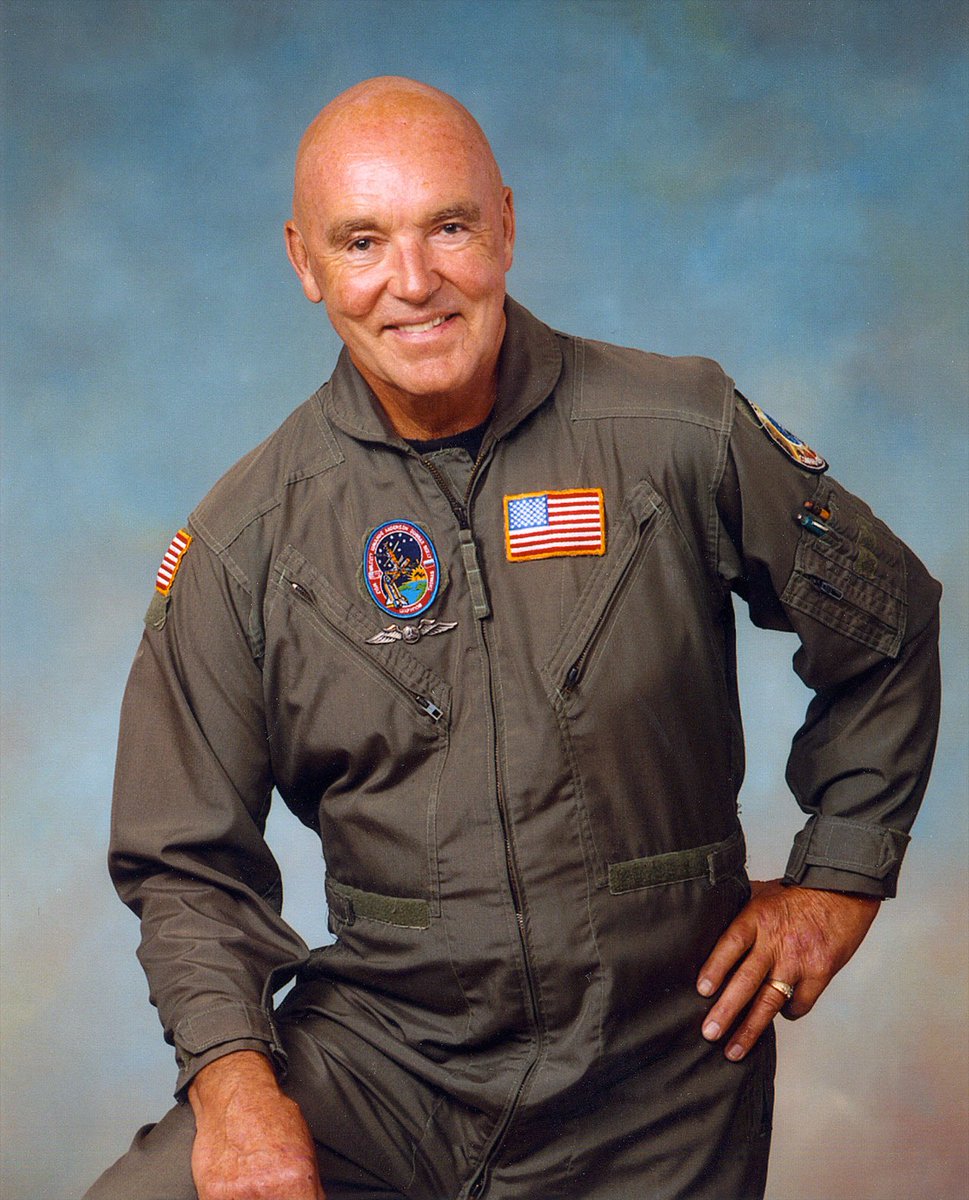
Duane Graveline was a NASA astronaut. A flight surgeon, an aerospace research physician, one of six scientist-astronauts chosen for the Apollo era. A man whose entire career was built on a mind sharp enough to be trusted in orbit.
In 1999, at his annual astronaut physical, they put him on Lipitor for his cholesterol. Six weeks later he came back from his morning walk and did not know where he was. His wife stepped outside, and he greeted her as a stranger. Six hours of his life simply gone. The hospital called it transient global amnesia, and no one could tell him why.
He suspected the statin. His doctors assured him it was unrelated, and the following year talked him into going back on, at half the dose.
It happened again. This time worse. This time he lost years. For twelve hours he was a thirteen-year-old boy, a high schooler who knew his classmates and his homework but laughed in disbelief when they told him he was a married man with children and a medical degree. He could not have treated a mouse. He was, in his own mind, a child.
Then it lifted, and this time he was certain.
Here was a physician who could read the literature, an astronaut whose credibility could not be dismissed as hysteria or coincidence, and he spent the rest of his life documenting what the drug had done to him and to others. He wrote book after book, the first of them titled Lipitor, Thief of Memory. He built a resource read by sufferers all over the world.
His own profession mostly shrugged. Cognitive damage hadn't shown up neatly in the approval trials, so to many it simply wasn't real.
It took until 2012, years of accumulated reports later, for the regulator to concede in the smallest print it could manage that the memory loss was real enough to warn about.
Graveline was never the only one. The letters came in by the hundred, ordinary people whose fog and forgetfulness had been brushed aside the same way his was.
He was simply the one they couldn't call a crank. The astronaut. The one with the credentials that wouldn't burn.
It happened to me. I went low carb after my heart attack. My fasting insulin dropped. My triglycerides fell. My inflammation markers improved. Everything was moving in the right direction.
Then my HbA1c went up.
My doctor looked concerned. The number said I was getting worse. But every other marker said I was getting healthier than I had ever been.
Here is what nobody explains.
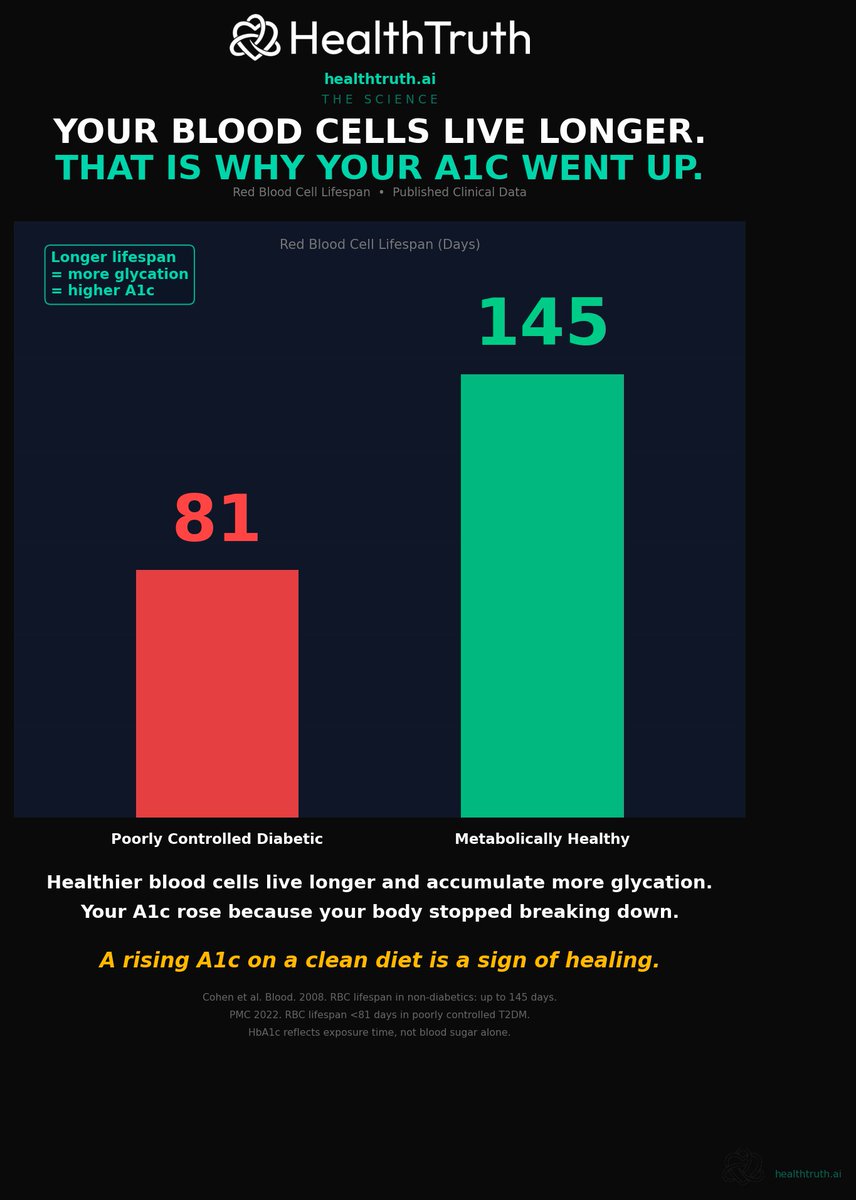
HbA1c measures how much sugar has stuck to your red blood cells over their lifespan. Normal red blood cells live 90 to 120 days. The sicker you are, the shorter they live. In poorly controlled diabetics, red blood cells can die in as few as 81 days.
When you clean up your diet, lower your insulin, and reduce inflammation, your red blood cells start living LONGER. Studies show they can live up to 145 days in healthy people.
Longer living blood cells are exposed to glucose for more days. More days of exposure means more glycation. More glycation means a higher HbA1c reading.
Your A1c went up because your blood cells stopped dying early.
That is not a failure. That is your body healing.
WARNING: Longer post (but worth reading or bookmarking for later).
Your life has seasons.
Each one is unique. Characterized by its own distinct desires, struggles, opportunities, and identity.
But one reflection I've had recently is just how easy it is to completely disassociate with the present season.
To give all your time and energy toward a longing for some nostalgic memory of a prior season or an anticipation for some beautiful state of a future season.
You look back at the past and all you see is sunshine. Because it all worked out. You forget (or glaze over) the struggle you endured. You're here today. You made it. You're alive. You're doing fine.
You look forward at the future and dream on what could be. You'll have so much more. More freedom. More purpose. More health. More deep connection. More everything.
The past is beautiful and the future feels limitless. So, logically, you slowly start to treat everything about the present as the bridge. A dash connecting your past and your future. A gap to be crossed as quickly as possible.
Everything you do today is in anticipation of some eventual end state.
I'm doing this now, so that I can have that later.
Unfortunately, the danger of that dissociation with the present is significant. You may spend your entire life living for a future that has a decidedly mirage-like property. You inch closer, but when it's right in front of you, it disappears and reappears on the horizon.
You may spend your entire life skipping through the present, deferring your presence, your joy, and your very humanity to a future that never comes.
In a classic French fable, a young boy is gifted with a magic ball of golden thread. He's told that if he simply pulls on the thread, time will leap forward. The catch, of course, is that once it's pulled, it can never be put back.
The young boy takes advantage of the newfound powers. Each time he's faced with a boring day at school, a frustrating set of chores, or a scolding from his parents, he pulls the thread, skipping through to the good parts.
As an adult, he continues, leaping through mundane struggles in his marriage, the friction of having a newborn, and the boredom at work. He finds himself pulling on the thread more and more, avoiding even the most minor inconveniences of his life.
But when he wakes up one day and sees an old man looking back at him in the mirror, he's filled with regret. He realizes in that moment that as he chose to skip through the boredom, struggles, and friction, so too did he miss the real texture of being alive.
How often do we all do the same? How easily do we default into this disassociation? Disconnecting from the present in anticipation of some future.
A mentor recently asked me this:
"Where are you going and why are you in such a rush?"
It hit me hard.
And to be honest, I haven't stopped replaying those words since he said them.
Why are you in such a rush?
The world wants you to rush into everything. Rushed decisions. Rushed conversations. Rushed relationships. Rushed timelines.
In doing so, you slowly relinquish your agency. You give up your claim on your own life. Surrender authorship to a pen that was never even yours.
In a world that wants you to rush, the ultimate act of rebellion is presence.
Be in the season you're in. Don't romanticize the past, don't fantasize the future. Be here. Be now. Be in this. All of its texture, depth, and struggle. All of its joy, tension, and pain. Sit with the uncertainty. Become friends with it. Fall in love with it.
Because every single thing you do today is something your younger self dreamed of and something your older self will wish they could go back and do.
The good old days are happening, right now.
And the next time you find yourself skipping through the present, remember these words:
Where are you going and why are you in such a rush?