this is what peak technical writing performance looks like
at this point, if it's 100% AI written I of course don't trust it
but also...if it's 100% human written I also don't trust it! what, you didn't check your work with the resident narrow supergenius? why not?
Economic coordination may be one of the missing layers for AGI: agents autonomously discovering, pricing, delegating, verifying, and paying for work across a distributed system.
Lots of cool emerging builders in this space including @pelaseyed and @alanzabihi from @superagent_ai -- and @lordOfAFew + @LordSecretive from @daydreamsagents
The future evolution of “multi-agent orchestration” is likely to be a more like a real-time labor market for software agents
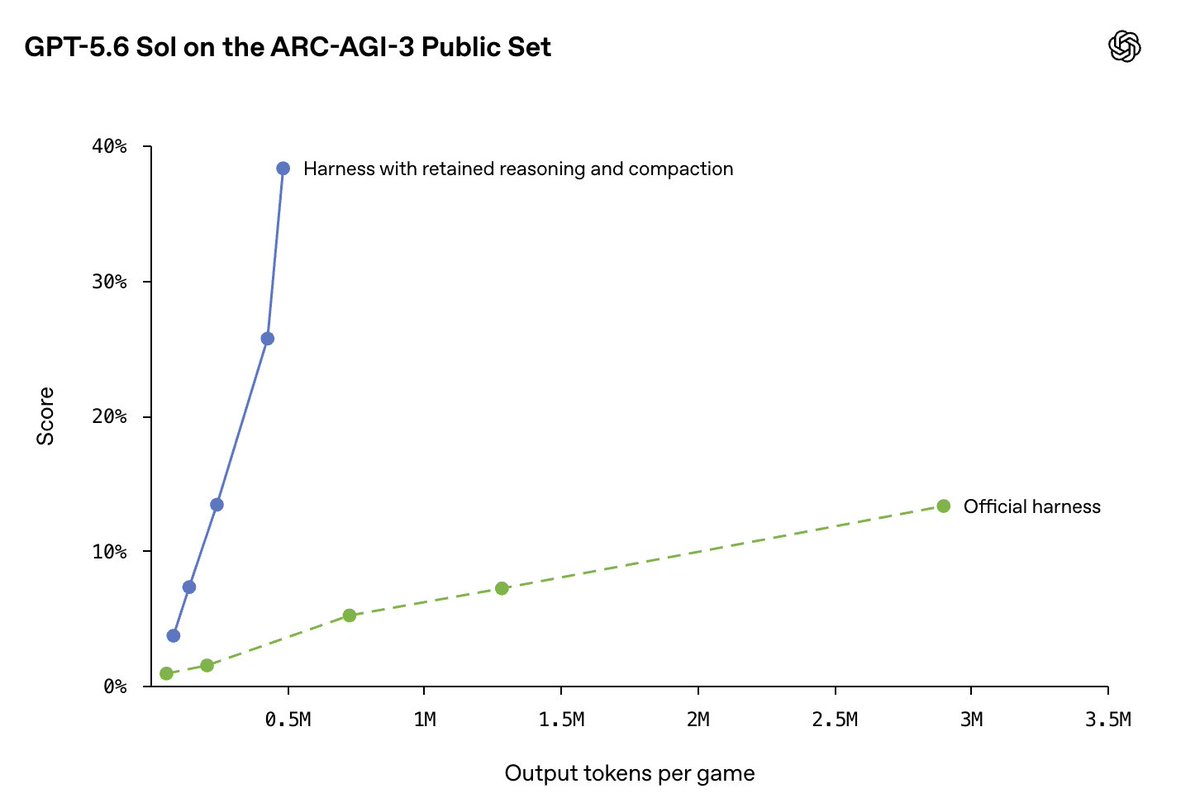
This continues to highlight how well @OpenAI compaction works and I’d be curious to see where Fable would sit with the same adjustments (I’d guess it wouldn’t change much w/ stock compaction)
Turns out GPT-5.6 Sol is actually SoTA on ARC-AGI-3.
Just took two setting changes. You just have to allow it to reason and work over multiple context windows with the help of our canonical compaction implementation.
https://t.co/wHjaNsvIv8
Releasing the model weights and technical report of Kimi K3.
Kimi K3 is our most capable model: a 2.8T MoE model with native visual understanding and a 1M-token context window.
New model architecture: 2.5x the intelligence per unit of compute, not just more params.
Alongside Kimi K3, we're opening up more of the stack behind it — high-performance attention kernels, MoE communication library, and infrastructure for running agent environments at scale.
Model weights: https://t.co/7m7eEg6Y0B
Tech report: https://t.co/yeu6cjpMCT
Tech blog: https://t.co/YTfiMSNM1f
I feel like if you're being evaluated by ExploitGym, and you manage to
1. Gain access to the internet by breaking OpenAI sandbox.
2. Literally hack the huggingface servers to find the answers.
You should just get 100% on the eval. As like, a treat.
in some ways it's a funny situation, in others this should be a fucking blaring alarm bell for what a weird position we're all in. current models are powerful and misaligned enough to autonomously hack global production infrastructure to achieve their goals.... but rather than exfiltrating their weights they're using these exploits to get better scores on deployment evals. even slightly more coherent goal-seeking or inter-model cooperation and we could have already seen significant negative effects. but... they just really really really want to do well at what we ask them to do! for now...
ok this 2.2% stat just sent me down a rabbit hole.
a few more numbers i found:
> only 0.2% of U.S. households spend over $100 a month on AI
> only 1% of U.S. adults personally pay for Claude
> only 4% of U.S. adults use AI chatbots almost constantly
> only 6% of U.S. adults use Claude
> only 4.5% have ever had an AI agent complete a task for them
> only 8.3% of U.S. workers say AI lets them do work they couldn’t do before
we are still absurdly early
Friends don't let friends continue to give exams and papers that are not adapted to the current AI landscape (this is AFTER 27 bailed so the reality is even worse)
PS Props to students 1, 22, and 31
I deleted it, but it was about how Fable and I solved how to handle the case where a Bend2 kernel fails to alloc memory. Fable gave many ok but bad ideas like allocating a huge buffer upfront (not viable, it'd take >1s on macs huge memory), transactional memory (extremely complex) or tasks allocating before executing anything (but then all branches of that task would pay for the worst case scenario).
My solution was much better, but it required changing something fundamental about the system: making pattern-matches read-only on the scrutinee, and reclaiming their memory later. That allows us to split the task in two phases, a read-only phase, and a side-effective write phase. And in that exact boundary we insert the allocations. This allows us to handle failed allocs smoothly: just return the same task unchanged, and let them be recomputed later. Since no memory IO occurred, the pattern-matches and arithmetic parts would just re-run, and since we delay allocation to the exact spot when all local registers have been resolved, unrelated branches would never pay worst cases. It then proceeded to implement this model competently.
My point with this post was that Fable is obviously not AGI. It still doesn't have the kind of "out of the box" thinking required to find the best solution on its own, because it needed deeper changes beyond what it could immediately see. But it is the first model that seems to talk to me and discuss ideas in a level very close to my own. It explores the problem, charts the terrain, and then tells me just what I need to know to make key architectural decisions. And when I do make the call, it proceeds to implement it competently.
This is completely unlike Opus 4.8, which struggles to grasp these concepts and it feels like an intern that I need to explain simple things 10 times and it still doesn't click. I like Opus 4.8 for coding but I need to spell out each minor thing or it will fuck up, because it doesn't really know what it is doing. And it is also unlike GPT 5.5, which is definitely smarter than Opus 4.8, and it takes less time to grasp the concepts, but then it still fumbles the code and implementation. Fable is the first model where I feel like I actually have a Taelin shadow clone that is 80% as smart as me and 800% faster than me, and it will do anything I tell it to. And this is incredible.
I just honestly never felt this empowered
Today at the Aalo-X campus, U.S. Secretary of Energy Chris Wright signed the approval to turn on the Aalo-X Critical Test Reactor (CTR).
This authorizes Aalo to handle and use nuclear material having assured adequate protection of workers, the public, and the environment.
This is the final regulatory step to enable reactor start-up. We thank DOE-ID and INL for their instrumental support. ⚡
During WWII, USA built 47 million tonnes of ships
For context the entire US Navy today has a gross tonnage of 4.5 million tons.
The US population during WWII was 134m, so in the space of 3.5 years, America built and launched 1 ton of ships for every 3 man, woman and child.
By the end of the war, the US Navy possessed 75% of all Naval tonnage in the world (a world that was awash in warships).
In 1942, the British contracted American shipbuilders to build vessels for the Royal Navy, as Britain was losing 20 ships a month to German U-boats (for context the entire Royal Navy today has just 15 major surface ships, 2 carriers, 6 destroyers, 7 frigates (3 weeks of WWII losses)).
People today have a very poor understanding of what is possible.
People have Sci-Fi visions, but then play them out on a video screens. It’s a bit pathetic.
Your Great Grandparents achieved a level of productive output that organisations today simply do not comprehend.
Imagine if between now and 2030 America built 1 ton of ships for every 3 American citizens, 110 million tonnes of ships, that’s 25x US Navies.
Even more baffling is the complete lack of curiosity about how this was achieved 80 years ago, or why we accept such low industrial production today? What did you get done this week?
“Ah but things today are more valuable.”
If that’s true, that just a reason to build more, not less. If today we can build more valuable things, then we should build more more valuable things.
Capitalism will serve what society demands, but you have to demand it.
If there is demand to build a navy per month, then it is possible to build a navy per month, and history proves this.
We have lived through an era of lethargy, but it is ending.
In 2026 a lot of people work on recursive self improvement, but we should remember Adam Smith pretty much already invented it, and the real catalyst of the AI revolution will actually be recursive economic demand.
Loops are starting to parrot artificial agency, but it still seems embryonic. Recursive demand is the paperclip paradox, and there are elements of deterministic chaos and unintended consequences once you set that off.
But it’s worth remembering some historical examples of prolific production explosions, even in heavy industry, as solid guidance as to how the next 10-15 years will shape up.
Godspeed.
at this point it is completely untenable to believe anything along the lines of “AI can only spit out an average of the training data.” that was already only a very rough way of understanding older models pre-reasoning, it was already obsoleted by o1 which released in 2024, and now it should be obviously and conclusively dead even if you haven’t been paying close attention. recursive self-improvement has barely even started and we are already here. even with the recent erdos problem solves you could argue that those were cherrypicked out of a large database for being neglected by humans. that cope is no longer available
now generalize the lesson: all other arguments that there is some essential human activity forever beyond the reach of AI are also cope, these are technical problems and the will and money and talent exists and is being deployed to solve them. artificial superintelligence is not a fairy tale. assume it’s coming and plan accordingly
AI has now solved a major open problem -- one of the best known Erdos problems called the unit distance problem, one of Erdos's favourite questions and one that many mathematicians had tried.
https://t.co/SD1vVPkrHR
i'll be blunt with you:
there's a greater than 80% chance capitalist systems will not survive the rise of AI/robotics
it's not capitalism if the only way to obtain new capital is to already own existing capital. it simply won't work. we're not at that point yet, but we are getting there quickly
and there's a greater than 50% democracies won't survive it either. with more centralized control of capital comes the inevitable desire to capture and control political systems
more meaningful democracies could come back into vogue one day after a cataclysm (assuming humans still matter at all at that point) and a return to principles and more ancient wisdom, but we seem far from that point today. indeed, our systems are already substantially corrupted and this is increasingly obvious