@matthewsyed makes a provocative argument: Angela Merkel, the politician who symbolizes European moderation, pursued policies whose consequences were anything but moderate. Her Russia policy is perhaps the clearest example. Even after Vladimir Putin annexed Crimea, Merkel pressed ahead with Nord Stream 2, deepening Germany’s economic dependence on the power that posed the central military threat to European security.
This risk was visible at the time. Washington warned Berlin while Germany was still choosing the exposure. Under Obama, Vice President Joe Biden warned against pipelines that would lock Europe into greater dependence on Russia. Trump made the contradiction explicit: Germany was paying Russia billions for energy while relying on the United States and NATO for protection against Russian power. The Biden administration continued the objection. Across three administrations, the warning remained consistent. Germany proceeded anyway. Then Russia invaded Ukraine, and the risks turned into reality.
That is what makes Syed’s description of Merkel as an extremist ring true to an American audience. Americans could see the risk of her strategy clearly because they were the ones expected to insure it. If engagement worked, the gains accrued to Germany. If it ended in confrontation, an American-led alliance would have to deter Russia and contain the consequences. Merkel’s language was cautious, technocratic and reassuring. The allocation of risk was not.
This is part of the transatlantic rupture today.
For Europe, the invasion began an emergency and opened a contest that could still be won or lost. Russian energy had to be replaced, Ukraine armed and supported, defense spending increased, and an economic and security model built over decades reworked at extraordinary speed. Europe was suddenly triaging vulnerabilities that years of policy had helped create.
For the United States, the outbreak of the war was the loss. The strategic outcome Washington had spent years warning against had occurred. Europe’s dependence on Russia had become a security crisis that American power was now required to help contain. The war could still be won, but the prewar strategy had already failed.
That difference changes the meaning of everything that has followed. Europe sees LNG shipments, weapons deliveries, troop deployments, new infrastructure, and higher defense spending as responses to a new emergency. America sees remediation. Europe is fighting the crisis created in 2022. America is also trying to prevent the pre-2022 failure from happening again.
This is where the true riskiness of Merkel's strategy becomes clear. Underneath were two bets: (1) that Russia would remain manageable, and (2) that if it did not, America would remain willing to insure Europe against the consequences. The second bet made the first possible. Germany could take risks because American protection was treated as a permanent feature of the European landscape.
But an American security guarantee is not a law of nature. It is a political commitment made by Americans. And it is expensive for Americans. The postwar European order rested on America’s continuing willingness to provide it. Merkel’s strategy treated that willingness as fixed while taking decisions that made the guarantee more costly to sustain.
That is why the American demand for greater European responsibility reaches beyond conventional burden sharing. The question is not simply who pays once a crisis begins. It is who chooses the risk and who bears it when the gamble fails. Europe cannot demand greater freedom to make consequential geopolitical choices while leaving America responsible for insuring their most dangerous consequences.
And that is why American posture towards NATO has become one of unpredictable conditionality rather than the historic ironclad reassurance. If American protection is treated as unconditional, future European leaders retain the same incentive Merkel had. Any durable reconstruction of the alliance has to break that assumption.
Seen this way, Merkel’s extremism was larger than a bad bet on Putin. She used the security provided by the American-led postwar order to take risks Germany could not insure for itself, and in doing so gambled on America’s willingness to keep providing security to all of Europe. She sits at the root of the transatlantic fracture. Reckoning with her failure is the path toward reunion.
Merkel left office five years ago to huge acclaim. Why? She ripped off Nato, cultivated gas dependency on Putin, cosied up to China and opened the door to a million migrants in 2015 alone. She, not the populist right, was the true extremist of our age
https://t.co/IpftTJBLOL
What is Saudi Arabia going to do? The Houthis are attacking Saudi cities and energy infrastructure, threatening commerce and civilians. Recent attacks have wounded civilians and disrupted energy facilities, while Houthi missiles and drones have reached Riyadh.
Leadership must secure the country.
They have three choices:
(1) Fight the Houthis independently.
(2) Make another power willing to fight the Houthis.
(3) Accommodate the Houthis.
The first approach asserts strategic autonomy and supports Saudi Arabia's Vision 2030 goal of national independence. It requires Saudi Arabia to procure weapons and develop the independent command and logistical capacity to coerce the Houthis into a favorable bargain. Leadership would need to mobilize society for war, limited though it may be. This ambition already has a material foundation: Vision 2030 explicitly made localization of military spending and defense capability part of Saudi national transformation. Demonstrating independent capability here would accelerate Saudi development and also change the balance of power in the region.
The second approach is to induce partners to use their military power to coerce the Houthis into a favorable bargain. It requires Saudi Arabia to exchange money and strategic commitments for military support. The Mecca Joint Defense Agreement with Pakistan and Turkey provides a potential framework for action: the agreement treats an armed attack against one member as an attack against all and commits the three states to deeper defense cooperation. Egypt’s interest in secure Red Sea navigation and dependence on Suez Canal tolls provides another basis for a bargain with Riyadh. Israel, Europe, and the United States remain other possible sources of support.
The best outcome of the second approach is for Saudi Arabia to build a lasting "Islamic Security Order" to resolve the crisis. The opportunity is to bind Turkey, Pakistan, and various Arab and Gulf countries together in a way that creates a long-lasting security institution. Saudi Arabia would bear significant cost in coordinating this alignment, including limits on its ability to act autonomously in the future, but it would retain significant influence and preferential treatment among participating countries in the region.
However, if the Mecca commitments and related overtures do not produce the military support Riyadh needs, then an external-protection strategy would depend on other providers. The United States is the most consequential. Washington is already providing intelligence and targeting assistance while declining to conduct direct strikes against the Houthis. Greater dependence on American military power would give Washington more leverage over Saudi strategic alignment and regional diplomacy. The price would likely involve the Abraham Accords, OPEC concessions, and/or alignment against Iran, Russia, and China.
The third approach is to accommodate the Houthis directly. This would restrain Saudi Arabia's ambitions for the region. A settlement could require reducing military support for Yemen's internationally recognized government and other anti-Houthi forces. If a settlement protects commerce, tactical accommodation could leave Saudi Arabia freer to act over time. Saudi leadership could present this as statesmanship: accepting limits abroad to protect development at home. But a settlement accepted because Saudi Arabia cannot stop the attacks would expose the distance between its claim to strategic independence and its capacity to sustain it. The risk is that other regional actors come to expect concessions in response to similar pressure. And the Vision 2030 narrative and plan would be put to question.
Saudi Arabia must secure itself. These are the three ways to do so. Saudi leaders can combine these approaches, but they cannot avoid their costs. What they decide to do in this moment will change their country's destiny.
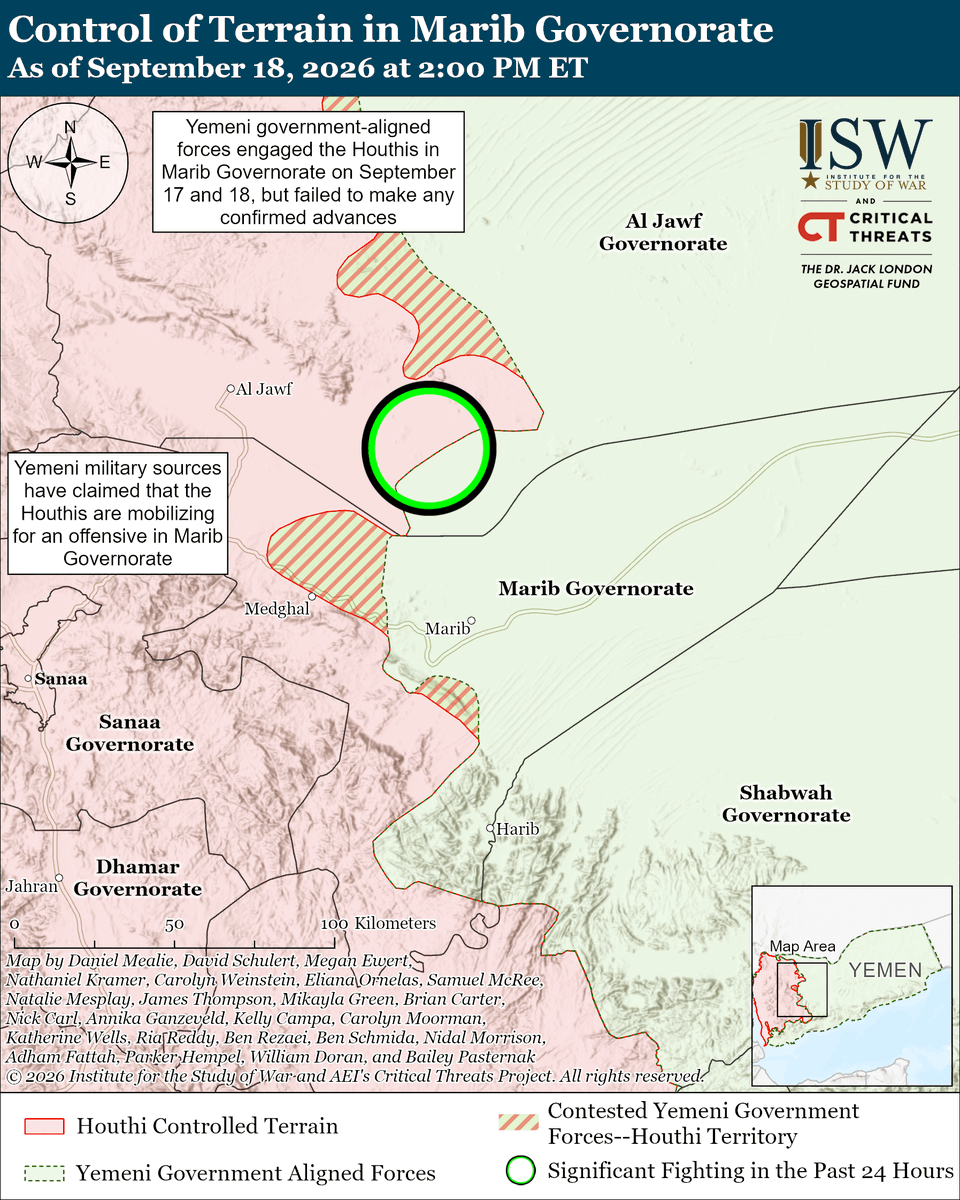
NEW: The Houthis exploited a window of opportunity in July 2026 to resume their war with Saudi Arabia and secure concessions from Saudi Arabia that would alleviate the group’s dire economic situation. The Houthis, with Iranian backing and encouragement, sought to impose economic pressure on Saudi Arabia to accomplish their objectives because the group sees economic pressure as a useful lever that has previously forced Saudi capitulation to Houthi demands. (1/2)
Other Key Takeaways:
The Houthis may decide to cease their present offensives in exchange for Saudi economic concessions. Addressing these concerns will not, however, satiate or moderate the Houthis. The Houthis view solidifying control over northern Yemen as a prerequisite to controlling at least all of Yemen.
Pakistan may seek to exert leverage over Iran to restrain Houthi offensive activity against Saudi Arabia. The Houthis are an independent partner of Iran and may resist potential Iranian pressure to halt their campaigns, however.
The Houthis likely seek to capture Marib Governorate in order to extract and export oil through the Red Sea, which could fund Houthi political and military activities, assuming export is possible.
Iran has continued its efforts to disrupt regional shipping and pressure the global economy to impose costs on the United States and its allies, even as transits through the strait have increased relatively and oil prices remain low relative to Iranian hopes.
David Sacks is right on two counts: (1) humanity does not want uncontrolled superintelligence, the market will not reward it, and frontier labs have a responsibility not to build it. And (2) he is also right that the public has almost no visibility into whatever is happening inside these labs that has produced such extraordinary alarm.
AI leaders and the rest of humanity are operating in different information environments. Researchers may be seeing capabilities, trajectories, or internal evidence that genuinely frighten them. The public mostly sees the fear: speculation about superintelligence, resignations, catastrophic forecasts, and appeals for urgent action. That gap is where distrust grows. We cannot know whether extraordinary claims are justified when the evidence behind them remains inaccessible.
Think of the boy who cried wolf. If you cry wolf too often without actual proof that a wolf exists, people will stop believing you. If you make people afraid without justification, you are committing a harm by making them fear something that might not exist. Over time people will react negatively and that reaction is rational.
The public's skepticism and disdain have been earned. I think AI leaders believe they are doing the right thing, but the communication has been so poor that they are actually doing the wrong thing. There is likely a "curse of knowledge" at play here, where these leaders do not know what the public does not know.
However, Dario’s recent proposal to “pace the frontier” represents an important turning point. If done correctly it can earn back the public's trust.
Pair frontier development with concrete safety standards and independent third-party evaluation from organizations like METR, and the relationship between AI leaders and the public will change. Private alarm can become public evidence. Claims can become measurable. Warnings can be tied to observable capabilities and explicit action.
If structured correctly, these organizations will dispel the curse of knowledge and build the necessary common frame of reference for fruitful public debate. They will show us whether the wolf exists beyond speculation. The warnings will be welcomed and believed rather than doubted and scorned.
In other words, this could be the moment AI doomsaying begins to become AI warning.
That distinction matters both practically and morally.
Consider the following claim: Proclaiming danger without providing evidence of danger is not only counterproductive but also unethical.
Asking other people to bear fear creates an obligation to give them the means to judge whether that fear is warranted. A warning transfers reasons: evidence, mechanisms, uncertainty, and paths to action. Doomsaying transfers the emotional conclusion without adequately transferring the reasoning behind it.
Warning respects agency. Doom suppresses it.
To see why, start with what a serious warning actually gives its audience.
A serious warning says: here is where we are. Here is the mechanism that concerns me. Here are the developments required to get from here to the dangerous state. Here are my assumptions. Here is what remains uncertain. Here is what we should watch for. Here is what would weaken my view. Here are the points at which action could change the trajectory.
The warning does not need to predict every contingent event in advance. It needs to make enough of the causal pathway visible that other people can inspect the argument, challenge its assumptions, watch reality develop against it, and decide what to do. It empowers the listener and asks them to act on their own judgment.
Doomsaying reverses that relationship. It says: here is a terrible possible future. Here is how frightened I am. You should be frightened too. It disempowers the listener and presses them to act on the speaker's judgment alone.
A headline like “major researcher quits out of fear of superintelligence” tells us something about the researcher’s state of mind. It does not itself tell us how superintelligence arises, whether recursive self-improvement works the way feared, what intermediate capabilities have to emerge, what barriers have to fail, how quickly any of this could occur, or where intervention remains possible.
Someone else’s fear is evidence that they are afraid. It is not evidence that the catastrophe will occur.
It does not count as a warning.
The problem becomes moral when fear begins doing the work that reasoning should have done. To pronounce doom without adequately transferring the reasons behind it is to impose some of catastrophe’s psychological consequences before the catastrophe itself has arrived. The catastrophe may never happen. The fear already has.
In that sense, doom can function like an assault: it changes another person’s psychological state without giving them the intellectual tools to judge whether that fear is deserved.
Worse, fear can become self-reinforcing. Once someone expects catastrophe, ambiguous events look ominous, setbacks become signs, and uncertainty itself begins to feel like confirmation. Fear can make the prediction that produced it appear increasingly plausible.
And researchers are not exempt from the same problem. If fear can distort the judgment of an audience, how can outsiders distinguish a robust causal model from an intellectual community in which frightened people are partly taking one another’s fear as evidence that there is something to fear?
The answer cannot be credentials, sincerity, or the number of prominent people who are frightened.
It has to be the argument.
The greater the fear a claim asks others to bear, the stronger the justification it owes them.
If recursive self-improvement could plausibly take artificial intelligence from today’s systems to catastrophic loss of human control, then warnings about AI need to become much more serious.
What capabilities have to emerge? What causes improvement to compound? Which bottlenecks disappear? Which safeguards fail? What observable developments would indicate that the feared transition has begun? What evidence would make the theory less plausible? Where, specifically, could intervention alter the path?
Build the threat model, teach it to the world, and interpret new developments within it. Most importantly, show where action remains possible.
Respect agency. Build agency.
These are the obligations that come with asking the rest of humanity to bear extraordinary fear.
I am willing to be frightened. Show me why I should be.
And this is why the move toward independent evaluation matters so much. Organizations such as METR can help convert knowledge that currently lives inside frontier labs into evidence the outside world can inspect. Concrete evaluations, thresholds, and safety standards can create a common frame of reference between the people issuing the warnings and the people being asked to believe them.
In a previous post I argued that METR should consider half its purpose to be communication and public education alongside the actual evaluation and inspection. The value provided by this service would be significant. It may even be more important than the standards and practices themselves.
That is how trust can be rebuilt. Not by asking the public to become more credulous, and not by asking AI researchers to become less alarmed, but by making the danger legible enough that outsiders can participate in the reasoning.
If the wolf is real, show us the tracks, show us how close it is, show us what would bring it closer, and show us what will keep it away!
Then when AI leaders shout “wolf,” the rest of us can run confidently. And we will thank them for the warning!
Dario has written that we need to “pace the frontier,” and Sam has agreed. People may be surprised by my response: go ahead.
You guys are the frontier. By any reasonable metric — market share, revenue growth, model capability — the two of you have a duopoly on frontier intelligence. You’ve also claimed the lead is widening because of recursive self-improvement.
I don’t see what you see in the lab. If the unreleased models are scary enough that you think you should slow down, I support your decision to be responsible.
But stop pretending you need anyone else’s permission. Stop pretending antitrust law has to be suspended so you can form a cartel. Stop pretending you need a regulatory approval process that supersedes product liability. Stop pretending METR is independent when it is intertwined with Anthropic’s investors and staff. Stop pretending you need those same evaluators to police competitors who aren’t even at the frontier.
Most of all, stop pretending the motivation to slow down is purely altruistic. You face massive product-liability exposure if your products enable a truly damaging cyberattack. The market already punishes models that behave in unpredictable or unauthorized ways. After the Hugging Face episode, it is simply good business for OpenAI and Anthropic to trade some raw power for reliability and predictability. Call it alignment if you want. It is also just giving customers what they want.
Pacing the frontier would also create breathing room for a more intelligent conversation about regulation than Bernie Sanders’ “shut it all down.” China is very unlikely to join a global agreement, as you know, and that has to be taken into account as well.
So go ahead and pace the frontier. You are the ones setting it. The easiest way not to build superintelligence is for you to agree not to build it. Demanding your preferred regulatory framework as the price of that will look like blackmail of the public and the political system. So just do it.
If you do, you’ll buy goodwill for the next conversation. If you don’t, we’ll know this was just another bid for regulatory capture — or an election-season psyop.
Call me naive, but this is how I read Dario's post. The word “pacing” is doing a lot of work.
He does advocate slowing down in order to coordinate on alignment. But given how capable models have already become, it is increasingly hard for me to see how alignment work and progress are counterposed.
Consider the following claim: The fastest possible race between individual labs may not be the fastest route to useful AI.
As an engineer, I need to know that the model I'm using will do what I intend within reasonable constraints. I need it to be honest, predictable, correctable, and respectful of the boundaries around the work I delegate to it.
As agent-to-agent transactions and interactions grow, I also need to know that the model you're using is trustworthy. I need to know that our agents can coordinate reliably, respect shared rules, and interact without creating risks neither of us intended.
Because ultimately I cannot delegate consequential work to agents I do not trust. And much of the transformative value of AI comes precisely from our ability to delegate increasingly consequential work to it.
This is why alignment, reliability, safety, quality, and progress are converging. Increasing the amount of intelligence we can safely trust, delegate to, and coordinate is itself a form of advancement.
And the same logic applies one level up, to the labs themselves.
An association of frontier labs can produce shared evaluations, standards, incident protocols, safety practices, and other common infrastructure that no individual lab can create for the entire ecosystem by itself.
Shared standards create leverage. They allow the work of one actor to become infrastructure that others can build upon.
This is how railroads, communications networks, financial systems, software ecosystems, and other forms of infrastructure became more useful: competitors continued competing, but they coordinated on the underlying standards that made everyone’s participation more valuable.
AI will need its own version of that. And I think that is what Dario's post is getting at.
This is also why I think “pacing” is a better word than “slowing.” A short delay for evaluation, coordination, or safety work is not necessarily a sacrifice of progress.
In engineering, tests, code review, and build checks introduce local latency precisely because they increase the throughput and reliability of the larger system. The fastest merge is not always the fastest way to ship good software.
Likewise, days or weeks spent establishing that increasingly powerful models can be deployed responsibly may allow society to adopt them faster and with greater confidence than an unconstrained race in which every actor must independently manage the uncertainty created by everyone else.
This is how I think about it:
- Capability expands what AI can do.
- Alignment expands what humans can reliably entrust it to do.
- Coordination expands what an ecosystem of powerful systems and institutions can do together.
These are different kinds of work. But they are not competing visions of progress.
The goal is to get useful AI into the world faster - AI we can actually trust with consequential work. And the fastest route there will require the frontier labs to coordinate more closely, not race more independently.
Lots of calls for "slowing down"... why aren't the labs calling for a 10x or 100x increased effort in ALIGNMENT work? After all, that is the core issue. ASI that is fully aligned with humanity uplifts everyone.
Greater Canadian integration with Europe is an excellent idea. Though currently framed in anti-American terms, a deeper partnership serves American grand strategy and benefits everyone in the alliance system. We all need Europe dependent on Canada instead of Russia. We all need NATO North to become serious guarantors of Arctic security. Anything that increases Western-led development of the Americas is a desirable outcome.
The strategic complementarity is obvious.
Canada has energy, uranium, critical minerals, agricultural capacity, enormous territory, Arctic geography, and one of the largest undeveloped resource endowments in the Western world.
Europe has hundreds of millions of affluent consumers, deep pools of capital, advanced manufacturing, sophisticated industrial firms, and enormous demand for energy, resources, defense equipment, and secure supply chains.
European capital financing Canadian mines, energy projects, ports, infrastructure, data centers, and defense production will develop Canadian resources while strengthening European security. Canadian energy will support European industry. Canadian uranium and critical minerals will reduce Western dependence on hostile or unreliable suppliers. Joint defense production will increase the industrial capacity of NATO. Greater northern development will reinforce an Arctic frontier connecting North American and European security.
A more developed Canada remains part of the North American economy while becoming a stronger northern anchor of the Atlantic economy. A more capable Europe requires less American protection. A stronger northern NATO allows the United States to devote more attention elsewhere.
Strategically, the case is straightforward. But institutionally, it is much harder.
Do either Canada or the EU have the institutions capable of actually executing?
Look at the scoreboard since 2008.
Canadian and Western European living standards have barely advanced. Productivity growth is weak. Investment is inadequate. Their industrial base has eroded. Their energy systems have become more expensive and constrained. Their defense industries are incapable of rapidly producing at the scale their security environment now requires. Their highly educated populations have produced remarkably few of the dominant technological companies of the 21st century.
Meanwhile, America produced the platforms, cloud infrastructure, artificial intelligence companies, biotechnology firms, and commercial space industry that increasingly define technological power.
And China built enormous productive capacity in batteries, electric vehicles, solar, shipbuilding, electronics, drones, and industrial supply chains.
Canada and Europe have had all the inputs needed to succeed, but they have failed to convert their latent potential into actual outcomes.
They share the same pathologies:
- regulatory overreach stifling innovation,
- environmentalism suffocating development,
- low fertility and demographic decline,
- immigration-dependent growth demoralizing youth and society,
- a ballooning trade imbalance and strategic dependency on China,
- a hollowed out defense-industrial complex, and
- widespread political hostility to the notion of prioritizing national security over social security.
These pathologies share a political root.
Canada and much of Europe spent the post-2008 era embracing a post-national politics that treated global economic integration as an end instead of a means, that demonized national power and national security, and that considered inherited prosperity a permanent condition rather than an achievement that had to be continually recreated.
The resulting political systems became extraordinarily capable at regulation and distribution, but much less capable at development. They:
- regulate industries they struggle to build,
- redistribute wealth they struggle to grow,
- announce climate targets without constructing enough energy infrastructure,
- announce defense commitments without producing enough weapons,
- announce industrial strategies without permitting factories,
- announce critical-mineral strategies without opening mines, and
- create highly educated populations without converting that education into dominant firms, technologies, and useful things.
Strategically, Canada and Europe fit together almost perfectly, but they suffer from many of the same diseases of political economy.
That is the central contradiction. Greater Canadian-European integration makes overwhelming strategic sense at exactly the moment the institutional record of both sides gives us reason to doubt their ability to realize its potential.
Will greater integration help facilitate change? Or will it simply reinforce the existing pathologies of decline?
Across Europe voters are turning to right-wing populism in response to the failures of the existing political establishment to deliver material progress. Nationalist movements want cheaper energy, more industry, tighter borders, and greater national sovereignty. They attack restrictions on development, immigration-dependent growth, deindustrialization, and the subordination of national economic interests to supranational priorities.
That exposes the paradox: the politics in Europe most capable of making deeper Canadian integration valuable are the politics least comfortable with the institutions through which that integration occurs. The forces pushing Europe back toward developmentalism are doing so by restoring national sovereignty against a post-national order they blame for stagnation.
Canada is moving closer to Europe at precisely the moment Europe is deciding whether the Union will become an instrument of national revival or an obstacle to it.
This is an excellent proposal from Dario. I would add that the public needs greater real-time visibility and education, either from governments or 3rd-party evaluators like METR, so that interested and trusted individuals in communities are equipped to assess risk and explain it to others.
Society knows how to understand the threat of pandemics, nuclear wars, and other forms of mass extinction. It's not unfamiliar ground for humanity to speculate about its doom.
But we do not yet have the same type of common knowledge about the risks of AI. Researchers can see how the dots connect, but it's difficult for lay-people to see how we practically get from where we are today to the forecasted dangers.
In many ways the AI companies are far ahead of the rest of society. This is great. But it represents a gap in knowledge that makes it difficult for warnings to be communicated in a way that's actionable.
In order to restore a sense of agency - that is, calibrate fear and response accordingly - we need a mass education campaign. We have to align ourselves.
For something like Recursive Self-Improvement, which is a novel form of thinking about thinking, this means something like the following:
1. State the precise claim: successive capability improvements cause research to accelerate autonomously. Then show how that acceleration connects to the proposed harm. Spell out the assumptions, observations, and unknowns. I don't know these yet.
2. Show evidence for: measured improvements in throughput, discoveries, successor-model performance, and other categories like cost and understandability of inference.
3. Show evidence against: tasks still requiring human intervention, experimental failures, and compute or hardware bottlenecks.
And everything else I don't know about yet.
Each entry on this evidence list must be justified and explained. This is how people will come to understand current status, progress, and risk. It is how warnings of danger transmute into actual collective action.
4. Show current evidence status: what was tested, under what conditions, what the results establish, what remains untested, and where interpretations differ.
One particularly important form of communication here would be a dashboard. Here the risks and pace of progress, both in terms of outcomes and mitigations, could be tracked and visualized in ways easy for non-AI researchers to understand. Government standards and model compliance can live here.
5. Show and narrate trends in the evidence over time.
Show evidence that should raise concern, such as repeated general improvements with less humans, less cost, and less time. Misalignment events during training or experimental review. What are the alignment evals and how are models responding to them?
Show evidence that would lower concern, such as controls that prevented or contained the relevant failures in testing and under what conditions. Help people develop an understanding of what's protecting us: simulations, honeypot traps, and other scenario-based evaluations.
The narrative to demonstrate with the data is simple:
- Here's how the failure could occur.
- Here's the barrier intended to stop it.
- Here's the evidence that the barrier works (or not!)
That leads cleanly to what we should do next, who can act, and what evidence would change that recommendation.
The goal is traceability and transparency. Help people connect the dots. This means serious education. It will move the discourse from dooming to warning, and thus from despair to confident action.
METR, and other similar organizations, should make real-time communication and education just as important as the actual evaluation. They are structurally able to perform this task in a way that no single AI lab can.
A disinterested evaluator can get everyone rowing in the same direction, and educate me and society in the process.
We Must Pace the Frontier: I’ve written a new essay on why the AI industry should slow down, with a three-part plan for doing so.
Anthropic is unilaterally committing to the first of these steps. We’ll provide third-party evaluators with permanent, employee-level access to our systems, so that they can verify adherence to our safety measures, report on incidents, and assess models’ alignment during training.
You can read the full post here: https://t.co/OGyPb7yaYt
“Words are wind.”
Canada cannot talk itself into sovereignty. It has to build the power to exercise it. Threats, defiance and moral appeals have value when they help secure a stronger position. Applause is not evidence that they have succeeded.
Canada wants sovereignty and the best trade arrangement it can secure. America’s strategic interest is a productive, geopolitically aligned North America, with Canadian energy and resources contributing to its strength. Those interests leave room for a bargain. Keeping Canada as dependent as possible is not the same thing as making America as secure as possible.
Trump’s threats and Carney’s defiance can serve that negotiation. Both have domestic audiences. Both need political support for the terms they eventually accept. The hostility can be instrumental: a negotiating position is not a declaration of the relationship either side ultimately intends to build.
If the confrontation drives Canada to develop its resources, energy infrastructure and export capacity, Canada gains real alternatives. Resources in the ground become leverage when they can be produced, transported and sold. European demand becomes an alternative when Canadian producers can actually serve it. The costs of getting there must be justified by those gains, not by the satisfaction of resistance.
The European opening signalled by Carney’s upcoming speech in the EU has an American strategic payoff. More Canadian energy and resources supplying Europe in place of adversarial suppliers strengthen the allied system. Washington has a strategic interest in supporting that outcome, even when it arrives under cover of anti-American rhetoric.
America can lose leverage over Canada and gain security at the same time. Canada acquires greater freedom of action; America acquires a more capable ally. Those Canadian alternatives then become leverage for a better continental settlement. Diversification does not have to replace “Fortress North America.” It can give Canada the power to negotiate better terms within it.
Words are wind. In this first sense, the rhetoric is instrumental. The speeches can sound like separation while the investments underneath them build the foundations of a stronger partnership. Once the bargain is reached, the words can disappear because the material interests remain.
But “words are wind” carries a second, harder meaning. Words can help a country bargain from power. They cannot create power where it does not exist. If Canada turns confrontation into a strategy that materially conflicts with American interests, declarations of sovereignty will not protect it from the consequences. Canada must possess the markets, capital, technology, infrastructure and alliances required to sustain the position it has chosen.
Carney’s play with China therefore raises a different question. If Beijing is being recruited as a counterweight to Washington, Canada is no longer simply creating alternative customers. It is strengthening a power with which both the United States and Europe have major strategic disputes. If Canada tries to organize European resistance to Washington while drawing closer to Beijing, it risks mistaking shared frustration with America for shared geopolitical interests.
Washington would then have a material reason to oppose the arrangement. It would not need to take offense at Canadian rhetoric. It would need only to conclude that Canadian policy was working against American interests. Market access, investment, finance and technology could then become instruments for raising the cost of that strategy.
Canada would have to answer power with power. A lost export market must be replaced by customers. Lost investment must be replaced by capital. Restricted technology must have an alternative source. Allies must be willing to bear costs alongside Canada. None of those capabilities is created by declaring that Canada will not be intimidated.
Words are wind.
That is the danger of mistaking political performance for strategic strength. A country can sound sovereign while becoming materially weaker. It can win the domestic argument while losing bargaining leverage. It can provoke an adversary into using powers it has no means to answer.
Canada can use this confrontation to build the capabilities that make greater independence possible. Or it can consume its existing strength sustaining the performance of independence. The first produces a country with more choices and a stronger hand in the bargain that follows. The second discovers, too late, that defiance is not itself a source of power.
Words are useful when they help Canada acquire power. They are worthless when Canada expects them to substitute for it.
Carney’s Whistling Past the Graveyard
The Carney government has chosen a dangerous premise for Canadian economic policy: that public anger at Donald Trump and the United States can be converted into a durable strategy of trade diversification.
It cannot.
Anti American sentiment may be politically useful. It may help frame the dispute as a “trade war” and make defiance sound like leadership. But Canada’s economic interests do not change because the rhetoric does. Canada needs access to, and integration with, the United States, full stop.
Carney’s earlier pivot at the Economic Club of New York was the right instinct. It recognized that Canada’s prosperity depends on maintaining a serious, practical relationship with American capital, industry, and policymakers. That approach was grounded in the reality of continental integration. His current approach, seemingly drawn from the Democrats’ political playbook, is the opposite. It turns a commercial dispute into a partisan emotional campaign.
That is dangerous and misguided. Designing Canadian policy around the hope that it can shape, or alter, an American election is not strategy. It is an extraordinary gamble with the country’s economic future. Canadian governments cannot afford to bet jobs, investment, trade access, and financial stability on the assumption that the U.S. electorate will deliver a preferred political outcome.
The United States is not merely Canada’s largest export market. It is the market around which Canada’s industrial economy was built. Southern Ontario is tied to the American Midwest and Northeast through supply chains, cross border investment, financial flows, energy links, and manufacturing networks that developed over generations. Canadian firms do not simply sell finished goods into the United States. They make products with American firms, finance them through North American markets, and move components back and forth across the border at speed.
That is why Carney’s central gamble is so reckless. He appears to believe that America’s turn toward tariffs, industrial policy, strategic protection, and economic nationalism will fade after the midterms. But this is not a temporary Trump impulse. It is a bipartisan American response to the belief that the old free trade model weakened domestic manufacturing, supply chain security, and national power.
Canada should take that shift seriously, not wish it away.
Carney is repeating the failed instinct of Pierre Elliott Trudeau after Ronald Reagan’s election. Trudeau responded to a more assertive United States by seeking political distance and greater room for manoeuvre outside the continental relationship. That strategy was a massive failure. It did not free Canada from American economic gravity. It left Canada more exposed to inflation, weak investment, fiscal deterioration, and a damaged business climate, before the Mulroney government ultimately pursued the Canada U.S. Free Trade Agreement.
Distance is not independence. For a smaller economy deeply integrated with a larger neighbour, access is not optional. It is a strategic asset to be protected.
This is why diversification must be understood properly. Canada should pursue new markets where it has real advantages. But selling more abroad cannot substitute for preserving access to the American market. A trade agreement with Europe does not replace an integrated North American production base. A warmer relationship with Beijing does not make Canada less exposed.
In fact, the China strategy magnifies the contradiction. Canada supports Ukraine while China sustains Russia’s war economy. Canada looks to Europe as an alternative market while Chinese industrial overcapacity undermines European manufacturing. Yet Carney appears prepared to pursue deeper economic integration with China. That is not a coherent strategy. It is a refusal to acknowledge that economics, security, and industrial policy are now inseparable.
The financial exposure should make Ottawa especially cautious. Canadian banks and corporations rely on U.S. dollar clearing, correspondent banking, cross border payments, trade finance, and American capital markets. A serious disruption to those channels would be far more damaging than a tariff. It would hit trade, credit, investment, and confidence at once.
Treasury Secretary Scott Bessent has made clear that the United States is willing to use financial power to advance national interests. Dismissing such warnings is not courage. It is complacency.
Canadians should remember Argentina, once among the world’s richest countries, which allowed political narratives to outrun economic reality and paid for it with decades of decline. Canada is not Argentina. But no country is immune from self inflicted damage when its leaders mistake rhetoric for capacity.
Carney should stop the performative politics and get a deal with the United States. Diversification should strengthen Canada’s bargaining position, not become a partisan fantasy that substitutes for the continental relationship on which Canadian prosperity still depends.
For now, Ottawa is whistling past the graveyard.
Exclusive—Secretary Scott Bessent on Canada: PM Carney ‘Needs to Stop Campaigning, Start Governing‘; ‘They Wanted the Benefits of Being a State Without Being a State‘ https://t.co/hsiFr3rn3K via @BreitbartNews
The AfD is routinely described by establishment German politicians as “far-right,” “extremist,” and even “anti-democratic.” But those terms make different claims. Are they three independently established descriptions? Or has political language fused them together so that ideological classification also delivers a verdict on democratic legitimacy?
The second question is a Spivakian one.
Power operates not only through laws and institutions, but through representation: through the categories used to describe political actors and the conclusions those categories make available. A description becomes an explanation. An ideological classification becomes a judgment about legitimacy without the intermediate argument ever being made.
Consider the progression:
far-right → extremist → anti-democratic
These terms overlap. But one does not logically establish the next.
“Far-right” is an ideological classification. It tells us where a party sits relative to a political spectrum.
“Extremist” makes an additional claim. Extreme relative to what? The median voter? The established parties? The prevailing constitutional order? Each reference point produces a different judgment.
“Anti-democratic” is stronger still. It says something about whether the party accepts the conditions under which political competition continues: whether opponents retain political rights, whether citizens can organize against the government, and whether those in power can subsequently be removed.
The distinctions matter because the AfD just won around 44% of the vote in Saxony-Anhalt.
That number does not prove the party moderate. A political movement can become popular without changing its ideology. But it eliminates one possible meaning of “extreme”: electorally marginal. Whatever else the AfD is, it represents a very large part of that electorate.
If “extreme” means far outside the governing consensus, the election is evidence that the consensus itself is losing democratic support. Elections exist partly so voters can replace not only governments but the policies and assumptions those governments represent.
If “extreme” means hostile to democratic government, electoral popularity does not answer the objection. 44% support does not immunize a party from scrutiny over what it would do with power. A popular proposal can still violate the rights of political losers.
So which situation are we observing?
A first pass through the AfD’s own platform does not make the answer obvious. Its positions on immigration, national culture, and Islam make “far-right” intelligible to me as an ideological classification. What I do not yet see from the platform is the argument that takes us from “far-right” to “anti-democratic.” The party formally endorses democratic government and proposes expanded use of referenda and direct political participation.
What is clear is that the AfD is anti-establishment. It seeks to overturn important parts of the political settlement built by Germany’s existing parties. But losing the governing consensus is not the same thing as losing democracy. A democracy requires the governing consensus to be defeatable.
So I am left with a genuine question:
Is the AfD actually a threat to democratic competition in Germany? If so, which actions or proposals establish that case?
Or has the established political order fused “far-right,” “extremist,” and “anti-democratic” into a single vocabulary that converts opposition to the governing consensus into opposition to democracy itself?
It's tempting to dismiss yesterday's huge win by the AfD, as Sachsen-Anhalt is Germany's poorest state. But the underlying issue - immigration - is a national one and the ruling coalition is paralyzed on this. The clock's ticking on the end for the Euro...
https://t.co/v6C7L8DI4m
At first glance, @DrJStrategy's argument is about Canada’s economic Overton Window. Its more consequential implication is strategic: the performance of sovereignty can obstruct the creation of sovereignty.
American pressure creates a demand to demonstrate Canadian independence. If resistance to the United States becomes a test of patriotism, economic distance can become a proxy for sovereignty. Under that test, policies that separate Canada from the United States look independent, while policies that deepen integration look submissive.
But economic distance does not necessarily make American coercion more costly. Canada can reduce its exposure to the United States without materially changing Washington’s ability to impose costs on Canada. Greater distance, therefore, does not necessarily produce greater practical independence.
Deeper integration can change the calculation in the opposite direction. If American industries depend on Canadian energy, minerals, electricity, manufacturing or other inputs they cannot readily replace, disrupting the relationship imposes costs inside the United States as well. As those costs rise, American leverage declines because pressure against Canada becomes more expensive for Americans themselves. Integration can therefore produce practical independence by making the dependence more reciprocal.
This is where Thorne’s complaint about the loyalty test becomes consequential. If deeper integration is classified as un-Canadian because it requires greater cooperation with the United States, a strategy for increasing Canadian leverage can be disqualified precisely because it does not perform resistance in the expected form.
But if the ultimate objectives are Canadian prosperity and independence, the relevant question is not which strategy looks more resistant to American power. It is which strategy actually improves Canada’s position relative to it. Deeper integration that makes critical parts of the American economy depend on Canadian production may achieve both: greater Canadian prosperity and greater Canadian leverage.
The strategy that looks less independent may be the one that makes Canada more independent.
Canada Needs an Economic Overton Window Reset
Canada’s economic debate has become strangely moralized. Raise a conventional question about investment, productivity, manufacturing, energy, deficits, or trade, and the response is too often not an argument but an accusation: un-Canadian, Trumpian, MAGA, anti-worker, anti-public service.
That is how the Overton Window closes.
The Overton Window describes the range of ideas considered respectable in public debate. In Canada, it increasingly excludes economic realism, not because the evidence is absent, but because the language of patriotism has been captured by the assumption that more government spending is synonymous with national strength.
It is not.
The private sector creates the wealth that finances the public sector. Businesses invest, hire, export, innovate, and pay the taxes that sustain health care, pensions, infrastructure, defence, and social programs. Government has an indispensable role, but it cannot indefinitely distribute wealth that the economy has failed to produce.
It is politically expedient to blame Canada’s current economic predicament on Donald Trump. Tariffs, trade threats, and American protectionism create real risks and deserve a serious response.
But Trump did not create the Canadian industrial-policy failures that weakened our competitive advantage. He did not create years of weak business investment, slow permitting, costly regulation, inadequate infrastructure, unaffordable housing, poor productivity growth, or the habit of responding to every structural weakness with another subsidy.
Nor did Trump hollow out Canadian manufacturing on his own. China’s entry into the World Trade
Organization reshaped global trade, and Canadian industry absorbed a significant adjustment shock. Research has found that rising Chinese import competition was associated with substantial Canadian manufacturing job losses between 2001 and 2011. Recognizing that fact is neither extremist nor xenophobic. It is an economic observation. The irony is missed by the economic elite in Canada!
The United States is confronting two long-running vulnerabilities: its massive debt burden and the erosion of parts of its manufacturing base. That is what lies behind the renewed American emphasis on tariffs, procurement rules, reshoring incentives, subsidies, strategic supply chains, and national-security industrial policy. Canada may object to particular measures and should defend its interests firmly. But retaliation against this modern Hamiltonian turn is not a long-term dominant strategy.
The United States retains the world’s deepest capital markets, the reserve currency, enormous energy resources, global technology leaders, a vast domestic market, and military power.
Betting Canada’s economic strategy on Trump losing the Mid-terms is wishful thinking. This is a generational economic pivot.
Canada needs a modern Hamiltonian agenda of its own: not blanket protectionism, but national capacity.
That means competitive taxes, faster permits, reliable energy, infrastructure that gets products to markets, deeper capital markets, selective strategic procurement, and a country open to productive foreign investment.
Economic sovereignty is not achieved by announcing more programs in Ottawa. It is achieved when Canada can attract capital, build things, develop its advantages, and finance its own ambitions.
Our relationship with the United States remains central. Canada should not seek economic detachment from its largest market; it should seek to become indispensable to North America, as a supplier of energy, critical minerals, food, electricity, advanced manufacturing, and trusted technology.
Calling these arguments un-Canadian is not a rebuttal. It is an attempt to place them outside the Overton Window before Canadians can judge them on their merits.
Three years ago, Jake Sullivan made a bold claim: Washington was forging a new bipartisan economic and security policy consensus. In an April 2023 speech, he called it the “New Washington Consensus.”
Marco Rubio’s speech yesterday at the launch of the Foundry School makes the case considerably stronger. A great transformation toward productive politics is underway.
Rubio described the post-Cold War economic model as a “terrible mistake.” America decided that the ability to make things no longer mattered, and that it did not matter where they were made. Production should simply move wherever costs were lowest. The result was deindustrialization and dangerous dependence on foreign countries for goods essential to American prosperity and national security. Reversing that mistake through reindustrialization will be the work of “multiple administrations.”
Sullivan began from almost exactly the same diagnosis. America’s industrial base had been “hollowed out.” Washington had elevated trade liberalization into an end in itself and assumed markets would allocate capital efficiently regardless of what competitors did or what strategic capacity America lost. Entire supply chains moved overseas. Semiconductors, infrastructure and other essential sectors atrophied. Economic integration was also supposed to make other states more responsible and cooperative. “It didn’t turn out that way.”
Sullivan called the emerging replacement a new consensus. At the time, that was an audacious label. Biden had enacted the CHIPS Act, the Inflation Reduction Act and infrastructure legislation, but it was entirely possible to interpret the new industrial policy as a Democratic program that the next Republican administration would dismantle.
Three years later, however, we see a Republican administration carrying the underlying turn toward reindustrialization forward.
Rubio was speaking at the launch of the Foundry School, a national program designed to train entrepreneurs, engineers, technicians and industrial leaders for American manufacturing. Eight universities are participating. The program sits inside Pax Silica, the State Department’s effort to secure strategic technology supply chains.
That is consequential evidence of consensus. A Republican State Department is not merely saying manufacturing matters. It is helping construct institutions to produce the human capital required for reindustrialization. The pre-Trump Republican party championed the failure. Then Trump destroyed and remade it. Now the GOP has formally admitted its mistake and is reversing course.
Trump and Biden disagree sharply about how to rebuild American industry. Biden’s model relied heavily on public investment, subsidies, climate policy, labor standards and coordination with allies. Trump’s is more nationalist, tariff-heavy, deregulatory, energy-intensive and transactional.
But on the foundational questions, the distance has collapsed.
Both administrations reject the idea that the geographic location of production is economically irrelevant. Both treat industrial capacity as a component of national power. Both see concentrated foreign supply chains as strategic vulnerabilities. Both believe government has a legitimate role in shaping the location and composition of production. Both have subordinated parts of trade policy to national-security and industrial objectives.
That is what a bipartisan political consensus actually looks like. It does not mean Democrats and Republicans choose the same instruments. It means they begin arguing from the same premises.
For those tired of gridlock and venomous politicking, take heart. This is a structural turning point. Both parties are now positioning toward many of the same economic and national-security objectives. That does not eliminate political conflict, but it does incentivize a politics of cooperative competition rather than "us vs. them" tribalism. Once the consensus begins to bear fruit, voters will reward civility over provocation.
SECRETARY RUBIO: There was this fantasy, really, that the whole world would become a free enterprise democracy, and that everyone would look like us. That ran into reality.
The recent strikes on Iran mark a shift in Washington’s approach to the war. In June, Trump tried to induce Tehran into a settlement with sanctions relief, restored oil sales, reconstruction, and negotiation. That failed. The current campaign is organized around coercion instead. American strikes are destroying the capabilities that give Iran leverage while Scott Bessent works to isolate the regime economically.
The two sides of the campaign perform different functions. Military coercion reduces Iran’s ability to impose costs. Economic coercion reduces its ability to absorb them.
Three months ago, Washington was trying something very different.
The June MOU offered Iran a route back into the international economy. Tehran would restore commercial passage through Hormuz, de-mine the strait, maintain the nuclear status quo while negotiating a final agreement, and participate in a broader cessation of hostilities. Washington would issue waivers for Iranian oil exports, release frozen assets as negotiations progressed, lift the blockade under the agreement, phase out sanctions, and work with regional partners on at least $300 billion of reconstruction and economic development.
Why offer Iran so much economic upside?
Because the economic terms were not incidental concessions. They were part of the strategy. Restore oil exports. Bring in foreign capital. Rebuild infrastructure. Give Iran productive assets and commercial relationships that renewed war would put at risk. The wager was that Iran could become more invested in regional stability than in disrupting it.
Iran did not need to become an American client for that to work. It needed to acquire more to lose from destabilizing its neighbors than it could gain from doing so. Preserve Iranian wealth, increase it through reintegration, and attach continued access to that wealth to restraint.
That was the "first-best" outcome: change Iranian behavior without first destroying the country you ultimately want participating in the peace.
And the potential payoff extended far beyond Iran.
Today, Iranian missiles, proxies, nuclear escalation, and threats to Hormuz impose a terror and security premium on the entire Middle East. Capital has to price the possibility that infrastructure will be attacked, shipping interrupted, energy flows disrupted, and regional wars reopened.
Reduce that risk and the region becomes easier to develop. Energy, manufacturing, housing, tourism, infrastructure, and cities become more attractive places to deploy capital. The India-Middle East-Europe Corridor becomes more viable. Indian and Gulf growth accelerates. Europe gains more economic and energy alternatives outside Russia and China.
The June strategy therefore offered a larger bargain: Iran could become richer by participating in a more stable region, while the rest of the region became richer because Iran was no longer threatening it.
That bargain did not hold. Implementation disputes followed, negotiations stalled, the blockade returned, and Iran continued to use Hormuz and its military capabilities as leverage. Iranian President Masoud Pezeshkian still argues that Tehran will reciprocate if Washington fulfills the June commitments. The June agreement remains a reference point, but Washington is no longer organizing its strategy around making that offer more attractive.
Instead Washington has switched methods from inducement to coercion.
The latest strikes are the kinetic half of the new approach. Mine-laying capability allows Iran to make passage through Hormuz dangerous and expensive. Destroy the launchers and that leverage falls. Missile and drone infrastructure allows Tehran to impose costs on Israel, Gulf states, and American forces. Destroy the production and supporting systems and that leverage falls. The latest U.S. wave targeted mine-laying capabilities, maritime assets, missile systems, radar, air defenses, and communications.
Washington is removing Iranian capabilities from the board.
Bessent is constructing the economic half. Iranian oil loadings have already collapsed from roughly 2 million barrels per day in March to roughly 220,000–255,000 in August under the blockade. Treasury is now trying to close the remaining financial escape routes through secondary sanctions. Banks that facilitate Iranian activity risk exclusion from the dollar system. Bessent says there can be “no leakage.”
Destroy the instruments that impose costs. Sever the lifelines that absorb costs.
The combination is what matters. Iran can endure military pressure if oil revenue and external connections allow it to replenish what is destroyed. It can endure economic isolation if missiles, mines, and proxies continue to impose enough costs that Washington is willing to pay Iran for restraint. Attack both at once and each strategy becomes harder to sustain.
That is the logic of the current phase. Washington is no longer trying primarily to increase what Iran gains from cooperation. It is reducing what Iran gains from refusal.
This is a "second-best" campaign.
The June approach offered the possibility of changing Iranian behavior while preserving Iranian productive capacity. The current approach gains leverage partly by destroying value that a successful peace would prefer to preserve. Military factories are destroyed. Oil revenue disappears. Commercial relationships break. Infrastructure deteriorates. Ordinary Iranians become poorer. America expends munitions, shipping remains disrupted, and escalation remains possible.
Coercion may still produce the settlement Washington wants. It simply reaches it through a more destructive route.
The desired settlement remains recognizable: no Iranian nuclear weapon, sharply constrained missile, drone, and proxy capabilities, secure passage through Hormuz, and an Iran that increasingly profits from peaceful regional development rather than threatening it.
What has changed is the bargaining environment. In June, Trump was prepared to offer reconstruction, oil access, sanctions relief, and reintegration in exchange for restraint. Today, Washington is degrading the military leverage Iran used to resist those terms while Bessent tries to make economic isolation comprehensive.
The first phase tried to give Tehran more to gain from stability.
The second is taking away what makes resistance sustainable.
That leaves one unresolved question. How far does Washington intend to carry the coercive logic?
It could end with a new bargain with the Islamic Republic, struck after Iran has lost enough leverage that it accepts worse terms. But if Tehran continues sacrificing oil revenue, economic development, military capacity, and domestic living standards rather than change course, the pressure begins to test something larger than its bargaining position. It begins to test how much the Islamic Republic can lose and still survive.
Will the Iranian people rise up? Only time will tell.
THOUGHTS: Something has changed in the U.S. strategy toward Iran.
If you look closely at the latest threats and the economic campaign. What is missing are specific demands. The U.S. is no longer publicly saying: do this, give up that, and we will relieve the pressure.
Trump is now saying he is not trying to force Iran back to the negotiating table. He is openly asking when the Iranian people will rise up and fight.
At the same time, the economic noose is tightening. Shipping, banking, oil, aviation, digital assets, everything and anyone helping the regime can be targeted. The squeeze is getting
tighter almost every day… In literally one one week Irans currency lost 10% of its value.
My read is that the U.S. is moving away from trying to negotiate a better deal and toward something much more ambitious: a slow burn strategy designed to collapse the Islamic Republic until the system can no longer sustain itself.
I have said from the beginning that the economic operation is more dangerous to the regime than another round of bombing.
But there is another side to this. Ordinary Iranians will suffer enormously under this pressure. I strongly believe many Iranians are willing to pay that price if it means the job finally gets done. If the U.S. is deliberately creating conditions that could bring down the regime, it cannot tighten the noose halfway and then reverse course. No 80% done, none of that, this time, it has to go all the way.
No Pakistan, no Qatar calls, economic pressure until the end.
(This is my personal opinion - Jay)
Three months ago, Washington offered concessions to make Iran de-mine Hormuz. Today, Washington bombs the mine-laying equipment instead. That is what a deteriorating bargaining position looks like.
The June MOU gives us the benchmark. Iran would reopen Hormuz, extend the ceasefire, and negotiate over its nuclear program. Washington would lift the blockade, permit Iranian oil sales, unfreeze funds, offer reconstruction incentives, and attempt to end fighting “on all fronts, including in Lebanon.”
That was the price of Iranian restraint in June.
Today, almost every component has moved against Tehran. The blockade remains. Iranian crude loadings have fallen from roughly 2 million barrels per day in March to around 220,000–255,000 in August. The rial has fallen beyond 2 million to the dollar and inflation reached 66% in July.
blockade → lower oil exports → less foreign currency → weaker rial → inflation → weaker fiscal capacity
Iran’s regional leverage has deteriorated too. Israel continues operating in Lebanon while Lebanon, with American and European support, moves toward strengthening its army and disarming Hezbollah. Iran tried to make restraint on that front part of the June settlement. It can no longer make Washington deliver it.
Hormuz shows the change most clearly. In June, Washington was prepared to exchange economic concessions for Iranian de-mining and safe passage. Now, when Iran prepares to deploy mines, America destroys the launchers. When Iran retaliates, America expands the target set.
Iran is still dangerous. But danger and bargaining power are different. Danger is the ability to impose costs. Bargaining power is the ability to make the other side pay to avoid them. Iran is increasingly failing that conversion.
Time makes the problem worse because Iran is losing both income and replacement capacity. The United States says Operation Epic Fury conducted more than 1,450 strikes on weapons-manufacturing facilities and damaged or destroyed over 85% of Iran’s ballistic-missile, drone, and naval defense-industrial base. External assistance has not replaced that industrial scale.
So Iran faces two compounding curves:
blockade → currency crisis → weaker fiscal capacity → less ability to sustain the war and its proxies
military expenditure → depleted weapons → damaged factories → weaker replacement capacity
The American effect is fundamentally different. Higher oil prices hurt consumers, but America is also the world’s largest oil producer and a record net energy exporter. Higher prices increase the return on additional American production while Washington expands alternative supply through Venezuela, including access to 17 fields containing roughly 65 billion barrels of reserves.
Iran is trying to weaponize scarcity. High prices help finance substitutes for that scarcity. This time in the safer Americas versus volatile Middle East. It juices Washington's long-term Grand Strategy of friendshoring and disengagement. So the effect is costly in the short-term, but strongly positive in the long-term.
Munitions impose an opportunity cost, not an equivalent destruction of productive capacity. A missile fired today cannot be used somewhere else until replaced. That loss of optionality matters if another contingency needs the same scarce system. It is not comparable to losing the factories required to manufacture the weapon in the first place.
The structural comparison is simple:
Iran: falling income + collapsing currency + damaged military production + continued expenditure → shrinking bargaining power
United States: consumer costs + fiscal costs + temporary loss of military optionality, while energy production, capital access, industrial capacity, and alternative supply remain intact or expand
The question is whether another month costs Iran more bargaining power than it costs Washington.
Return to the benchmark:
June: Iranian restraint → blockade relief + oil access + sanctions relief + reconstruction incentives + attempted regional restraint
Today: blockade remains + oil exports collapse + Israel retains operational freedom + Washington destroys mine-laying capability instead of paying Iran to remove it
The price of peace is falling. Washington does not need time to be free. It needs time to be more expensive for Iran than it is for America. So long as that remains true, Washington has no reason to purchase peace at June prices.
Iran's currency is really tumbling. The dominant narrative on Iran is wrong. The US has time on its side. Iran doesn't. In the end - like Russia - Iran is a gas station masquerading as a country. You choke off oil exports and the house comes falling down.
https://t.co/sqEjdJEjDx
Germany forgot a basic rule of statecraft: the first duty of the state is security. For thirty years it behaved as though that rule had become obsolete. New leadership is changing the game.
After 1991, Germany built an entire political vocabulary around the assumption of permanent peace: Friedensdividende (peace dividend), Von Freunden umzingelt (surrounded by friends), Wandel durch Handel (change through trade), Annäherung durch Verflechtung (rapprochement through interdependence), Modernisierungspartnerschaft (modernization partnership).
The idea was that trade would reduce conflict, energy ties would impose restraint, and interdependence would turn exposure into stability. The phrases changed, but the strategic assumption remained the same: German prosperity could be separated from German power. Today's hybrid attacks expose the flaw.
Germany is now being probed through the systems that prosperity depends upon: power, airports, logistics, communications, civilian infrastructure, etc. These are cheap ways to impose real costs below the threshold of conventional war. If a substation fails, Germans lose power. If an airport closes, German logistics suffer. Allies can help with intelligence, attribution, resilience, or retaliation after the fact. But they cannot undo the damage, nor hide the outcome: Germany pays. Germans lose.
That makes German-led deterrence the objective. Make attacks harder to execute, easier to detect, less damaging when they succeed, and more expensive to repeat. Harden the target, build redundancy, find the attacker, and raise the cost.
The metric to target and measure of success is whether the expected payoff from the next probe is falling.
This is the logic underneath NATO 3.0. Europe assumes primary responsibility for European security because Europe bears the first-order cost when security fails. Every country must pull their own weight. This is NATO Article 3.
Germany is not an economic zone suspended inside a permanently benign system. It is a sovereign state operating in a strategic environment. Trade can produce prosperity, but only security can protect the conditions that make prosperity possible.
It's good to see Merz leading his country in a positive direction. Adaptation will restore deterrence and confidence.
Russland ist die größte Bedrohung für Frieden in Europa. Es führt hybride Attacken gegen uns – durch Sabotage, Cyberangriffe, Desinformation. Deswegen handeln wir entschlossen: Wir härten die Infrastruktur, verdichten unsere Abstimmung und machen die Gesellschaft resilienter.
Carney is right that America has changed. He is wrong about what the change is.
The old North American bargain is over: deep integration without strategic alignment. Privileged access to the American economy is now part of Washington’s China strategy — and Canada has not accepted the conditions of that bargain.
Canada keeps reading the change as a collapse of American character. It is a collapse of the old compartmentalized relationship. If the whole story is American pressure on a close partner, the coercion looks gratuitous. Why would the United States damage one of its closest economic partners over disagreements that ordinary diplomacy should be able to manage?
But this is not fundamentally personal.
China is the strategic problem Washington is trying to solve. Canada is the partner whose alignment with that effort has remained ambiguous. Both facts matter. The first explains why the American bargain changed. The second explains why the cost is being applied to Canada.
The United States has concluded that the economic model of the last several decades created vulnerabilities it will no longer accept. Production moved offshore. Critical supply chains concentrated abroad. Industrial capacity weakened. Access to strategically important goods came to depend on countries whose interests may not align with America’s in a crisis.
This is not a Trump idea. The Biden administration described the same problem through friendshoring, industrial policy, resilient supply chains, export controls, and the New Washington Consensus. The method has changed. The strategic diagnosis has not.
What has changed is the American offer to allies.
The old bargain allowed deep economic integration alongside substantial political divergence. Trade was treated as beneficial in itself. Disagreements over defense, China, industrial policy, energy, or foreign policy could remain compartmentalized.
The new bargain makes privileged economic integration conditional on strategic alignment. Washington wants to rebuild productive capacity at home and inside a network of countries it can trust. Market access, industrial integration, technology, investment, defense, and foreign policy stop being entirely separate relationships. They become parts of the same bargain.
Canada should be one of the largest beneficiaries.
It has energy, critical minerals, manufacturing capacity, geographic integration with the United States, access to the Arctic, and a shared continental defense perimeter. There is an obvious first-best outcome in which American reindustrialization runs through a deeply integrated North American production system.
This is Fortress North America.
But friendshoring requires more than friendship. It requires alignment. The United States is not asking whether Canadians like Americans. It is asking whether Canadian trade, industrial, defense, and foreign policy reinforce the American response to China.
That is not an abstraction. The American trade offer was not only about steel rates and lumber. Washington also wanted cooperation on export controls, transshipment, and external tariffs — tools aimed at preventing Chinese industrial policy from entering North America through a trusted partner. Canada, meanwhile, has reopened commercial space with Beijing, including a quota for Chinese electric vehicles.
Under the old bargain, these could be treated as separate files.
Under the new bargain, they are the file.
Canada wants the benefits of continental integration insulated from disagreements over China. Washington now treats those disagreements as inputs into the terms of integration itself.
That is the conflict.
Persuasion is the cheapest way to obtain alignment. Friendshoring itself is an offer: join the American capacity buildout and retain privileged access to it. Biden tried to purchase alignment through incentives, subsidies, coordination, and allied industrial policy.
That approach did not produce sufficient alignment. Trump is now pricing non-alignment through coercion.
The strategic objective is continuous across both administrations. The method changed. That continuity matters because it tells us that the underlying change is structural, not personal to Trump.
Where alignment is sufficient, Washington has little reason to impose costs. Where alignment remains ambiguous, Washington can increase the price of ambiguity.
Canada is being repriced.
This is where the Canadian moral objection becomes serious. Coercion is not inherently immoral, but it is always morally expensive. Tariffs, market restrictions, procurement rules, investment conditions, and threats to withdraw benefits deliberately raise the price of another country’s choices. The stronger party incurs a moral burden when it uses them.
But the fact that coercion is occurring does not settle whether it is justified.
The strategic objective has to justify the costs imposed. The pressure has to be proportionate. Canada has to retain a real ability to refuse. If the behavior Washington wants actually changes, the pressure should come off.
Those are the tests.
“America is coercing us” names the instrument. It does not answer them.
And the sequence remains part of the moral argument. China changed the strategic environment. Washington changed its economic strategy in response. It attempted to reorganize production, technology, supply chains, and security with its allies. Where persuasion did not produce sufficient alignment, it began using price.
The relevant question is therefore: what became important enough that the United States was willing to incur the economic, diplomatic, and political cost of coercing one of its closest allies?
The answer leads back to China.
Canada retains agency throughout. It can accept the bargain, negotiate different terms, or reject it and bear the resulting costs. Those choices may be expensive, but expense is not the absence of sovereignty.
The United States is sovereign too. It can decide that access to its market, technology, capital, procurement, defense infrastructure, and industrial base will no longer be offered on the same terms regardless of another country’s strategic choices.
This is where much of the Canadian argument breaks down. Canada wants its own policy choices to remain discretionary while treating the benefits of the American relationship as fixed. It claims sovereignty when choosing greater independence from Washington, then invokes the old relationship when Washington changes the price of that independence.
Both countries get to choose.
Canada can reject the new American bargain. What it cannot do is reject the new bargain while requiring Washington to preserve the old one.
That leaves a real strategic choice. Greater autonomy from the United States is available, but it requires Canada to absorb more of the economic, industrial, and security costs that continental integration currently absorbs.
Deep integration is also available, but then American concerns about China cannot be treated as somebody else’s problem.
Canada cannot maximize freedom of action while simultaneously demanding that the United States preserve every benefit of a relationship built under different strategic assumptions.
The United States is reorganizing its economy for a world in which trade, technology, industrial capacity, and national security can no longer be separated. It can build that system with Canada or around Canada. Canada benefits enormously from being inside it.
The coercion is not the strategy. It is what happens when the strategy encounters resistance.
That is the change Carney is describing without identifying. It is easy to experience it as a collapse of American friendship because Trump expresses the new bargain personally and coercively. But the underlying change is not about personality or national character. America has changed what it requires from economic integration because China changed what economic integration means strategically.
Canada should stop asking only why America is coercing Canada. It should ask why adapting to China became important enough that Washington changed the terms of one of the deepest economic relationships in the world — and then decide which future it actually wants.
Canadians cannot make a decision about alignment with the US without first discussing its desired relationship to China.
The name Lake Ontario comes from the Wendat word Ontari’io, which, appropriately, means “the lake is beautiful, the lake is big”.
The name is more than 400 years old, predating both the Confederation of Canada and the Declaration of Independence of the United States of America.
We know that America is changing. Their trading relationships, their foreign policies, their national monuments, their hydronyms.
Canadians also know that naming reality means calling it Lake Ontario – then, now and always.
Delcy Rodríguez is one of the most formidable political operators in the world right now.
She survived Chávez, built her own power center under Maduro, became indispensable to the Venezuelan economy, positioned herself for a post-Maduro transition, and is now negotiating directly with the United States over the reconstruction of the country she leads.
The easiest way to misunderstand what she is doing is to erase her agency and describe her simply as an American puppet. She deserves far more credit and could easily become one of Latin America's greatest leaders. I hope, a legend.
Start with the basic political problem. Maduro was destroying Venezuela and, in the process, destroying the economic basis of Chavismo itself. You cannot run a redistributive oil state when the oil industry cannot generate enough revenue to fund the state.
Rodríguez appears to have understood that before Maduro fell. Reporting indicates that she and her brother had quietly signaled to American and Qatari intermediaries that they were prepared to cooperate with Washington in a post-Maduro government. That does not establish that she helped execute his removal. It does establish that she was already planning for the world that would follow him.
And look at what she has done with the opportunity. She opened Venezuela’s oil sector further to private capital, restored relations with Washington, and yesterday concluded an extraordinary oil agreement with the United States. The new venture covers 17 fields containing roughly 65 billion barrels of proven reserves. Venezuela says the arrangement could attract around $100 billion of private investment and ultimately generate more than $200 billion in tax revenue.
To someone starting from the premise that American involvement is inherently imperial, this looks like surrender.
But center Delcy and Venezuela as agents and the deal looks completely different.
Rodríguez wants a functioning Venezuelan state. If she actually believes in the left-wing political and social project she has spent her career defending, then she needs the oil industry to work. Social programs require revenue. Revenue requires production. Production requires capital, technology, infrastructure, management, security, and access to markets.
Maduro’s relationships with Russia, China, Iran, and Cuba did not produce enough of those things to keep Venezuela from collapsing.
The United States can. In other words, the bargain may be much simpler than the ideological narrative around it. Venezuela gives Washington geopolitical alignment and privileged access to oil development. Washington gives Venezuela the capital and market structure required to rebuild the productive base of the state.
That is a huge concession by Rodríguez. It may also be exactly the concession required to make her own political project viable. It demonstrates seriousness and pragmatism.
This is why the “puppet” interpretation is too easy. A puppet simply does what the stronger power wants. Rodríguez is using American power to solve a Venezuelan problem.
Opening the oil sector to private investment is a major reversal of the model she inherited. But if private capital makes the Venezuelan state richer, then ideological flexibility might realistically preserve more of the left-wing political project than ideological purity ever could.
The strongest interpretation of Rodríguez is therefore that she cares about delivering real outcomes to her country and her people.
There is one test that will determine whether this interpretation is right: Democracy. Will she preside over a return to credibly fair and free elections?
US-backed negotiations between the government and opposition are now underway around institutional reforms and future elections. The process is incomplete, major opposition figures remain outside it, and Venezuela is nowhere near a proven democratic transition.
But if Rodríguez uses American alignment to stabilize the country, rebuild oil production, improve state finances, and restore genuinely competitive elections, her historical role will look extraordinary.
She will have survived one of the most dysfunctional authoritarian systems in the world, positioned herself to succeed its dictator, used a bargain with the United States to rebuild the economic foundations of the country, preserved the political movement she actually believes in, and then returned the final choice of government to Venezuelans.
If she consolidates personal power instead, then this interpretation fails.
But her actions so far are consistent with something much more interesting than submission. They show a politician who decided that Maduro had become an obstacle to Venezuela, that ideology without results was worthless, and that the United States was the partner capable of helping her produce the outcome she actually wanted.
If that is what Delcy Rodríguez is doing, she is playing the game extraordinarily well. Agree or disagree with her politics, but respect her capability and shrewd leadership.
Venezuela anuncia un histórico acuerdo con el Gobierno de los Estados Unidos, que tendrá un impacto significativo en el renacimiento de nuestra nación.
Why does Trump bully Canada and Europe, but largely leave Japan and Australia alone?
Because Japan and Australia have already given Washington what it wants: alignment.
Japan has committed $550 billion in investment to the United States, targeting energy, semiconductors, critical minerals, pharmaceuticals, and shipbuilding. It is also deepening military cooperation with Washington to deter China.
Australia is spending heavily on AUKUS, preparing to host American nuclear-powered submarines, and integrating its defense industrial base with the United States.
Both countries are making concrete investments in American productive and military capacity because they understand that American power serves their security and prosperity.
These are not acts of submission but mutually beneficial bargains. Japan and Australia want the United States to succeed because American capacity reinforces their own; the United States wants them to succeed for the same reason.
That is what alignment looks like. It does not require praise or constant performances of friendship. Their actions have already demonstrated something more valuable: cooperation serves the interests of every party.
That is a more durable basis for trust than the previous operating pattern, which relied mostly on goodwill and narrative reassurance. American support was treated as durable even when allied contributions, defense spending, trade policy, or geopolitical alignment diverged from American interests. That stability had benefits, but it also created moral hazard. If protection remains constant regardless of behavior, then free-riding and hedging are rational.
Many allies now experience the removal of that reassurance as betrayal: “How can we trust the US if its commitments are conditional?”
But there is another way to ask the question: how could the US trust an ally whose own support was conditional while American support was expected to remain fixed?
Trust based on mutual benefit solves that problem. The relationship does not survive because the countries feel warmly toward one another. It survives because both sides continue to gain from the strength and success of the other.
This is also why the claim that Trump is “losing allies” can be misleading. A country is not a strategic asset merely because it is formally allied with the United States. It becomes an asset when its military, industrial, and economic capabilities can be relied upon in support of shared objectives.
If an ally will not act with the United States when interests diverge, then the alliance exists more in name than in practice. This can cause miscalculation resulting in catastrophe. Trump’s pressure is intended to resolve that ambiguity: either the relationship becomes a clearer, mutually beneficial bargain, or the United States stops treating nominal alignment as usable power.
That is what Japan and Australia have already done. Washington takes their concerns seriously because they take American concerns seriously.
Canada and parts of Europe are still negotiating that relationship.
How does Trump's bullying help? The provocation is part of the negotiation. Trump is unusually willing to make allied governments angry, because anger creates political pressure and forces decisions that reassurance allowed governments to postpone. Higher European defense spending, Canadian resource development, and greater attention to Arctic security become easier to justify domestically when an external threat makes the old equilibrium impossible.
The stick is not necessarily permanent. Once alignment is demonstrated, the relationship can become easier because the underlying bargain is clearer.
The relevant question for every ally is simple:
Does your country become stronger when America becomes stronger—and does America become stronger when your country does?
If the answer is yes, there is a durable basis for alliance.
If the answer is no, then it is an alliance in name only and should be culled.
Yesterday I read Kevin Warsh’s Jackson Hole speech strategically: as a hawkish doubling-down on the old Fed model of suppressing demand at exactly the moment the rest of Washington is trying to expand productive capacity. But @robin_j_brooks offers a compelling alternative interpretation -- read the speech tactically, and the hawkishness may actually signal strategic alignment with Treasury rather than conflict with it.
That's the opposite of what I concluded yesterday. In Brooks' view, the key is the long end of the yield curve.
Here's the tactical problem: After Warsh’s July 29 press conference, long-term Treasury yields sold off sharply. The 30-year reached its highest level in 19 years. Treasury subsequently took the unusual step of doubling its buybacks of long-dated bonds, pushing yields back down. Another dovish performance could have reignited the long-end selloff and undone Treasury’s work. So he needed to restore the Fed’s inflation credibility without necessarily committing to higher rates.
As a solution: Warsh reaffirmed the 2% target, said the Fed still had “work to do” if inflation did not improve, and markets sharply increased the probability of a September hike. But he also rejected forward guidance and ended the speech by saying he was committed “to a discipline, not to a decision.”
In other words, the hawkishness may have been the instrument rather than the policy. A tactical approach to managing yields through narrative manipulation.
It convinced me! If this was the goal, I think he succeeded.
Brooks argues that the speech accomplished what Treasury needed. This is a signal of alignment. The short end repriced toward tighter policy, while the long end remained contained. Markets heard “the Fed will defend the inflation target,” which reduced the risk that long-term bondholders would demand an even larger inflation premium.
If that reading is right, then there is no contradiction between Treasury and the Fed. There is an emerging division of labor. Treasury wants to keep long-term borrowing costs down and has begun intervening directly through larger long-bond buybacks. The Fed supplies the inflation credibility that makes those interventions sustainable without immediately producing another selloff in long-duration debt.
That is much more consistent with the economic strategy I described yesterday.
The US is trying to build housing, energy, infrastructure, factories, defense capacity, and other long-lived assets. Those investments depend heavily on the cost of long-duration capital. A government pursuing a capacity buildout needs long rates contained.
But containing long rates while inflation remains elevated creates its own credibility problem. If investors think the government is simply suppressing yields and tolerating inflation, they demand a larger premium and the strategy defeats itself.
So the coordination problem becomes:
Treasury supports the long end → the Fed protects inflation credibility → long-term borrowing costs remain low enough to build.
Brooks calls this an emerging Treasury-Fed Accord. I think that interpretation is compelling enough that my reading yesterday may have been too literal.
The distinction now comes down to actions.
If Warsh follows the speech with sustained rate hikes that raise the cost of capital across the economy, then the strategic conflict I described yesterday is real.
If instead the Fed uses hawkish rhetoric to anchor inflation expectations while avoiding unnecessary tightening—and Treasury continues managing the long end—then the speech was not a rejection of the new capacity strategy.
Which is right? Only time will tell. The suspense is killing me.
Warsh had to sound hawkish yesterday. That wasn't a signal for a September hike, but about containing long yields, which rose sharply after his dovish performance on July 29. The joint objective of Treasury and the Fed is to cap long yields. A new accord.
https://t.co/nD7giamZZE
Kevin Warsh’s hawkish Jackson Hole speech was a mistake. The US government is trying to build productive capacity. Higher interest rates make that capacity more expensive to build.
Under Biden, Jake Sullivan’s “New Washington Consensus” made rebuilding the industrial base an explicit national objective. The current Treasury argues that “economic security begins with national capacity” and invokes Hamilton directly. Across administrations, Washington has converged on the need for more housing, energy, transmission, semiconductors, defense production, mineral processing, infrastructure, and advanced manufacturing.
That shift matters for monetary policy because Warsh is still treating inflation primarily as a demand problem. Inflation remains above target, employment is strong, and financial conditions are not especially restrictive. His prescription is to keep money tight until demand slows enough for inflation to fall back toward target.
But that chooses one particular way of closing the gap between demand and supply: reduce demand until it fits the productive capacity we already have. The rest of Washington is increasingly trying to close the same gap by expanding productive capacity instead.
The conflict is straightforward:
Warsh: demand exceeds supply → restrain demand → keep capital expensive.
The rest of Washington: supply is inadequate → encourage investment → build capacity → increase productivity and abundance.
Higher rates do not distinguish between consumption and construction. They make both more expensive. That is especially important for the investments Washington is now trying to accelerate. Factories, shipyards, transmission lines, power projects, housing, and mineral-processing facilities require large upfront commitments and often take years before they produce returns.
Warsh’s own speech helps illustrate the problem. Business investment is strong, but more than half of this year’s capex growth comes from AI. That tells us private capital is still perfectly capable of funding sectors with extraordinary expected returns. It does not tell us that enough capital is flowing into the physical capacity the government now considers strategically necessary.
That gap between private return and national value is precisely why industrial policy exists. A mineral-processing facility can be essential to national capacity, for example, without offering the highest return available to private capital. Congress and Treasury are therefore using procurement, tax incentives, subsidies, loan guarantees, tariffs, and public credit to make those investments financially viable.
A hawkish Fed pushes in the opposite direction by raising the underlying cost of capital. One part of government is lowering the price of building strategic capacity while another raises it. The projects may still get built, but the fiscal state has to work harder to make the economics clear.
That means larger subsidies, larger guarantees, cheaper public credit, and more direct intervention. The tighter monetary policy becomes, the more aggressively Treasury and Congress must offset it to produce the same capacity buildout.
In other words, Warsh’s policy does not eliminate industrial policy. It makes industrial policy more expensive and more dependent on the state.
That creates a problem for the Fed itself. If elected governments across both parties have decided that expanding national capacity is an economic and security priority, they will not abandon that objective because the Fed raises the hurdle rate. They will route around the Fed using fiscal tools they control. More responsibility for allocating capital will move toward Treasury and Congress.
The Fed risks weakening its own institutional position. Central-bank independence is easier to sustain when monetary policy complements the economic objectives of the elected government. If the Fed systematically raises the cost of a bipartisan national strategy, political pressure to circumvent or subordinate it will grow.
Warsh is right that inflation matters. He is wrong about which side of the economy should bear the adjustment. America needs more supply, and Washington has already chosen to build it. Keeping capital expensive will not reverse that choice. It will make the buildout more costly, require more government intervention to finance it, and shift more economic power away from the Fed toward Treasury.
Keynote remarks by Chairman Warsh at the 2026 Jackson Hole Economic Policy Symposium @KansasCityFed: https://t.co/YHKoUyq3r3
Watch live: https://t.co/xOEbfu9h6K
Learn more about Chairman Warsh: https://t.co/b8iRmcfSbS