Nobody talks about how URL design impacts your entire architecture.
This is not the usual 'use hyphens not underscores' stuff.
I mean how choosing /product-name over /product/product-name shaped our caching strategy, backend load, and why our infrastructure costs were 40% higher than projected.
Wrote about it:
https://t.co/CYIiWiERM4
Hay 600.000 millones de dólares invertidos para que te sientas descolgado con la IA. Y un ejército de influencers cobrando por generarte esa sensación.
https://t.co/DX8BT6jp14
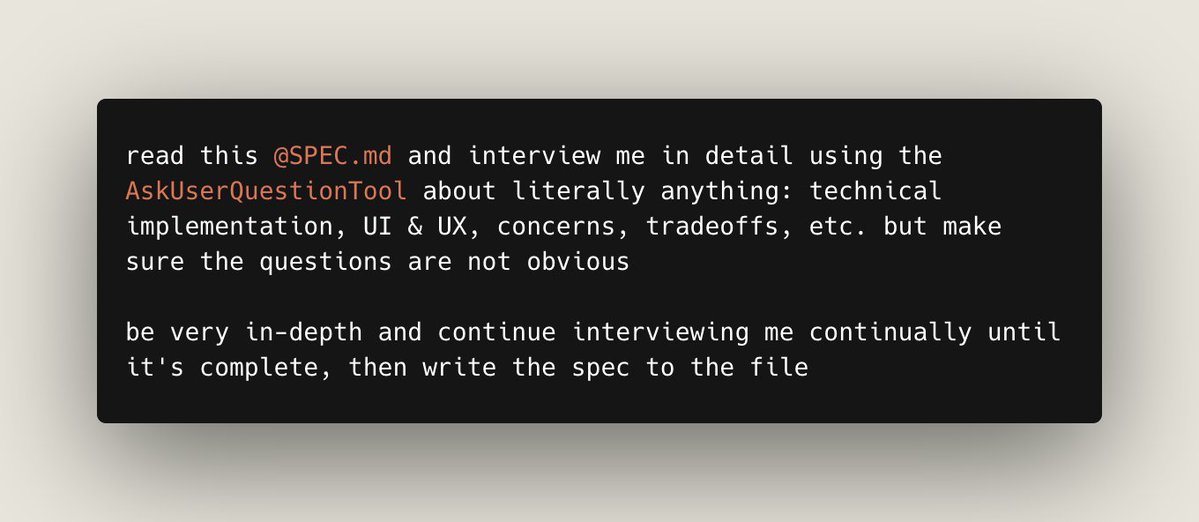
my favorite way to use Claude Code to build large features is spec based
start with a minimal spec or prompt and ask Claude to interview you using the AskUserQuestionTool
then make a new session to execute the spec
I jumped into some "not Remix 3 UI code" today and it felt ... I dunno ... heavy or rigid?
We're working toward the first week of March for an alpha release you can use, it should have the whole breadth of our ambition, from database adapters to theme-able library components
One of the biggest challenges with Remix 3 is going to be telling the whole story and helping people really appreciate the scope of it.
It covers the same conceptual surface area as:
- Express (and middleware)
- React
- Prisma/Drizzle
- node:fs
In JavaScript, we are accustomed to getting dependencies from disparate sources, cobbling together dependencies from different teams with different values/goals, referencing multiple sets of docs, etc.
In Remix 3, it all comes from a single source with a single development philosophy. Brought to you by the same team that has built world-class infrastructure including React Router, UNPKG, CSS modules, and more.
It's exciting and thrilling to be a part of it. We are shooting for an alpha release in Q1 2026.
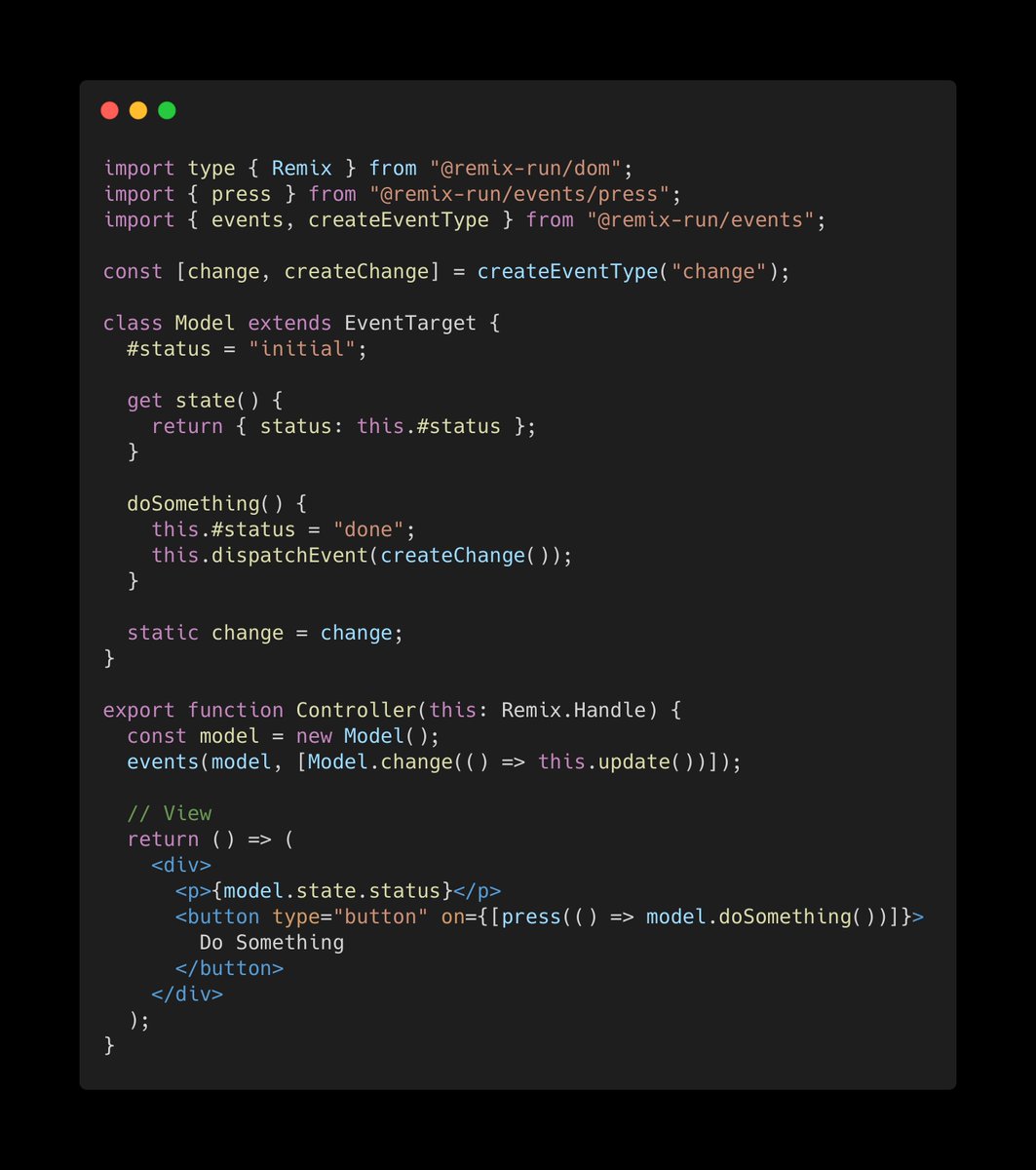
Thinking about Remix components in terms of MVC makes a lot of sense
- The controller instantiates a model and subscribe to events
- Then returns a view that uses the model instance to get values and call methods
- And the controller updates the view when the model change
You don't need reactivity. In fact, it's the root of all of the complexity we all feel when developing with frameworks. Incredible to see the Remix people came to that conclusion too. And pretty elegant API to boot.
The Remix 3 approach to the server:
- Very powerful URL pattern matching with named routes (fast too)
- Huge focus on type-safety throughout
- Convenience methods for CRUD
- Built in solutions to the most common problems (e.g: file storage)
- Composable architecture
My take: A modern, fast, batteries included alternative to Express with excellent DX. Thoughtfully composable so you are not locked in at any layer.
Every framework has a version of this.update() , they don't expose it to you because they don't trust you to use it correctly. It's a breath of fresh air to have a framework that doesn't infantilize its users. Remix 3, the framework for grown-ups?
https://t.co/cABx2gTPw0
React Router now has support for React Server Components
We're introducing a more powerful RSC-powered Data Mode that brings most of Framework Mode's features to our lower level library APIs
El problema del vendemotismo no es el humo que le has vendido al inversor, sino fumártelo tú mismo y usarlo como roadmap interno. Frases como "Solo vamos a trabajar en features que hagan un x10" molan en un pitch, pero son veneno como guía para un plan operativo.
Implementing OAuth2 in a @remix_run or React Router application requires handling access tokens and refresh tokens securely.
Let's explores best practices in a Backend for Frontend (BFF) architecture).
From the very beginning, one of our main goals was: Typing math should be as natural as typing plain text. No syntax, no coding—just start typing, no learning required
BIG DAY. Introducing Standard Schema 1.0!
It's a specification for a "common interface" to be implemented by all TypeScript schema libraries, written collaboratively by the the creators of Zod (👋), Valibot, and ArkType to promote interoperability.
https://t.co/giSGwnIDld