I'm always really surprised by how companies lose money on @solana.
As CEO of @Circular_fi, I'm led to speak with many companies across the ecosystem.
Most of them create value with their transactions. They are either unaware of it or they are afraid of the monetization solutions currently offered by the market (they are right to be).
After all these years analyzing arbitrage and speaking with them, two profiles stand out:
- The first is the company that are unaware that there are ways to monetize a transaction.
They create DeFi transactions but they do not have visibility into the impact a transaction can have.
It's never just a simple transaction when you send it on a decentralized network. Your transaction has a real impact on the entire ecosystem and therefore can generate value through arbitrage.
Here, my role is simple: educate them and help them understand why they can better monetize their transactions.
- The second profile is the more complex one: companies that are fully aware of arbitrage, but do not want to arbitrage their users transactions.
That is a noble position and I respect it.
But what they do not realize is that with this position, they are not helping their users. They are penalizing them and literally making them lose money.
The value created by their transactions will be captured by an external arbitrager anyway, that is a fact.
Not wanting to arbitrage their own transactions means voluntarily letting their users money leak into the ecosystem, for free.
If we push this thinking further: wouldn't it be more reasonable to capture this value and redistribute it to their own users as cashback?
This money generated through arbitrage is not created out of thin air. It is a direct loss for the user caused by AMM inefficiencies.
With our years of experience, our public image and our data, we decided a few months ago to create a Monetization Layer.
Simple, healthy and transparent for companies.
(0.0ms) We receive transactions.
(0.1ms) Analyze them in real time.
(0.5ms) If a transaction will destabilize the price of a token; we will send an arbitrage transaction who lands after the analyzed transaction.
(1ms) We redistribute the majority of the profit directly to the company wallet during the execution of the arbitrage transaction.
Then, it's up to the company to decide whether it wants to redistribute a part of this profit.
Clear traceability is what makes Circular the first fully transparent Monetization Layer for companies.
That is why they choose us.
Accelerate.
Alpenglow has arrived on @solana and it's going to change everything for analytics platforms.
As the CEO of a platform that analyzes all of Solana's activity, block by block, we were limited to the "Finalized" status.
This status is reached when a consensus of validators agrees to accept the block.
On average, before Alpenglow, we received blocks after 12.8 seconds.
After the Alpenglow update, the wait is no longer measured in seconds but in milliseconds: 150 ms.
This means that all analytics platforms will be able to operate nearly in real time with the blockchain, a win for data.
A big shout-out to @anza_xyz, who've been working for months, even years, on this update, you guys are the best! 🔥
@Splatter7_@solana@AxiomExchange Provider fees are one thing, but manipulating the recommended fees and setting them by default at excessive rates in order to keep as much as possible is something else entirely, far more serious.
Axiom's $55.7M "Validator Bribe" Rip-Off on @solana.
@AxiomExchange is deliberately extracting millions from its traders through misleading transaction fees.
I stumbled upon this piece of data while exploring our database, here's our analysis 👇 https://t.co/Xd40QgoePe
@1337_jay@solana@AxiomExchange I haven't done an in-depth investigation into who owns the addresses used for the backrun (maybe in a another article), but the one thing I can say for sure is:
When they perform a backrun, the bribes increase by 1% to 20%.
Sometimes troubling things happen on @solana that nobody talks about...
With so much data on Circular, sometimes I'm looking for one piece of information and I stumble upon another... darker one.
The on-chain data speaks for itself; I think I should talk about certain things 🤔
@bawsebuilds@solana Sure! We offer two types of cashback:
- Cashback on price impact
- Cashback on tips
Cashback on price impact is already live, you can enter your wallet address when you submit a transaction; cashback on tips is coming soon 🫡
The dashboard for our Fast landing service on @solana is now live!
This is a game-changer for landing services; transparency is Circular's hallmark, so we've just rolled it out on Fast.
Traders use landing services not only to execute their trades in 0-slots but also to recover the value they lose due to price impact; 65% of the recovered value is sent directly back to your wallet.
No more wondering whether your tips are making a real impact and being put to good use, the data is right here!
See a breakdown of how Fast has used your tips, an analysis of the transactions you've landed, and which validators processed them.
FAST.
The Fast dashboard is live.
We just shipped the Fast dashboard, so you can now see what’s actually happening behind your transaction on Solana.
Track your requests, landed transactions, volume, tips, and the average number of blocks between sending and landing.
You can also break performance down by region, see which validators are landing your transactions, and inspect the flow transaction by transaction.
And for eligible flow, cashback has its own dedicated view too.
Now you can see what’s happening behind it.
This month, Fast, our landing service on @solana, processed over $6 million in volume.
That's sick.
You can now view your own stats on the dashboard, now live! 🔥
The dashboard for our Fast landing service on @solana is now live!
This is a game-changer for landing services; transparency is Circular's hallmark, so we've just rolled it out on Fast.
Traders use landing services not only to execute their trades in 0-slots but also to recover the value they lose due to price impact; 65% of the recovered value is sent directly back to your wallet.
No more wondering whether your tips are making a real impact and being put to good use, the data is right here!
See a breakdown of how Fast has used your tips, an analysis of the transactions you've landed, and which validators processed them.
FAST.
I think there are two major issues with the MEV on @solana today.
- The biggest one, in my opinion: a lack of transparency and the inability to understand who benefits from a transaction (though I can say with certainty: it’s rarely the traders)
- The fragmentation of schedulers, which makes it very difficult to predict when a transaction will land.
There’s still so much to do.
Glad more people have been talking about it lately!
With all the "discussion" about MEV on solana. Unsolicited comment from me.
All of this shitshow is caused by scheduler fragmentation. You send a txn to a validator. You dont know how the validator will rank it ? Is it by PF, is it TIP? Is there a bundle endpoint?
It's crazy to see comments like that (or such a complete lack of understanding).
If there's even a modicum of transparency in arbitrage, it's because we created Circular and brought that transparency to the ecosystem.
Literally $1 billion was mass-extracted in 2025 through arbitrage and trading platforms.
So your idea is to let traders get mass-extracted and, above all, not to talk about it? 👀
Based on Mriya wallet:
Trade: 87k USDC -> 8.1m CLAUDIA
Arbitrage: 37.9k USDC -> 56.6k USDC
Profit from arbitrage: $18.7k
Loss incurred by the trader: $18.7k
I don't think it's acceptable for a trader to lose 21.5% of their trading volume, but maybe I'm wrong.
It's a really basic example, you should check out Circular and try to understand what arbitrage is, money isn't created out of thin air:
- https://t.co/W7aErbGa92
- https://t.co/7iHmJv27AF
I'm also including one of my tweets so you can understand why an arbitrage is the direct result of a loss incurred by the trader:
https://t.co/SdzcQgcJdt
Have you ever heard about the inefficiency of AMMs? When you trade on-chain, you lose money.
As a daily Solana user, I make swaps every day.
Simpler, cheaper, faster.
But I have a crazy statistic to share with you: traders on Solana lost $1 billion in 2025 because of the math.
What does math have to do with any of this?
An AMM/liquidity pool operates, for the most part, without an order book but using math (x * y = k).
This mathematical formula is the core concept behind an AMM.
Let's take a simple example:
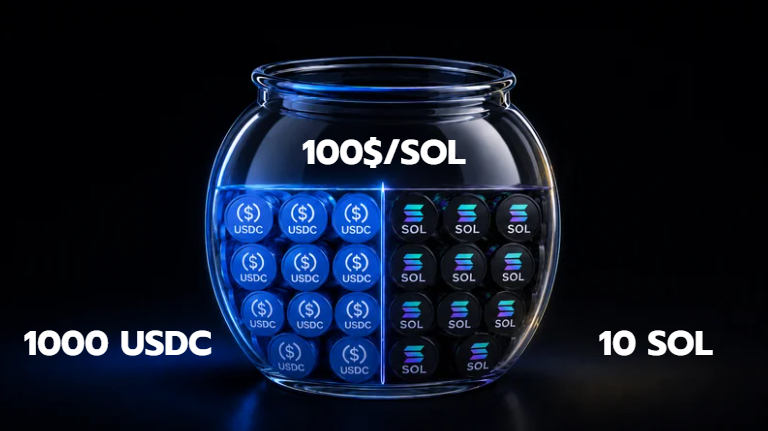
x = USDC
y = SOL
Market price of $SOL is $100.
If I deposit 1,000 USDC, I’ll also deposit 10 SOL so that my liquidity pool has a market price of $100 per SOL (1,000/10 = $100).
Now, let's do the calculation (x * y = k):
1,000 USDC (x)
*
10 SOL (y)
=
10,000 (k).
Great so we know the mathematical value our liquidity pool aims to achieve: 10,000.
Now let's make a trade of 250 USDC to exchange it for SOL… how much do you think you'll get back?
If the price is $100 per SOL, by exchanging 250 USDC you'll get 2.5 SOL, right?
Absolutely not!
Let's do the math again:
1,250 (1,000 initial USDC + 250 deposited by your trade)
*
7.5 (10 initial SOL - 2.5 withdrawn by your trade)
=
9,375.
9,375, not 10,000.
Whereas:
1,250 * 8 = 10,000.
So the liquidity pool will give you 2 SOL instead of 2.5 SOL.
You just lost 0.5 SOL.
This is what's known as AMM inefficiency.
Now the question is: how can you protect yourself from this?
Arbitrage.
You can recover the value you lost by arbitraging liquidity pools.
In this case, if I buy SOL from another liquidity pool and sell it on this one, I’ll rebalance it to 1,000 USDC – 10 SOL and capture the lost value (0.5 SOL).
It was by realizing this that we built @arbmesol for the @colosseum.
It's an extension that lets you recover the SOL you lose during your trades on Solana as cashback directly into your wallet.
Now that you know this and that a solution exists… you're the only one responsible for losing SOL due to the inefficiency of AMMs.
Trade to Earn.