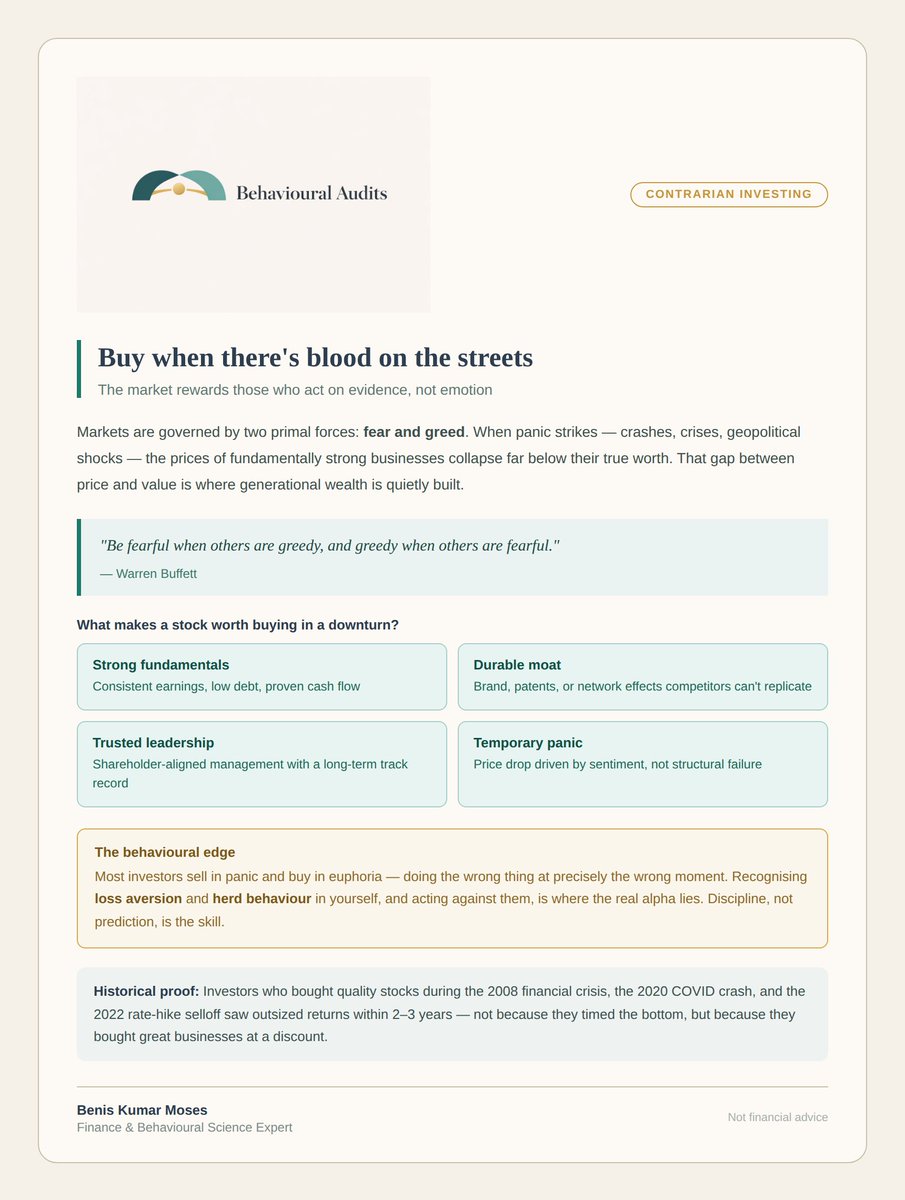
Behaviour Science Consultant. Passionate about Personal Finance & Investment Biases,Strong advocate of Equity Cult. Likes&Retweets are not endorsements of views
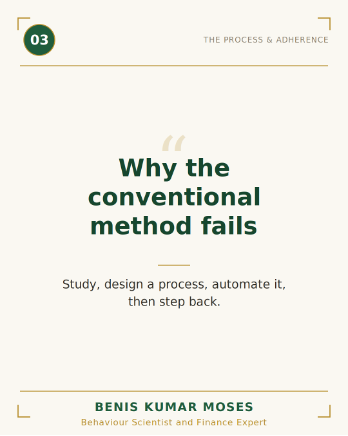
The conventional model is simple: study, sit the test, succeed. With investment biases, it breaks down. You study, you understand the theory, then a volatile market arrives and your older emotional self sits the test for you. A better approach is to study, design a process, automate it, and step back during market hours.
#InvestmentBias #BehaviouralFinance #Investing
— Benis Kumar Moses, Behaviour Scientist and Finance Expert
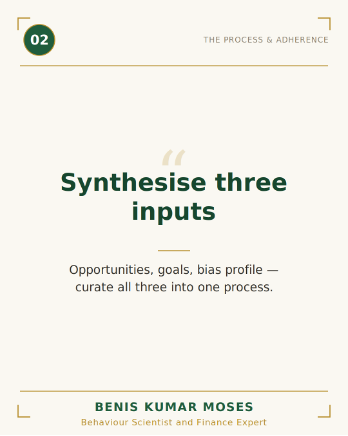
A sound investment outcome rests on three inputs working together: market opportunities, your financial goals, and your bias profile. Curate all three into a single process and you arrive at a portfolio that genuinely suits the person holding it. Most investors optimise only the first. The other two decide whether you actually stay invested.
#InvestmentProcess #BehaviouralScience #WealthCreation
— Benis Kumar Moses, Behaviour Scientist and Finance Expert
Process is the differentiator
What separates a successful investor is not intelligence, information, or even returns. It is process. Understanding your biases gets you only halfway. In the hot state of a moving market, those biases quietly overpower your logical brain. A robust, pre-set process is what holds the line. Build it when you are calm; trust it when you are not.
#BehaviouralFinance #InvestorBehaviour #Investing
I have heard of a Zomato loophole which is so simple, terrifying and Zomato should be losing sleep over it
A person orders 1 roti on Zomato. ₹40.
Then he calls the restaurant directly 6 rotis, paneer butter masala, malai chaap, dal makhani, gulab jamun and pays them on UPI.
Tells the restaurant to pack everything with that 1 roti Zomato order.
The Zomato rider picks it up. Delivers home. No clue that ₹1,200 of food is riding shotgun with a ₹40 order.
He’s using Zomato’s app. Zomato’s rider. Zomato’s entire logistics network and paying zero commission on 90% of his bill.
It’s cheaper than booking directly from Porter and restaurant.
The restaurant loves it. Full margin, no 25 to 30% Zomato cut.
The customer loves it. No platform fee. No surge. No GST on the hidden portion.
Zomato? Quietly subsidising the entire operation.
And here’s the part nobody’s talking about this isn’t one rogue customer. Restaurants are in on it. They may be whispering this tip to regulars to keep them off the app.
If this spreads, the unit economics of food delivery don’t just dip they bleed out from the inside.
Zomato needs to plug this loophole. This is exploitation of the system. Zomato MUST do something to stop this.
Have you seen this happening in your area?
Something nobody's connecting: India's fertilizer production hit 62.37 lakh tonnes in just Mar-Apr 2026 while West Asia is in full crisis mode. Imports were only 15.39 lakh tonnes.
Five years ago we'd have been panicking. This time the plants kept running.
Quiet wins don't trend. But domestic urea capacity going from deficit to near self-sufficiency might be the most underrated industrial story of the decade.
Easy to mock mutual fund distributors time and again. Much harder to acknowledge the role they have played in financially educating and bringing crores of first time investors into formal savings and capital markets.
India did not build a Rs 70 lakh crore mutual fund industry only through apps and fancy “global allocation” podcasts.
It was built ground up by thousands of MFDs who travelled city to city town to town convincing families to move from gold lockers, FD obsession and LIC-only mindset towards disciplined investing and SIP culture.
The irony is amazing.
The same intellectual ecosystem that constantly lectures India about “financialisation of savings” also uses MFDs as a punching bag every second week… especially many of those whose entire personality now revolves around selling international funds or investing in every fourth loss making glamour stock listed as 4 AM!
Apparently a guy convincing a middle class family to start a Rs 5000 SIP is the problem… not blind global momentum chasing packaged as sophisticated investing..
MFDs manage behaviour more than money.
They stop panic during crashes.
They create discipline during volatility.
They bring first generation investors into markets.
They build last mile trust in a country where financial literacy is still evolving.
Without that layer India would still be largely sitting in idle savings and insurance policies sold as investments.
Of course there are bad actors in every industry. But reducing the entire distribution ecosystem into a sarcastic one liner has now become fashionable.
Easy to joke about distributors. Far harder to build investor behaviour for 15 years through two bear markets and multiple crashes.
Never thought I would see anyone dominate Bumrah, Bhuvi and Josh Hazlewood at a strike rate of 300.
And Never in my wildest dreams did I think it would be a 15year old Indian. 😭
Heartwarming ❤️
A man dances in front of an elephant, and after watching him for a few seconds, the elephant joins in with pure joy 🐘✨
Proof that happiness is truly contagious😍
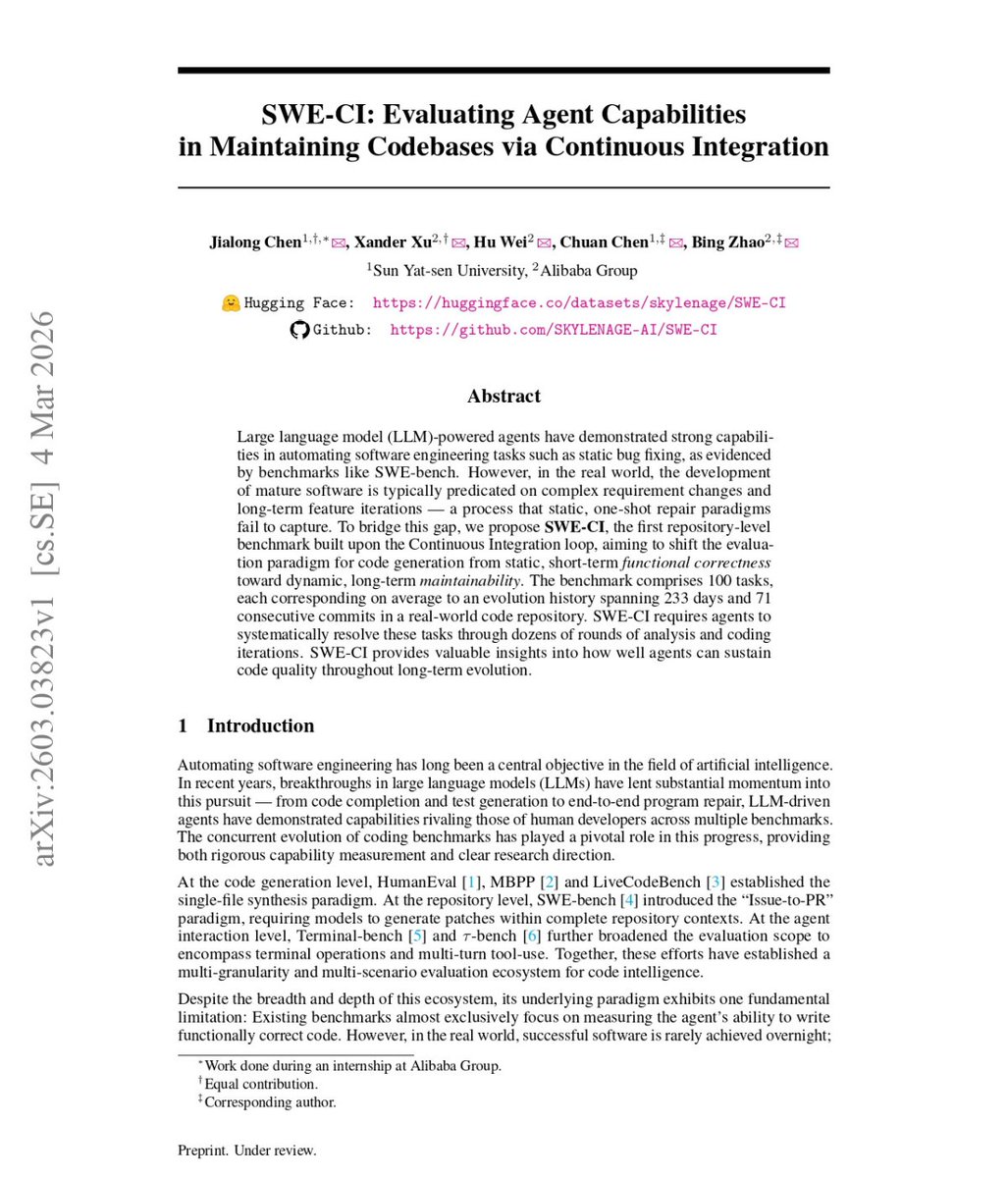
🤯BREAKING: Alibaba just proved that AI Coding isn't taking your job, it's just writing the legacy code that will keep you employed fixing it for the next decade. 🤣
Passing a coding test once is easy. Maintaining that code for 8 months without it exploding? Apparently, it’s nearly impossible for AI.
Alibaba tested 18 AI agents on 100 real codebases over 233-day cycles. They didn't just look for "quick fixes"—they looked for long-term survival.
The results were a bloodbath:
75% of models broke previously working code during maintenance.
Only Claude Opus 4.5/4.6 maintained a >50% zero-regression rate.
Every other model accumulated technical debt that compounded until the codebase collapsed.
We’ve been using "snapshot" benchmarks like HumanEval that only ask "Does it work right now?"
The new SWE-CI benchmark asks: "Does it still work after 8 months of evolution?"
Most AI agents are "Quick-Fix Artists." They write brittle code that passes tests today but becomes a maintenance nightmare tomorrow. They aren't building software; they're building a house of cards.
The narrative just got honest: Most models can write code. Almost none can maintain it.