Iglesia ni Manalo, eto bang si Marcoleta ang isa sa mga ipinagra-rally niyo for justice, transparency and accountability?
Panoorin niyo kung paano niya ipinagyabang na tumanggap siya ng P75-M donation nung eleksyon at hindi idineklara 'to sa kanyang SOCE.
MGA KULTO!
ANDROID USERS, READ THIS!
Your phone says "Storage Full."
So you delete photos. Delete videos. Uninstall apps. Yet the storage barely moves.
That's because the real culprits aren't your photos or apps. it's the hidden junk Android quietly stores in the background
Here's how I cleaned my phone yesterday and recovered 35GB without deleting a single photo, video, app, or chat I actually use.
Here's exactly how I did it:
👇🏼👇🏼
LOOK: Notice ng Blue Ribbon Committee para sa June 8 hearing ukol sa flood control anomalies. Imbitado ang umano’y “18 ex-Marines.”
Ayon kay Sen. Erwin Tulfo, pinaimbitahan din niya si Rep. Martin Romualdez. | via @nimfaravelo
We called it weeks earlier!!! Mighty CONGRATS to my good friend Sen @WinGatchalian74!!! New Senate PRESIDENT!!! Now let’s clean up the DDS mess & serve our democracy ✊
Another hypocrite in the person of Pia Cayetano who was a Senator on May 5, 2015 when they allowed to compute the quorum at 12 instead of 13.
Girl thinks she ate with her citation of Joaquin Bernas but she cited him out of context.
#KamustaSiPia
I've already seen some legal analyses saying that Avelino v. Cuenco might be inapplicable to what happened in the Senate today, thus arguing that the reorganization was invalid. Some are saying that the mention on the basis for quorum in that case was mere obiter dictum. Some even say that that 1949 case could have been superseded by the 1987 Constitution already.
In my view, Avelino v. Cuenco is applicable.
What is clear in the case is that the Supreme Court held that it did not have jurisdiction to interfere in the manner by which the Senate selects its officers. This is a long settled principle in Constitutional Law. In that case, Senator Cuenco was designated as acting Senate President by the remaining senators. He was then recognized as such by then President Quirino. (The same is the case today.) The refusal by the Supreme Court to interfere is an example of the political question doctrine.
The 1987 Constitution, particularly Article VIII, Section 1, limited the applicability of the political question doctrine by expanding the certiorari jurisdiction of the Supreme Court, if any branch or instrumentality of government acts with grave abuse of discretion. In recent years, there has been a development towards the acceptability of looking into the wisdom of a particular action of government by the SC to see if there was grave abuse of discretion. (This was evident in the interpellation of Justice Amy Lazaro-Javier yesterday in the oral arguments on the Unprogrammed Appropriations Cases.)
By citing Avelino v. Cuenca, and the 5 May 2015 Senate precedent, SP Pro Tempore and acting Senate President @WinGatchalian74 demonstrated that there was wisdom and basis for the Senate's action of electing him and choosing other officers of the Senate. There was no grave abuse of discretion, so the SC will most likely not interfere with the Senate reorganization. Notably, Art. VI, Section 16(1), last sentence, allows the Senate to choose its own officials (with the exception of the Senate President) "as it may deem necessary."
THEREFORE,
1. The declaration that all position in the Senate, including SP, was vacant is valid.
2. The election of Win Gatchalian as SP Pro Tempore, including the election of the other officers of the Senate, is allowed under the Senate Rules, the 1987 Constitution, and Avelino v. Cuenco
3. The Supreme Court will most likely not interfere with the Senate reorganization.
Loren Legarda was about to join Chiz Escudero to be with the new majority but she wanted to have Energy Secretary Garin ousted from the Cabinet. This is because of Leandro Leviste’s solar power scandal. Malacañang declined.
EXPLANATION
Why Avelino vs Cuenco 1949 is enough for a quorum of 12
Normally, the Senate has 24 senators, so quorum is 13.
Senate PH Rule II says that for Senate officers: they are elected by “majority vote of all its members.”
So if all 24 are counted, 12 is not enough.
But the anti-Cayetano camp’s argument comes from Avelino v. Cuenco, 1949.
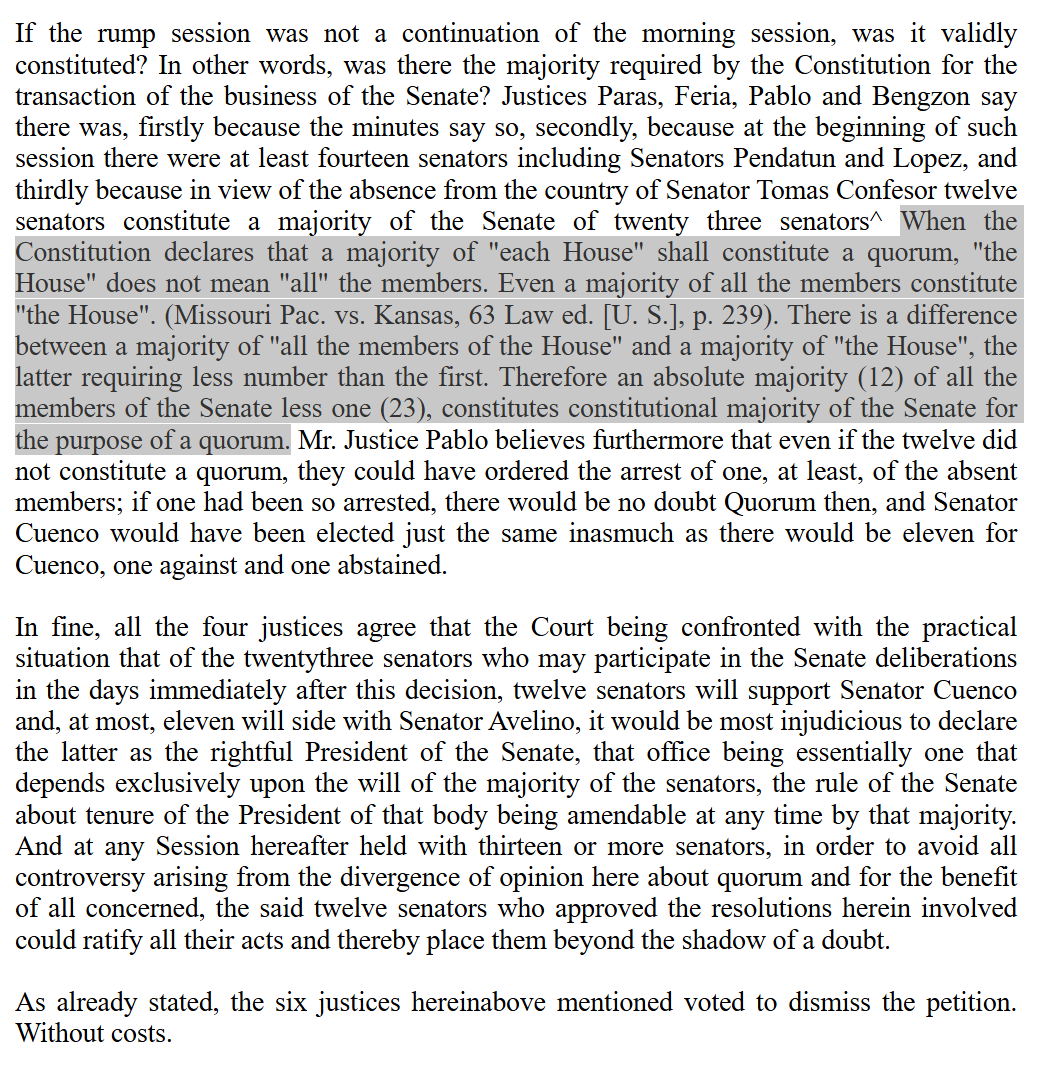
In that case, the Supreme Court accepted the idea that because one senator was outside the country and could not participate, the Senate could be treated as having only 23 participating members. That made 12 a majority.
The Supreme Court said that “an absolute majority (12)” of the Senate “less one (23)” could be quorum, and Justice Feria explained that the count may be based on “actual members or incumbents” who are not incapacitated or outside the Senate’s jurisdiction.
Applied today: if Jinggoy Estrada is unable to participate because he is arrested, they can argue the working Senate is 23, not 24.
So 12 becomes quorum under Avelino logic.
Now add the Cayetano issue.
A Senate President is not the owner of the Senate.
The Senate Rules say the Senate normally meets at 3 PM on weekdays, unless the Senate decides otherwise.
If a session is postponed, the Senate President must consult the Majority and Minority Leaders. And the Senate President cannot just suspend or adjourn a session by himself without a motion or resolution approved by senators present, except in the specific postponement situation.
So if Cayetano refuses to preside or tries to stop the chamber from functioning, the anti-Cayetano camp can say - the chair cannot kill the chamber.
That is also consistent with Avelino v. Cuenco, 1949.
In that case, the Senate President abandoned the chair and did not attend.
Worse, Cayetano not only was absent, he did not designate a Presiding Officer either - the Senate is not functioning.
The anti-Cayetano senators continued, and the case records say the deliberate abandonment made it necessary for the remaining members to continue “in order NOT TO PARALYZE the functions of the Senate.”
So the anti-Cayetano camp’s legal theory is basically this:
(1) The Senate is bigger than Former SP Cayetano.
(2) If he refuses to preside, and enough senators are present, the Senate can still function.
(3) If Jinggoy cannot participate, Avelino gives them an argument that 12 is quorum.
(4) Once quorum exists, the Senate can act on its internal organization, including committees per the Senate Rules.
They are on stronger ground when reorganizing committees, because committees are part of Senate internal organization.
Rule X says permanent committees are formed by the Senate after organization, including the Committee on Rules (take notice, yan ang unang call to motion ni Sotto).
So what did Cayetano did wrong?
Essentially by refusing to attend the Senate or any of the presiding officers (ie: Former Pro Tempore Legarda, and Former Majority Leaders), the situation became more and more similar to Avelino v. Cuenco, 1949.
The former Majority could even argue that Avelino v. Cuenco, 1949 is a "special circumstance" . However, the similarities between then and now became more apparent with the former Majority leaders absence and made the arguments of the anti-Cayetano camp stronger.
With this, the new Majority got their quorum and they rearranged leadership.
So why only the leaderships and not the actual Senate Presidency?
So the pro-Cayetano camp can ask: "If you truly have quorum, and the majority of all members, why not also elect a Senate President?"
Short answer: Because of the Constitution.
The Constitution makes electing a new Senate President more sensitive because it specifically requires a “majority vote of all its respective Members” for that office.
The Constitution then separately says each House may choose “such other officers as it may deem necessary.”
For Senate President:
The Constitution itself sets the rule. The Senate President must be elected by “a majority vote of all its respective Members.”
For President Pro Tempore and other officers:
The Constitution does not give a specific voting threshold. It only says each House may choose “such other officers as it may deem necessary.” (Sec. 16)
It also says each House may determine its own rules.
That is where Senate Rule II comes in:
the Senate used its rule-making power to say its officers, including the President Pro Tempore, Secretary, and Sergeant-at-Arms, are elected by majority vote of all members.
LOGICAL DIFFERENCE:
So the Constitution does not dictate the definition of "all members" for other Senate officers - only for the Senate President.
Thus, the dictation and definition of "all members" lies on Senate Rules per the Constitution Sec. 16, "...as they deem necessary..."
But with Avelino v. Cuenco 1949 coming in...
The Senate PH has already defined "majority of all members" to be "active members of the Senate - that could participate"
In the ruling,
Justice Feria said the count may be based on the Senate’s “actual members or incumbents,” excluding those unable to discharge their duties because of death, incapacity, absence from jurisdiction, or other causes making attendance impossible (ie: arrest).
Feria treated the Senate as having 23 actual members, so 12 became a quorum and majority.