Being part of the Science of RL team for Beam has been an absolute privilege. It's been wonderful to learn how the big RL sausage gets made over the last year and a half and witness the dedication and pace of this team. I look forward to building many more models in the future!
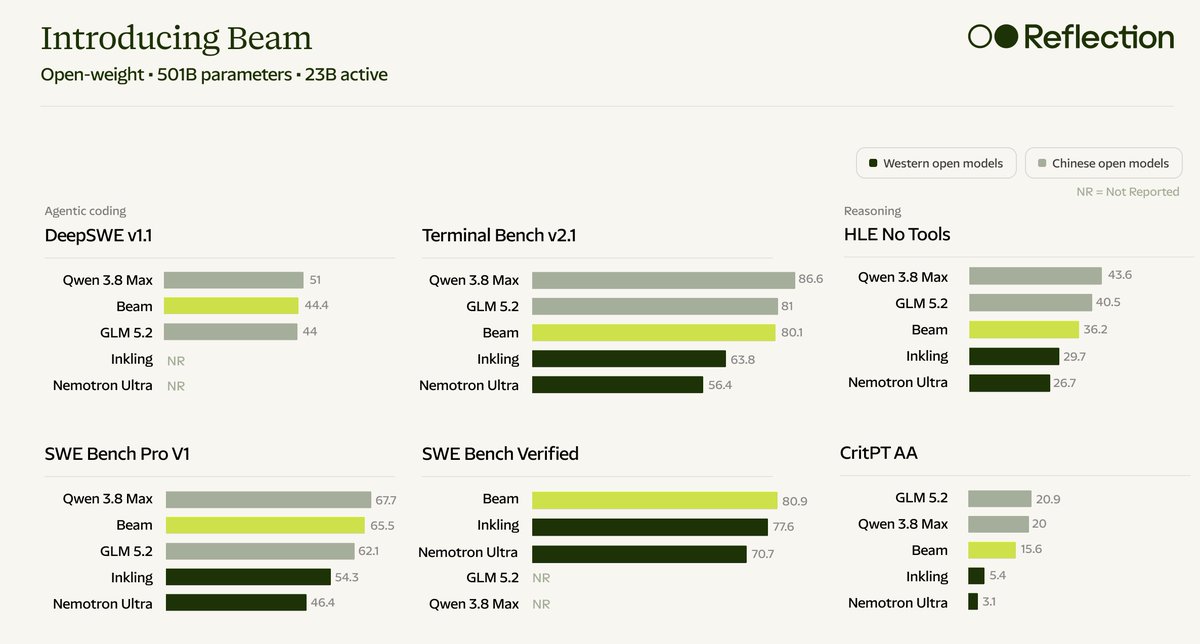
Introducing Beam: a highly efficient agentic open model with 501B total parameters and 23B active.
- Frontier reasoning efficiency
- Advances the Western open frontier on coding & agentic tasks
- Trained end-to-end from scratch
Full weights release this month.
Learn more about Beam: https://t.co/c3Qx2cpM8G
A few thoughts on this fascinating post.
1) I applaud OAI's push toward more transparency among the labs. You may call it self-serving at a given moment, but the push is commendable nonetheless.
2) At the same time, log-perplexity on a heldout set is a great metric for comparing to your past self, but not necessarily to others. Not only do we need to agree on a shared heldout set, we need to agree on the algorithmic standards to decontaminate it! It's not enough to say "it's internal code thus heldout by construction". Different tokenizers and mixtures further compound the discrepancy across labs.
Code in particular suffers from a lot of fuzzy duplication because humans and agents reuse & rewrite whole files. Even between an internal monorepo and public Github code. This duplication will impact different pretrained bases differently, thus the best techniques run multiple complex tiers of decontam. I'm sure OAI does this internally, otherwise they can't use their own valset as a test of generalization.
To align on a shared method, we need (a) an independent valset that's more general than "internal monorepo", possibly rolling in time; (b) an RFC standard for decontamination, pulled from SOTA approaches at different labs; (c) a monitoring organization with employee-level access that enforces and measures the above. Maybe someone like @METR_Evals is up for the task?
3) Here on X, one can see circumstantial evidence that models that are built on better pretrains are perceived as being more human-like, having better writing style, or being more creative. People had said this way back about GPT-4.5, they are saying this now about Carbon and Neon, and I'd love to see if the same sentiment remains for "Bel" and for Fable 5.5. The dip of GPT-4.5 matches that.
IMO that's more of a relative statement than an absolute one – people perceived GPT-4.5 as a better writer at the time, compared to GPT-4o and GPT-4.1. But as Bezos said, "when anecdotes disagree with data, the anecdotes are usually right".
Maybe it's more about what is being optimized. RL scaling is doing exactly what we ask it to do: when most of the reward comes from verifiable tasks, the model becomes superhuman at getting work done, and defaults to a certain mode of "productive" thinking and writing. A major base model jump widens that prior and "feels different" in comparison – richer prior means a wider writing distribution with the same productivity.
4) The RSI point is critical, and requires frontier models, nontrivial experimental compute, and people who know what to ask and how to validate. OAI themselves say that their recent improvement trend is more attributable to "the outcomes of long term research and compute investments". They have seen recent evidence of RSI automation. So have we. So has everybody! We have these incredible models at our disposal – the ones on the frontier of intelligence are increasingly more capable of automating pretraining iteration. But only after one has established the right experimental framework, infrastructure, measurements, and dedicated compute for self-iteration. Without those, it's easy to miss a contaminated eval measurement, or a recipe proposal that helps on small-scale but hurts at large-scale, or simply waste FLOPs on flawed directions.
To draw an analogy – the math discoveries of 2026 were built on the years-long infrastructure of @leanprover that verifiably rejects invalid thoughts, the community that formalized (and autoformalized) all necessary knowledge, and on mathematicians like @__alpoge__ to steer the AI. That is what enabled auto-verification of math, and moved the bottleneck back into intelligence, such as hypothesis generation.
Pretraining is not quite like that yet – but I expect pretraining RSI to follow the same pattern:
We'll want a high-fidelity experimental framework to reliably validate hypotheses.
We'll want pretraining & data & accelerator experts in the loop.
And we need to invest compute into this exploration, which I'm already excited about.
5) One can approximately see the evidence of rumored history here. The first phase that discovered PreT scaling. The second phase hit a temporary wall (GPT-4.5 being an eventual release of a bigger model that had underperformed expectations) but instead discovered the new scaling power of reasoning & RL, optimized inference efficiency, and invested in that scaling. And the third phase this year that brought PreT science & scaling back alongside it. This is tangential to the point, but just fun to observe as a confirmation for the science historians among us 😂
We’re introducing Reflection’s Trusted Access Program, to give vetted organizations access to advanced AI capabilities and tools for cybersecurity.
We’re starting with Laser, an autonomous penetration-testing harness for Mirror, Reflection’s terminal agent.
https://t.co/DqJ2Rkpbc2
⚠️ Numerical issues can go on silently for decades like in the softmax/CE! Similar issues are present in other widely-used divergences like the KL and JSD
I just posted this paper overviewing what they are and how to fix them:
📚 https://t.co/hKlMwrV6xN
I'm not going to comment on the author's post. There are different sides to every story, but that's not the point.
I take issue with the impression of company culture though. It's Q4 2026 - Reflection is a rapid neolab with AI agents, Tailscale, CI/CD guardrails, agentic review loops, internal RSI iteration, and solid infra that underpins it.
Velocity is key. I know people who land 100 PRs a day. We have built up to a great end-to-end open model in <1 year starting from complete zero - I think the only other teams that have pulled that off were TBD and TML. Heck, we recently built up a full-featured API platform stack in ~1 month. If you think that all is achievable with pervasive FAANG-style engineering bureaucracy in 2026, think again how could that make sense.
But that's enough wars on the Internet :) Going to go focus on finishing up the next model release instead.
Beam’s model technical report is now available. Read the full report to learn about the methodology our team used to train Beam end-to-end in-house, here: https://t.co/wqc0nOyqhC
Internship opportunity!
I'll be hosting a Student Researcher next year @GoogleDeepMind.
Humans got to the moon with roughly the same brains as our ancient ancestors; culture did the work. Can a population of frontier agents compound their abilities by accumulating artifacts?
We teamed up with @huggingface to give away $20,000 to anyone who's building with Beam 🤗
Use Beam for any project - make a demo or a dataset, benchmark the model, create an RL environment - and comment your link in the model's repo page by Monday, November 2.
We choose the winners. Winners choose cash or credits. Claim $25 in Hugging Face credits to build with Beam and enter the competition 👇
https://t.co/XCxKkWB9Bp
This was the first big run we've done at Reflection. We had a so much fun running a lot of RL on this one! It was very satisfying to see scaling RL in action with no plateau in sight!
Ben taught me so much about doing proper research in RL and the ways to debug policy gradients. Glad the Science of RL team and @reflection_ai gets to have this expertise for their models!
Being part of the Science of RL team for Beam has been an absolute privilege. It's been wonderful to learn how the big RL sausage gets made over the last year and a half and witness the dedication and pace of this team. I look forward to building many more models in the future!
Introducing Beam: a highly efficient agentic open model with 501B total parameters and 23B active.
- Frontier reasoning efficiency
- Advances the Western open frontier on coding & agentic tasks
- Trained end-to-end from scratch
Full weights release this month.
Learn more about Beam: https://t.co/c3Qx2cpM8G