Are you interested in finding giant viruses, virophages, and PLVs inside your metagenomes? Struggling to figure out an easy way to do so? Look no further than BEREN, a one-stop-shop tool for recovery, taxonomy, and annotation of these viruses.
https://t.co/OMCDlAGXcT
This perspective highlights that giant viruses arose from smaller viruses by taking up host genes. They remain typical viruses despite genomes that can reach 5 Mb and virions larger than many bacterial and archaeal cells. The virus-cell boundary to is put between replicators, which use host ribosomes, and reproducers, which build their own. This is a distinction no currently discovered giant virus appears to have crossed. One of the open questions that remains is what drives some lineages to a K strategy, accumulating virus-host interaction genes, while others stay compact. https://t.co/L4hXTA0SlH
Our newest paper is out now in Nature Comms! We explore the mosaic nature of giant viruses and their ability to harbor genomic islands, differentiating closely related strains. These islands carry key cargo that could help the viruses adapt to new hosts
https://t.co/Mei6W3VZ7S
Giant virus genomes carry discrete genomic islands that concentrate sequence variation and mosaic gene content. These regions, rather than the conserved core, account for much of what separates closely related Nucleocytoviricota genomes. https://t.co/8iQW46ErzP
This update was made possible by the new study on PLV diversity and phylogenetic framework by Chris Bellas and Ruben Sommaruga. Go check out their paper (https://t.co/92zIt8NE2V)
Happy to announce that a new BEREN update is out, focusing on improving virophage/PLV detection and classification.
1) 5x faster run speeds on PPV module!
2) New capsid HMMs
3) Updated protein cluster database
4) Integration of capscan to get taxonomy.
https://t.co/rHvr0DgVAX
Giant viruses aren't just big, they are modular. Go check out our latest #preprint where we highlight widespread genomic islands driving genome plasticity and mosaicism in giant viruses! https://t.co/nMHnELo1Zy
We found many of these islands to be enriched in host interaction genes and surface adhesion proteins, demonstrating that they could be a mechanism for host adaptation.
Our lab's most recent paper is out now! Go learn about all the integrated giant viruses inside the genomes of polar algae and how they are shaping their stress responses.
https://t.co/GIBgzwWulD
Our work in collaboration with Jed Furhman lab at the USC on the temporal dynamics of marine giant viruses published in ISME communications. PhD student @Benjamin_Minch a co-first author. Please take a look!
https://t.co/p3Zps001gj
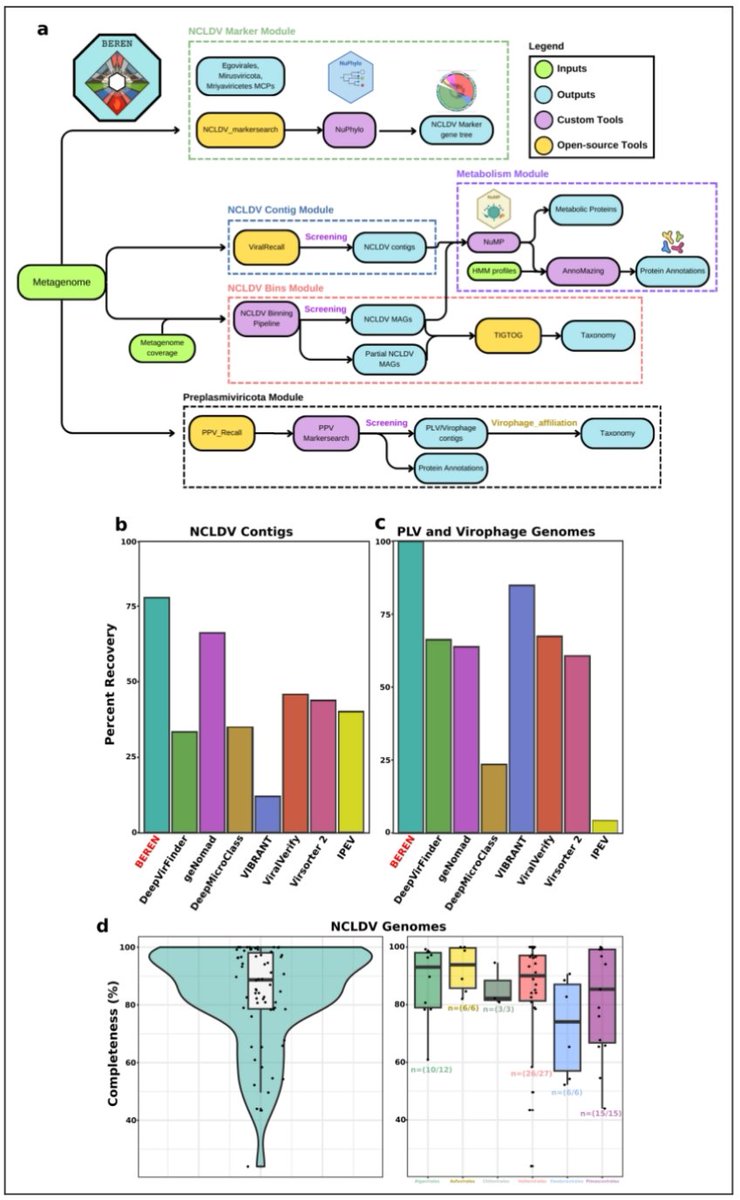
🦠 Now published in Bioinformatics Advances: “BEREN: A bioinformatic tool for recovering giant viruses, polinton-like viruses, and virophages in metagenomic data.”
Full article available: https://t.co/oImIhEPgui
Authors include: @Benjamin_Minch
Excited to share our new paper introducing BEREN, a tool for identifying giant and other dsDNA viruses from metagenomic data — now online! Let BEREN help with your discovery-based reseach in viral metagenomics!
https://t.co/H3DqmZBO0y
We’re recruiting a PhD student (Fall 2026) to study the ecology & evolution of aquatic giant viruses! Research spans lab experiment, field sampling, & bioinformatics. Background in microbiology/bioinforamtics encouraged. More information:
https://t.co/bshyrMLtiW
Please retweet!
Scientists used bespoke computer software to identify the genomes of microbes in seawater samples – including 230 giant viruses previously unknown to science. @univmiami@Benjamin_Minch
https://t.co/L9oBdVcBt9
New paper out where we highlight many newly recovered giant viruses and find new functional potential encoded in their genomes!
#giantvirus#Bioinformatics
https://t.co/lEK95lBUcc