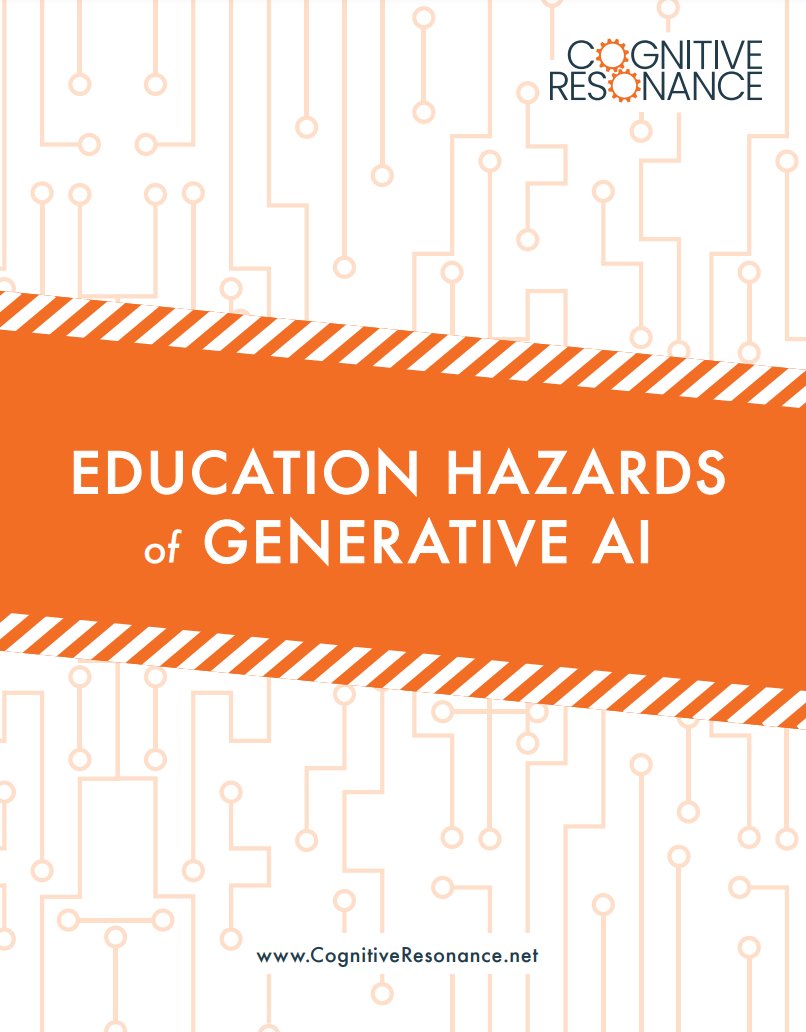
Today, Cognitive Resonance is releasing a new guide titled Education Hazards of Generative AI. This free resource clarifies common misconceptions about how AI works and warns against misuses of this technology in education. Please share this widely.
https://t.co/SmWOTDopSW
"According to current neuroscience, human thinking is largely independent of human language — and we have little reason to believe ever more sophisticated modeling of language will create a form of intelligence that meets or surpasses our own."
https://t.co/Ccqe2THMDk
@colin_fraser Feels like the third leg of the triangle to your thesis is the political realignment/shift of Silicon Valley political culture to align with the right.
@clydeiii@colin_fraser I don't want to speak for @colin_fraser, but I think he's suggesting there might be performance differences between deciphering "coherent" text, aka actual words, versus deciphering random strings of letters.
@mpshanahan Hard to square this with Rorty's notion that human understanding of "truth" shifts when existing vocabularies become unsatisfactory for describing the external (or internal) world, methinks.
@colin_fraser Although I myself would invest in a vending machine startup that dispenses Harry Potter books where every 1000th book is randomly laced with sarin gas
@colin_fraser@Stalker6Zauzich@littmath@gregeganSF That score may over time tell us something about the performance of LLMs on certain types of tasks. But absent LLMs having the broader capabilities humans have because we are embodied creatures with agency, the IQ score of an LLM won't be predictive of anything interesting.
@colin_fraser@Stalker6Zauzich@littmath@gregeganSF It may end up being the case that as various benchmarks are developed across various tasks, AI performance will positively correlate across them. I'd expect that, actually. We will be able to do factor analysis and then give AI a general "intelligence" score. But...so what?