A great thread from @uthsavc describing some of the math behind GASTON, our new method for modeling spatial variation in gene expression, now out in @naturemethods!
GASTON, our method to learn “topographic maps” of gene expression, is out now @naturemethods!
IMO the coolest part is a new model of *spatial gradients in sparse data*.
As is typical for bio papers, it’s buried in Methods, but see below for a quick outline on the math 👇
Congratulations to all the winners and finalists of the 2024 @Regeneron Science Talent Search! It was inspiring to meet the next generation of leaders in science and technology!
🏅We're excited to announce the winners of the 2024 @Regeneron Science Talent Search. Congratulations to these extraordinary young scientists! #RegeneronSTS https://t.co/2L1GCpcbbm
Thank you @rohitsingh8080 for hosting me at @DukeCellBiology! A great visit with a packed auditorium and many stimulating conversations! This photo was me being delightfully surprised that I was speaking in a lecture series next to these truly distinguished cell biologists
I forgot to take a photo during his talk, so this will have to do.
@benjraphael gave a fantastic talk at @DukeCellBiology on the creative and elegant spatial transcriptomics methods from the Raphael Lab. Check out Gaston, Belayer, PASTE2 and the rest!
Also, a quick observation: our 1-D coordinate is a spatial *potential function* - like the height in the famous Waddington's landscape - for some tissues
Modeling spatial information -> more accurate differentiation potential vs pseudotime methods which do not use spatial info
Our new method GASTON learns a “topographic map” of a tissue slice, enabling simultaneous identification of spatial domains and gene expression gradients in spatial transcriptomics https://t.co/mnZSxzUkqx
Led by @UthsavC w/ @BrianJohnArnold@hrksrkr@Cong992 Sereno + Kohei (1/7)
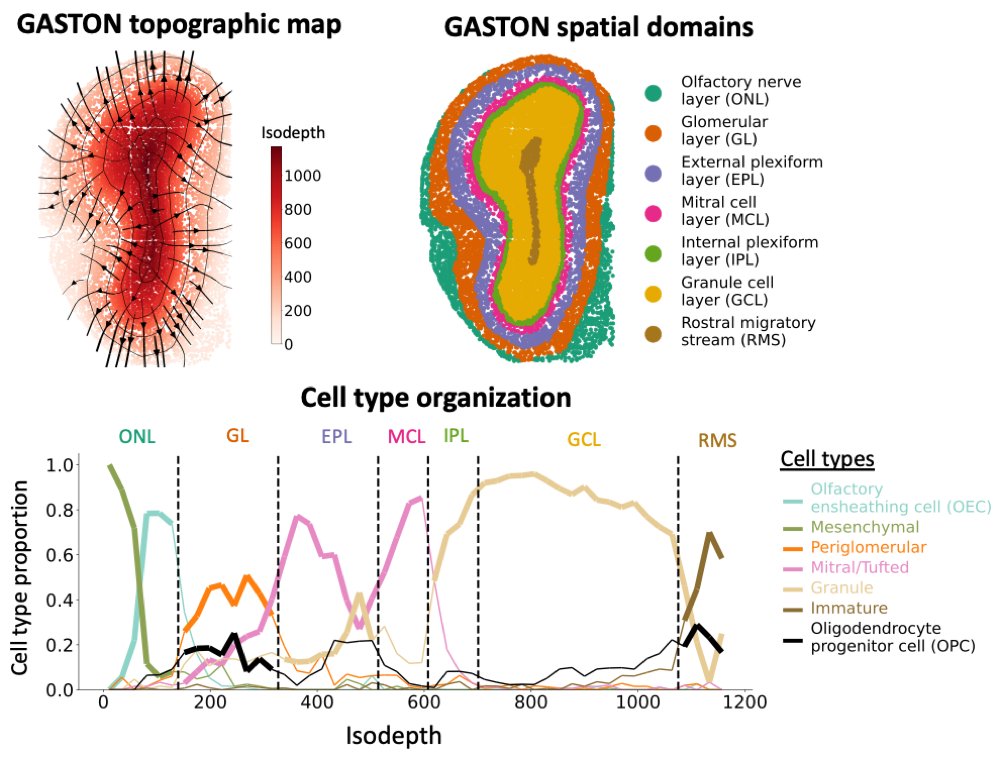
In the olfactory bulb, the GASTON isodepth indicates the “differentiation potential” of neurons – with isodepth gradients showing trajectories of neural maturation. Moreover, GASTON reveals the distinct layers and cell type gradients within the layers. (6/7)
Consider this great opportunity to submit algorithmic or analysis cancer comp bio contributions to present to the phenomenal @RECOMBconf community and to be considered for PLOS CB! Deadline extended but happening soon!
Belayer first appeared @Recomb2022 and in preprint form (https://t.co/yYoQrRTHQ2). Excited to be one of several exciting papers in the “Focus on #recomb2022” special section in @CellSystemsCP 6/6
Spatial transcriptomics meets complex analysis – our new method Belayer models spatial gene expression in layered tissues, now published in @CellSystemsCP. Work led by @Cong992 and @uthsavc with Shirley Zhang. 1/6 https://t.co/OV0Fq0Hsyo