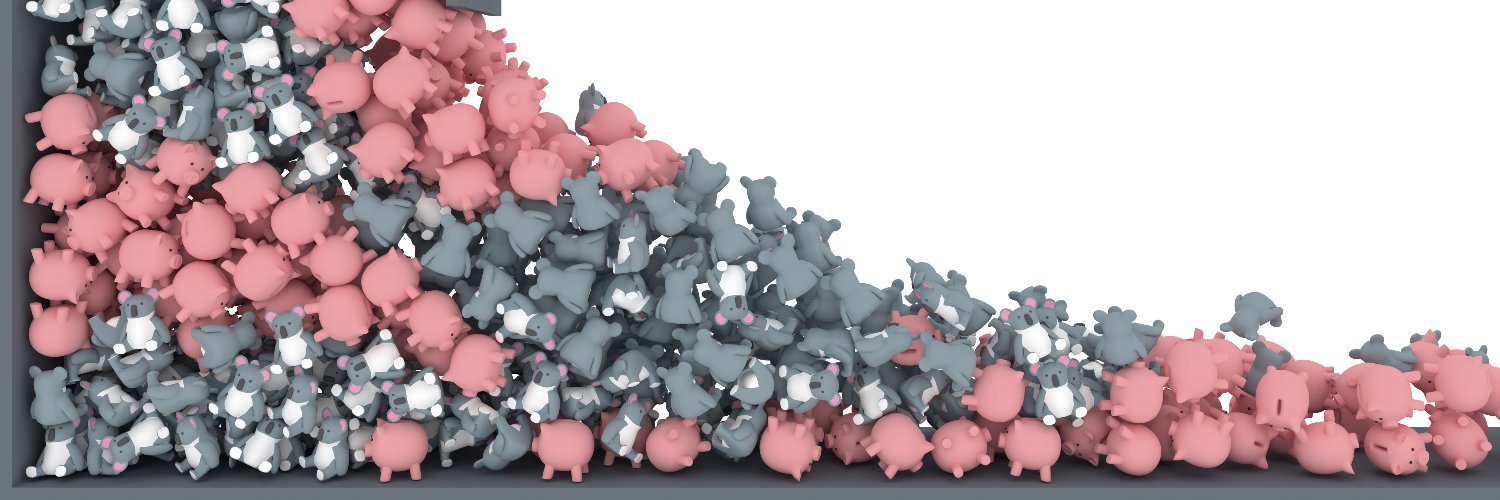
Grain Days 2022! Registrations closing soon. Doctoral School: PhD students and colleagues, learn new tools and skills from @IEinav, Giang Nguyen and Antoinette Tordesillas; visit the @ausynchrotron, meet new friends (all nearly for free!!!) https://t.co/kZKI1BlR2K
Is there some way to complain about ARC expert reviewers? Got this lovely jewel in a recent application "...it is concerning that some top 10 publications include topics in education, rather than research outputs relevant to the project". I guess I can only research one thing...
*Grain Days 2021 - 29-30 Nov* Let us learn (a bit) about how to deal and analyse granular systems and about the amazing research by our graduate researchers. https://t.co/7N93o9jNfe
Have you ever done triaxial testing and wondered how to correct for the effects of the membrane? The latest paper at https://t.co/JlAZoZ3TXw by Andrzej Niemunis and Lukas Knittel proposes a simple procedure for "Removal of the membrane penetration error from triaxial data"
At https://t.co/JlAZoZ3TXw you can read the latest paper by Kateryna Oliynyk and Claudio Tamagnini about a new "Finite deformation hyperplasticity theory for crushable, cemented granular materials"
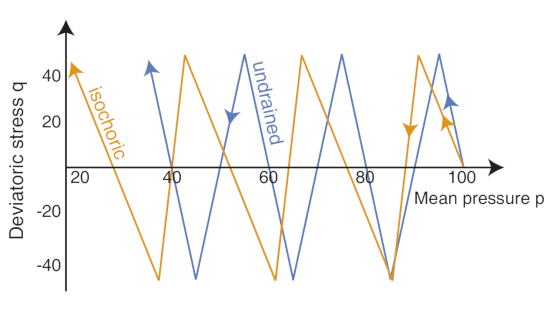
The latest paper in Open Geomechanics describes "A simple method for the determination of sensitivity to density changes in sand liquefaction" by Bozana Bacic and Ivo Herle at TU Dresden. Read it open access here: https://t.co/PqTgLTV2cV
@OGeomechanics@MatteoCiantia@RealJoseAbell Personally I think all of these rankings are a cancer on science and should be banned as soon as possible. Experts know what quality papers and journals are without needing to check JCR.
Done some earth shattering research you want to share with the world? Publish it #OpenSource at https://t.co/JlAZoZ3TXw, where it is free to read and publish.
@Eng_IT_Sydney@lewislehe It's currently just a random walk, but by the time students get at it, it will be modelling based on the city the students build
Dr Benjy Marks from the School of Civil Engineering has built an interactive city environment out of #LEGO in order to project real-time simulations of traffic 🚘 , pollution 💨 and water flow 💦. #usydonline
Ever wanted to listen inside a sample as it is being pulled apart? The latest paper from Robert A. Caulk at https://t.co/JlAZoZ3TXw presents a new, open source method which you can try out yourself that couples image analysis, a discrete element model and the acoustic emissions.
Why reviewers are anonymous when they can see the authors' names? Is there a particular reason for this? It would make sense to remove all the names in a manuscript before sending it to reviewers.
@Peyman_Ayoubi We at Open Geomechanics agree completely! We use a double blind peer review for all papers (reviewers and authors both don't know each other's names) and we also publish those reviews alongside the paper. See https://t.co/JlAZoZ3TXw for examples.
Do you have some groundbreaking research in testing rocks to failure? Share your work #OpenSource at https://t.co/hOJEuKbBKv, where it is free to read and free to publish. We now have three excellent papers published already, and more coming soon! #geomechanics
Head to https://t.co/JlAZoZ3TXw to read the latest work by Fabian Schranz, Wolfgang Fellin and Dimitrios Kolymbas on "Comparative performance of some constitutive models in stress rotation".
@IGT_Fellin@IGT_Kolymbas
In the latest publication in Open Geomechanics, Prof Guy Houlsby introduces "Frictional Plasticity in a Convex Analytical Setting", where he develops a new mathematical terminology to describe plasticity. You can find this paper and more at https://t.co/hOJEuKbBKv.