Sequoia's thesis that the next $1T company will sell work, not software, is the most important reframe in AI right now.
The argument: if you sell a copilot, you're competing with every new model release. But if you sell the outcome — books closed, contracts reviewed, claims handled — every AI improvement makes your margins better, not your product obsolete.
The key insight most people miss: for every $1 spent on software, ~$6 is spent on services.
The entire SaaS playbook was about capturing the software dollar. The AI playbook is about capturing the services dollar — at software margins.
Not "AI for accountants." The AI accounting firm.
Not "AI for lawyers." The AI law firm.
The companies that figure this out won't look like SaaS companies. They'll look like services firms rebuilt on software infrastructure.
That's a fundamentally different company to build, fund, and scale. And most founders are still building copilots.
24 years ago, Brandy released "Full Moon".
It peaked at #18 on the Hot 100, charted in over thirty countries and sold over 2 million units in the US. It has been ranked at number #10 on 'The 100 Greatest R&B Songs' of the 21st Century by Billboard.
Jack Dorsey just fired half his company.
Not gradually but all at once.
More than 4,000 people, gone.
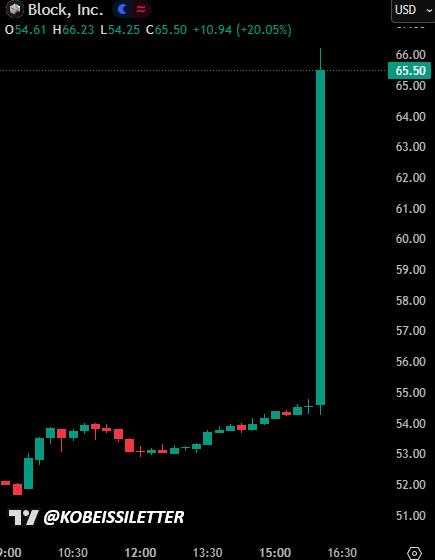
And the stock didn't crash, it EXPLODED 22%.
Here's what's really going on.
Block, the company behind Cash App, Square and Afterpay, just announced the largest AI driven layoff in corporate history.
Headcount is being cut from 10,000 to under 6,000.
This was not a distress signal.
The company is profitable and the revenue is growing.
Dorsey chose this.
His exact words: "Intelligence tools have changed what it means to build and run a company."
"A significantly smaller team, using the tools we're building, can do more and do it better."
Translation: AI can do their jobs now. So they're gone.
But here's the part that should concern everyone.
Dorsey didn't stop there.
He said most companies will reach the same conclusion within a year.
"I'd rather get there honestly and on our own terms than be forced into it reactively."
He's not apologizing but he's warning.
The numbers tell the story Wall Street wanted to hear.
Block's 2026 profit guidance: up 54%.
Earnings per share projection of $3.66, crushing analyst expectations of $3.22.
Gross profit growing 18%.
The math is brutal but simple, fewer humans, more margins.
Inside the company, this has been building for months.
Block already cut 10% of staff earlier this month and 1,000 more last year.
Every remaining employee was required to use AI tools daily.
AI fluency was built into performance reviews.
If you couldn't keep up, you were next.
The internal AI platform is called "Goose."
It started as a small engineering test tool two years ago.
Now nearly every employee uses it.
Engineers are shipping 40% more code per person than they were six months ago.
That's the productivity gain that made 4,000 people expendable.
And here's the part nobody is talking about.
Days before this announcement, a research firm called Citrini published a fictional scenario:
AI tools so powerful they forced mass layoffs across America.
It rattled markets.
Then Block made it real.
Wall Street's reaction is the most dangerous signal of all.
A company fires half its people and stock rockets 22%.
Every board in America just watched that happen.
Every CEO just did the math.
Every worker should understand what that math means for them.
This is not one company's decision, this is a blueprint.
The question is no longer whether AI will replace jobs.
It's how fast.
On this day in 1990: the World Wide Web was first tested.
Tim Berners-Lee and Robert Cailliau set up successful communication between a web browser & server via the Internet.