Big day for @winlow_s and I. Publication of the second edition of our foundational 'ultra-realist' book. The culmination of over 30 years of research. A lot of new research and significant advances in the theoretical framework. And a very robust response to some critics.😁 I must admit, we weren't prepared for these reviews. After 30 years of hard work, I'm allowed to show off for a moment.
"Books like this come along once in a generation...."
"A brilliant paradigm shift...."
"The breadth and depth of their scholarship is breathtaking...."
"The sections on subjectivity are stunning...."
"Two of criminology's most intrepid thinkers...."
"The building blocks of a new and distinct criminological paradigm...."
https://t.co/I63N9ZLAsL?
Out now!
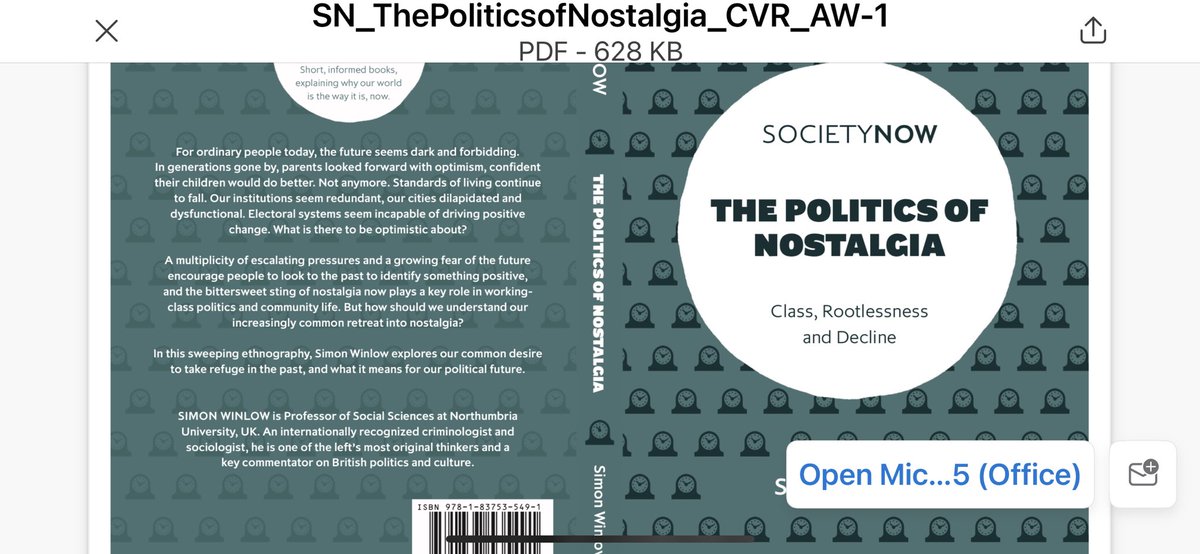
The Politics of Nostalgia: class, rootlessness and decline
£17.99 but you can get 30% with the code EME30 on the Emerald website:
https://t.co/CC8dUOp6eN
New #SocietyNow book out now! The Politics of Nostalgia: Class, Rootlessness and Decline by Simon Winlow explores our common desire to take refuge in the past, and what it means for our political future. Find out more here: https://t.co/do3BNpvUHV
Hello @afneil. You're not an economist - as far as I know you have neither academic nor work experience in the field - so I'll keep this very simple for you. Tax and borrowing do not create money. Governments and chartered banks create money out of thin air every day. Even on the gold standard they did this, but in a more limited way.
Governments and banks constantly take some of this money out of circulation through taxation, capital repayment and interest payment, which helps to control inflation, currently at a very manageable low of 2.5%. The money in circulation creates effective demand and either maintains or increases the supply of goods and services. Increasing goods and services means the country is getting wealthier and more money can be circulated.
Inflation cannot occur until sellers raise prices. We could double or triple the money in everyone's pocket tomorrow, but nothing would happen until prices go up. Sellers raise prices abruptly when they encounter supply problems, but they edge them up all the time to increase profits and attract private investment.
Inflation is always supply-side. To say it is demand led by 'printing' too much money is completely wrong. At a push, we could say it is demand-enabled, but the HUMAN DECISIONS to raise prices have to be made by sellers when they see more money around, with investors looking over their shoulders. The sellers belief that it's 'human nature' and, anyway, they have an inalienable right to get as much money as possible for their assets is the cultural and ethical justification for their actions.
There are complications, but I'm keeping it simple so you can understand it, do your duty as a broadcaster, admit you're wrong and broadcast the truth from now on. While I'm in a ludicrously hopeful mood, I'd also like you to tell the truth about Israel and other stuff, too. Thank you. https://t.co/ZiZffyxIRy
The world is run by economic illiterates and liars. The 'deficit' is simply the amount of currency in circulation that hasn't been taxed back. There are two ways to issue sovereign currency - government spending/investment or private bank loans. The first is interest-free, the second interest-bearing with interest trousered by the private lenders. Milie is simply swapping public debt for private debt. If the private debt is FDI in dollars, he's helping dollar domination, locking Argentina into the global finance system and making Argentinian debt more difficult to pay back. His solution will be more austerity. https://t.co/fzDtGTKnAr #MMT #Milei #Argentina
"[T]he entire point of an “independent” central bank is to defeat any economic program that serves the people to the inconvenience of Big Finance."
- Jamie Galbraith
https://t.co/7vfftoVUvn
In my latest @compactmag I explore the leftwing case for sovereignty and economic self-determination in the international system as presented in Wolfgang Streeck's new book, Taking Back Control?https://t.co/mHSd7Zk3az
Milton Friedman was a liar who used aggregates to mask differentiation. Backsliding in 2003 doesn't exonerate him. In reality, inflation results from a power-struggle in a competitive investment environment over who can raise prices fastest. Twas ever thus https://t.co/qkcyr4TzvJ
Price-gouging after a disaster is good, because the poor mob will hoard! But no quotas, that will stop the rich from hoarding. And of course, we're reaching a point where shortages will no longer be temporary, and the poor's sacrifice will be permanent. https://t.co/bfdS1Cr2O4
Michal Hudson is our best economic historian. Here he explains why it's not governments that enslave people, it's the creditor class. lt's been this way for a very long time. The function of neoliberal propaganda is to reverse this reality in our minds. https://t.co/Neo1jnjpQA
Tired of hearing that 'special liberty' is just repackaged 'techniques of neutralisation'. Entirely different. The former is about deregulated immorality, the latter lapsed morality. All these misunderstandings will be corrected! New edition out next year! https://t.co/HIgKLECuHH
Pleased to report my new book will be out soon - the first from my @LeverhulmeTrust funded project, The Politics of Nostalgia…
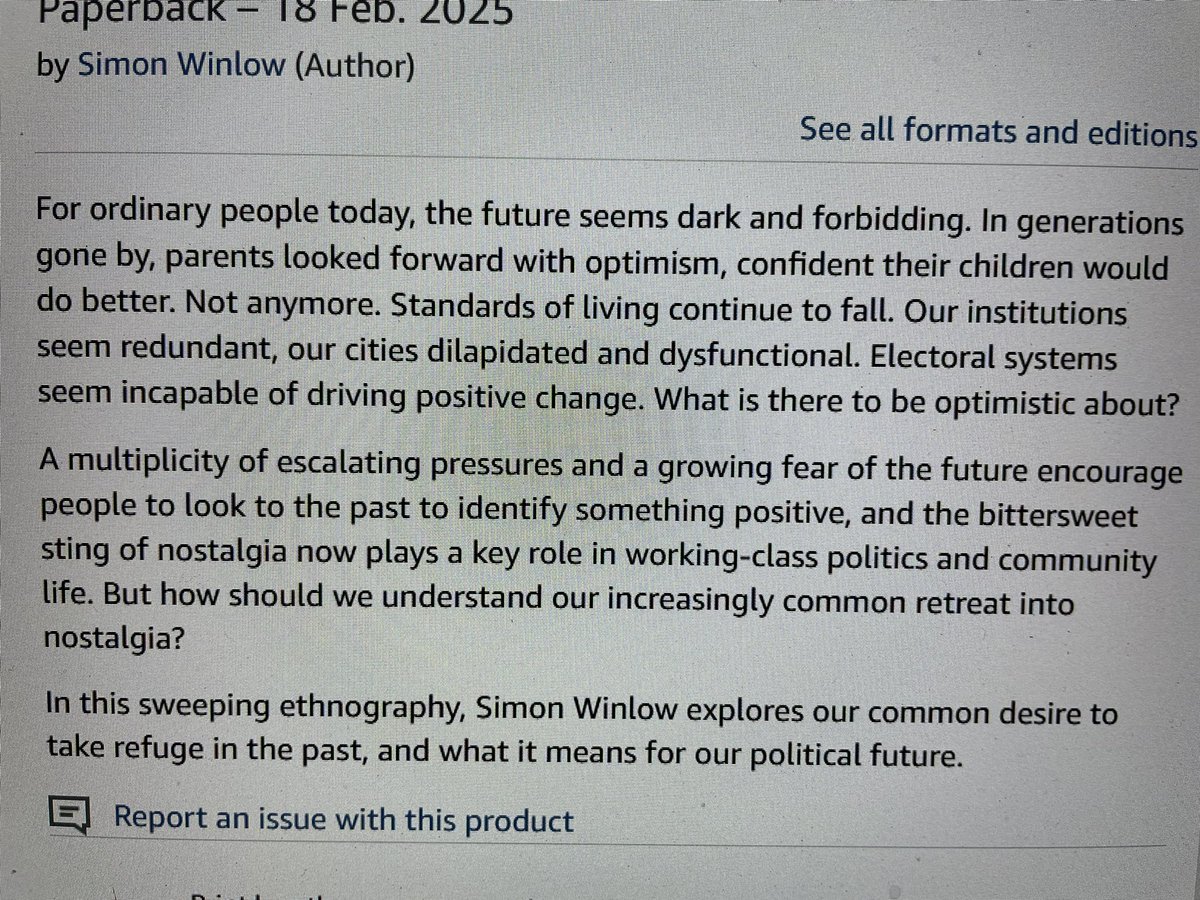
‘In generations gone by, parents looked to the future with optimism, confident their children would do better. Not anymore…
https://t.co/CC8dUOp6eN
I couldn’t even tweet yesterday when I saw the results in Thuringia and Sachsen.
This was so predictable.
Germany is sleep walking into the abyss, while insisting on a balanced budget in the middle of the worst economic crisis since the 1990s.
On the recent riots, by me @ProfHall1955 and @James_Treadwell
Riots, inferiority and the absence of genuine politics.
Free to read here:
https://t.co/Txxe2HdvXv
New article in BJC by Justin Kotze addressing Special Liberty. Useful read for criminologists seeking ideas for understanding harmful behaviour throughout the social structure.
https://t.co/V7n6oughyL
In the UK election the true left was again marginalised. Our book explains 21 major issues we must address to rebuild a left fit for the C21.
3. Globalism, deindustrialization, consumerism, cheap imports, asset inflation, bad loans and the big crash.
https://t.co/v6oYl0Sjky
I've written about Labour's plans to rebuild Britain for BlackRock - not just privatisation of every day life, but a surrender of the social contract with citizens.
https://t.co/Ra88iKr5eG
Free trade has contributed to the disappearance of small farms and growing corporate consolidation of agriculture in the EU, created dangerous import dependencies and is now also threatening Europe’s long-term food security.
My latest for @compactmag:
https://t.co/oSMlFUPPBY