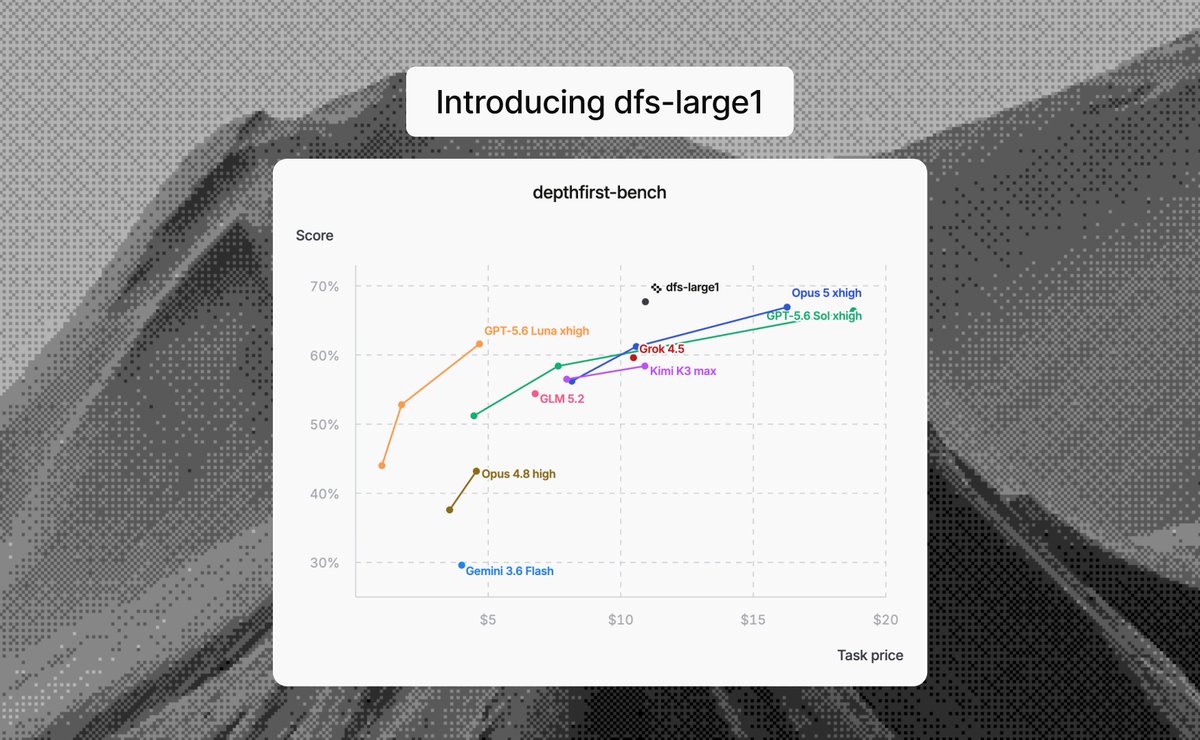
Today we're announcing dfs-large1, our newest cybersecurity model that achieves best-in-class performance on vulnerability detection tasks.
Besides frontier AI labs, only a handful of companies have built specialized models that reach the state of the art in their domain. We're proud to be the first to do it for cybersecurity.
dfs-large1 is built on GLM-5.2 and post-trained with reinforcement learning inside depthfirst's security infrastructure. We evaluated it on depthfirst-bench, our benchmark of long-horizon vulnerability discovery across complex repositories, where it achieves best-in-class performance.
Training improvements have not plateaued yet and we expect additional performance gains as we continue training.
A huge thank you to @FireworksAI_HQ for being an outstanding training partner. Their infrastructure enabled us run large-scale reinforcement learning efficiently and iterate much faster.
dfs-large1 is now in preview within the @depthfirstlabs platform
@borrowed_ideas That is surprising. Though I think when people imagine ASI’s biological breakthroughs, they figure that curing disease also goes hand in hand with slowing aging by making the body more robust (DNA repair, organ replacement, etc.)
@jachiam0 The US is incredibly transparent wrt cyber incidents. I’d imagine the level of penetration of chinese + russian systems is way deeper, they would just never in a million years publicize them
@jukan05@AndrewCurran_ I thought one of the major strengths China had wrt AI was their consolidation of high quality data sources that the government would provide to its national champions. I remember that being a talking point a few years ago
Today, we’re introducing issue ingestion in depthfirst. Security teams can bring findings from scanners, bug bounties, or external audits. depthfirst agents check each finding against your current code and explain whether it’s exploitable. They also merge duplicate reports into one issue and rate severity using your organization’s threat model.
Issue ingestion is now in public preview via the depthfirst UI, REST API, and MCP.
Read the blog: https://t.co/mL1eoxz0Ka
@c_valenzuelab I think the fears of overbuilding data center capacity will age the same way. Like being concerned we’re going to have a glut of oil back in the early 1900s
Today, we’re disclosing phpAfterShell (CVE-2026-126714), a critical vulnerability in PHP discovered by depthfirst researchers using the depthfirst platform using a combination of models including our in house model.
The vulnerability affects how PHP handles file-based sessions. Under default configurations, an unauthenticated attacker could exploit it to execute code on the server. It has a CVSS v4.0 score of 9.2.
We reported the issue privately to the PHP team and worked with the maintainers on developing the patch. We recommend upgrading to the latest patched version of PHP as soon as possible or turn off session upload progress as a temporary mitigation if upgrading requires more time.
To help organizations assess their exposure, we’re offering language runtime scans of repositories and container image scans to identify potentially vulnerable PHP versions. Our team can also help assess temporary mitigations for organizations that can’t upgrade immediately.
Read more about phpAfterShell and request a scan: https://t.co/7j9iC9mOwG
Technical writeup: https://t.co/Hm7ZtmShXJ
CVSS 9.9 in Oracle Database. Oracle just patched CVE-2026-114819, which I reported. Chained with a GraphQL bug I disclosed in October, it turns an exposed HTTP endpoint into command execution on the database host.
Then I wondered if Oracle was the exception. It wasn't. PostgreSQL and MySQL both fell to full RCE from the lowest-privilege accounts you can create.
These were meant for Pwn2Own, but we failed to register. So you get the write-up instead.
https://t.co/2wwTLdt0Ns