Love this quote: "Never doubt a small group of thoughtful, committed citizens can change the world." We got this picture on last Sunday #NationalYangGangDay event in front of Human Right Museum. This is call out the history we #YangGang are making. #Yang2020
If the 22nd Amendment were repealed, enabling Donald Trump to seek a third presidential term, would you support him with your vote?
A. Absolutely yes
B. Nope
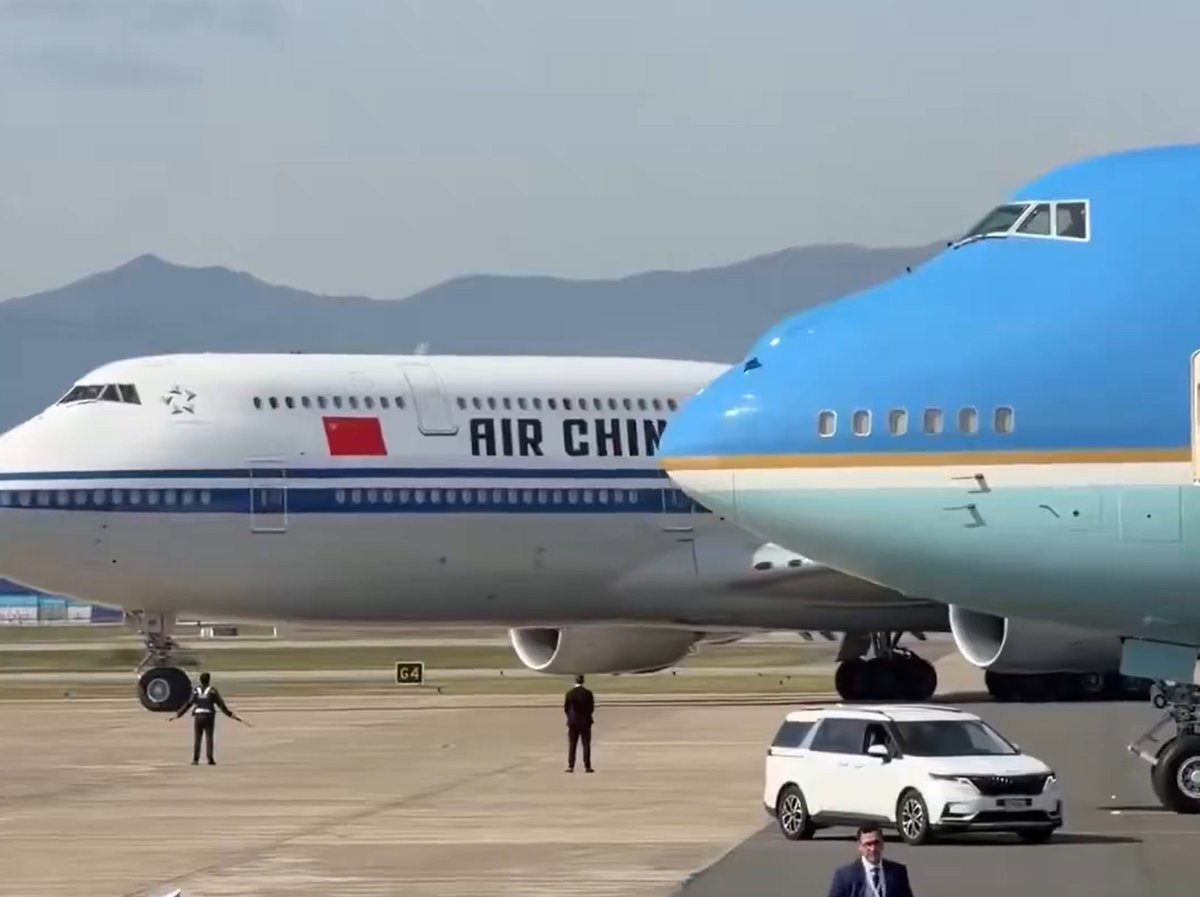
President Xi Jinping arrived in Busan after after 9:00 am Beijing time on Oct. 30, and held a meeting with President Trump at the airport. I think this marked their first face-to-face conversation since the G20 Summit in Osaka in the summer of 2019. According to video clips released by the White House and others at the beginning and end of the meeting, the talks lasted about 100 minutes. After the meeting concluded, Trump departed for Air Force One to return to the United States.
As of now, I have not seen the White House release a readout of the meeting. However, China issued an official press release three hours ago. I've carefully reviewed that statement by paragraph (the italicized text represents full translations from the official Chinese press release) and here's my analysis of what it really tells us.
-- Xi Jinping pointed out that under the joint guidance of both sides, China-US relations have remained generally stable. The two countries being partners and friends is what history has taught us and what reality needs. Given the differences in national conditions, it is natural that China and the United States, as the world's two largest economies, may from time to time have disagreements or frictions. That is perfectly normal. Faced with winds and waves, as the helmsmen of China-US relations, the two heads of state should steer the right course and keep the giant ship of bilateral relations sailing steadily forward. Xi said he was ready to continue working together with President Trump to lay a solid foundation for China-US relations and to create a favorable environment for the development of both countries.
The phrase "joint guidance of both sides" highlights the decisive role that both heads of state play in maintaining the strategic stability of bilateral relations. It also underscores China's emphasis on high-level communication and strategic coordination.
The notion that "the two countries being partners and friends" implies that China and the United States have a proven record of successful cooperation, from their alliance in WWII, to coordination during the late Cold War, to decades of mutually beneficial trade. It conveys that bilateral cooperation was viable in the past and remains essential nowadays.
The expression "steer the right course" stresses the responsibility of major powers to act from the perspective of global stability and people's well-being, rather than being trapped in short-term disputes. It also hints at the pivotal role of national leaders in providing strategic guidance and managing risks.
-- Xi emphasized that China's economy maintains a strong momentum. In the first three quarters of this year, GDP grew by 5.2 percent, and the country's total imports and exports of goods increased by 4 percent, achievements made through overcoming internal and external difficulties, which do not come easily. China's economy is like a vast ocean-large in scale, resilient, and full of potential. We are confident and capable of addressing all kinds of risks and challenges. The 4th plenary session of the 20th Central Committee of the CPC has reviewed and approved recommendations for the country's economic and social development plan for the next five years. Over the past seven decades, China has followed a consistent blueprint and worked generation after generation. It has never sought to challenge or replace anyone, but has focused on running its own affairs-becoming a better version of itself and sharing development opportunities with the world. This is a key to China's success. China will further deepen reform and expand high-level opening-up, strive to achieve qualitative improvement and reasonable quantitative growth in its economy, promote all-round human development and common prosperity for all its people, and that this will also open up broader space for China-US cooperation.
Xi's introduction of China's recent development achievements was, in essence, a response to international speculation about the Chinese economy having "peaked," "slowed," or being "decoupled" and in a "crisis." China will launch its 15th Five-Year Plan in 2026, and the guiding recommendations were just approved last week. The plan sets out new measures and targets across a wide range of areas, including science and technology, advanced manufacturing, ecological protection, and people's livelihoods. Five years ago, China announced a long-term goal of achieving the per capita GDP level of a mid-level developed country by 2035.
If China has any ambition, it is to deliver a better life for its people and earn more international respect. Yet in recent years, narratives accusing China of seeking to replace the United States or to pursue global hegemony have become increasingly loud. By outlining China's consistent planning over the past seven decades, Xi once again sought to clarify this misunderstanding: China is a long-term, predictable, and reliable partner. It does not aim to challenge the United States or become the "next hegemon." Instead, it cares about managing its own affairs and contributing as an active participant, respected partner in global development.
Xi also noted that China's continued growth will create broader space for China–US cooperation. In my understanding, examples such as Tesla's manufacturing operations, pr Apple's strong sales, or Starbucks and McDonald's on almost every corner in China, illustrate this potential. As China's middle-income population expands and its consumer market grows, it will offer more tangible business opportunities, for US companies, and for enterprises around the world. Both peoples can lead better lives.
-- Xi noted that the economic and trade teams of both countries have had in-depth exchanges on important trade issues and reached consensus on resolving key matters. The teams should promptly refine and finalize follow-up measures so that agreed consensus can be maintained and implemented. Concrete results should provide "a reassurance pill" for both economies and for the world at large. Although recent twists and turns in bilateral trade relations have brought insights for both sides, economic and trade cooperation should continue to serve as the ballast and propeller of China-US relations, not a stumbling rock or conflict flashpoint. Both sides should focus on the big picture, look to the long-term benefits of cooperation, and avoid falling into a vicious cycle of tit-for-tat retaliation. Both negotiating teams continue discussions in the spirit of equality, respect, and reciprocity, narrowing the list of problems while lengthening the list of cooperation.
This part indicates that China has no intention of continuing confrontation, but rather hopes to restore stability through dialogue. The phrases "in-depth exchange of views" and "reached consensus on resolving key issues" suggest that the economic and trade teams of both countries have already achieved a decent degree of understanding. The message also implies that the US side should value the progress made in negotiations and avoid back-and-forth reversals-a gentle reminder against potential policy flip-flops in Washington.
The statement that "recent twists and turns in bilateral trade relations have brought insights for both sides" implies that the trade war and "decoupling" strategies were not successes but costly lessons. In diplomatic language, it is a subtle way of saying that both nations have paid a price and that it is time for the US to return to rationality and cooperation.
-- Xi stressed that dialogue is better than confrontation. All channels and levels of communication between China and the United States should remain open to enhance mutual understanding. The two countries have bright prospects for cooperation in combating illegal immigration and telecom fraud, countering money laundering, artificial intelligence, and the fight against infectious diseases. Their respective agencies should strengthen dialogue and carry out mutually beneficial cooperation. On regional and international affairs as well, China and the United States should engage in positive interactions. The world today still faces many difficult problems. China and the United States can jointly demonstrate the sense of responsibility of major powers and work together on more major, tangible, and beneficial projects that serve both nations and the world. Next year, China will host the APEC Economic Leaders' Meeting, and the United States will host the G20 Summit. The two sides can support each other to ensure both meetings achieve positive results and jointly contribute to promoting global economic growth and improving global economic governance.
The phrase "all channels and levels of communication between China and the United States should remain open to enhance mutual understanding" is a call to restore full-spectrum dialogue mechanisms between the two countries, for me encompassing diplomacy, the military, law enforcement, and economic affairs. In response to the recent suspension of high-level contacts and the almost freezing of military exchanges, China has proposed a clear pathway toward resolution, demonstrating a proactive attitude aimed at reducing the risk of miscalculation and rebuilding mutual trust.
The APEC Economic Leaders' Meeting and the G20 Summit hosted by China and the United States respectively in 2026 offer valuable opportunities for reciprocal visits by the two heads of state. Both sides should seize these opportunities to deepen engagement and maximize their impact.
-- President Trump stated that he was honored to meet with President Xi. China is a great country, and President Xi is a great and highly respected leader as well as his long-time good friend. They have had very pleasant interactions. The relationship between the United States and China has always been good and will get even better in the future. He hoped for an even brighter future for both countries. Trump noted that China is the United States' largest partner, and together the two countries can accomplish many great things in the world. Looking ahead, he said he is confident that US-China cooperation will achieve even greater success. He also said he welcomes China's hosting of the 2026 APEC Economic Leaders' Meeting and looks forward to the success of both the APEC and G20 summits.
The two heads of state agreed to strengthen cooperation in areas such as economy, trade, and energy, and to promote people-to-people exchanges.
They also agreed to maintain regular communication. Trump expressed his anticipation of visiting China early next year and extended an invitation to Xi to visit the United States.
Trump's remarks were generally positive. He described China as the United States' "largest partner" and expressed confidence that future China–US cooperation would achieve even greater success-a message that leaves ample room for further deepening of bilateral ties. In addition, Trump said he looked forward to visiting China early next year. Given that the APEC summit will take place later in the year, this suggests he may visit China twice in 2026, a development of considerable symbolic significance.
The China-US relationship, like a giant ship, has seen rain and sunshine. What matters now is whether the two countries can steer it steadily with foresight and responsibility, guiding it toward the vast seas of peaceful coexistence and mutual benefit. So long as China and the United States maintain communication, enhance understanding, and work hand in hand in a rational, fair way, they are fully capable of proving that we are not destined for confrontation, but can co-exist, and even thrive, together.
🇨🇳🇺🇲 Last night, upon arrival to Detroit Metropolitan Airport from Beijing I was held and questioned by customs for hours.
Although I have violated no laws, and by now the US government knows with certainty I am not a terrorist, I was treated as a criminal and asked a series of questions that were absolutely irrelevant to US national security.
What does YouTube have to do with genuine concern over the safety of the American public?
This has become nothing more than a form of harassment and intimidation.
I have been de-facto revoked of my freedom of travel as a US citizen, the purpose is to deter and intimidate me from showing the American public the truth about nations unjustly targeted by our regime.
It appears routine that I would be questioned upon arrival from Iraq or even Lebanon (which I was, on both occasions).
But when I am continuously harassed, held, questioned and my devices seized for traveling to China (or even Canada!) for an academic conference - a country with no recent history of instability or terrorism, it's clear I am being targeted and harassed solely for my opinions and beliefs.
I have violated no laws and by now the most advanced security agencies of the US government have me under constant surveillance and monitoring.
They know with certainty I pose no threat to the safety or well-being of my fellow Americans and that I am not a criminal. They continue to harass me purely as an intimidation tactic.
Has there ever been an "Israeli" harassed this frequently by the US government? Israeli dual citizens and even non-citizens regularly violate US laws, engage in espionage and engage in numerous types of criminal behavior - yet the government turns a blind eye to them.
I am a law abiding US citizen, born and raised here, while being treated as an enemy of state in my own homeland.
Why is the US government so fearful of Americans knowing the truth about China?
The US is not a free country. Freedom of travel and the right to privacy exist only insofar as you do not hold opinions that contradict regime ideology.
You can be fully compliant with the law, but if you hold beliefs contrary to the regime, you are targeted as a criminal.
China is accused of similar "authoritarianism" by our media. Yet China, unlike today's America isn't degenerating into a dysfunctional shithole.
It's a highly functional society making rapid advancements in the people's quality of life.
Meanwhile: My taxes are spent on Israel, amidst crumbling infrastructure, societal dysfunction, and skyrocketing debt.
And my regime targets me as an enemy of state for the simple reason that I strongly advocate for the betterment of my nation and my people.