Georges, the last teacher of the original Aramaic, the language of Jesus, reciting one of his own poems in Aramaic today in Maaloula, Syria, a small village, half Muslim and half Christian, where 750 people still live and which suffered unspeakable cruelty in the last 15 years.
“There is no difference between Christian and Muslim: we are all Palestinian in our predicament”
- a line written by Emile Shukri Habibi in his novel Saraya, the Ogre’s Daughter, 1991
Emile Shukri Habibi was a Palestinian writer, journalist, and politician born in 1922 in Haifa, Palestine 🇵🇸
Considered one of the most important figures in modern Arabic literature and a defining voice for Palestinians who remained in their homeland after the Nakba 1948.
Born into an Anglican Christian Palestinian family whose roots traced back to the Palestinian village of Shefa-Amr, his family had originally belonged to the Greek Orthodox Church before converting to Anglicanism.
In his early life, Habibi worked at an oil refinery and later as a radio announcer, experiences that grounded him in the social realities he would later portray with sharp irony and empathy.
During the British Mandate, he became a leading member of the Palestine Communist Party. When the 1948 Arab–Israeli War began, Habibi was allowed to stay in Haifa and subsequently became an Israeli citizen. After the war, he helped establish the Communist Party of Israel and founded the Arabic-language communist newspaper Al-Ittihad, which became a central platform for Arab political and cultural expression inside Israel.
In 1956, he moved to Nazareth, where he lived for the rest of his life. Although he died there in 1996, his will expressed a wish to be buried in Haifa, and that his tombstone bear the phrase “remained in Haifa,” symbolizing his deep attachment to the city and the idea of steadfast presence.
Habibi played a major political role for decades and a key figure in the Israeli Communist Party (Maki). He served in the Knesset between 1951 and 1959 and again from 1961 to 1972. Later, he broke away with Tawfik Toubi and Meir Vilner to form Rakah. In 1991, amid disagreements over the party’s stance toward Mikhail Gorbachev’s policies, he left the party.
Throughout his political career, he advocated equality, civil rights, and recognition of Palestinians in Israel as a national minority, navigating the complex space between ideology, identity, and lived reality.
His literary work ultimately gave him broader and more lasting recognition. Habibi began publishing short stories in the 1950s, including “The Mandelbaum Gate” in 1954, but turned fully to literature in the late 1960s. In 1972, he resigned from the Knesset to focus on writing his first novel, The Secret Life of Saeed the Pessoptimist (1974), now regarded as a classic of modern Arabic literature.
Using satire, absurdity, and dark humor, he portrayed the psychological and political contradictions of a Palestinian living as a minority citizen in Israel, creating an anti-hero whose survival strategies reflected the moral and political dilemmas of his community. He continued with novels, short stories, and a play, with Saraya, the Ogre’s Daughter (1992) as his final novel.
In 1990, he received the Al-Quds Prize from the PLO.
Emile Habibi’s legacy lies in how he transformed a condition of political marginality into powerful literature. Through irony, satire, and compassion, he articulated the fractured yet persistent identity of a people who stayed, turning personal and collective predicament into art that continues to resonate far beyond his time and place.
Ziad Rahbani, one of Lebanon’s most influential cultural figures and the son of Arab music legend Fairuz, has died at the age of 69
https://t.co/tJsnD9tgNr
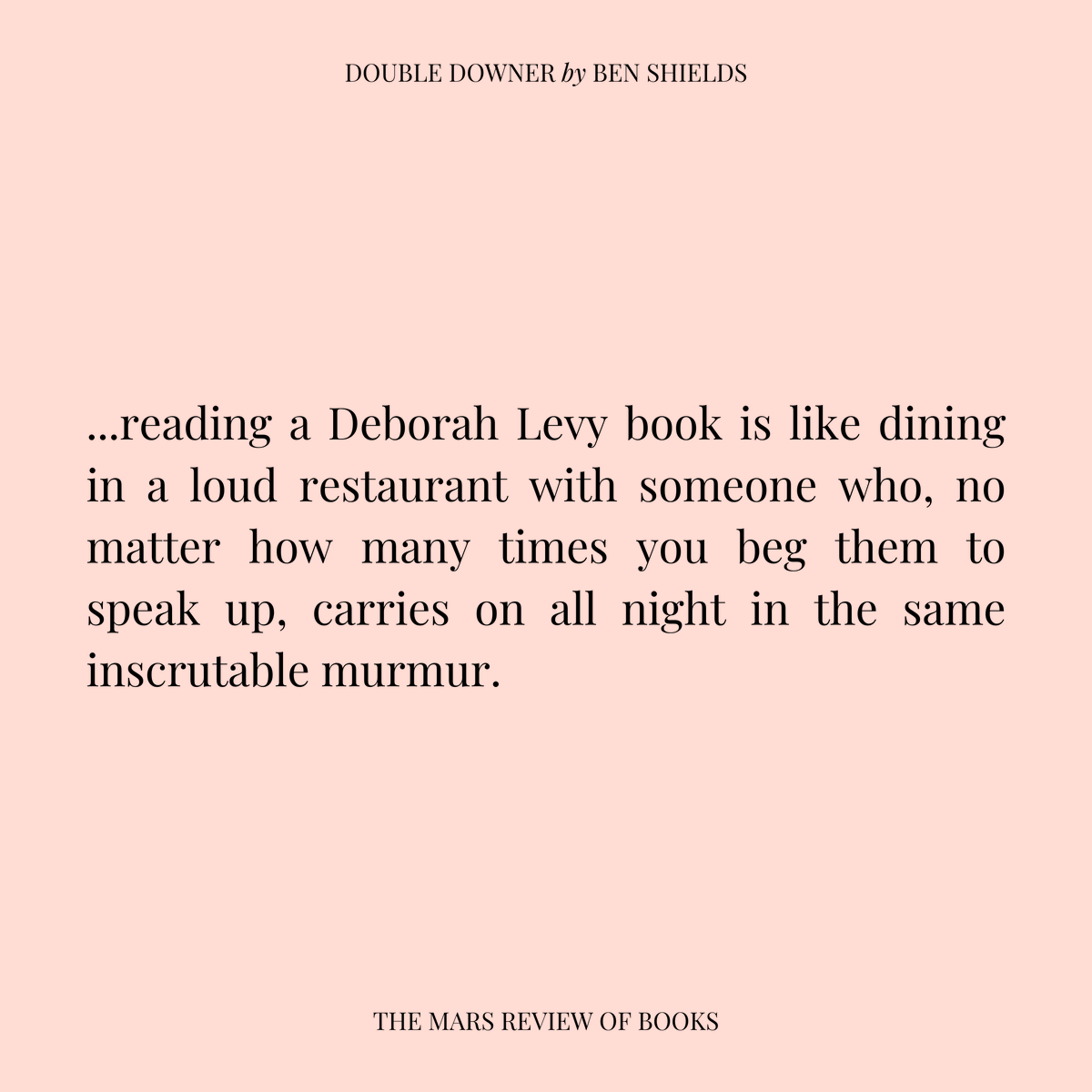
Does Deborah Levy’s August Blue do justice to the rich literary history of the theme of the double? Find out what @benmshields thinks: https://t.co/bmFPI8MIHd
“Perfected over the course of more than a dozen poetry collections, @ElaineEqui’s compositions are a door to a lavish commonplace,” writes Ben Shields. Her latest collection, “Out of the Blank,” “invite[s] us . . . to arrive at a blissful mental stasis.” https://t.co/NO9J9SHNkr
Big thanks to Ben Shields @benmshields and
@Artforum for this sparkling review of my new book, Out of the Blank, from @Coffee_House_ !
https://t.co/2chJGNoR6R
Debunking BS
Surgeon General declared ALL drinking=cancer. They can't read their own data!
Heavy drinkers, 7.2%, cause 75% of cancers.
Allora: Risk ratios are TINY for LIGHT drinkers, offset by a walk in the park listening to Rachmaninov.
Cheers!
New in the Mars Review Fiction Issue:
"The Strange Case of Garth Greenwell" by @benmshields:
Garth Greenwell’s first book, What Belongs to You, succeeded even if his weaknesses were in plain sight. His sense of language so effectively captured abjection and sexual obsession that you didn’t mind whatever else was wrong with it. Greenwell seldom changes register, and he can no more imagine his way into another person's life than the author of your car manual. Yet he’s a born writer, a master at transposing his consciousness onto the page. I understood people’s initial reservations about him: too ornate, a knack for perfectly unsexy sex scenes, a nonexistent sense of humor. But I understood even better the across-the-board raves the book received. Here was something from another time, a Serious Novel you’d actually want to read, a swelling narrative voice whose subject was the nature of passion. I wish What Belongs to You were coming out now. A soaring exercise in style transcending corporate literary accolade magnets, distinct from the nauseating, irony-saturated gameplaying of downtown New York — has there been anything like it since?
His second novel, Cleanness, was respectfully received by reviewers, if more reservedly than the triumphant debut. Actually, depending on whom you ask, it might not be a novel—it might be a story collection, or if you consult Greenwell himself, it might be a “lieder cycle.” While all this gaseous talk of form suggests everything irritating about Greenwell, Cleanness was structurally spry—clean indeed. The chapters stood alone, yet drew life from each other, rescuing the careful prose from feeling overdetermined. But for all that structural sophistication, too many fundamentals went out the window. Both Greenwell’s first two books chronicle relationships with other men. Mitko, the Bulgarian hustler muse of the debut, was the perfect vacuum for the greedy Greenwell treatment. Merely by reading it, you feel like you're the author, methodically, ruthlessly actualizing a sexual fantasy. What Belongs To You worked because it seduced us—never mind that it wasn't actually very sexy. "R," the boyfriend in Cleanness, was on the other hand as captivating as his dreary moniker suggests, an anemic presence strangled by prehensile prose. Beginning in Cleanness, now, too, in his latest, Small Rain, Greenwell’s characters do not get names, just a soggy letter in the alphabet soup of self-consciousness. Quotation marks are dispensed with, soldiering the words of others into conformity with the narration's catatonic drone. Conventional dialogue, like names, risks giving those outside the author's head too long a leash. Since Cleanness, Greenwell runs his imagination like an internment camp, one where the warden's pensive inner monologue must never be disturbed.
Small Rain, the follow-up to Cleanness, isn’t merely bad:
Delighted to see my translation of Victor Heringer's unique & unforgettable The Love of Singular Men shortlisted for the ALTA First Translation Prize - thanks to @LitTranslate & the judges, & congrats to the other writers & translators on the list! @NewDirections@PeirenePress
Just so you know Iran’s weirdo hardliner regime activist, who runs an association dedicated to “Combatting Zionism, Humanism and Freemasons” (really, this is what his org is called literally)… is attacking Kamala Harris on classical misogynist lines