Some of you don’t love your husbands. You love the provision. The moment he can no longer provide, he’s no longer worthy of your love, patience or respect.
You’re no better than the man who only loves his wife while she’s young, beautiful and can cook.
“His name is Ifechukwu Udogu. While I was beating him, he developed convulsions. I rushed him to the hospital but he was declared dead. I buried him here.”
-I just got this VIDEO of a lady in Anambra confessing to beating her maid to death and burying him.
I'm speechless!✍️
Enugu State: Moment a Woman Was Confronted And Be@ten By Angry Residents After She Was Caught Abus!ng a Little Girl Living With Her. Also The Girl Suffered a Serious Eye Injury And Lost Her Eyesight After The Woman Poured Pepper Into Her Eyes. The Girl Also Appeared Malnourished And Had Not Been Properly Fed For Days 💔😢
I may not have kids of my own yet, but I’ve been blessed to play a fatherly role in the lives of many children. Happy Father’s Day to every man showing up, guiding, protecting, and leading.
Lady rescued after 4 years of being Chained and locked inside the house by her Brother Over a Business dispute
A woman was reportedly rescued from captivity in the Mpape area of Maitama Extension, Abuja, after allegedly being chained and locked inside a dark room by her brother for four years following a dispute over a cement business they started together.
According to an eyewitness account, the woman’s brother allegedly declared her mentally unstable and confined her in a room to prevent her from claiming her share of the business.
The situation came to light when a man fetching water near the compound heard unusual sounds coming from a locked room. Alarmed by what he heard, he alerted members of the community, who forced their way into the room and found the woman chained inside.
She was subsequently rescued and rushed to a hospital for medical attention, as she was unable to walk after years of alleged confinement.
The eyewitness further claimed that the woman’s daughter had gone missing and alleged that the brother was responsible for the child’s disappearance alleging that the child may have been used for ritual purposes. However, these claims remain unverified.
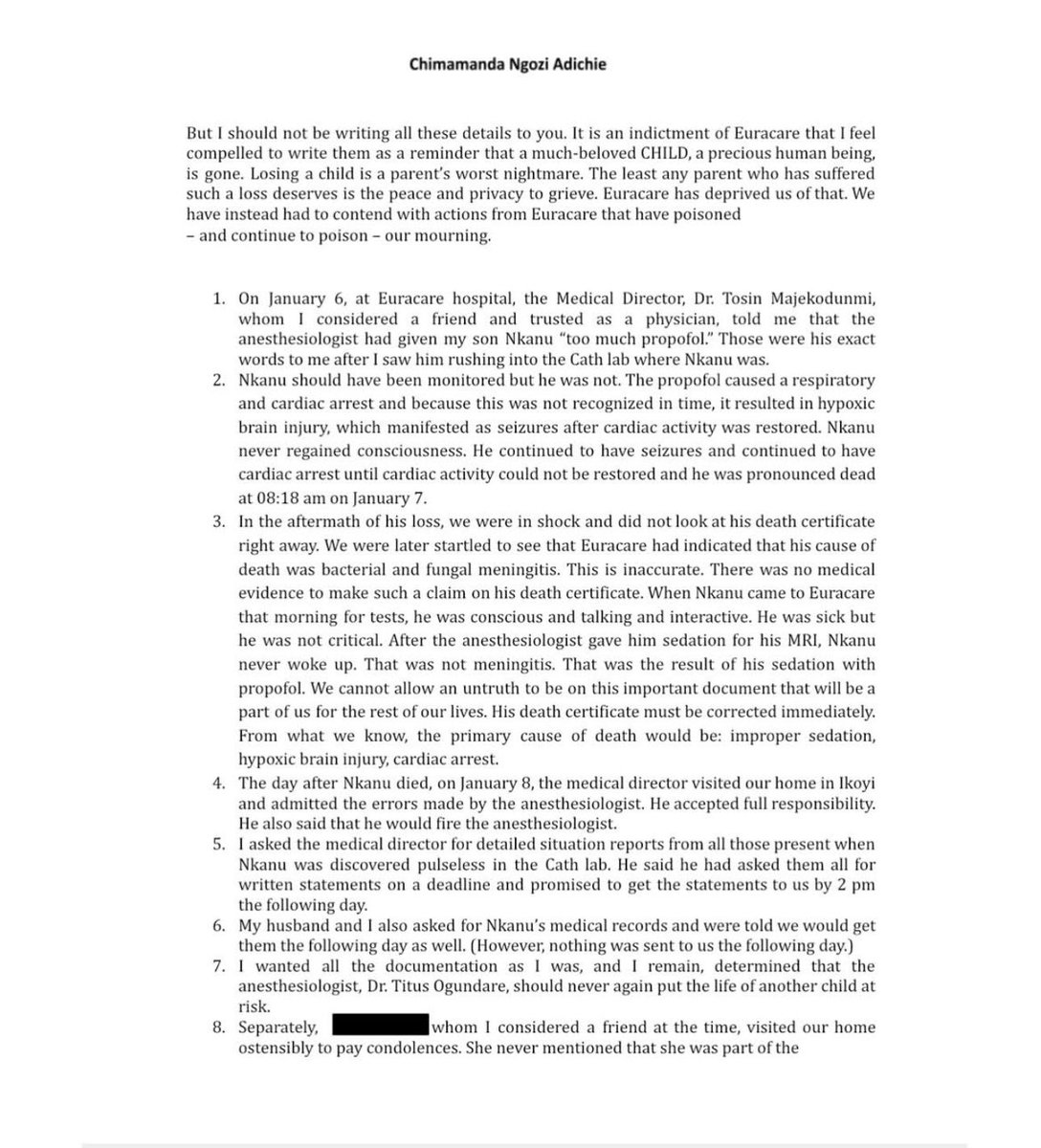
Chief Chimamanda Ngozi Adichie has spoken publicly for the first time following the death of her 21-month-old son, Kanu Nnamdi, earlier this year.
Chief Chimamanda and her husband, Dr Ivara Esege, lost one of their twin sons on 7 January 2026 at Euracare Hospital in Lagos.
The family alleges Kanu died during medical procedures and has raised concerns about possible medical negligence, including the use of sedation and oxygen management. The hospital denies any wrongdoing.
The case is now the subject of regulatory scrutiny and a coroner’s inquest. Reports indicate that some medical personnel have been placed under interim disciplinary measures while investigations continue.
In her statement, Chief Chimamanda described her family’s grief and accused the hospital of attempting to delay or obstruct the coroner’s inquest.
She also renewed her call for justice and accountability as the legal and medical processes continue.
The full circumstances surrounding Kanu’s death remain under investigation, with the findings of the inquest and regulatory reviews expected to determine what happened.
@ChimamandaReal
The brain is designed to learn through constant repetition and active, hands-on involvement. Through such practice and persistence, any skill can be mastered.
OF POSSESSION AND THE POVERTY OF ENOUGH
…The desire to own everything is the beginning of losing what matters
There is something very old in the human need to own things. Not just to use them or to hold them briefly, but to claim them — to draw a line around what is ours and defend it as though our existence depended on the boundary. Perhaps, at some earlier point in the story, it did. But we have carried the instinct long past the conditions that produced it, and what was once a matter of survival has, in many lives, become a kind of compulsion — the accumulation that never quite reaches satisfaction, the fortress that never quite feels safe.
To build from nothing is not a small thing. There is real courage in it, and a kind of philosophical nakedness — standing in uncertainty without the cushion of inheritance or the comfort of a net. That deserves genuine recognition. But I have noticed, in watching lives shaped by early deprivation, that the wound of having nothing can follow a person into abundance and rearrange it. What began as a necessity becomes an appetite. The person who once needed more finds they cannot recognise the moment they have enough, because enough was never quite the point. The point was to never feel that way again.
Enterprise, in itself, is not the problem. At its best, it is one of the more honest things people do — a conversation between what you imagine and what the world will actually permit, between effort and luck and the grace of arriving at the right moment. The problem is when the enterprise tips into compulsion, when expansion becomes reflexive, when the question shifts from what is worth building to what can I still take. That is not ambition. That is fear wearing ambition's clothes.
Discernment is harder than accumulation. Accumulation is, in a way, passive — you simply keep reaching, and things collect around you. Discernment requires you to stop, to look honestly at what you have and what it has cost, and to ask whether the next thing is truly yours to take. Not every open door leads somewhere you should go. Not every resource that is technically available is yours by right. The builders I find most worth studying are not the ones who took the most, but the ones who chose well — who understood that restraint is not timidity but precision, that knowing what not to build is its own form of mastery.
There is a deeper unsettling truth beneath all of this, which is that nothing we call ours ever entirely is. We arrived in languages that other people built and refined over centuries. We walk on land that was shaped and scarred by hands long before ours arrived. The systems we move through — legal, economic, linguistic — were designed by people we will never know, in response to problems we have forgotten existed. Ownership, when you press on it honestly, turns out to be borrowed time with our name written on it in pencil. What remains after us is not the catalogue of what we claimed but the quality of what we left — whether we made anything more honest, more habitable, more possible for those who come after. That is the accounting that matters. And it is never done in our favour simply because we owned a great deal. Value is not in what we take, but in what we leave behind.
Prince S.J. Samuel
April 2026
There’s one uncomfortable truth about Onitsha that many people don’t want to admit…
It’s not just the government.
A lot of the city’s problems are sustained by the people themselves.
Onitsha is built on hustle.
Everybody is trying to survive, make sales, move goods, beat traffic and outsmart the system.
Nothing wrong with that.
But here’s the problem…
That same hustle mindset has slowly turned into:
“Let me get what I want, the system will adjust.”
That’s why you see:
Shops and traders blocking roads
Keke and buses parking anywhere
Drainages filled with refuse
Zero respect for public order
Everybody is contributing… but nobody wants to take responsibility.
We complain about the government—and yes, they deserve it.
But be honest…
How many people in Onitsha actually follow a simple order if it affects their profit or convenience?
That’s the real issue.
Not just lack of infrastructure.
Not just bad leadership.
But a mindset of:
“My survival first, the city later.”
The irony?
Onitsha has the money.
Onitsha has the energy.
Onitsha has the people.
What it lacks is coordination and discipline.
Until we shift from:
individual hustle → collective responsibility
Even the best policies will struggle to work.
This is not even an attack.
It’s just a truth we need to face if we actually want a better Onitsha.
📸 @oyibo_ugbo
A lot of students don’t understand what JAMB ranking really means yet.
And that misunderstanding will cost people admission.
Before now, people asked:
“Did you score 280?”
Now the real question is:
“You scored 280… but what number are you in Nigeria?”
That’s the shift.
Ranking means you are no longer competing against a cutoff mark.
You are competing against millions of other candidates.
So two students can score the same 280:
– One gets admission
– One doesn’t
Why?
Because ranking decides who goes first.
Universities will no longer just look at your score.
They will look at where your score places you nationally.
This changes everything.
It means:
• 240 is no longer safe
• 260 is no longer impressive
• Even 300 is not a guarantee
What matters now is how far above the crowd you are.
This is why students must stop preparing to pass JAMB and start preparing to dominate JAMB.
Read that again.
If you score high and still miss admission, it won’t be because someone cheated you.
It will be because thousands of others scored higher.
That’s the reality of ranking.
This policy quietly changed the game and many students are still playing by old rules.
Share this with every JAMB candidate you know.
It’s better they understand now than cry later.