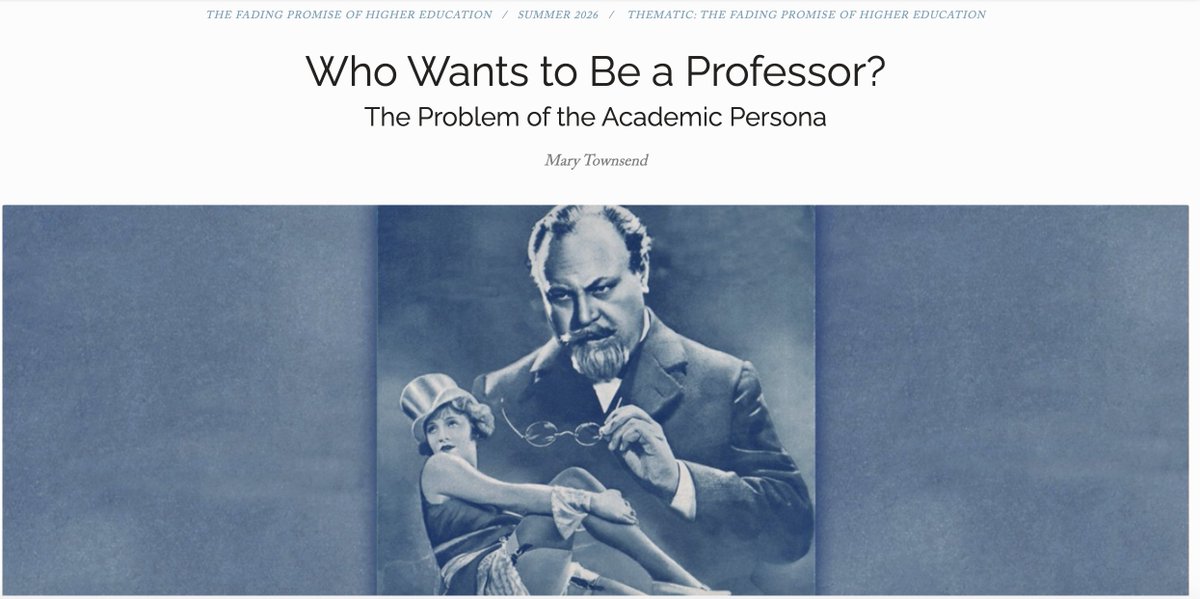
Despite the collapse of the academic career, people still want to be professors—but being a professor seems to require pretending to not want anything at all.
The university often thinks of itself as a defender of Enlightenment values against a rising tide of misinformation. That may be exactly the wrong lesson to draw from its history, argues @bensbernard in this remarkable essay:
@DavidAstinWalsh Idk, this year one of my field’s article prizes is going to a piece that clarifies a lot of stuff in Foucault (…it’s my piece, the person still obsessed with Michel is me 😅).
@BenBrodyDC I’m interested by how the conversation doesn’t seem to be returning to the fundamentals of moral economy, not like “labor policy” or tech policy. Are those big questions getting discussed too?
@BenBrodyDC He says we’re “all in the same boat”; sure, if “we all” work for wages. But some ppl own capital. And if capital replaces their employees with AI bots, then besides some AI jobs, millions of ppl are out of work while the rich are fine. Doesn’t seem like the same boat.
We at @thenewdigest are thrilled to feature a guest essay from Jodi L. Short, the Mary Kay Kane Professor of Law at UC Law, San Francisco, on “The Moral Turn in Administrative Law”. Professor Short includes CGC as part of this trend. Available ⬇️
UC Berkeley has a new policy for alumni where if your Berkeley account has over 5GB stored in it, on Sept 17, they will just delete your whole account. Can you pay for more storage? No.
Paris, août 1792 : des collégiens, accompagnés de leur principal, se présentent devant l'Assemblée nationale pour faire don d'un trésor.
"Vous avez sous vos yeux quatre élèves du Collège du Cardinal Lemoine qui viennent vous présenter le produit d'une découverte...
1/5