You lecturing about “free press” is a joke.
The night Stevens and Sean Smith were killed you pointed at a YouTube video. That same night you emailed your daughter it was an al Qaeda-like group. The next day you told Egypt it was a planned attack, not the film.
Then the public story stayed on the video. The press ran it. Nakoula got locked up on a probation hit after that narrative.
Tyrone Woods’s father said you told him you would arrest the filmmaker for his son’s death.
You used the press to sell a fake protest so an election calendar wouldn’t have to say “terror attack.” Now you call three lost badges authoritarianism.
You spent a career hiding from questions, ranking reporters as friends or problems, and feeding stories to the ones who played along. Your campaign tracked journalists so they couldn’t close to you or ask you anything hard. That is managing the press. Not defending it.
You hid official work on a private server. Comey called it extremely careless. Classified mail went through it.
They can still publish. Other critics are still inside. A door is not the First Amendment. Your record is not a clean conscience.
Hello @DanLamothe:
This is Tom Anderson here. I am the purveyor of the popular social media commentary account, “Cynical Publius.”
I am working on an article regarding the extreme lack of ethical behavior by modern American legacy media outlets such as your employer, the Washington Post.
The Washington Post recently published an article with your byline where the personally identifiable information (��PII”) of certain alleged service providers to the Department of War was publicly revealed. In a separate, private communication you stated that you had obtained all or some of that information via the “Pentagon system.” Since you are a private citizen who has no authorized access to such system, I can only assume that a federal employee (the “Leaker”) provided you with unauthorized access to data from such system.
I was hoping you could answer a few questions regarding this matter:
1. If you solicited such information from the Leaker, did you advise the Leaker that the unauthorized release of PII is potentially a criminal misdemeanor under 5 U.S.C. § 552a?
2. What is the Leaker’s identity? If there is no Leaker, how did you gain access to the "Pentagon system"?
3. Do you have any moral qualms over the popular journalistic practice of soliciting information from a federal employee that could potentially lead to his or her imprisonment?
4. Does your employer condone the practice of journalists soliciting criminal behavior from federal employees? Is this standard practice for the Washington Post?
5. Assuming the Leaker provided you with the unauthorized PII, did you pay the Leaker any money or otherwise make promises of remuneration in exchange for the information you obtained?
6. You have been a vocal opponent of the Pentagon limiting unaccompanied Pentagon access for journalists. One of the Pentagon’s stated reasons for this policy is to prevent journalists from soliciting criminal behavior from federal employees. Do you still oppose limiting unaccompanied journalist access to the Pentagon?
I would be most appreciative if you could provide answers to these questions, as well as any other comments you may have on the matter, by 4:00 pm Eastern today.
Best regards,
Tom Anderson
I bought a box of slides in a Los Angeles warehouse for twenty dollars.
Thanksgiving, 2019.
An antique store was emptying an old warehouse. Inside was a pile of Kodachrome that almost went nowhere. The woman selling it said the slides had belonged to a photographer whose house had been liquidated after he died.
The boxes were addressed to Hugh Stevens Bell.
Bell was born in St. Joseph, Missouri, on January 10, 1899. He served in the Navy in 1918, finished Western Reserve University with honors, edited the campus paper, and worked at the Cleveland Museum of Natural History. He wrote for the Cleveland Plain Dealer, Nature Magazine, and the Journal of Geology. In the 1930s he joined the U.S. Indian Service and then soil conservation work. A son was born in Flagstaff in 1936. He did hydraulic research at Caltech and in 1942 published a USDA study on stratified flow in reservoirs.
National Geographic published his photographs along the way.
He lived out his last years in Sierra Madre and died there in 1989 at ninety.
What I found was not a few snapshots. It was a working life in color.
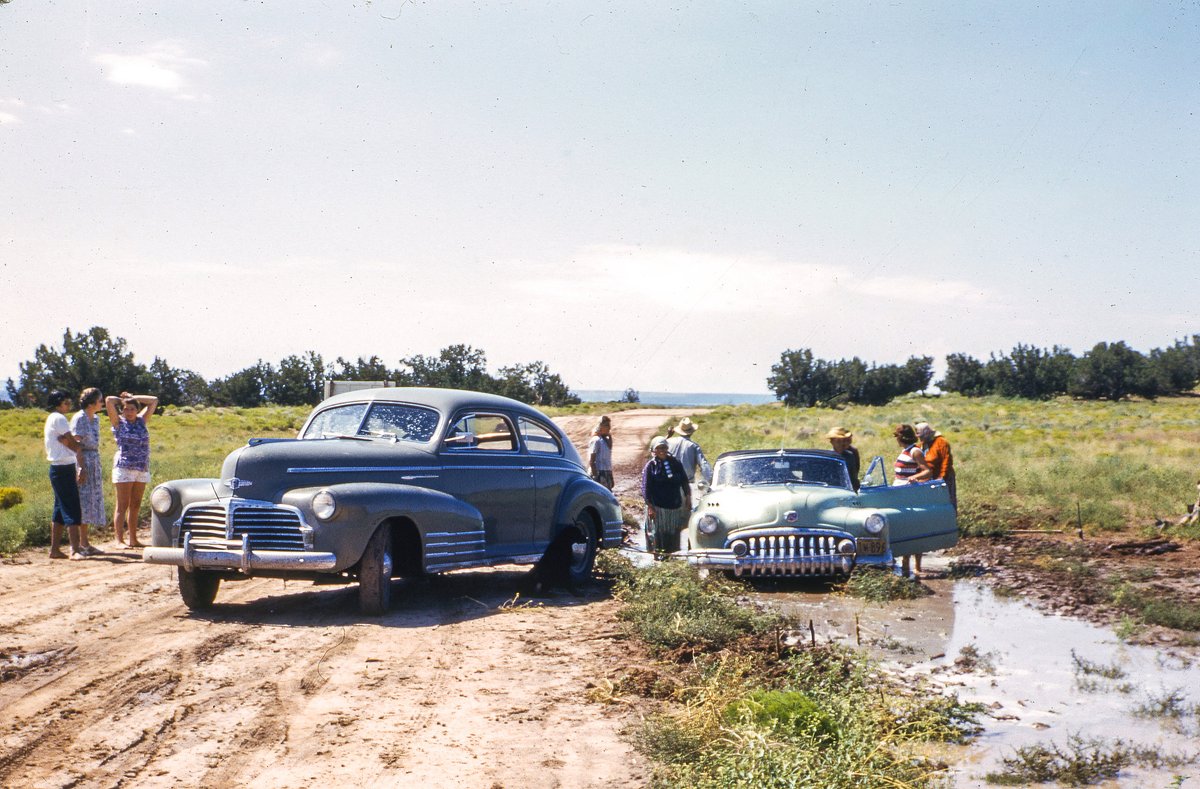
Desert roads. Cars stuck in the mud. Families standing in the sun. Monument Valley. Native communities of the Southwest in the 1940s and 1950s.
Mixed in were the personal frames. His people. His trips. The ordinary days that never make a magazine.
Kodachrome is why these still look alive. The dyes hold. Reds stay red. Skies stay blue. Seventy and eighty years later the film has not faded the way so many other color processes have. You can still feel the heat coming off the dirt.
I scanned them. I put them online. That box is what started my own personal collecting of what I've since learned is called vernacular photography.
Since then I have collected tens of thousands of snapshots, slides and photo albums and organized them into many different digital albums on Flickr.
Everything after that, the estate sales, the lockers, the orphaned pictures, began with the Hugh Stevens Bell Collection, sitting in a warehouse waiting to be thrown away.
Here is one of them.
The full collection is here if you are a fan of the American Southwest you will enjoy this trip back in a time machine:
https://t.co/TmOoHG50Oh