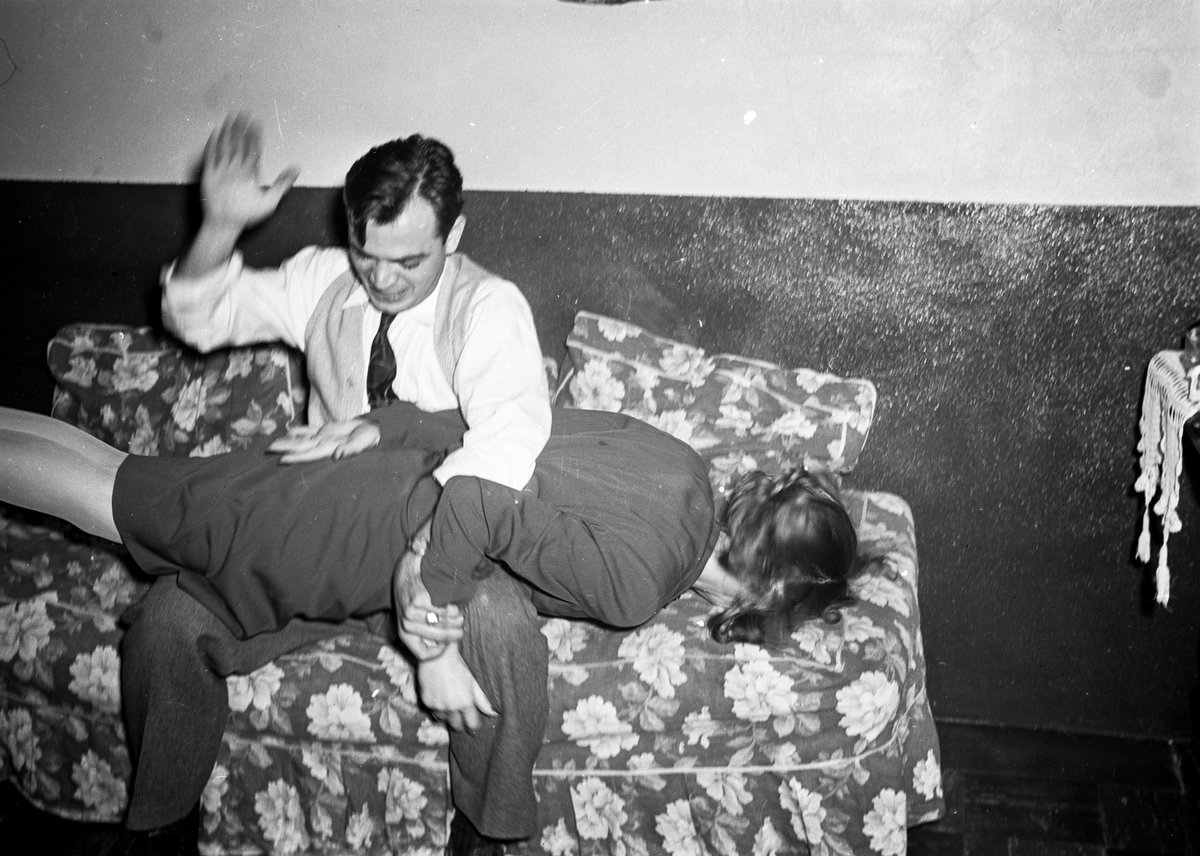
The spanking photo.
I bought this archive of negatives out of Maryland a while back and I have been scanning through it a little at a time ever since. Most of it is ordinary stuff, and honestly that is what I love about it. Porches and kids and cars and people standing around in their good clothes on a Sunday.
And then this one shows up.
He is looking right at the camera and grinning. She is across his lap on this floral couch with one leg kicked way up in the air and his hand is halfway down in a blur.
He has got a wedding ring on. Her face is in the cushions so you cannot see if she is laughing but come on, she got to be laughing, right? Nobody falls into a picture like this. Somebody stopped everything and said wait, get the camera, and then they held it together long enough to actually pull it off.
So some night back in the forties, in a living room somewhere in Maryland, this was the photograph they wanted. Not the wedding and not the baby and not the new car. This one. I do not know what the joke was but they wanted it kept.
And now the negative has outlived all of them. There is no name on the sleeve and nothing written on the back and no way to ask anybody. Just the two of them, mid swing and mid laugh, in a box, waiting for some stranger to scan it eighty years later.
That is why I sit there and feed negatives into a scanner one at a time. Ninety nine frames of nothing much and then a room full of people you will never meet lights up, and for a second they are right there.
I've only found a few old photos of spankings but apparently maybe it was a thing back then. Then again I have taken a few photos of spankings myself, but mostly those photos were taken at the Folsom Street Fair.
I still don't know who these people were but I think there are probably clues in this album. https://t.co/95skLuO7BY
@bilalmahmood When you catch them, will you give them a very stern talking to and then let them chill out in a La-Z-Boy with some free movies and snacks for a few hours?
The spanking photo.
I bought this archive of negatives out of Maryland a while back and I have been scanning through it a little at a time ever since. Most of it is ordinary stuff, and honestly that is what I love about it. Porches and kids and cars and people standing around in their good clothes on a Sunday.
And then this one shows up.
He is looking right at the camera and grinning. She is across his lap on this floral couch with one leg kicked way up in the air and his hand is halfway down in a blur.
He has got a wedding ring on. Her face is in the cushions so you cannot see if she is laughing but come on, she got to be laughing, right? Nobody falls into a picture like this. Somebody stopped everything and said wait, get the camera, and then they held it together long enough to actually pull it off.
So some night back in the forties, in a living room somewhere in Maryland, this was the photograph they wanted. Not the wedding and not the baby and not the new car. This one. I do not know what the joke was but they wanted it kept.
And now the negative has outlived all of them. There is no name on the sleeve and nothing written on the back and no way to ask anybody. Just the two of them, mid swing and mid laugh, in a box, waiting for some stranger to scan it eighty years later.
That is why I sit there and feed negatives into a scanner one at a time. Ninety nine frames of nothing much and then a room full of people you will never meet lights up, and for a second they are right there.
I've only found a few old photos of spankings but apparently maybe it was a thing back then. Then again I have taken a few photos of spankings myself, but mostly those photos were taken at the Folsom Street Fair.
I still don't know who these people were but I think there are probably clues in this album. https://t.co/95skLuO7BY
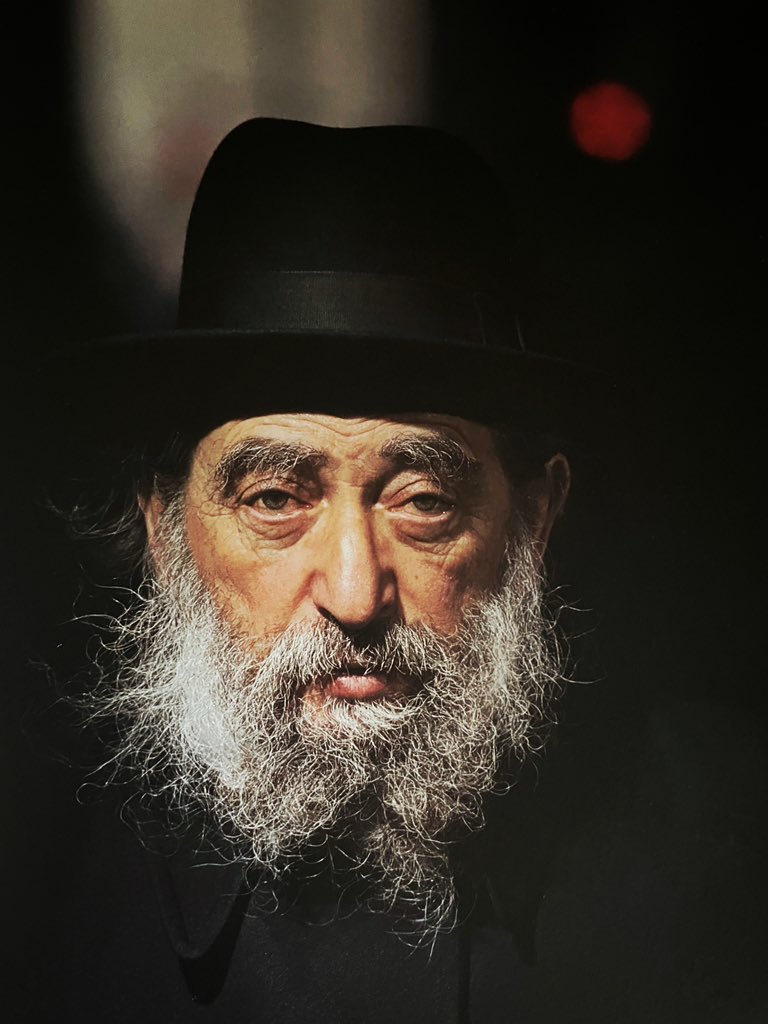
This man never agreed to be photographed.
His name was Erno Nussenzweig, an Orthodox Jewish man walking through Times Square when Philip-Lorca diCorcia made this portrait, one of a series called Heads. No hello. No permission. No release form. Just a stranger's face caught in a burst of light, every hair of that beard lit like wire.
DiCorcia printed it big, hung it in a gallery, and sold copies for $20,000 to $30,000 apiece.
Nussenzweig found out four years later. He was a Klausenburger Hasid, and his faith forbids graven images. He sued in New York, arguing the photograph violated the state's privacy law and his religion along with it.
The case climbed all the way to the Court of Appeals in Albany, the highest court in New York. And the courts held the line. A photograph made as art is protected expression. Out in public, you do not own your own face. No consent needed to make the picture, hang it, or sell it as art. Consent only enters when somebody uses your face to sell soap. The first judge on the case wrote that she believed his distress was sincere. She ruled against him anyway.
Garry Winogrand, probably the most famous street photographer who ever lived, built his entire body of work on never asking permission. Not once. He just shot, thousands of frames of strangers who never knew his name. And Henri Cartier-Bresson summed up the whole approach in one line: "Aim well, shoot fast, and scram!"
I have made thousands of portraits out on the street myself. Sometimes I ask. Some people you can talk to, get a yes, and the portrait is better for it. But other times there is a moment, a look, a second of somebody being completely themselves, and asking would kill it dead. The face arranges itself, the truth leaves, and you are left holding a picture of nothing. So you take the photograph. The unguarded second is the whole reason to be out there.
None of that means Nussenzweig was wrong to be angry. Both things are true at once. He got to be furious, and the photograph got to exist.
Should a photographer need permission to photograph a stranger in public? I know where I stand. Where do you?
Wait, what?
You’re telling me this Andy Duong guy photographed here with @AGRobBonta was not only bribing Mayor Sheng Thao but also had the shit beaten out of some guy, put him in the hospital and stole his watch and chain?
These Duongs are starting to sound straight up gangster.
May 3, 2024 -- a turning point for the alleged pay-to-play scheme for former Oakland Mayor Sheng Thao. This is a photograph taken by Andy Duong and submitted into evidence of the ambulance called for Mario Juarez.
He says a group of men called by the Duongs beat him up, the business relationship had soured that badly. They couldn't get anyone to order their converted shipping containers for the homeless, and Juarez's bills at the plant in Mexico were adding up.
You can see Juarez on the ground, his back to the building, and David Duong standing to the left. Juarez said Andy Duong stole his watch and necklace that day. During the FBI raid June 20th, agents say they found Juarez's watch and necklace at Andy Duong's home. The prosecutor passed the items to the jury today.
@DadaLives Sure. And I’m just saying if someone is soooooo opposed to having their picture taken maybe wear a mask or a burka or something when they go outside. Or maybe even stay in and order door dash.
Not so sure that's true. Art is whatever the artist says it is. Whether some art is illegal or unethical is another matter entirely. I'm not sure I'd say this portrait is not art. Many, many people would consider this portrait art. Something can be dehumanizing and still be art.
@wilso3069549 Actually we don’t have a First Amendment right not to be photographed. There is actually no right granted anywhere in our Constitution not to be photographed.
There is no question it's legal. You seem to be making the case though that despite it being legal it is somehow wrong because of this man's religion, the best I can tell. But I'm suggesting that what about this man's religion trumps another man's religious practice in the public square? Might it not be incumbent on the person not wanting to be photographed to take such precautions should they feel so strongly about their religion. They could wear a mask for example.
So Garry Winogrand and the thousands of street photographers who followed him would not be able to do their art if this was the requirement. Not sure I agree with asking everyone in public to take their photo. If you shoot a scene on a street and there are 12 people in it, do you have to ask all 12? Or do we just say people aren't allowed to do street photography anymore because a few people out there are too fragile with having their picture taken in public.
Richard Prince: Yeah, I just wanted to make sure, if you were going to buy my Catcher in the Rye, you were going to have to pay twice as much as the one Barnes and Noble was selling from J.D. Salinger. I know that sounds really kind of shallow, and maybe that’s not the best way to contribute to something, but in the book collecting world you pay a premium for really collectible books. I thought, we charged, I think on the book flap it’s $62. There’s a certain kind of adolescent thinking there that I can’t seem to get away from. And I don’t know if I should get away from it, but I certainly acknowledge that it might not be the most interesting way to contribute to the making of that particular object, but I like the fact that the price is twice as much. And it’s enough.
@thomashawk Making a "copy" of a published and copyrighted artifact is one thing, maybe to show your friends over wine. Making it to resell is another and the publisher is backed by laws to win in court. Now, if it's in a different country that's another matter.
I photographed this at Pier 24 in San Francisco, at Secondhand, a show built entirely out of other people's pictures. Up front was John Baldessari, being more direct than the show might have been otherwise.
"I really don't think imagery should be owned, including my own. If it's part of our world, it's like owning words. How can you own words? It's just stuff to use."
Baldessari was the godfather of conceptual art, and he did not just talk like this. In 1970 he hauled every painting he had made between 1953 and 1966, about a hundred one of a kind canvases, to a crematorium in San Diego and burned them all to ash. The ashes went into boxes and an urn. Some got baked into cookies. He called it the Cremation Project.
Warhol did his version. He took a hibiscus photograph by Patricia Caulfield, poured his colors over it, and made the Flowers paintings. She sued. They settled.
Richard Prince went further. He screenshotted other people's Instagram photos, printed them huge, added a comment underneath, and sold them for as much as $100,000 apiece. Photographers sued, and this time the courts did not side with Prince. In 2024 the judgments landed: $650,000 in damages to photographers Donald Graham and Eric McNatt, plus $250,000 for their legal costs, the infringement found willful.
Robert Frank, in 1989, drilled straight through a stack of his own work prints from The Americans, bound them in wire, and hung the thing like a crucifixion.
I am not burning anything or drilling anything. But here is where I land. Every photograph I publish is Creative Commons non-commercial. Use one for art, a personal project, a classroom, a non-profit, whatever, just not commercially. Commercial is a different conversation, and people can always reach out.
I wrote this years ago and I still believe it. When I take a photograph it belongs to me while it is in the camera, while I process it, while it waits in a folder. Then I upload it and it is like taking a bird, opening the window, and letting it go. Off she goes. Her song is for whoever hears it. It is no longer only mine.
So what would you do with a photograph once it is out in the world? Should imagery be owned at all, or is it just stuff to use?