@volkswagenindia Hi @VolkswagenIndia, I'm planning to buy the Taigun 1.5 and wanted to understand your 75% buyback policy clearly. Will the policy remain valid if any damage occurs due to ethanol-blended fuel? Appreciate your clarification. Thanks!
@volklub@Trendulkar Hi Sunder Paaji, thanks for posting this. What's your thoughts on Taigun buyback at 75% after 3 years?
In context of ethanol blending, is there a term & condition which one should be aware of?
If not, it's a great insurance against Ethanol blending.
@shubh19 One big thing you missed or mentioned incorrectly intentionally - there was no 80% fall in a session, it's in last 5 years. But yes, a scam is a scam.
Bill Ackman went on a fishing trip in the Tierra del Fuego, Argentina.
His guide was so impressive that Ackman offered him a job at Pershing Square — one of the world's most powerful hedge funds.
The only condition: read 12 books before your first day.
Here are those 12 books. And why Ackman swears by them. 🧵
Greenland just signed away the last 50.5% of the largest heavy rare earth deposit in the Western world. The yellow box on this map shows where it sits. As of April 30, it belongs to a Nasdaq-listed company.
China just lost its biggest chokehold on the United States.
Heavy rare earths are dysprosium, terbium, yttrium, holmium. They're the four elements that let a permanent magnet hold its field at 200°C inside an F-35, a Tomahawk, a Patriot battery, and an EV traction motor. Substitutes don't exist. China processes 99% of the global supply. The headline 85% number covers all rare earths combined. For the heavy ones, where the magnets actually need them, the share is 99%. That's been the single biggest piece of leverage Beijing has held over Washington for two decades.
Tanbreez is the answer. 27% heavy rare earth content. Mountain Pass in California runs 1-3%. Mt Weld in Australia runs 1-3%. Nothing else in the Western world comes close.
Critical Metals Corp now owns 92.5%. Greenland approved the final transfer on April 17. The deal closed April 30. The stock went from under $9 to $13.52 in three weeks. Texas Capital launched coverage with a $20 price target.
The orebody is 8 kilometers wide, 5 long, 400 meters thick, sitting inside the 1.16 billion year old Ilímaussaq Alkaline Complex. The mineralogy is eudialyte, which the industry wrote off as uneconomic because the metallurgy collapsed at extraction. Every prior Greenland rare earth project died on that exact problem. Independent testing at Fremantle Metallurgy in March showed 40% better refined concentrate recovery. The chemistry problem just got solved.
Logistics are stacked. License valid until 2050. Deepwater fjord shipping into the North Atlantic year-round. New international airport 12 km from site. A $120 million EXIM Bank letter of intent already in. Pilot plant commissioning this month. First production targeted for 2028, scaling 85,000 tonnes per year up to 425,000.
Three-quarters of the concentrate is already pre-sold. The biggest piece is a 10-year offtake to Ucore in Louisiana, feeding directly into US defense magnet supply.
Greenland to Louisiana to the F-35. America just took the magnet supply chain back.
@vtchakarova The 1970s oil shocks drove the world toward coal and nuclear. History is about to repeat itself. Demand destruction will remain a short term phenomenon.
The euphoria is over. Time to buy.
S. Naren is officially bullish—first time since the COVID crash.
Valuations are reasonable. Equities are flashing green.
The new playbook:• Returns reset to nominal GDP. Mega-gains are dead.• Tech euphoric. Debt in despair. Go where no one is looking.• India’s edge: Exports. Services + Manufacturing.• IPOs: Loss-making companies? Party’s over.
This conversation changes portfolios 👇https://t.co/MJ5O1a1lZC
EquityMarkets #IndianStockMarket #Nifty50 #Sensex #ValueInvesting #MarketCycle #MarketBottom #AssetAllocation #AlphaGeneration #MarketOutlook #ICICIPrudentialAMC
1. The First Anchor Trap
Situation: The recruiter asks for your number in the very first phone screen. You give a specific number, instantly capping your earning potential before you even know the scope of the job.
System: Deflect smoothly. "I need to learn more about the specific technical challenges of the role before I can accurately price my labor. What is the approved range for this position?"
Why it works: The first person to name a specific number loses the negotiation. Force them to reveal their budget first.
Everybody ( especially with no financial knowledge) should listen to this podcast.
You want to know why you are not rich … why you can’t make ends meet… why things have become so difficult then listen to this.
Don’t go for AI summary.. do spend time listening to this ..
Towards the end @LynAldenContact mentions Bitcoin but I must mention here that I don’t have any view on Bitcoin but apart from that .. this podcast is gold standard.
https://t.co/YU9Vqx4Md7
Breaking news: The CEO who created Claude just published a 38-page letter to all of humanity.
Dario Amodei mapped out exactly which careers will survive AI and which won't.
No hype. No doomsday. Just the coldest, most specific prediction any AI leader has ever made.
But page 29 contains a reasoning framework that transforms AI from what will replace you into your greatest unfair advantage.
Here are 9 prompts from Claude based on Amodei's methodology that will put you years ahead of everyone who didn't read this:
The most honest repo on GitHub has 25,000 stars and it’s called MoneyPrinter.
MoneyPrinterV2 automates the entire content-to-cash pipeline. Twitter bots on CRON jobs. YouTube Shorts generated and uploaded on a schedule. Affiliate marketing across Amazon and Twitter. Local business scraping and cold outreach. One person, one laptop, one API key, and the output of what used to require a 10-person content studio. 3,000 forks. 131 people in the chat right now.
The reason those numbers aren’t surprising is that the economics already work at scale. Kapwing studied 15,000 trending YouTube channels and identified 278 producing nothing but AI-generated slop. Combined: 63 billion views, 221 million subscribers, an estimated $117 million a year in ad revenue. The top channel, an Indian account posting AI clips of a monkey fighting demons, pulls roughly $4.25 million annually. Production cost is near zero.
21% of YouTube Shorts served to new accounts are now AI slop. YouTube CEO Neal Mohan used that exact phrase in his January 2026 letter. In the same year, YouTube shipped Veo 3 Fast for instant AI video generation inside the Shorts camera. The platform is funding the fire brigade and the arsonist from the same budget line.
This is where distribution is heading. Every recommendation feed is now a two-player game: human creators competing against automated pipelines with infinite volume and zero marginal cost. The channels that survive will be the ones algorithms can’t replicate. Personality, trust, and audience relationships become the entire moat. Faceless content is cooked. The slop arbitrage will compress as detection improves, but the permanent shift is already locked in: distribution now defaults to synthetic unless you give the algorithm a reason to prefer you.
The repo is worth studying not because it works forever, but because it shows you exactly what you’re competing against.
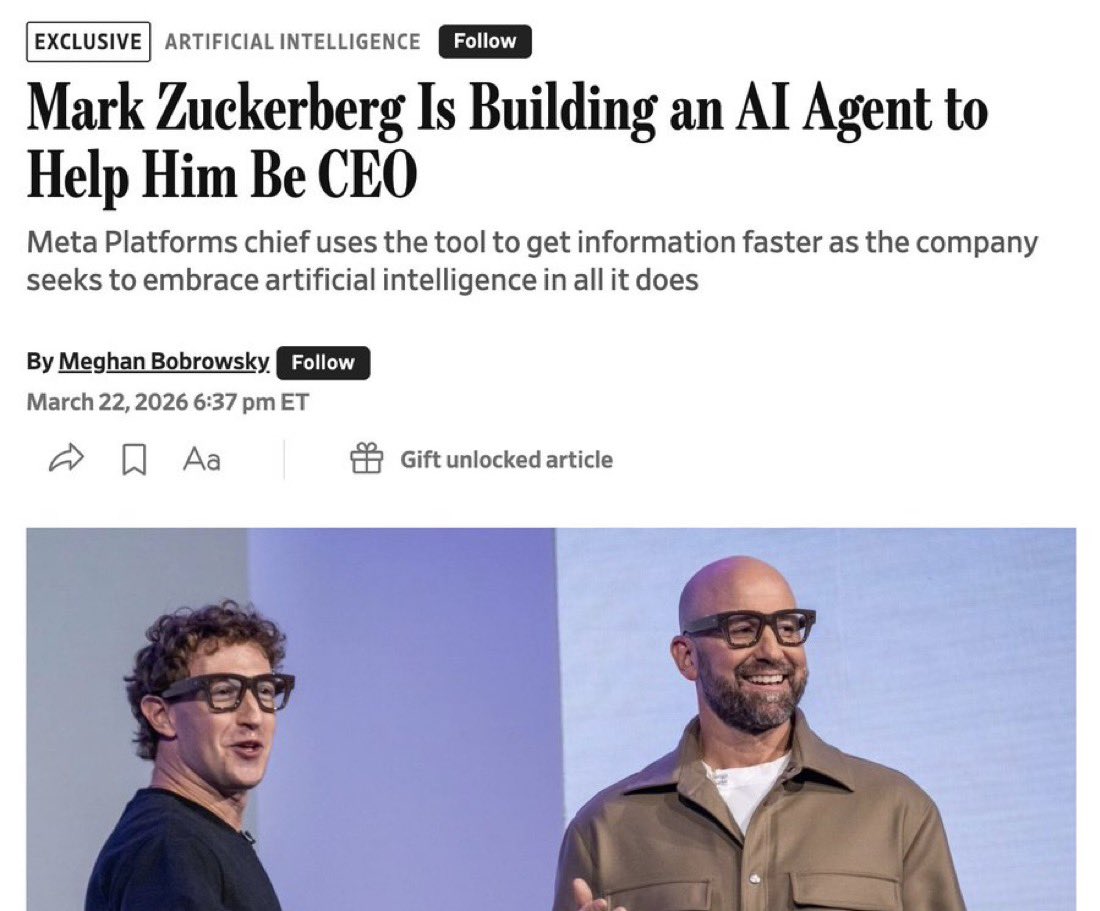
Every CEO will be running an OpenClaw within 12 months. Zuck is just building his in-house.
Here’s what to expect.
Six days ago Jensen Huang stood in front of 30,000 people at GTC and said every company needs an OpenClaw strategy. OpenClaw hit 250,000 GitHub stars in 60 days, faster than Linux, React, or any open-source project in history. Peter Steinberger built the first version in an hour. Nvidia shipped NemoClaw, an enterprise security layer, on top of it. Anthropic shipped Cowork Dispatch before OpenAI shipped anything. The infrastructure for autonomous AI agents went from side project to enterprise standard in under two months.
Zuckerberg building a personal CEO agent is what this looks like when a Fortune 5 company does it internally.
A CEO at Meta’s scale sees maybe 1% of the information that determines whether a decision is right or wrong. The other 99% gets filtered through VPs, chiefs of staff, dashboards, and whatever made it into the pre-read. The agent replaces the filter.
Think about what a CEO agent actually does. It ingests every product metric, every internal thread, every customer escalation, every competitive intelligence report across every team simultaneously. Then it surfaces the three things that actually matter this morning. Before every 1:1, it pulls that person’s team metrics, open headcount, recent launches, and the two things they said they’d deliver last quarter. When the CEO asks “what happens to our glasses timeline if we move 200 engineers to AI infra,” the agent gives a first-pass answer in minutes instead of a two-week strategy team exercise. And it never forgets. The person who remembered why the company killed that project in 2019 left two years ago. The agent didn’t.
Meta employees are already running their own versions. Tools called “My Claw” and “Second Brain.” Engineering output up 30%, power users up 80% year over year. Zuckerberg is doing what his employees are doing. Applying it to the highest-leverage seat in the company.
Now think about what that means for the people currently doing this work.
Chief of staff. Executive assistant. BizOps. Strategy and planning. These roles exist to perform one loop: gather information from across the org, filter it, synthesize it, route it to a decision-maker, track the follow-through. Every step is a text-in, text-out task. Summarize this doc. Pull these metrics. Draft this brief. Follow up on action items. Cross-reference what engineering said with what finance approved.
A typical Fortune 500 CEO has 8 to 12 people whose primary job is making them effective. Multiply that by every SVP with a chief of staff, every VP with a BizOps partner, every director with an EA. Thousands of roles per large company built around the information-routing function.
The agent reads 400 pages of internal docs in seconds. It never misses context from a meeting three months ago. It doesn’t need to Slack four people for the latest numbers because it’s already connected to the source systems. The human in BizOps spends 70% of their week on information gathering and synthesis. The agent does that in minutes.
That’s a 90% headcount reduction across chief of staff, EA, BizOps, and strategy roles over the next five years. The surviving 10% will be the ones doing work agents can’t: reading a room, managing a difficult exec relationship, knowing that the CFO’s “sure, let’s revisit” actually means no. Political judgment and human navigation. Everything else dissolves into software.
The question every board should be asking: if your CEO isn’t running one of these by 2027, what are they making decisions on?
HAL Out of Race for India’s Fifth Generation Stealth Fighter Jet
India’s big plan for a home-made stealth fighter jet, called AMCA, has a surprise twist. State-owned Hindustan Aeronautics Limited (HAL) is no longer in the running to build it. Instead, private companies like Tata Advanced Systems, Larsen & Toubro, and Bharat Forge have been picked after checks on their tech skills. The winner will be chosen soon, in about three months. This move aims to speed up India’s fifth-gen fighter program, with the first model expected by 2027.