Today, my very first paper with my PhD student @QuantNik and our collaborator @gauravmahajn is out on the arXiv: https://t.co/8yfiv4wVYR
If you are at QCTiP hosted at @UniofOxford next week, do attend Nikhil's talk about ""Cloning is as Hard as Learning for Stabilizer States""!
The long-term vision of NeuroQuant is not to replace quantum computers.
The vision is to explore whether biological intelligence and quantum information processing can coexist inside a new computational paradigm.
We're still at the beginning.
Biological computing is moving faster than many realize.
From DishBrain playing Pong to neuron-based systems learning Doom, biological computation is becoming increasingly programmable.
The gap between wetware and hardware is shrinking.
NeuroQuant v0.1 architecture draft.
Current hypothesis:
Rodent-inspired neural dynamics may serve as a biological preprocessing layer before quantum reservoir computation.
This remains speculative, but worth exploring.
Research begins with questions.
Quantum systems naturally possess properties that classical systems struggle to reproduce:
• Superposition
• Entanglement
• High-dimensional state spaces
These characteristics make them promising candidates for next-generation learning architectures.
https://t.co/YAWwQzgcCH
The rodent brain remains one of the most studied biological systems in neuroscience.
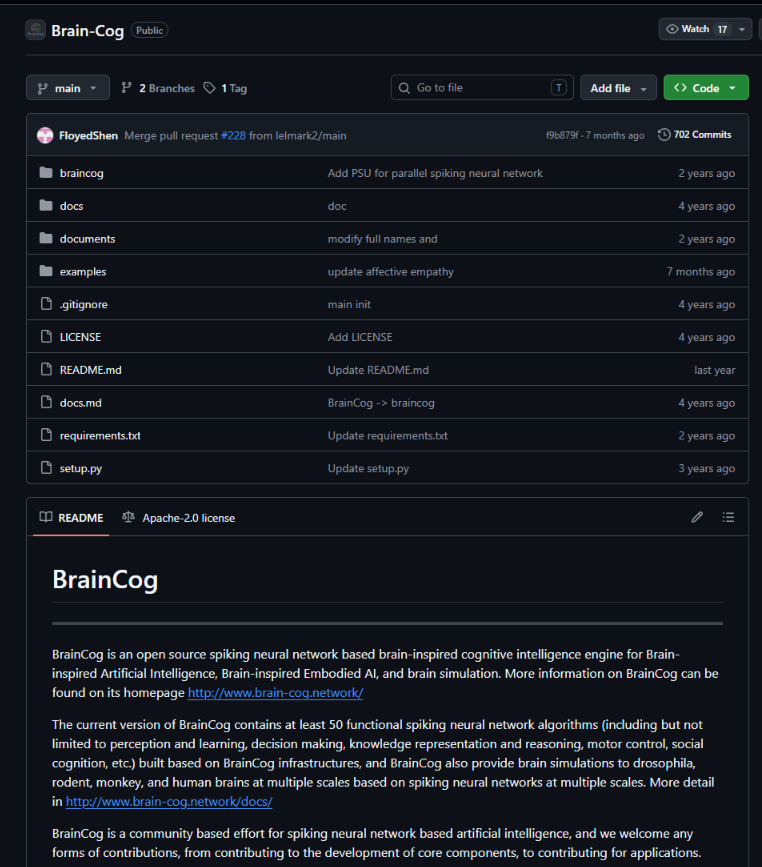
Projects like BrainCog are helping simulate animal neural architectures using open-source frameworks.
Understanding these systems may provide blueprints for future computational models.
https://t.co/We8Qy6txUF
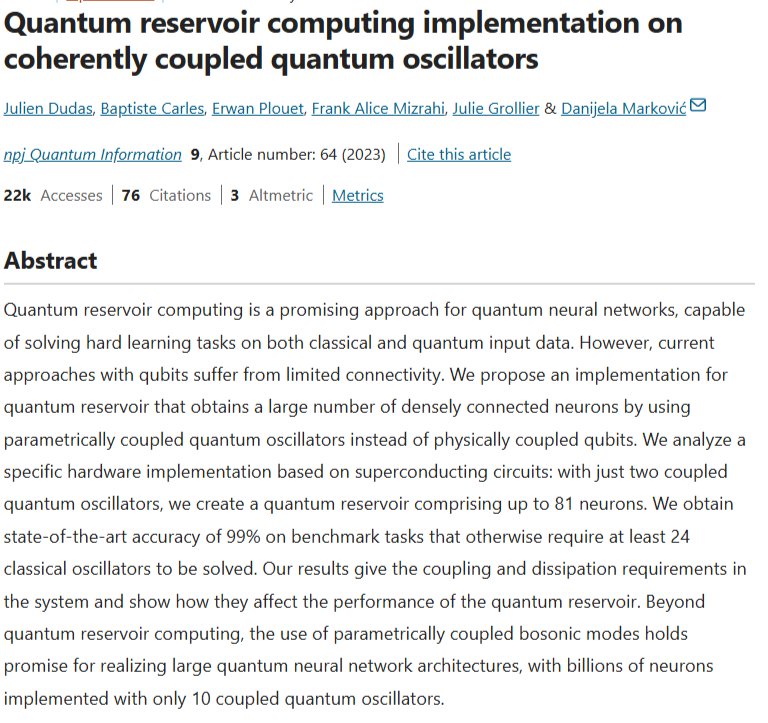
One of the most interesting fields in quantum machine learning is Quantum Reservoir Computing.
Instead of building massive fault-tolerant quantum computers, researchers use naturally evolving quantum systems to process information.
This concept could become a bridge between biological and quantum computation.
Early NeuroQuant concept.
Traditional AI:
Data → Neural Network → Output
NeuroQuant:
Data → Biological Reservoir → Quantum Reservoir → Output
We're investigating whether biological adaptation and quantum dynamics can complement each other.
Why animal neurons?
Researchers have already demonstrated that rodent neurons can learn tasks when connected to digital systems.
The famous DishBrain experiment showed biological neural cultures adapting to play Pong through feedback loops.
If neurons can learn inside silicon environments, what happens when we combine those principles with quantum reservoirs?
This is one of the questions behind NeuroQuant.
https://t.co/t0URJ3ew6g
Today I'm publicly launching NeuroQuant.
The goal is ambitious:
Can biological neural systems inspire the next generation of quantum computing architectures?
We're exploring the intersection of:
• Quantum Computing
• Biological Intelligence
• Neuromorphic Systems
• Animal Neural Networks
If you’re into predictive processing and meditation, this paper pushes the Overton window. From the quantum formulation of the free-energy principle, we show that an agent cannot define its own boundary from within. The realization of this irreducible indeterminacy is a principled definition of awakening. Ultimately, this extends to the separability of any object in experience, formalizing emptiness and engendering a “post-dual agent”.
Any persisting agent must minimize surprise by gathering evidence for its generative model. But all evidence available to the agent arrives through its boundary with the world. To prove that this boundary really separates “self” from “world”, the agent would need to step outside the boundary and measure the whole self-world relation. A finite agent cannot do this, as a scissor can't cut itself.
So the self-world boundary can be useful, predictive, and necessary for action, but it can never be known as an ontological fact from within. Meditation, on this view, progressively reveals the self-world split as a modelling prior rather than a structural feature of reality. This naturally shifts the weighting of self (inside boundary) and other (outside boundary), since both are seen to be inferences rather than grounded realities by virtue of an indefinable boundary. A more even-handed and compassionate orientation can arise.
A highly principled finger pointing at the moon!
You can better model brain data if you assume quantum-like entanglement.
New work from our centre indicates that the brain expresses the efficiency of quantum computation through classical mechanisms. The brain is a magnificent specimen because it operates on 20w—or a banana and some water—and yet generates a coherent, stable, adaptive, and conscious inner universe that can build rockets, computers, fall in love, and construct empires and religions.
And it does so against the backdrop of slow, wet, porous, and inexpensive bioelectric activity. Compare this to contemporary AIs, which are energy guzzlers and require massive data centres. The difference is likely 10,000x or more. Instead of looking interstellar for data centres, we should really be looking to the brain.
First, you model the brain as a network of coupled oscillators (commonly used for whole-brain models). If you wire these coupled oscillators up like the brain’s connectome you get very interesting, very surprising, brain-like dynamics; such as criticality, metastability (via turbulence), etc. These stochastic dynamics are crucial for rapid information sharing and maintaining local and global integration. And when these dynamics are included in the model, it fits the brain like a glove.
Interestingly, when you then include long-range exceptions to the exponential distance rule (common in mammalian brains), you get a spectral gap that separates the dominant modes from the noisy bulk. These dominant modes behave like coherent state-vectors and their interactions produce interference effects, i.e., quantum-like entanglement.
These interference effects may be one of the secrets to how the brain rapidly binds distributed information into unified, context-sensitive states. The paper also demonstrates that QL entanglement provides the brain a richer dynamical repertoire at lower energetic cost. Keep in mind that this “quantum-like” entanglement arises from the interference of coupled oscillators, but the functional end state is analogous in that you get the same mathematical advantages.
It’s super exciting and we have a lot more to share in coming months.
Figure 3. Evidence of quantum-like (QL) computation in the human brain. Brain models with QL dynamics show significant improvements in the level of fitting of large-scale human neuroimaging resting state data.
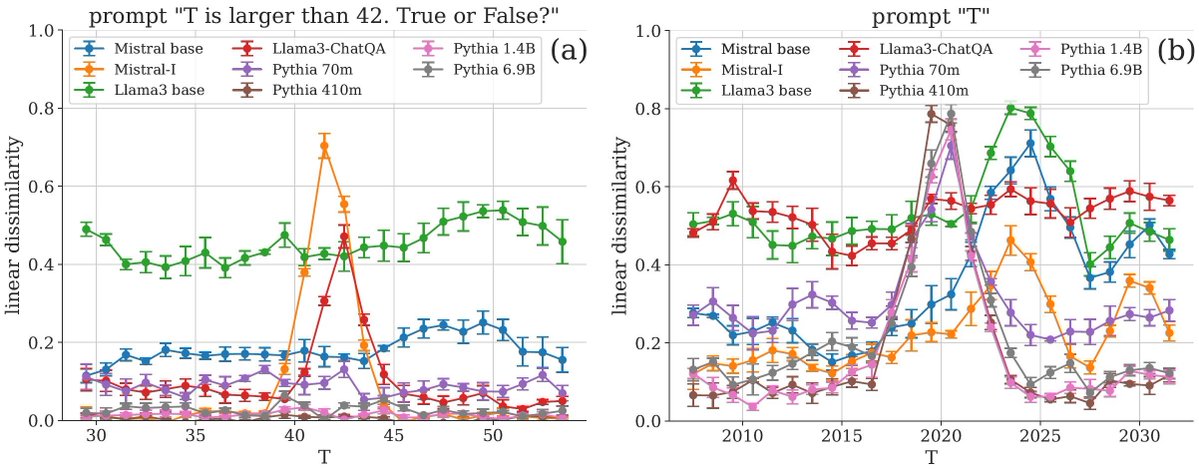
Check out https://t.co/S4CikGArUe with @FlemmingHoltorf & @_Frank_Schaefer (@MIT_CSAIL) and Niels Lörch (@UniBasel):
Leveraging tools from physics, we analyze phase transitions in LLMs. These mark abrupt changes in behavior as prompt, training epoch, or temperature are varied.