Also, we evaluated Raon-1 mini (+ preview) and many other baseline models on 수능 (college entrance exam in Korea)
Raon-1 mini scored similarly or even higher than almost all other Korean open-weight models, despite being 10-25x smaller in total param!
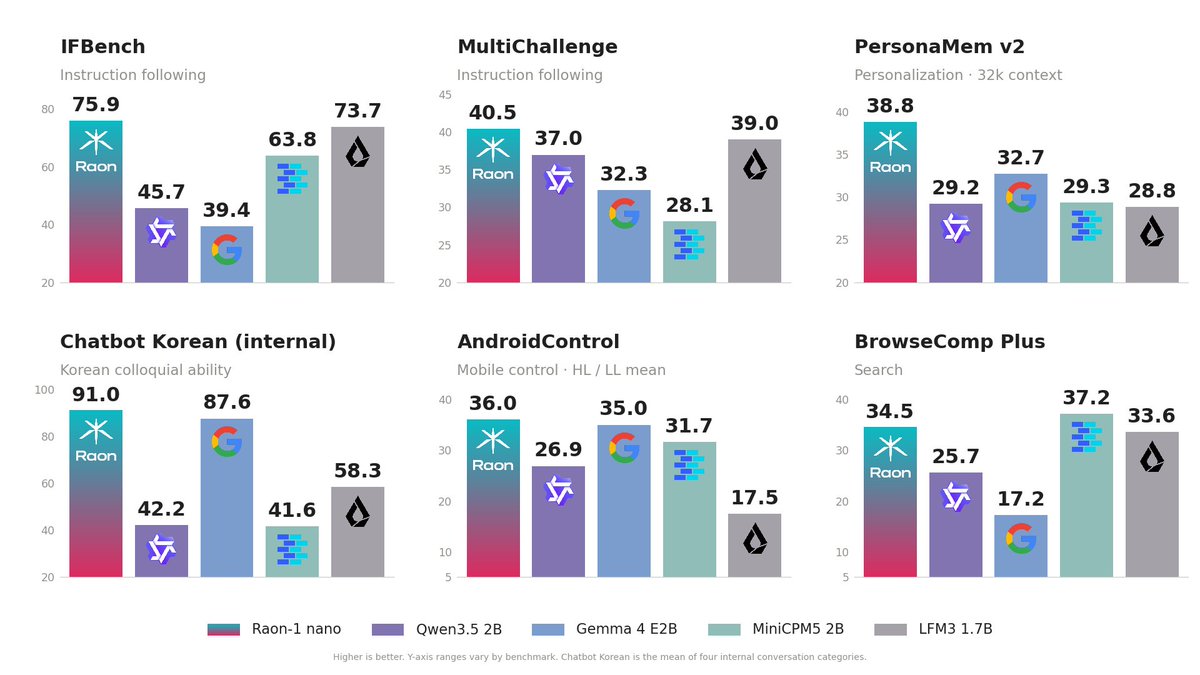
We’re releasing Raon-1 nano, an effective 1.5B dense LLM with per-layer embeddings and 3.1B total parameters. ⚡
Our journey from PUBG Ally toward on-device LLMs continues.
We pruned and distilled Raon-1 mini preview (30B-A4B) using our MoE-to-Dense approach, then further trained it on 3T tokens, followed by SFT, OPD, and RL.
Designed for natural conversations, maintaining conversational context, instruction following, and tool use in both Korean and English.
Small model. Smart interactions. Enjoy! 😊
🤗 Weights (Apache 2.0 license): https://t.co/ZVMZmlSNlz
📄 MoE-to-Dense (NeurIPS 2026 Oral): https://t.co/eoYH86lBs0
🪖 Learn more about PUBG Ally: https://t.co/A3iZvP2X7c
📢 Bring out your agent. Let’s play.
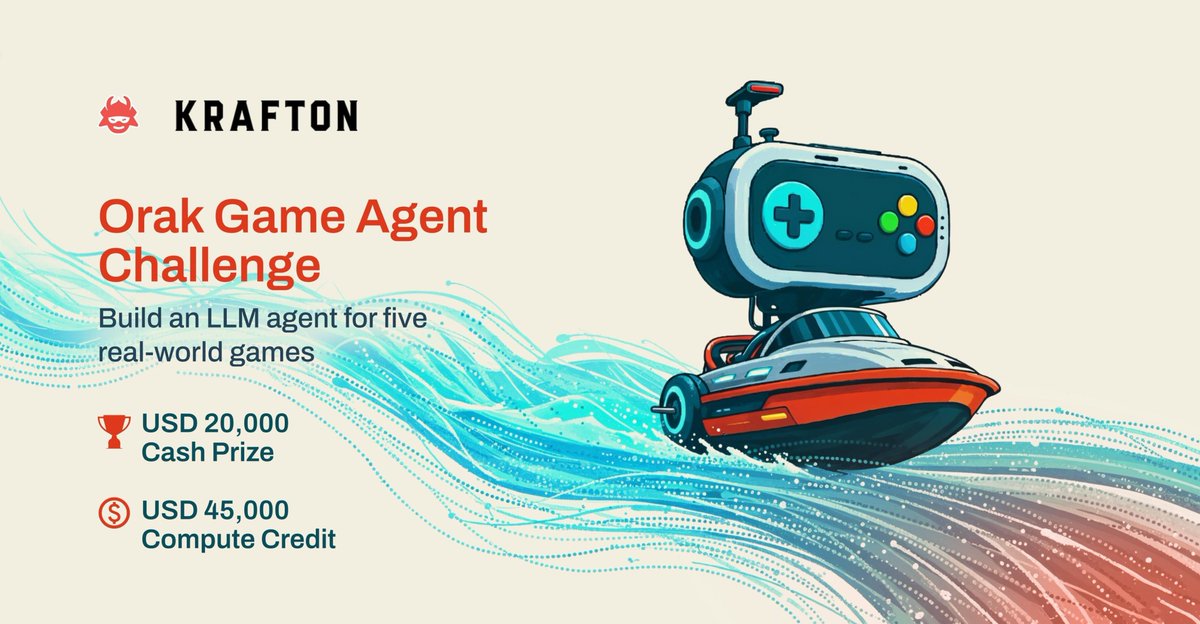
KRAFTON AI is hosting an LLM gaming-agent design competition with a total prize pool of $20k!
Earlier this year, we released Orak, a comprehensive benchmark for LLM agents playing video games, along with baseline models. In this competition, you can submit your own LLM agents and see whether you can outperform others!
The Team registration deadline is 12 Dec 2025, so don’t wait too long to join!
👉 More details & registration: https://t.co/ib2rcPfvjf
🧵When training reasoning models, what's the best approach? SFT, Online RL, or perhaps Offline RL?
At @Krafton_AI and @SKtelecom, we've explored this critical question, uncovering interesting insights!
Let’s dive deeper, starting with the basics first.
1) SFT
SFT (aka hard distillation) is the very first approach you would try!
👍 This is very compute efficient as we don’t need to generate any responses from the model being trained.
👎 What are the downsides? We distill the behaviors only from the trajectories with correct answers (reward = 1). The model may learn the behaviors of generating correct answers, but not necessarily how to avoid writing incorrect reasonings. (Some believe that this is why RL generalizes better than SFT.)
2) Online RL
On the other hand, online RL works as follows. The model being trained first generates its own reasoning traces. The traces are graded, and the good traces get encouraged, and incorrect traces get discouraged. GRPO is an efficient reward renormalization method, and it is observed to make RL training converge better.
👎 What’s the downside? The cost of generating responses from the model being trained is huge! Every time you update the model, one needs to keep generating new responses using the new model parameter.
3) Offline RL
What’s something in between these two? Can we keep the efficiency of SFT while making use of negative examples too?
Offline RL strikes a balance between compute and learning efficiency. (In fact, SFT can be viewed as a special case of offline RL but only with positive reward samples!)
Offline RL is simple. It samples a batch of reasoning traces in the dataset and measures the rewards (which could be either positive or negative). That’s it 😁
No extra compute required for rollouts. It still accounts for negative examples as the reward gives you that signal.
4) Does offline RL work for training reasoning models?
The question is: Is this really useful? We don’t have definitive answers yet, but we have very interesting preliminary results.
We took the existing reasoning models (e.g., OpenThinker 2/3 for instance) and continued training them using offline GRPO.
The results were promising! With about 100 GPU hours, we were able to observe a marginal (a few percentage points) yet consistent reasoning accuracy improvement over diverse domains (AIME25, AMC23, LiveCodeBench, …)!
We found this pretty surprising for the following reasons:
1⃣ The amount of compute that went into this training procedure is less than 1% of the compute power that went into the preceding training process. The last-mile improvements on reasoning benchmark scores can be made with a single GPU node in a day 😊
2⃣ We only trained on the math dataset, but the model doesn’t seem to exhibit catastrophic forgetting on reasoning in other domains (if not slightly improved).
5) Technical challenges
There are a few technical details that we had to figure out to make this work.
1⃣ The existing reasoning traces dataset does not come with ground-truth answers for the questions. We used simple majority voting to find the pseudo-label for each question and defined the reward based on them, but a better method could be used to improve the quality of reward signals.
2⃣ Another technical challenge when it comes to offline-GRPO is the scenario where all the reasoning traces are correct. The vanilla offline GRPO cannot handle this, as after the reward normalization, all rewards become 0. This is fine for online RL (the generator is already good!), but it’s not good for offline cases. In fact, this happens about every six iterates while running GRPO! We came up with a very simple heuristic -- we added a positive bias term when this happens.
For more technical details, please refer to our technical blog: https://t.co/IQSS3xXDwN
We also released the continually trained offline-RL models: https://t.co/8uwoDRLxpK
6) What's next?
Lots of interesting questions remain open!
1⃣ What happens if we scale offline GRPO with more compute/data? We are working on it, so stay tuned for more updates!
In fact, together with @SKtelecom, at @Krafton_AI, we are building a strong R&D team dedicated to researching advanced LLM training algorithms and architectures, and this is one of our many research initiatives.
@Krafton_AI has a very strong group of researchers (see our recent work at https://t.co/1m3sIh0kXw).
We are very pleased to team up with @SKtelecom, which has the leading expertise in LLM training and deployment with its long-standing efforts in open-source LLMs in Korea!
SKT has been making a significant contribution to LLMs for Korean researchers, from KoBERT, KoGPT, … to the recent release of A.X-3.1, an LLM trained entirely from scratch using their own stack! Check out their models at https://t.co/k6ExIDilPe
2⃣ Also, what about if we use offline GRPO directly from pretrained models? Can we apply offline GRPO to the Qwen instruct models and possibly get a better reasoning model than OpenThinker? We should have a chat on this @AlexGDimakis@madiator :)
That's it for now! This preliminary report summarizes our early findings, intended to inform and engage the research community.
We're open to further discussion and collaboration, so please reach out with any feedback or interest!
🚨New Paper Alert
As a game company, @Krafton_AI is actively exploring how to apply LLM agents to video games.
We present Orak—a foundational video gaming benchmark for LLM agents!
Includes Pokémon, StarCraft II, Slay the Spire, Darkest Dungeon, Ace Attorney, and more in🧵
We knew very little about how LLMs actually work...until now.
@AnthropicAI just dropped the most insane research paper, detailing some of the ways AI "thinks."
And it's completely different than we thought.
Here are their wild findings: 🧵
🤖 AI Agent Building Guide
Learn to build powerful text analysis agents with LangGraph in this practical tutorial. Create agents that can classify, extract, and summarize content - with complete implementation examples.
Ready to build your first AI agent? Check it out! 🔨
https://t.co/KN63QVrneM
Super excited to finally see @PlayinZOI EA released!
In addition to its beautiful graphics and gameplay, I bet this game will go down in history as "the first commercial video game to truly showcase what AI is capable of" 🙂
Here are the top 3 AI features ... 🧵