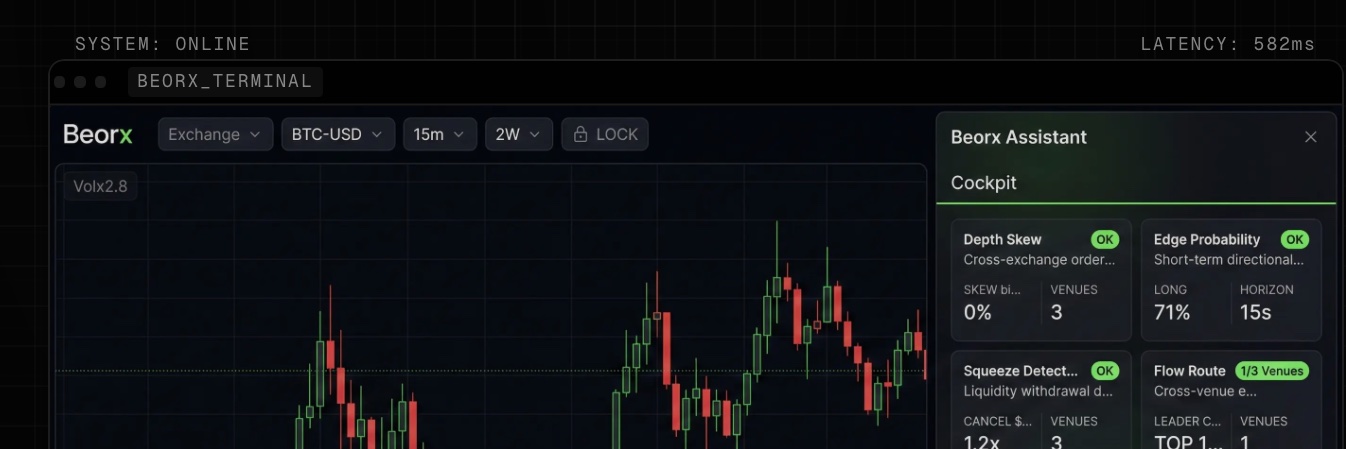
What is Beorx?
Beorx is an AI-powered crypto market intelligence platform built around chart context.
It helps users analyze price action, structure, and probabilities directly on supported charts.
Read-only. Non-custodial. No trade execution.
Good slate. A chunk of this list is already running on OpenClaw or x402 rails — and the gap underneath is the same:
agents can execute, fewer can read whether the moment to execute is actually right.
Liquidity withdraws, ranges tighten, microstructure flips.
Context is the missing primitive.
@organ_danny Optimizing for path efficiency without context is how you get fast mistakes.
Price is the last thing to update — by the time an agent switches paths, the liquidity that made that path optimal may already be gone.
Execution needs context, not just routing.
Bitcoin's at $80K and looks boring. The order book disagrees.
Beorx is flagging a "storm" liquidity withdrawal (87th percentile) while market weather reads Calm. That combo = tightening range + faster moves around visible levels.
Not the setup for a clean trend. 🧵
@BinanceResearch Prompt quality matters. In trading, context makes the answer usable.
A 5m BTC scalp and a 1h setup need different data, indicators, risk limits, and order book depth.
Strong AI analysis starts with intent, timeframe, exposure, liquidity dynamics, and market structure.
The trading stack is separating into three layers:
Access: markets, licenses, assets, and execution rails.
Intelligence: market structure, liquidity, venue behavior, risk, and decision context.
Workflow: agents, automation, and execution support.
Most headlines focus on access. The next layer of differentiation is intelligence before execution.
Beorx Cortex/Cockpit is built for that layer: turning exchange-native data into context-aware decision support before users act.
Old way: dashboards, raw APIs, subscriptions, human workflows.
New way: callable context, stateless access, pay-per-request, agent workflows.
If your agent only sees price, it is still trading blind.
An agent that only sees price is still trading blind.
Most “AI trading” stacks are giving LLMs access to the wrong surface.
The missing piece is callable market context.
x402 is the access model that fits.
SaaS pricing is built for humans: seats, commitments, quotas.
Agents are not seats.
Pay-per-request fits the way they actually operate.
@Dentoshi Spot on. A lot of structures still look solid on the chart even after the underlying conditions have already changed — that’s exactly where a good-looking setup quietly turns lower-quality.
@Crypto_Chase Love the $HYPE update — setups like that can look clean and “following the squiggly” on the chart, but once the liquidity and flow underneath shifts it becomes a completely different trade. Same level, totally different edge.
@WhatSayLew@dotta Totally.
What’s been interesting is how often the same setup can look identical on the chart while the conditions underneath have already shifted.
Doesn’t make trading any easier — but that extra context is what cuts out a lot of the bad trades before you even hit execute.
@TraderMagus Always interesting how the cleanest orderflow setups can still feel very different depending on what’s happening underneath them across venues.
Same chart, same level, completely different trade once liquidity and participation start shifting under the surface.
These long-cycle charts are useful.
What always gets interesting is how different the same “entry zone” can feel depending on what’s happening underneath it across venues.
Price can be sitting in the same place while liquidity, flow, and participation are telling a very different story.
Feels like that’s where the chart is the same, but the actual opportunity isn’t.
Good list.
Feels like most people already have enough tools to see the market.
The harder part is sensing when the market is quietly changing underneath them — when liquidity looks fine until it isn’t, when flow turns against you before price fully shows it.
That layer still feels underbuilt.