We know of 93 calves born in the wild to our ex-orphans. How? Because they chose to bring their newborns home.
Some make the pilgrimage from the wild within hours of giving birth. They walk back to the Reintegration Unit they grew up at, find the Keepers who raised them, and introduce the baby. Others might return a few weeks or months after. Each time, our Keepers are like proud grandparents, over the moon with happiness.
Yatta has done it four times. Melia twice. This is the moment Tumaren came back with her newest baby.
Meet our wildborn family, all alive today because we chose to rescue their orphan mothers: https://t.co/gAYG28HymE
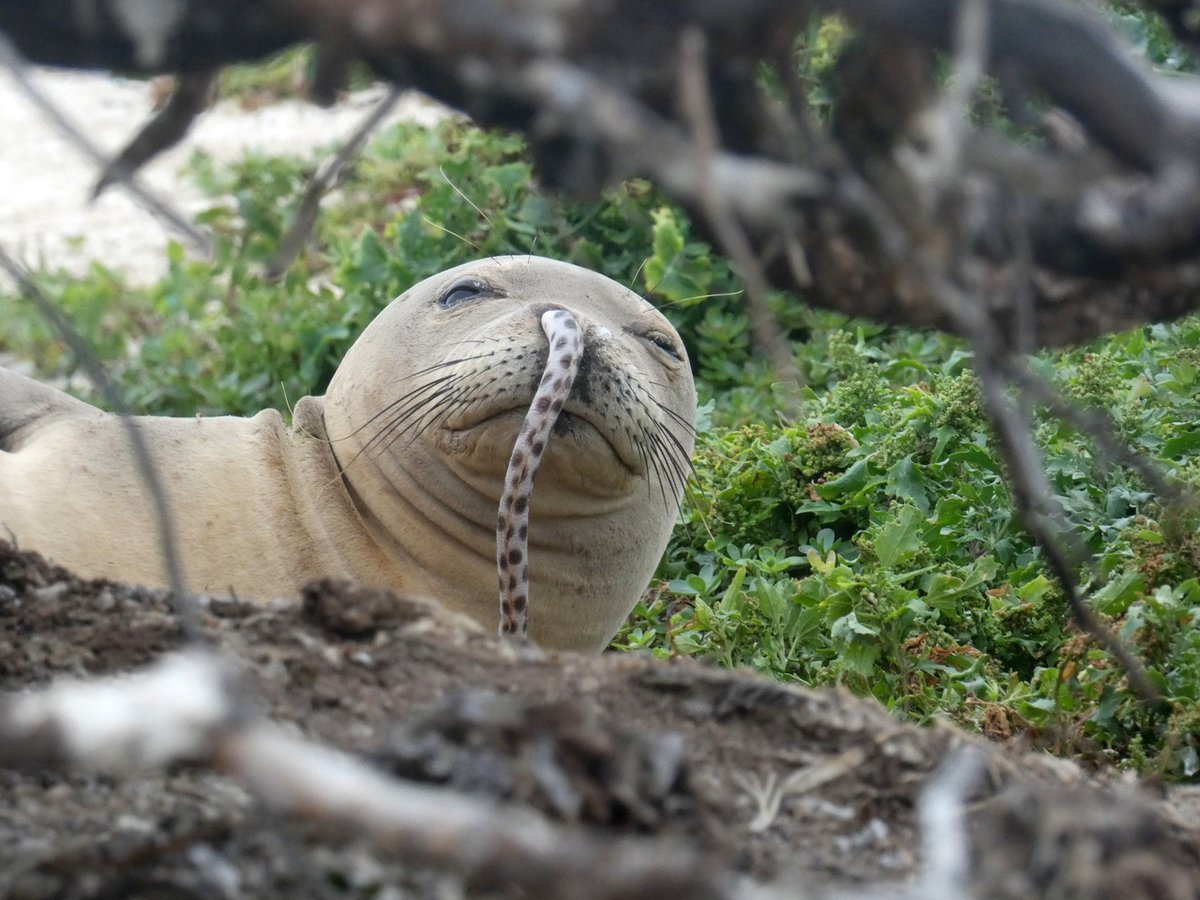
Even after decades of research, we still don’t know everything about the animals we study—for example, why Hawaiian monk seals sometimes get eels stuck in their noses. (And yes, it’s happened more than once!)
https://t.co/CxHRBlImfB
#SealAndSeaLionWeek
When two galaxies encounter each other, it takes more than a billion years for them to merge and settle down. While the stars already in the galaxies don’t change much, the collision can spark lots of new stars to form! #MondayMotivation
The giant hexagonal storm at Saturn's north pole, with the Earth for scale by Paul Byrne
The image of the hexagon is from the Cassini mission, and was taken by the spacecraft on 27 November 2012 with infrared filters. The image was processed by Kevin Gill. Earth is from Google Maps. Credit:NASA/JPL-Caltech/SSI/Kevin M. Gill/Paul Byrne
Webb captured this new image of galaxy Messier 58, in both the near and mid-infrared, as part of a treasury of 55 massive, star-forming galaxies. The data on the properties of these galaxies will add insight to our picture of how galaxies grow and evolve over cosmic time.
According to Walter Isaacson's biography, "Einstein: His Life and Universe," the personality traits that contributed most to Einstein's greatness were curiosity and nonconformism. Do you have those traits? Let us know in the comments.
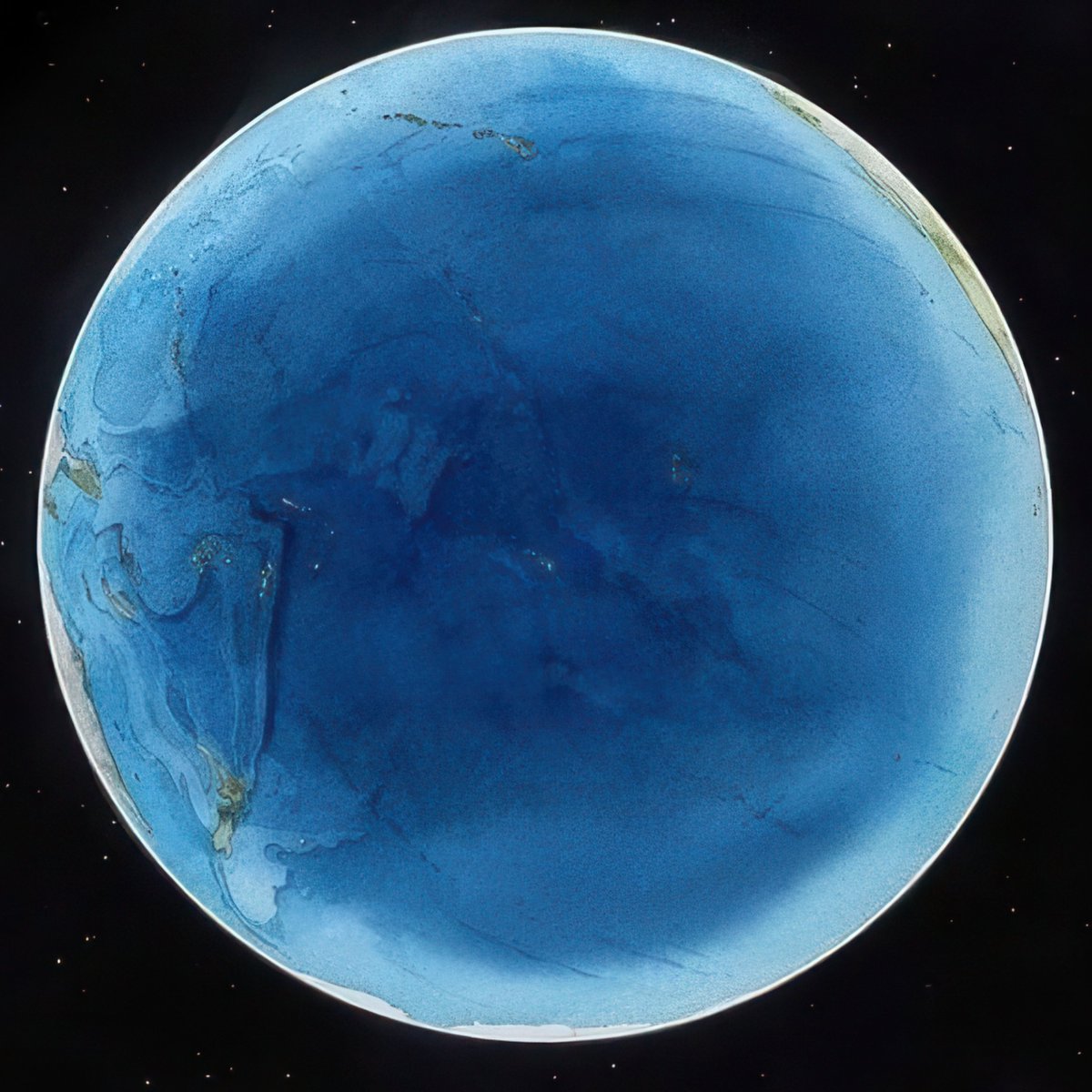
Imagine gazing at Earth from the heart of the Pacific Ocean—not the familiar patchwork of green continents and brown deserts, but an immense, almost seamless "blue marble" stretching endlessly in every direction. This rare vantage point reveals our planet's true nature: a water world where land is the exception, not the rule.The Pacific alone spans roughly 165 million square kilometers (about 63.8 million square miles), claiming around one-third of Earth's total surface area (510 million km²). That's larger than all the world's landmasses combined (149 million km²), making this single ocean vaster than every continent put https://t.co/AQrhtWNQPI this expansive "water hemisphere," isolation reaches extremes. Point Nemo—the oceanic pole of inaccessibility—sits at coordinates roughly 48°52.6′S 123°23.6′W, where the nearest land (scattered specks like Ducie Island in the Pitcairn group, Motu Nui near Easter Island, or Maher Island off Antarctica) lies over 2,688 kilometers (about 1,670 miles) away in every direction. It's so remote that astronauts aboard the International Space Station are often closer to you than any person on solid ground.Far from an empty blue void, this colossal expanse drives Earth's climate engine. It powers massive phenomena like El Niño and La Niña, whose ripples influence weather patterns, rainfall, droughts, and storms across the globe.Our "Blue Planet" is aptly named—mostly ocean, profoundly interconnected, and breathtakingly dominant when viewed from its watery core. Stunning views of Earth centered on the Pacific:
Point Nemo, the loneliest spot on Earth:
(Source: NASA imagery, NOAA, Wikipedia, Britannica, and related scientific references, 2020–2026)
@creepydotorg@grok This is the side of the Earth we're not used to seeing.
The immense Pacific Ocean occupies a third of our planet's total surface area.
This image below was taken from Google Earth Pro.
Einstein’s “visual imagination allowed him to make conceptual leaps that eluded more traditional thinkers,” writes Einstein biographer Walter Isaacson.
It's not all milk bottles and mud baths. Sometimes, the job description is just: play.
Our Keepers are with the orphans 24 hours a day, seven days a week. They sleep beside them at night, walk with them through the bush by day, and yes – they play. Because for a young elephant overcoming grief and learning to be an elephant again, play is everything.
Discover what it takes to be a Keeper for orphaned infant elephants: https://t.co/Vv7yll9JJt
Dame Daphne Sheldrick often said that when you've earned the love of an elephant, they never forget it.
This Valentine's Day, set up an adoption for your special someone and introduce them to our world of elephants, where every member of the family is treasured. They'll receive a personalised adoption certificate and monthly email updates on the orphans in our care. Find out more: https://t.co/a2ZQ5mpCW9