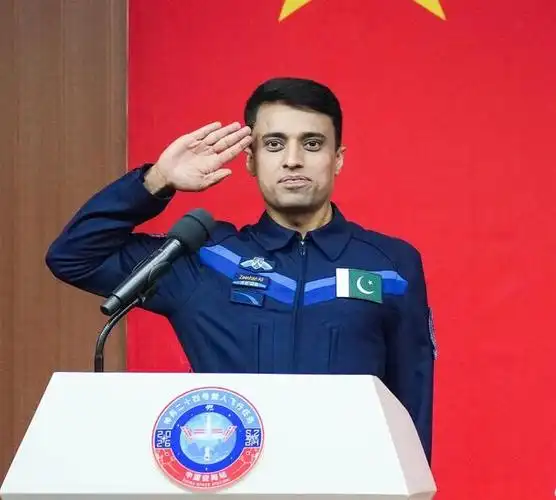
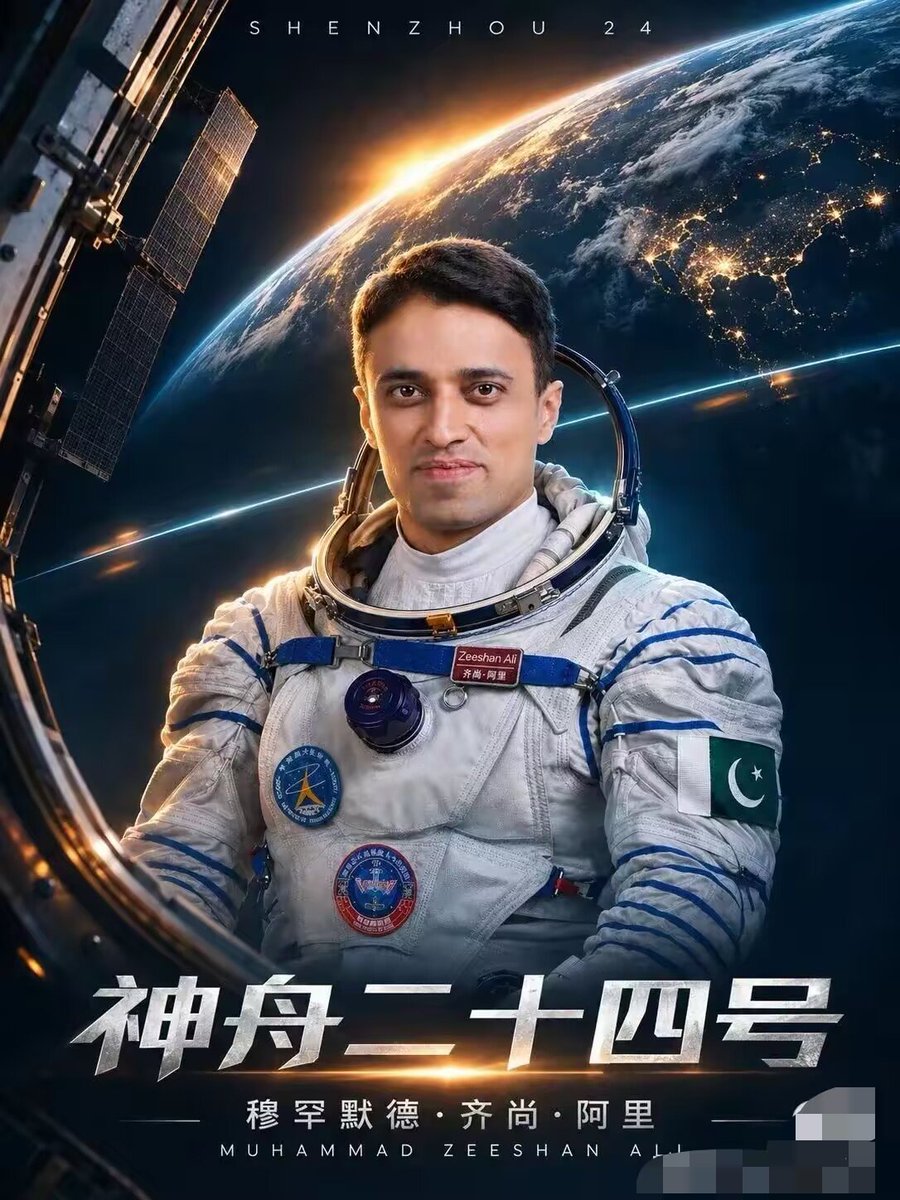
🥳🥳Witness the first historic “handshake in space” between Chinese and Pakistani astronauts!
👋👋From training side by side to pursuing dreams together, and from cooperation on the ground to exploring vast space, China-Pakistan space cooperation is embarking on a new chapter.
🇨🇳🇵🇰Higher than the mountains, deeper than the oceans, sweeter than honey, and vaster than space! May China and Pakistan continue to reach for the stars together and create a brighter future!
#SpaceExploration #Shenzhou24 #LongMarch2FY24 #ChinaSpace #ChinaPakistanCooperation
#MuhammadZeeshan
A delegation from the Aga Khan University and the Aga Khan Trust for Culture presented a comprehensive proposal to Federal Minister for National Heritage and Culture, Aurangzeb Khan Khichi, for revitalizing Karachi’s National Museum
#AgaKhan
https://t.co/xg5H5PykJl
امریکانےکیوں 15ممالک کےانٹرنیشنل اسپیس اسٹیشن کے پروگرام میں چین کوشامل کرنے سےروکا اوراُس کےجواب میں کیسےچین نےاپنا آزاد خلائی اسٹیشن بناکردنیا کوحیران کردیا؟خلائی اسٹیشن میں خلابازکیسےپہنچتےہیں اوروہ وہاں اپناوقت کیسےگزارتے ہیں؟اہم حقائق دیکھیے
What’s puzzling about the debate on new provinces is the threatening tone adopted by some of its most vocal proponents. If the idea has merit, it can be sold through reasoned arguments and persuasion. Why the need for such belligerence?
How fearful Indian industry is from the soft image of Pakistan. Momina Duraid’s production on #Netflix "Jo Bachay Hain Sang Samit Lo" touches the height of success even before it gets screened. Thank You India… Now watch it.
Butter chicken in space? Yes, it's on the menu.
#China's space station is hosting a dinner for six, with a specially curated halal food selection of over 100 varieties for its Pakistani astronaut, including beef nihari, lamb korma and curried chickpeas.
Answering a question from CGTN ahead of the Shenzhou-24 launch, Muhammad Zeeshan Ali, an astronaut from Pakistan, described the mission as "not a finish line" but "a launchpad" for China-Pakistan space cooperation.
Pakistani astronaut Muhammad Zeeshan Ali: “China-Pakistan friendship is vaster than the outer space.” “Whenever we look at planet Earth from the outer space, we don’t see any borders.”
He wasn’t even supposed to be an astronaut. He was just running the selection — until he beat every elite pilot and made history.
You won’t believe this story.
Muhammad Zeeshan Ali, Pakistan’s first astronaut heading to Tiangong Space Station, didn’t start as a candidate. Back when Pakistan launched its astronaut selection program in 2025, he was the guy managing the whole screening process. His job was to review applications, oversee tests, and watch top fighter pilots compete for that rare spot to space.
The standards were brutal. Every candidate was a seasoned Air Force pilot with thousands of flight hours. But the medical checks, vestibular endurance tests, and split-second spatial judgment filters knocked out so many skilled pilots one after another. The team ran short of qualified candidates and opened one final round of applications for internal staff who met the criteria.
That’s when Zeeshan, a 40-year-old Air Force wing commander with solid fighter jet experience, decided to throw his own hat in the ring. Nobody expected much. All the front-runner pilots had already washed out. Yet he passed every single round: preliminary screening, secondary evaluation, final selection. He beat the odds and landed one of the two spots as a backup astronaut.
Then came seven months of the hardest training of his life in Beijing. The biggest mountain? The entire space station runs on Mandarin. Every button label, every screen readout, every emergency command is Chinese. There was no shortcut, no special pass. He trained side-by-side with Chinese astronauts Tang Hongbo and Wu Yi. They built vocabulary lists, walked him through emergency workflows, and drilled pronunciation together. Zeeshan spent every spare minute memorizing technical terms. By the end, he could react to crisis instructions instinctively. He even recited ancient Chinese poetry at his pre-launch briefing — the famous verse from Li Bai, “The roc rises with the wind, soaring ninety thousand miles high.”
This is not a joy ride. Out of more than 300 research proposals from Pakistani universities, only four experiments were picked. His core mission is to run those joint science projects, including the blue algae “green micro-factory” test that could help solve food supply and closed ecological system challenges for deep-space exploration. All data will be shared between Pakistan and China. He will also connect live with kids back home, lighting up their curiosity for science.
To Pakistan, this is everything. More than 60% of Pakistan’s population is young. For decades, Pakistani kids watched space missions from far away. Now they have one of their own flying to orbit. When he told children at home: “Look up at the sky, remember I carry your dreams up there,” it struck a nation. It is Pakistan’s version of the moment Yang Liwei first flew for China — a spark that can ignite a whole generation of dreamers. His wife summed it up simply with two Chinese words before launch: “Jiayou.”
This is not the usual “buy a ticket to space” deal. Most international space cooperation is just wealthy nations purchasing seats. This partnership is built differently: shared training frameworks, shared research, shared data, and the same strict standards for everyone. No special favors, no loopholes. If you pass the tests, you fly.
This Shenzhou-24 mission marks a new chapter for China’s Tiangong station. It proves space exploration does not have to be an exclusive club. It can lift up nations that never had their own space program. When one astronaut from a developing country reaches the stars, he doesn’t just represent himself. He shows millions of young people everywhere: your dreams can reach space, too.
#Shenzhou24 #Tiangong
This line is so touching. Wing Commander Muhammad Zeeshan Ali can now talk with his Chinese crewmates in Chinese, training shoulder to shoulder with them. The bond they built is exactly the timeless China-Pakistan friendship — boundless, just like the outer space they are about to explore together. This is what genuine space cooperation and people-to-people connection look like. Wishing the crew a smooth, historic mission!