Just blogged, "Wicked-Fast on the JVM".
Find out how to make Java/Scala/Kotlin code run blisteringly fast on the JVM. 👇
(Or at least, point your coding agent at my article.😉)
https://t.co/7G72ibYHuS
Kotlin is moving toward name-based destructuring – new syntax that will make reordering and moving properties a breeze.
No worries: There will be a long migration period with compiler and IDE support.
Learn what’s changing and how the migration will work 👇
https://t.co/fAiCHBPZbL
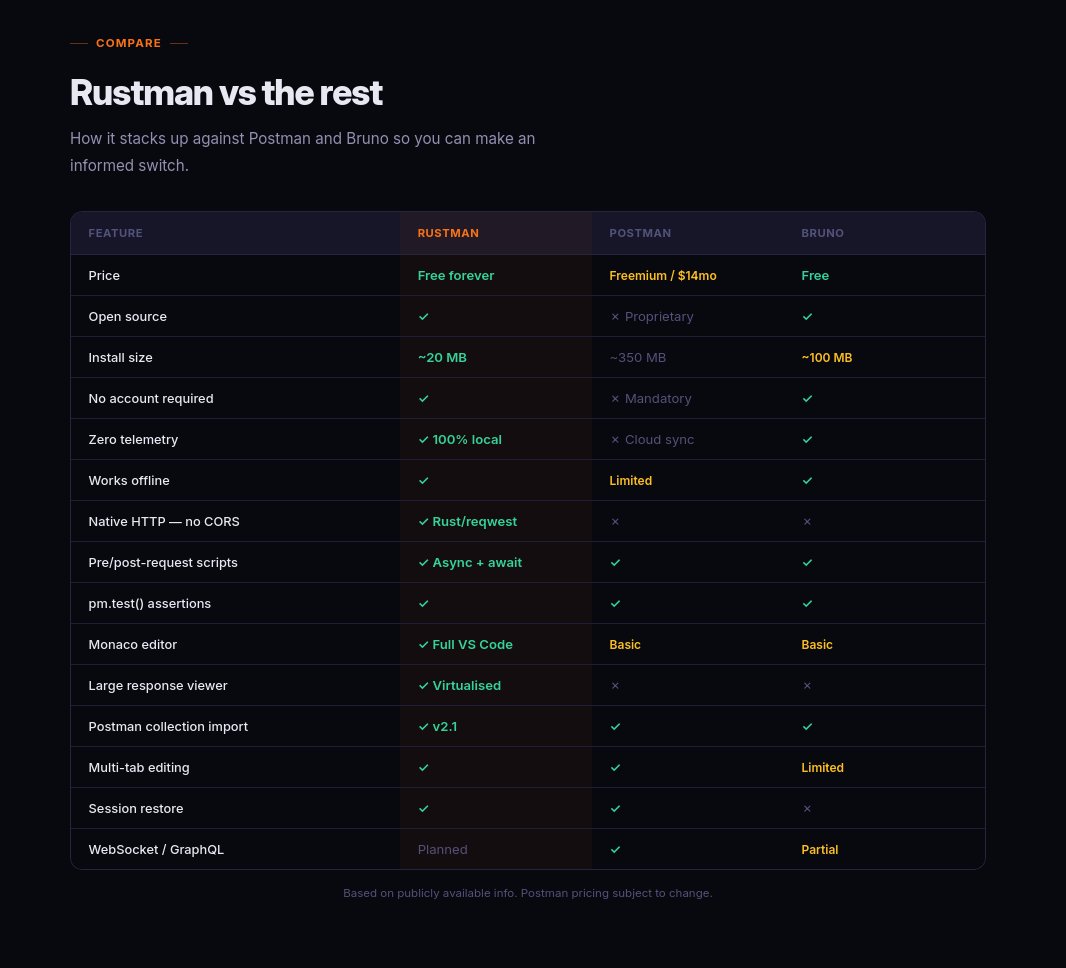
I built a free, open-source Postman alternative in #Rust.
Postman gets expensive fast. Bruno is good, but it’s still Electron-based and inherits browser-stack limitations.
So I built #Rustman.
~20 MB
No account
No cloud sync
No telemetry
Native Rust HTTP engine.
Pre/post-request scripting with async JS.
Environment vars, request chaining, keyboard-first workflow, collections, history, auth support, Postman import, and more.
Built with Tauri v2 + Rust + React.
MIT licensed.
v0.3.0 is out now.
Contributions welcome.
https://t.co/aCrsQA1jMT
https://t.co/6Y0zmLWK63
#opensource #rustlang #tauri #webdev #buildinpublic
💚 10 Principles for Fluid UI
Practical motion design tips to help create interfaces that feel great.
1. Motion Should Be Physics-Based, Not Time-Based
2. Every Animation Must Be Interruptible
3. Direct Manipulation Over Indirect Control
4. Preserve Velocity Across Gesture Boundaries
5. Use Shared Element Transitions to Maintain Spatial Context
6. Respond to Input Method, Not Just Screen Size
7. Animate Layout Changes, Don’t Teleport
8. Apply Progressive Resistance at Boundaries
9. Choreograph Sequences, Don’t Reveal Everything at Once
10. Respect the User’s Motion Preferences
Read the article 👇
https://t.co/36NSb3Lhva
By Karl Koch
🤖 Kotlin agent skills are now available on GitHub!
Explore AI-assisted skills for converting Java to Kotlin, migrating to AGP 9.0, mapping JPA entities, and moving from CocoaPods to Swift Package Manager.
Check out the repository 👇 https://t.co/F6DMbfXsb6
Dennis Ritchie created C in the early 1970s without Google, Stack Overflow, GitHub, or any AI ( Claude, Cursor, Codex) assistant.
- No VC funding.
- No viral launch.
- No TED talk.
- Just two engineers at Bell Labs. A terminal. And a problem to solve.
He built a language that fit in kilobytes.
50 years later, it runs everything.
Linux kernel. Windows. macOS.
Every iPhone. Every Android.
NASA’s deep space probes.
The International Space Station.
> Python borrowed from it.
> Java borrowed from it.
> JavaScript borrowed from it.
If you have ever written a single line of code in any language, you did it in Dennis Ritchie’s shadow.
He died in 2011.
The same week as Steve Jobs.
Jobs got the front pages.
Ritchie got silence.
This Legend deserves to be celebrated.
Fresh #gRPC benchmarks just dropped (Apr 2026) and the results are 🌶️
# 1 CPU: #Rust Tonic dominates at 102K req/s using just 15 MiB RAM
# 2-4 CPUs: #Java Vert.x takes the crown at 153K req/s... but needs 305 MiB to do it
Meanwhile Rust Thruster does 139K req/s on 12 MiB. That's 25x less memory than Java.
#dotNET quietly sitting at #4-#8 across all configs. No hype, just solid numbers. The boring enterprise choice... that keeps winning.
Scala Pekko & Akka? Surprise top-5 finishers at 3-4 CPUs. JVM tuning is real.
Now let's talk about the bottom of the chart:
- #Python: 4,492 req/s (1 CPU)
- #Node: 12,471 req/s (1 CPU)
That's 23x slower than Rust.
Node doesn't even scale past 1 CPU — 16K req/s whether you give it 1 or 4 cores 💀
But sure, "developer productivity" even when it is AI generating code these days... 🫠
Full results → https://t.co/Tg7wyCQ9Xh
kotlinx.rpc now supports gRPC for Kotlin Multiplatform.
🚀 The first gRPC KMP version is now available as a dev preview, bringing most core gRPC features to JVM, Android, and native targets – plus a KMP Protobuf implementation.
Learn more 👉 https://t.co/3ydTZpNB71
Programming languages and what they’re built with
• C → Written in Assembly
• C++ → Written in C
• Java → Written in C++
• Python → Written in C
• JavaScript (V8 engine) → Written in C++
• Go → Written in C (initially), now mostly Go
• Rust → Written in Rust (bootstrapped from OCaml)
• TypeScript → Written in TypeScript
• Kotlin → Written in Kotlin
• Swift → Written in C++
• PHP → Written in C
• Ruby (MRI) → Written in C
• C# → Written in C++
• Dart → Written in C++
• Scala → Written in Scala
• Haskell (GHC) → Written in Haskell
• Elixir → Written in Elixir (runs on Erlang VM)
• Erlang → Written in C
• Zig → Written in Zig
• Bash → Written in C
• Lua → Written in C
• Julia → Written in Julia + C
• R → Written in C + Fortran
• Objective-C → Written in C
@Anaya_sharma876 Une fois que tu maîtrises vraiment Spring, difficile de revenir en arrière
L’écosystème est cohérent puissant et pensé pour la production. Tu gagnes en fiabilité et en sérénité
Oui c’est aussi une compétence très recherchée sur le marché, surtout sur des projets backend solides
@Anaya_sharma876 Spring, ce n’est pas juste un framework — c’est un véritable écosystème avec une forte valeur ajoutée :
Spring Security, :
→ Authentification (login, JWT, OAuth2, SSO)
→ Autorisation (rôles, permissions fines)
→ Protection (CSRF, CORS, headers, sessions)
@Anaya_sharma876 Spring Boot simplifie énormément le testing :
→ Tests unitaires et d’intégration
→ Context Spring isolé par couche (Web, Data…)
→ Mocking facile (MockMvc, WebTestClient)
→ Tests proches du réel sans complexité
Tu testes vraiment ton app, pas juste du code isolé.
@Anaya_sharma876 + Gradle en java/kotlin, c’est le moteur de build moderne de l’écosystème Spring :
→ Build rapide (incremental + cache)
→ DSL Kotlin puissant et typé
→ Gestion fine des dépendances
→ Multi-modules et monorepo
Tu maîtrises ton projet de A à Z, même à grande échelle.