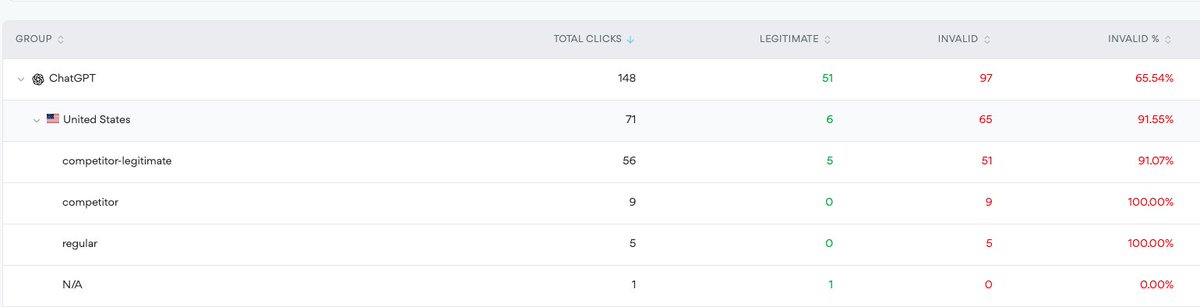
148 clicks via OpenAI ads in the U.S. Of those, more than 91.55% are from bots.
Cost: $213.
Real human clicks: 6.
That’s a lucrative business model for those guys! Especially if you’re working with soft conversions.
We (@clickpatrol) have a solution for that, at any rate.
You might be losing part of your ad budget without even realizing it.
If you run your own Google Ads or Meta Ads, click fraud is something worth checking.
Bots, competitors, scrapers and other fake clicks can:
→ Burn your ad budget
→ Create junk leads
→ Distort your campaign data
→ Train Smart Bidding toward the wrong audience
That means you’re not just paying for a bad click.
You’re potentially teaching your ad platform to find more people like them.
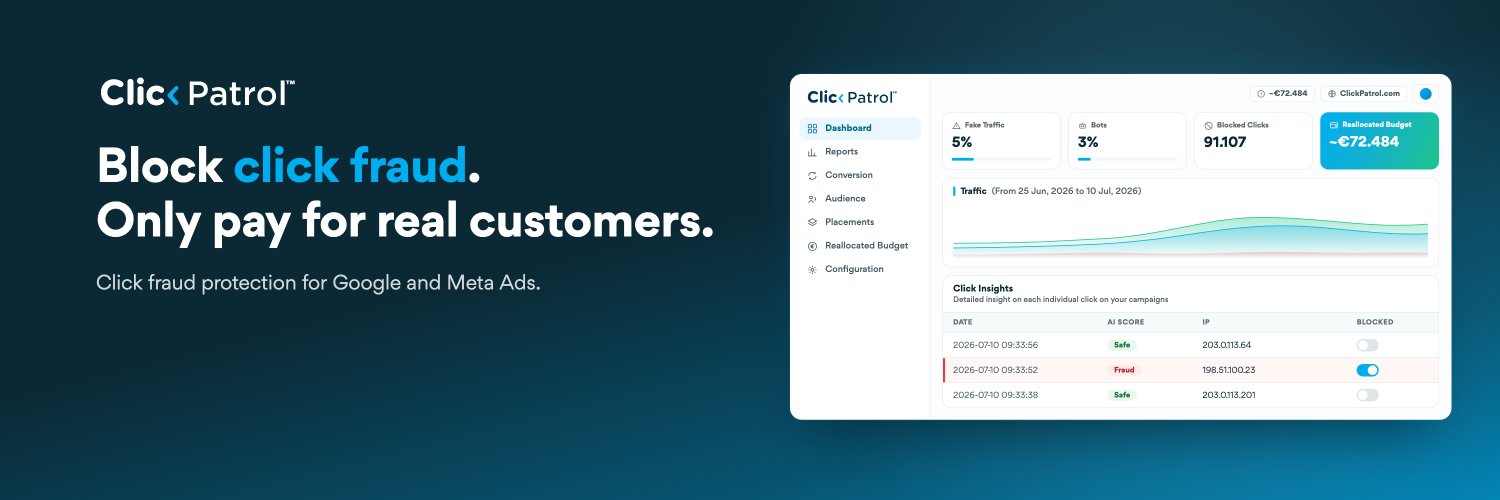
That’s where ClickPatrol comes in.
It detects suspicious clicks in real time and blocks bots, competitors and scrapers before they keep draining your budget.
A few things that caught my attention:
• Up to 20% of ad budget potentially recovered
• 800+ data points analyzed per click
• 99.97% bot-detection accuracy
• Works with Google Ads, Meta and other platforms
• Setup takes under 1 minute
• GDPR & CCPA compliant
• Trusted across 61+ countries
If you manage your own paid ads, this is one of those things I’d definitely check before increasing your ad spend.
👉 https://t.co/vrWDECvnsY
#ClickFraud #GoogleAds #PPC #PaidMedia #MetaAds #DigitalMarketing #AdTech
One thing I’d check before increasing your Google Ads budget:
Are real people actually clicking your ads?
Because not every click is a potential customer.
Bots, competitors and scrapers can click your ads repeatedly, eating into your budget and filling your data with noise.
And there’s a bigger problem.
Those fake clicks can affect what your ad platform learns about your audience.
So you could end up spending more money while teaching Smart Bidding to target the wrong people.
I came across ClickPatrol, which helps detect and block suspicious clicks before they keep draining your ad budget.
What stood out to me:
→ Up to 9% of ad spend saved
→ Works with Google Ads & Meta Ads
→ Setup takes less than a minute
→ Used by 4,100+ websites
→ Available across 61+ countries
→ GDPR compliant
If you manage your own paid ads, click fraud is definitely worth checking.
👉 https://t.co/ZnszzTMSZO
#ClickFraud #GoogleAds #MetaAds #PPC #PaidMedia #DigitalMarketing
Next gen. Waking up every morning to messages like this.
For the past few weeks, I’ve been using Grok @bot for everything. Literally.
When I wake up (It starts with 'Goodmorning' for non-dutchies), it’s prioritized everything I want done and even made progress on it. It’s done research and checked the code.
It makes sure I don’t forget things and helps me organize my work and tasks.
I’ve been using it for a few weeks now, and I think my productivity has gone up to 150%. No joke.
Give it a try: ChatGPT has Dots, META has Muse. They’re all the same.
If Ads CPA looks fine but CRM or revenue CPA got worse, check what is Primary before you loosen targets or raise budget.
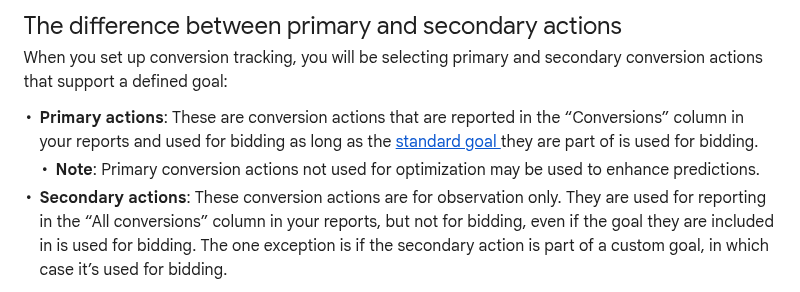
Smart Bidding optimizes the Conversions column. Primary actions in a goal the campaign uses for bidding land there. Secondary actions are observation-only in All conversions, unless you pull them into a custom goal.
So soft events as Primary (page view, begin checkout, add to cart, form start) teach bidding the wrong lesson. Ads CPA can look healthy while closed deals and revenue drift.
Also check lag. Enhanced conversions and offline imports can make Ads look ahead of CRM for days. Help notes a standard 7-14 day Smart Bidding learning window, and imported conversions take time to land. Reconcile a matched window before you call the CPA "fixed".
Do this before you change Target CPA or Target ROAS:
- List every Primary action on the goals your Search, Shopping, PMax, and Demand Gen campaigns actually bid on
- Move soft funnel events to Secondary unless that volume is the real business outcome
- Segment Conversions by Conversion action name
- Match Ads vs CRM for the same 7-14 day window (conversion time, not click time if your CRM uses close date)
Takeaway: a pretty Ads CPA is only useful if Primary equals the outcome finance cares about.
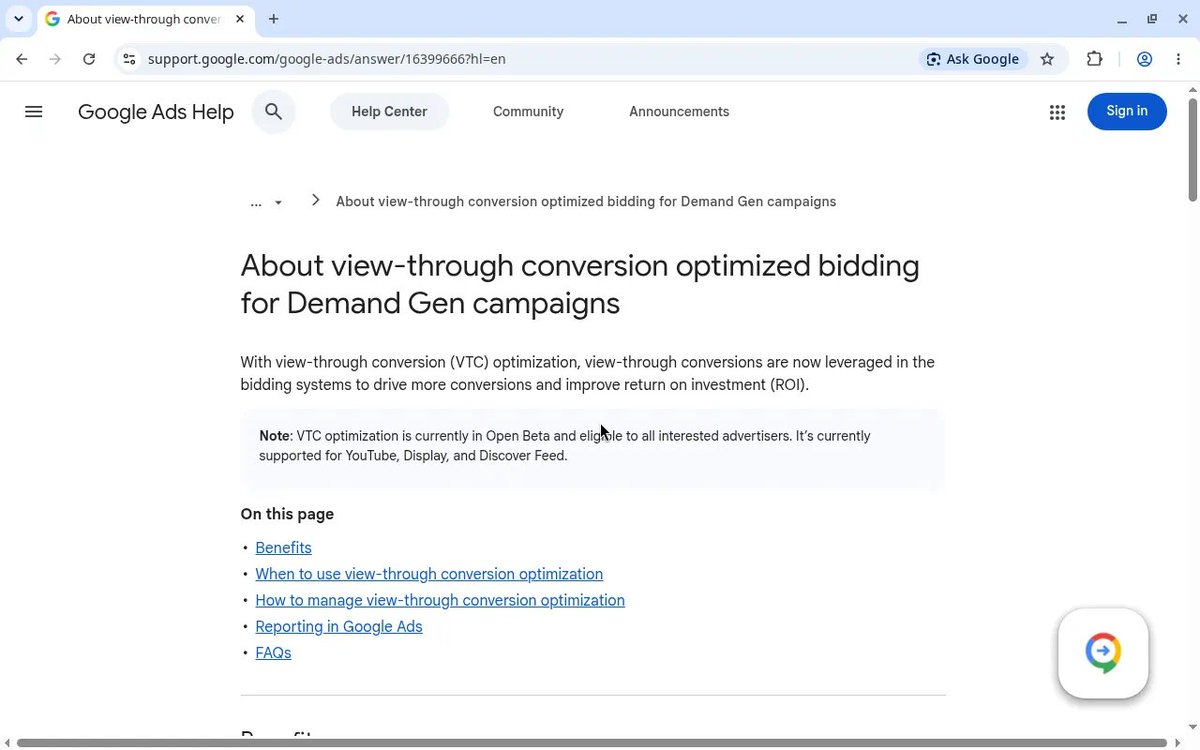
If your Demand Gen CPA just got prettier, check what you are optimizing for before you scale.
Two settings can make Demand Gen look like Meta on purpose:
- View-through conversion (VTC) optimization
- Demand Gen Campaign Type Attribution
Google now frames pairing them as the most apples-to-apples comparison with social platforms that bid on views by default and give full path credit.
What that means in the account:
VTC optimization (Open Beta, ON by default on new Demand Gen):
- Puts view-throughs into the Conversions column as biddable events for video on YouTube, Display and Discover
- A view is at least 1 pixel on-screen for any duration
Campaign Type Attribution (Beta via your Google rep):
- Scopes data-driven attribution to Demand Gen only
- DG can take full credit instead of sharing with Search or PMax
Useful when you deliberately want Meta-style reporting. Risky when Ads CPA is your decision metric. Stacking 1-pixel view credit with unshared DG attribution can inflate Demand Gen conversions, double-count against Search in the same account, and feed those numbers into Smart Bidding.
Do this before you raise budget:
- Segment Conversions by Ad event type (Impression = VTC)
- Confirm your VTC window (Help recommends 1 day for primary VTCs)
- Reconcile Ads conversions to CRM
Help already notes VTCs often will not export to third-party systems, so a gap is expected.
If Ads CPA looks fine but CRM or revenue CPA got worse, check what is Primary before you loosen targets or raise budget.
Smart Bidding optimizes the Conversions column. Primary actions in a goal the campaign uses for bidding land there. Secondary actions are observation-only in All conversions, unless you pull them into a custom goal.
So soft events as Primary (page view, begin checkout, add to cart, form start) teach bidding the wrong lesson. Ads CPA can look healthy while closed deals and revenue drift.
Also check lag. Enhanced conversions and offline imports can make Ads look ahead of CRM for days. Help notes a standard 7-14 day Smart Bidding learning window, and imported conversions take time to land. Reconcile a matched window before you call the CPA "fixed".
Do this before you change Target CPA or Target ROAS:
- List every Primary action on the goals your Search, Shopping, PMax, and Demand Gen campaigns actually bid on
- Move soft funnel events to Secondary unless that volume is the real business outcome
- Segment Conversions by Conversion action name
- Match Ads vs CRM for the same 7-14 day window (conversion time, not click time if your CRM uses close date)
Takeaway: a pretty Ads CPA is only useful if Primary equals the outcome finance cares about.
If your Demand Gen CPA just got prettier, check what you are optimizing for before you scale.
Two settings can make Demand Gen look like Meta on purpose:
- View-through conversion (VTC) optimization
- Demand Gen Campaign Type Attribution
Google now frames pairing them as the most apples-to-apples comparison with social platforms that bid on views by default and give full path credit.
What that means in the account:
VTC optimization (Open Beta, ON by default on new Demand Gen):
- Puts view-throughs into the Conversions column as biddable events for video on YouTube, Display and Discover
- A view is at least 1 pixel on-screen for any duration
Campaign Type Attribution (Beta via your Google rep):
- Scopes data-driven attribution to Demand Gen only
- DG can take full credit instead of sharing with Search or PMax
Useful when you deliberately want Meta-style reporting. Risky when Ads CPA is your decision metric. Stacking 1-pixel view credit with unshared DG attribution can inflate Demand Gen conversions, double-count against Search in the same account, and feed those numbers into Smart Bidding.
Do this before you raise budget:
- Segment Conversions by Ad event type (Impression = VTC)
- Confirm your VTC window (Help recommends 1 day for primary VTCs)
- Reconcile Ads conversions to CRM
Help already notes VTCs often will not export to third-party systems, so a gap is expected.
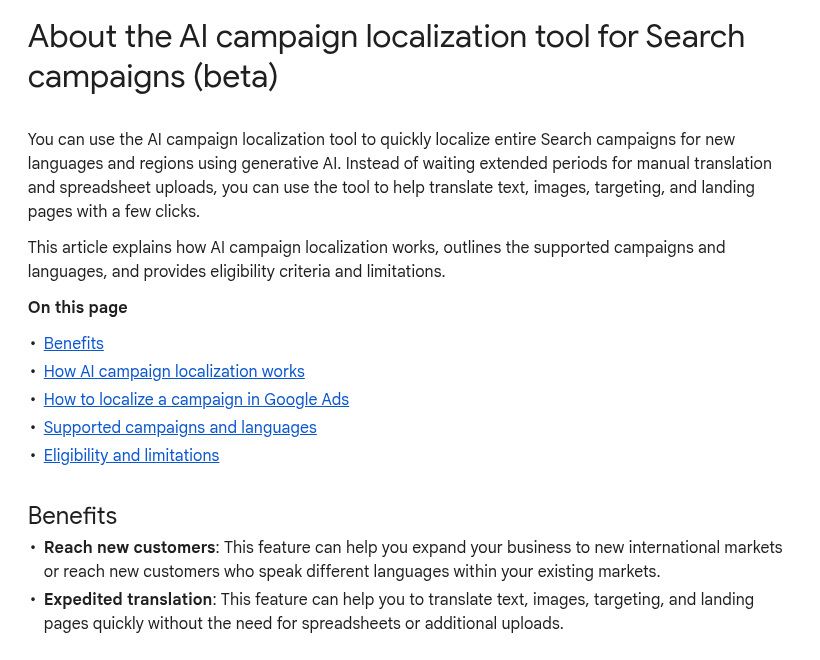
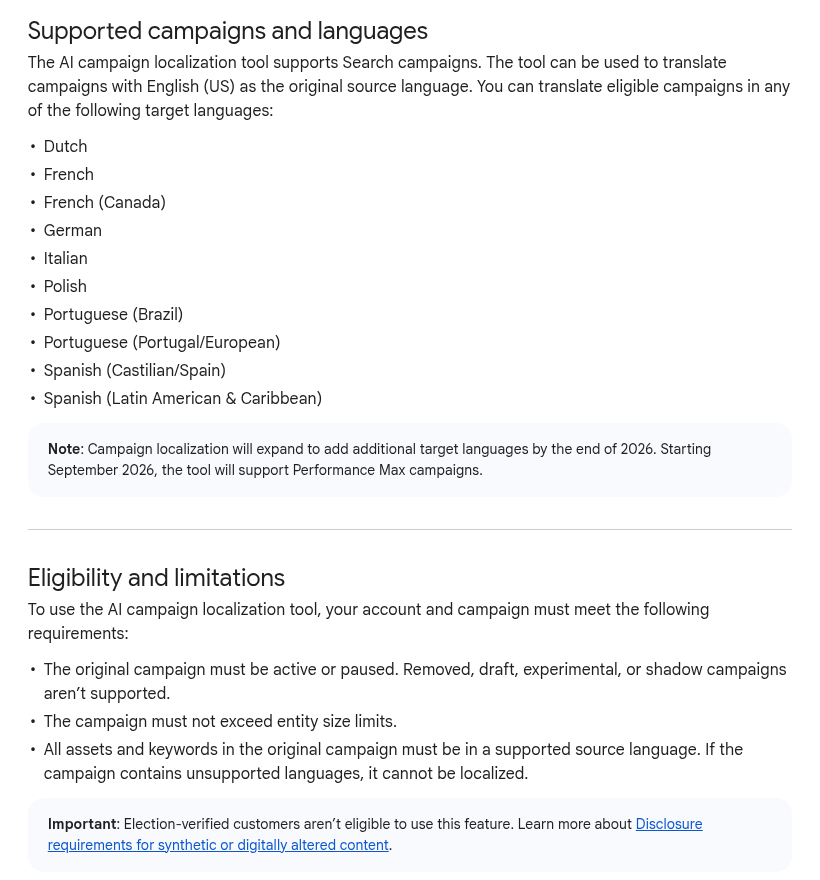
Google just shipped a beta that can spin a whole Search campaign into another language without touching the original.
AI campaign localization: pick an eligible English (US) Search campaign, choose target language, location and budget, and generative AI builds a new, independent campaign. The source stays as is. Headlines, descriptions, sitelinks, callouts and keywords get translated. Images with text overlays get the text in-painted out, with the message added as text assets. You review in a four-column table (original, translation, back-to-English, notes), can leave free-text instructions like "do not translate the brand," and publish paused by default.
Dutch is on the day-one language list, so NL/BE tests from a US-English source are suddenly a few clicks away. Entry points: Campaigns table, Tools > Localization, or an Optimization score localization recommendation.
The traps matter more than the wizard. Budgets and bids copy 1:1 with no FX, so a $100 US budget is still $100 in the new market. Translated keywords are not researched keywords. Local query language still wins. Landing pages: either a Google JS machine-translate snippet, or bulk URL find-and-replace. Neither is a native market page.
Treat the output like any new market draft: bids, keyword research and LP quality still need a human pass. And before you scale that geo on a copied budget with loose translations, sanity-check traffic quality so you are not learning from junk.
148 clicks via OpenAI ads in the U.S. Of those, more than 91.55% are from bots.
Cost: $213.
Real human clicks: 6.
That’s a lucrative business model for those guys! Especially if you’re working with soft conversions.
We (@clickpatrol) have a solution for that, at any rate.
Google just shipped a beta that can spin a whole Search campaign into another language without touching the original.
AI campaign localization: pick an eligible English (US) Search campaign, choose target language, location and budget, and generative AI builds a new, independent campaign. The source stays as is. Headlines, descriptions, sitelinks, callouts and keywords get translated. Images with text overlays get the text in-painted out, with the message added as text assets. You review in a four-column table (original, translation, back-to-English, notes), can leave free-text instructions like "do not translate the brand," and publish paused by default.
Dutch is on the day-one language list, so NL/BE tests from a US-English source are suddenly a few clicks away. Entry points: Campaigns table, Tools > Localization, or an Optimization score localization recommendation.
The traps matter more than the wizard. Budgets and bids copy 1:1 with no FX, so a $100 US budget is still $100 in the new market. Translated keywords are not researched keywords. Local query language still wins. Landing pages: either a Google JS machine-translate snippet, or bulk URL find-and-replace. Neither is a native market page.
Treat the output like any new market draft: bids, keyword research and LP quality still need a human pass. And before you scale that geo on a copied budget with loose translations, sanity-check traffic quality so you are not learning from junk.