Bu fotoğraf yanlış hatırlamıyorsam 2014 yılında Trabzon havaalanında çekildi. Yanınızdaki kızım. İlçe Başkanı olduğum dönemden kalma.
Bu çocuk 21 yaşında şimdi, üniversite öğrencisi. İki yıl önce ilk oyunu size vermiş ve göğsünü gere gere arkadaşlarına anlatıyordu.
Bugün telefonda; ‘Allah belasını versin Kılıçdaroğlu’nun’ dedi bana, durup dururken.
Umutlarını tükettiniz gençlerin. Yetmedi güvenimizi de sarstınız, ne söylesek inanmıyorlar artık. Başkası adına utanmayı çocuklarımız önünde yaşıyoruz, utançla…
Ne diyeyim;
Gün yüzü görmeyesiniz…
@kilicdarogluk
Kemal Kılıçdaroğlu’na hain diyenlerin partiden ihraç edileceğine dair bir haber okudum. Bu vesileyle Kemal Kılıçdaroğlu’na yalnızca hain demeyi yeterli bulmadığımı belirtmek istiyorum. Çünkü kendisi yalnızca hain değil aynı zamanda işbirlikçi, işgalci ve operasyoncu birisidir.
Devletin polisiyle partilileri karşı karşıya getirmekten imtina etmeyen, milyonlarca insanın iradesini gasp ederken bir an bile geri adım atmayan bu kişiye ne desek azdır. Böyle bir kişinin karşısında olup onunla mücadele etmek, tarihin bize yüklediği en doğru vazifelerden biridir.
Biz senin ne kardeşin nede yol arkadaşınız.Senin kardeşlerin ve yol arkadaşların sarayın koridorlarında.Sana oy verenleri sattın ve sana vatan haini diyenlerle yol yürümeyi tercih ettin...
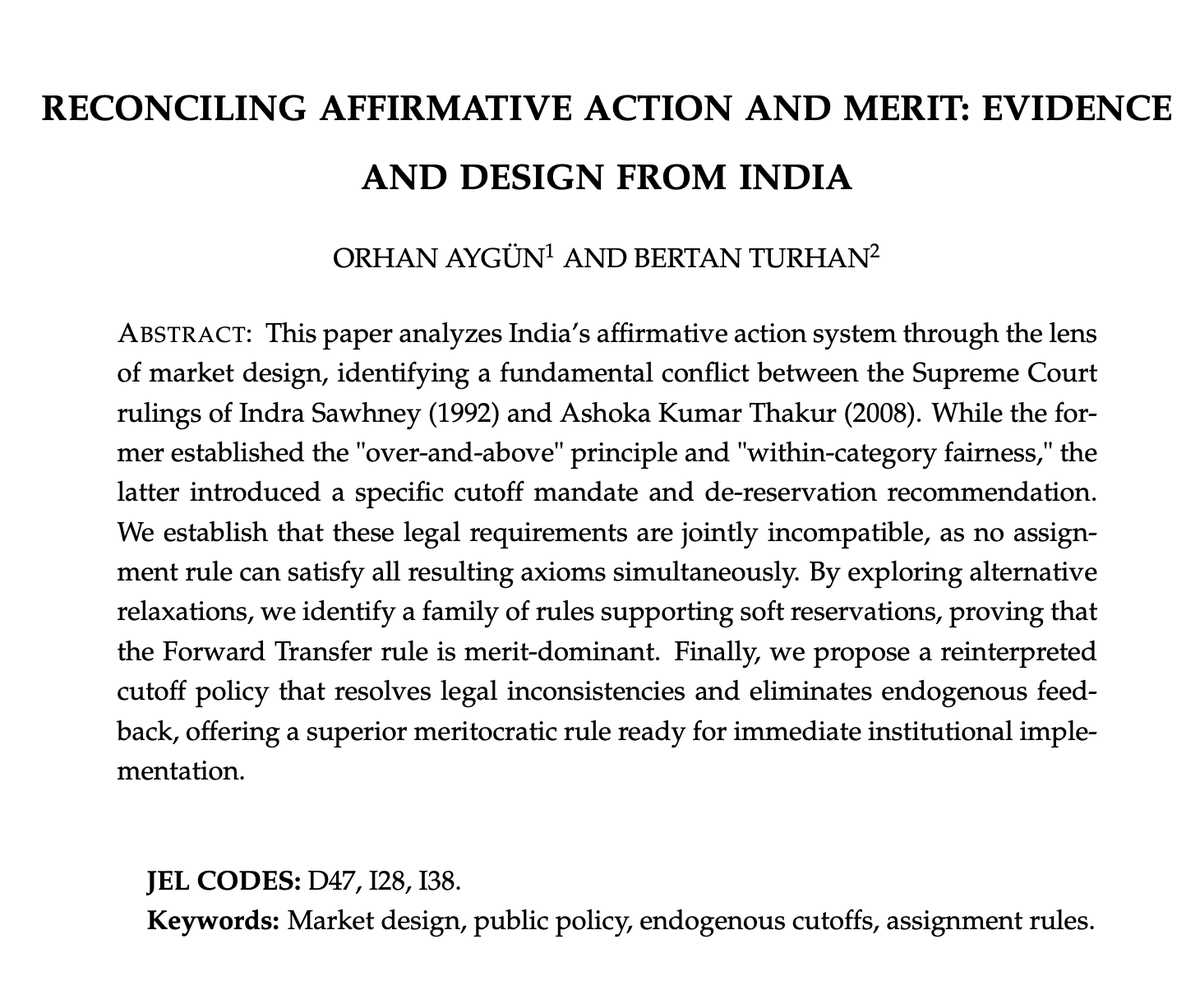
Excited to share our new paper: "Reconciling Affirmative Action and Merit: Evidence and Design from India," joint work with @orhanaygun_boun .
India operates one of the world's largest affirmative action systems, directly shaping the life outcomes of tens of millions of people each year. Our paper analyzes this system through the lens of market design — and uncovers a fundamental legal tension at its core.
Two landmark Supreme Court rulings are at the heart of the story:
📌 Indra Sawhney (1992) established three foundational principles — the over-and-above principle, within-category fairness, and quota-filling subject to eligibility — which together uniquely characterize the assignment rule India has used for decades.
📌 Ashoka Kumar Thakur (2008) introduced an OBC eligibility cutoff tied to the open-category score and recommended converting unfilled OBC seats into open-category positions.
We show that these two judgments are mathematically incompatible: no assignment rule can simultaneously satisfy all the resulting axioms.
To resolve this, we:
✔ Characterize the unique rule implementing the Ashoka Kumar Thakur cutoff mandate (AKT rule) — and show it can be severely wasteful.
✔ Propose a family of soft-reserve rules satisfying the Indra Sawhney principles with OBC de-reservation, and prove that the Forward Transfer (FT) rule merit-dominates all others in this family.
✔ Introduce η*, a reinterpretation of the cutoff policy that eliminates the endogenous feedback loop, resolves the impossibility, and strictly improves upon FT in meritocratic terms.
The result is a clear merit ranking: η* ≻ FT ≻ other soft-reserve rules ≻ Indra Sawhney ≻ AKT.
All proposed rules are practically implementable within India's existing centralized admission platforms — no new data or infrastructure required.
Happy to share the paper with anyone interested!
@econD47 #india @January #economics #publicpolicy
@TurkishAirlines announced 23% discount yesterday for flights from USA for April23-24 to celebrate National Sovereignty dayof Turkiye. However, the promo code they provided did not work. @TurkishAirlines simply misled millions of people. Do you have any explanation @TurkishAirlines?
I have been working on developing better ways to implement affirmative action in admissions to higher education and government jobs in India, among other countries. Reservations in India have been a very contentious social and political issue for decades. A Congress MP and a former Chief Justice of India discuss the merit vs. reservations tradeoff in the short 12-minute video below. Very enlightening. (Thanks, @KritiManocha, for sharing it with me.)
#India #Reservations #affirmativeaction
https://t.co/MNnk7PR4aj
At @NUEconomics, we have some amazing economics PhD's graduating this year interested in private sector jobs (not limited to the usual economic consulting track)
If you're hiring brilliant thinkers trained at one of the world's best economics programs, please DM or email
Very sad to hear of the passing of John Kagel.
He was a foundational figure in behavioral and experimental economics. His research reshaped how economists think about strategic interaction and social preferences. His teaching and mentorship influenced generations of students.