📢📢📢 Introducing VoroTracing
Differentiable Voronoi ray tracing that is faster than most rasterized splatting.
623 FPS on Mip-NeRF 360 (RTX 5090)
→ 3.2× the fastest prior ray tracer
→ 2.8× 3DGS
Paper + Code + Web Viewer: https://t.co/Mif178ijOf
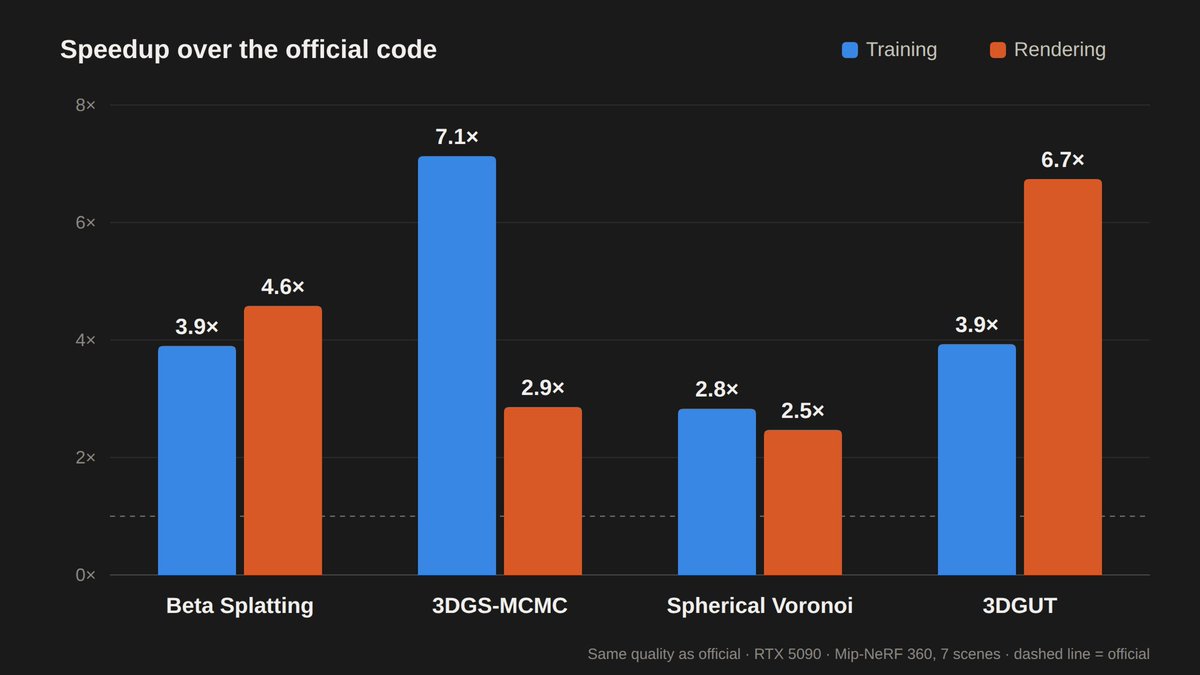
Aparently 3DGUT can be rendered 6.7x faster without losing quality!
I was curious to try the Faster-GS recipe on alternative Gaussian Splatting methods and was surprised how well it transfers.
All these methods have been added to MojoSplat: https://t.co/2EGs6zzmmo
@CSProfKGD Well recently Overleaf added tabs. Major improvement in quick navigation. Now you can split in multiple .tex and quickly change to any other open file
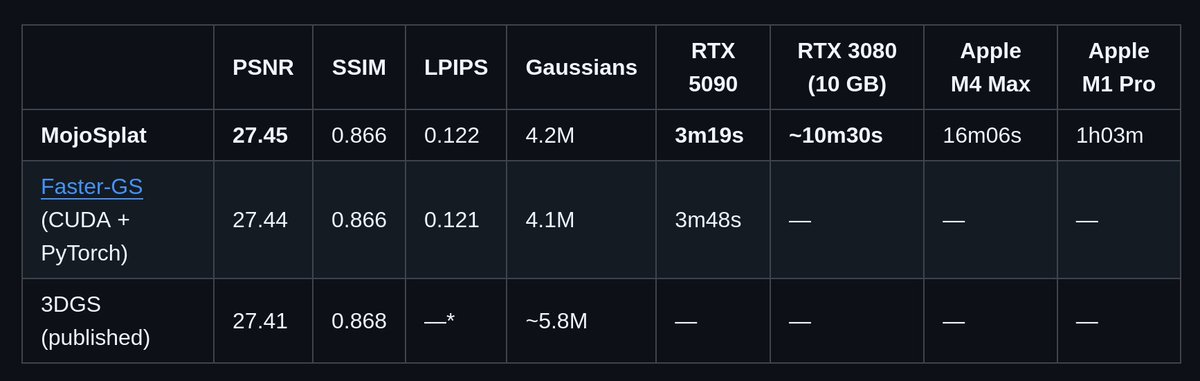
MojoSplat now lighter on memory supporting older hardware like an RTX 3080, it works on Apple Silicon macbooks and had some simple optimizations. Still no CUDA Toolkit involved, no multi-languages, or branched code. A single source of truth for all GPUs.
Next: AMD testing?
3DGS now running without CUDA, without Python and with a single language for both training code and GPU kernels.
Finally got around to update MojoSplat (using @Modular Mojo), matching @fhahlbohm Faster-GS on CUDA GPUs without even CUDA Toolkit installed
https://t.co/2EGs6zzmmo
@ylecun@davnords@gabriberton Well I think I can read and you wrote that DINO is a JEA. So I guess the question could be rephrased as: why do you think JEAs have outperformed JEPA despite you have worked on both with the same resources at Meta? Is there still something about JEPAs we haven’t figured out?
@pablovelagomez1 Hmmm how long in total does it take and for which scene? The training usually starts very fast and drops speed fast as the gaussians and spherical harmonic degree increase. So M4 Max seems to take about 16min, my M1 Pro takes 1h03min
3DGS now running without CUDA, without Python and with a single language for both training code and GPU kernels.
Finally got around to update MojoSplat (using @Modular Mojo), matching @fhahlbohm Faster-GS on CUDA GPUs without even CUDA Toolkit installed
https://t.co/2EGs6zzmmo
@Parskatt You have convinced me to upgrade... that is useable for small tests and development. Now the question is if to go for an RTX Spark laptop (slower RAM) or wait for the M7 Pro/Max with a potential beast of a GPU
@SoumilBhandari@Modular@fhahlbohm So each Gaussian issues one atomic per bucket instead of one per pixel. Warp shuffles, shared memory and atomics are all just Mojo stdlib calls. Gradients are checked against a float64 PyTorch autograd reference and match to ~1e-6
@SoumilBhandari@Modular@fhahlbohm No hand-rolled atomics. Mojo's stdlib has Atomic[Float32].fetch_add, which compiles to the hardware float atomic. Then like the Faster-GS per-Gaussian backward, a warp per bucket of 32 Gaussians, pixels passed lane to lane with shuffles, gradients kept in registers.
After a few tweaks and improvements MojoSplat is now running natively on Apple Silicon!
M1 Pro - 1h 03min
RTX 5090 - 3min 25sec
Not bad for this old laptop… same exact kernel code for all GPUs. No need to maintain multiple branches or paths
3DGS now running without CUDA, without Python and with a single language for both training code and GPU kernels.
Finally got around to update MojoSplat (using @Modular Mojo), matching @fhahlbohm Faster-GS on CUDA GPUs without even CUDA Toolkit installed
https://t.co/2EGs6zzmmo
@WaleedAjmal16@Modular@fhahlbohm Sorry confusing phrasing, I meant: ..Mojo kernels are regular Mojo, compiled to PTX and machine code like CUDA C++, with no translation layers.
@WaleedAjmal16@Modular@fhahlbohm Brush codes GPU using CubeCL, a DSL embedded in Rust. Kernels go CubeCL -> WebGPU shader -> Vulkan/Metal/DX12 -> driver, limited to WebGPU's feature set (no float atomics). Mojo kernels are regular Mojo, compiled straight to native GPU code like CUDA.
Hey @Apple@AppleSupport , why do Metal developers need to install 10GB+ of Xcode just to compile GPU kernels?
I don't need an IDE, simulators, or iOS SDKs. I need metal, metallib, and a compiler toolchain.
Easire to install CUDA Toolkit, and that is a low bar...