God’s baby💫!Can you see the world through my eyes? founder @by_soye Co founder @inhershoes_Nig. mostly ranting about stocks and crypto. I love fitness.
It's the general operating system they all run; the UK has one of the worst versions.
See what happened with Intl students recently. A single cohort was estimated to contribute about £41.9bn to the economy.
Yet, the public framing became "students are abusing the route" b/c politicians were too frightened to say plainly that universities & local economies had become dependent on them. Their very lifeblood, even. Which was what the government, in the first place, had pushed the universities to do when they asked for funding and a proper policy.
Then they moved the same framing onto immigrants generally. And accelerated the agenda when they saw they could lose some seats to fringe far-right parties.
The UK is one of the most expensive countries to enter legally.
People paying visa fees, IHS, rent, tax & NI are still discussed as if they arrived with a bowl in one hand & a benefits form in the other.
That is, anyway, the defining feature of empire. The state wants the labour and the money, but it does not want the cost of telling voters the truth about who is keeping parts of the engine room running.
@EmmaAjoku@Farida_N But this proves what she said right. A lot of Chinese and Indian citizens send money home for investments or to enrich existing infrastructure that benefits them directly. A lot of what is sent back in Nigeria is mainly for survival. And not for economic growth.
Every British PM’s nightmare
With Keir Starmer expected to fall on his sword shortly, here is my take on the conundrum facing Andy Burnham, indeed any and every British PM.
The true nature of Britain’s ‘special relationship’ with the United States has far more to do with American financiers’ willingness to keep borrowing to purchase British government debt than with history, culture or Britain’s defence needs. This is the burden under which every UK Prime Minister must labour.
Mike Tyson famously said, “Everyone has a plan until they get hit”. The same could be said of prospective British prime ministers, especially after Liz Truss's spectacular defenestration. They all have a plan until the guilt market hits them. Andy Burnham, Nigel Farage, my friend Zack Polanski will have to face this, if they ever move into 10 Downing Street. I think they know it. But I doubt whether they appreciate the true magnitude or nature of their predicament.
Conventional wisdom has it that the bond market comprises people looking to invest their savings in a government's debt. They seek the right balance between a higher interest rate and the increased risk this implies. For example, higher bond yields may signal that the market expects future inflation to reduce the value of the fixed interest payments that their bonds will yield. Worse still, it may foreshadow a risk of government default, as occurred in Argentina and Greece.
That’s more or less what first year economics and finance students are taught. And it’s all true. Except that, in the case of the United Kingdom, this story misses the most fascinating and worrying aspect of its government bond or gilt market: The British government’s ability to refinance its public debt of almost 3 trillion pounds does not depend on savers choosing to invest in gilts. In fact, the British government’s ability to sell gilts hinges heavily on the willingness of numerous US-based financial institutions to borrow substantial sums of dollars to purchase British gilts, which they then use as collateral to borrow for their own purposes within the US.
And there’s the rub. There is a world of difference between needing to borrow from savers and from relying on speculators who borrow themselves to lend you. Savers who lend to you focus on your long-term ability to repay them. They may tolerate your desire to make infrastructural investments that could increase your debt in the short term, in return for future profits that will help you repay them when their bonds expire. However, speculators who borrow in order to lend are a different beast entirely. They are much jumpier and prone to margin calls: situations where, if the bonds they purchased from you begin to lose value, fearing they will not be able to repay their own creditors, they dump your bonds thus turning their decline into a crash.
The question arises: Why are British bonds, or gilts, so much more reliant on American speculators borrowing money to buy them than German bunds, Japanese bonds, Italian bonds or Greek bonds? Why does every British government rely so heavily on American leveraged capital inflows?
It all started in the 1950s when the City of London discovered how to avoid following the British Empire down the road to oblivion. The trick was to carve out a niche for the City within the emerging dollar empire, which was institutionalised within the Bretton Woods system. American financiers faced rigid capital controls within that system, but the City of London was able to alleviate these due to three invaluable features.
First, London’s trading expertise and legal system offered American financiers efficiency with immunity from all sort of interventions, including democratic accountability. Secondly, Britain’s network of offshore jurisdictions offered fabulous tax-minimisation opportunities. And, thirdly, London quickly became the holding depository of a torrent of petrodollars and eurodollars, not to mention the shadowy dollars created outside the United States by foreign bankers.
Thus, the Great British paradox: while the UK's real economy was in decline, the City of London was flourishing. When the Bretton Woods system collapsed in the 1970s, American financiers discovered another use for the City: they borrowed dollars in the US short-term to buy long-term UK government gilts, which they then sold quickly to repay their loans. They would then repeat this process again and again to profit handsomely. This is how the British government became reliant on leveraged US institutions. In order to continue operating as usual, London today requires American balance sheets that are willing to expand through borrowing and use British gilts as collateral in order to maintain liquidity in the US.
Put differently, the flipside of the City’s success story is that, even though it borrows in a currency that it prints, the UK is not financially sovereign. Yes, the City occupies a strategically important position within the global dollar system but the price for this is that the UK government’s sovereignty is circumscribed by its priority to maintain the City’s central position in American finance. While this remains the priority, the occupant of 10 Downing Street is like the captain whose powers are limited to re-arranging the deck chairs on the Titanic.
Is there an alternative to this peculiar form of financial subservience to US-based leveraged financiers? Yes, but it requires a willingness to accept a falling pound and falling house prices while increasing public investment through a new investment bank that issues bonds supported by the Bank of England.
Any Prime Minister who tries to maintain Britain’s financial servitude to US capital while also investing in public goods may well put Britain on a path towards the IMF, whose sole purpose, lest we forget, is to create the political leverage that will bring about – like it did in Greece – the permanent loss of sovereignty over tax and spending policy. The question is: Do the current contenders for Britain’s top job understand this?
https://t.co/xGrWjjcudY
A democratically elected British Prime Minister has been driven from office by a relentless campaign of propaganda and misinformation; funded, amplified and perpetuated by foreign billionaires and elites whose interests bear zero resemblance to those of ordinary working people.
A noble gesture from an emotional Keir Starmer, entirely consistent with his conduct in office.
A truly sad day for British democracy.
His full resignation speech:
If you pay the price for intimacy with God. There is nothing he won’t tell you or confirm through you.
Try it today, 3 days retreat with God, no phones, no social media, no agenda no nothing, just you and God
If you struggle to decipher the voice of God, this will help.
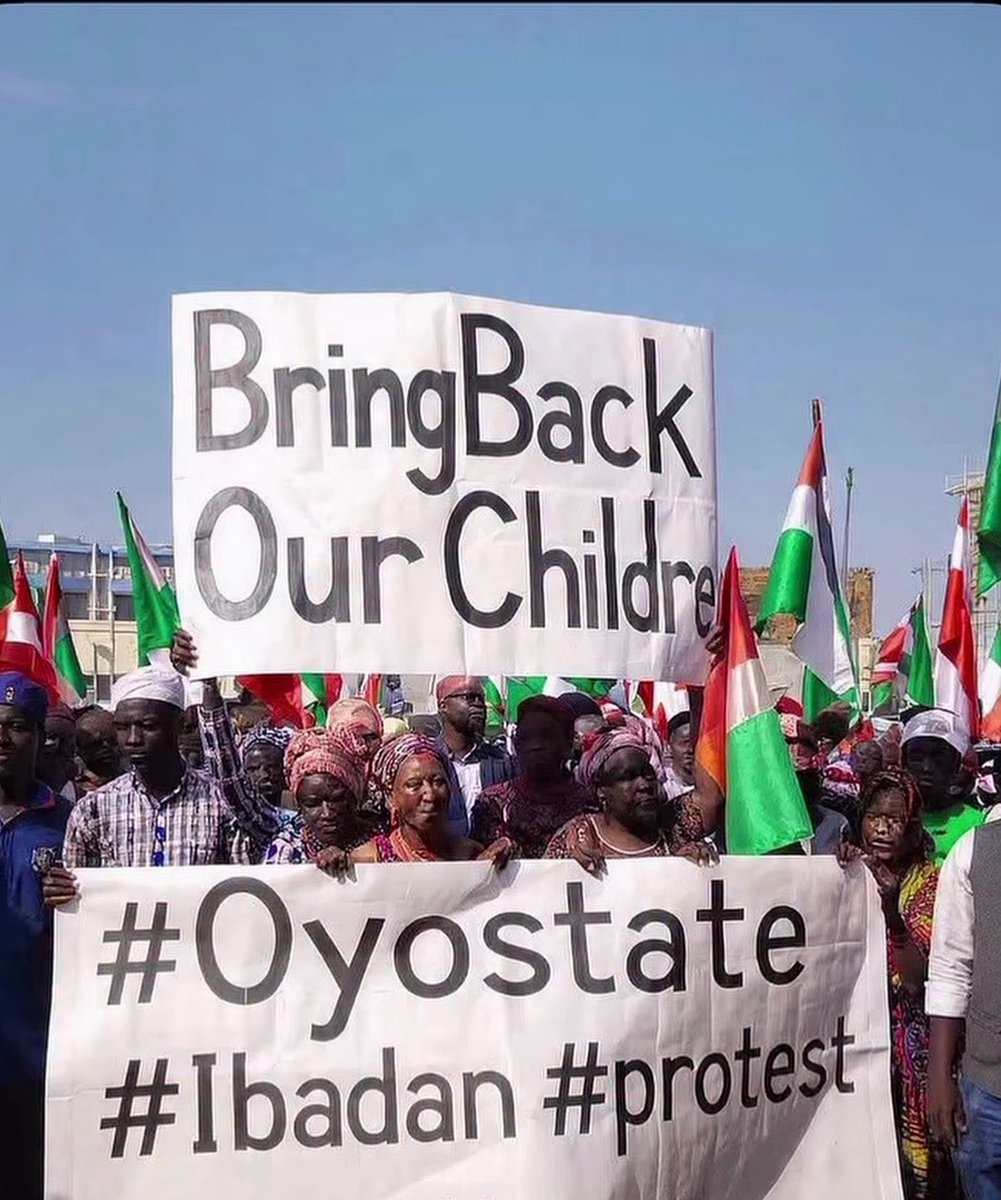
They are people’s children, people’s parents, people’s spouses. They’ve spent 20 days in captivity. We cannot normalize silence! This too heartbreaking!💔
💔
I haven't slept properly in days.
I keep thinking about those children. About the teachers. About the parents who kissed their kids goodbye, expecting them home after school, never imagining that a normal school day would turn into a nightmare.
Maybe it's because I keep putting myself in their shoes. Maybe it's because I can't stop wondering what those families are going through right now.
How did we get to a point where going to school feels like a risk?
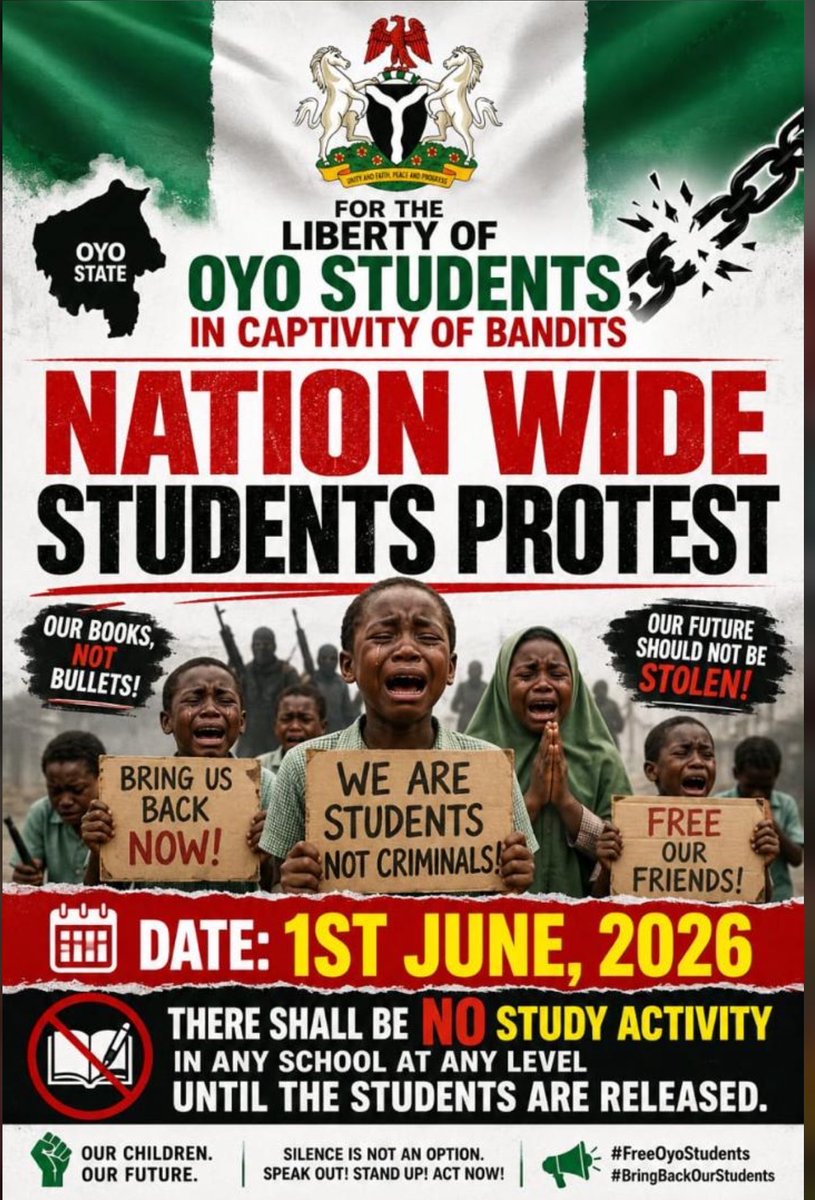
Part of me feels like schools across the country should shut down until every student and teacher is returned safely. Not because education isn't important, but because our children are. Because no parent should have to choose between giving their child an education and keeping them alive.
And then a thought keeps breaking my heart....what if this fear becomes normal? What if parents stop sending their children to school because they are terrified? What happens to a generation that grows up afraid of classrooms?
I don't know the answers. I just know that my heart is heavy, and I know I'm not the only one losing sleep over this.
Enough is enough. Our children deserve to learn without fear💔💔💔💔💔💔
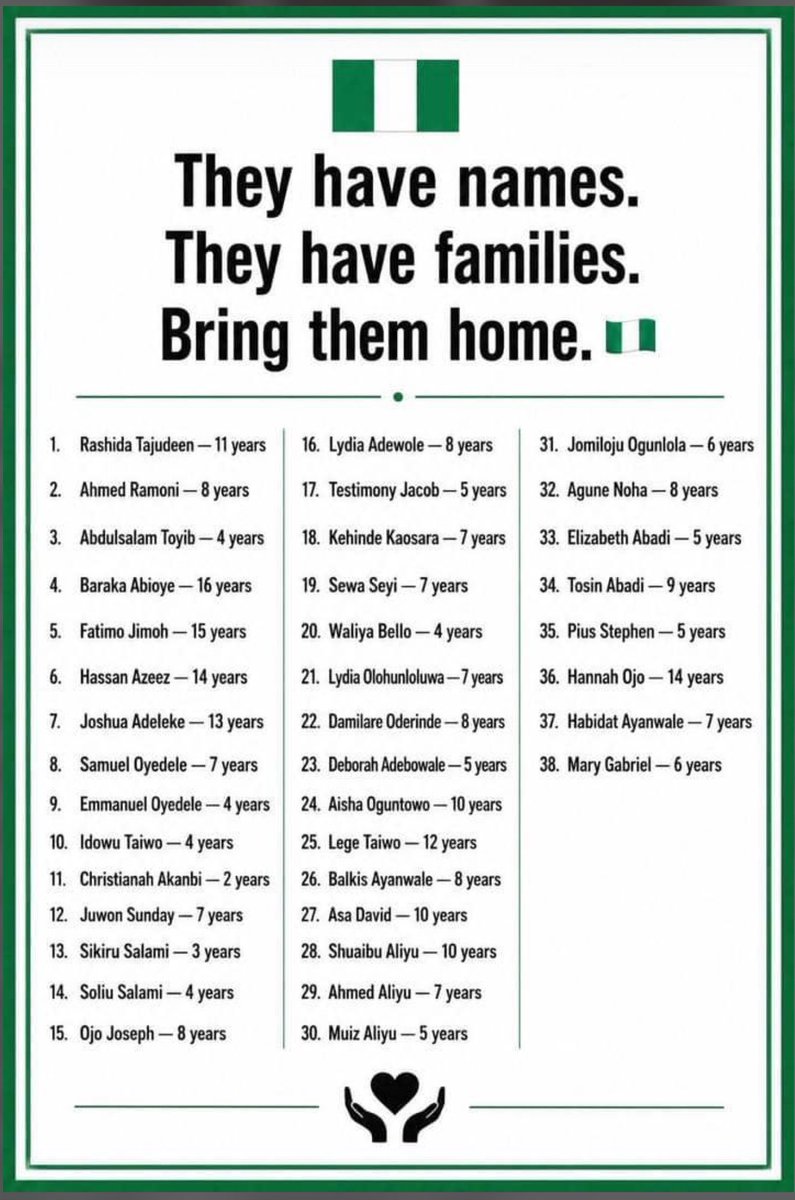
Damilare Oderinde - 8 years old
Deborah Adebowale - 5 years old
Aisha Oguntowo - 10 years old
Lege Taiwo - 12 years old
Balkis Ayanwale - 8 years old
Asa David - 10 years old
Shuaibu Aliyu – 10 years old
Ahmed Aliyu – 7 years old
Muiz Aliyu – 5 years old
Jomiloju Ogunlola – age not known
Agune Noah – 8 years old
Elizabeth Abadi – 5 years old
Tosin Abadi – 9 years old
Pius Stephen – 5 years old
Hannah Ojo – 14 years old
Habidat Ayanwale – 7 years old
Mary Gabriel – 6 years old
Jacob Gabriel - age unknown
@officialABAT #BringBackOurChildren
As a survivor of kidnapping and banditry, I can tell you that these criminals believe that no matter how much they take from you, you will eventually work and earn it back after your release.
Let me use myself as an example. After my family paid the ₦15 million ransom they demanded, along with other items worth over ₦600,000, they still weren't satisfied. They continued demanding more money and eventually asked for ₦55 million. They even told my mother to sell her house and car to raise the money.
Because my family rented a vehicle to deliver the ransom and other requested items, the kidnappers assumed we owned the car and were wealthy. They kept insisting that we sell all our properties and hand over the proceeds to them.
Omo, it was a terrible ordeal. The fear, pressure, and emotional torture were overwhelming. Watching my family struggle to meet their endless demands was heartbreaking.
One painful reality is that they often target ordinary and struggling people like us because we are easier to capture than the elites, who usually have better security and protection.
This is why we cannot continue to stay silent. Kidnapping and banditry have destroyed countless lives, families, and dreams across Nigeria. We need to raise our voices, stand together as a nation, and demand urgent action against insecurity.
Today it may be someone else's family. Tomorrow it could be yours. Enough is enough. 💔🇳🇬🙏🏽
Until Nigeria begins to have issue-based politics, we won’t make it out of the hood. Fact
Pick a random elected govt official and you cannot even tell what their ideology is. What do they believe in? what are they against? It is just vibes & you can’t run a country on vibes.