Charlie Kirk reminded us that a life of courage and virtue isn’t easy—but it’s worth living. His example should inspire us all to stand boldly for what’s right.
Elon Musk just put a price tag on obedience. It costs $200,000.
Musk: “You don’t need college to learn stuff. Everything is available basically for free. You can learn anything you want for free.”
Every lecture. Every textbook. Every framework ever written. Free on any screen in any country right now. The entire knowledge monopoly collapsed in a decade. Nobody updated the price tag.
Musk: “Colleges are basically for fun and to prove you can do your chores. But they’re not for learning.”
Strip the ivy and the branding. What’s underneath is a four-year obedience trial. Can this person follow instructions on a schedule without asking why.
Musk: “There is a value that colleges have, which is seeing whether somebody can work hard at something, including a bunch of annoying homework assignments, and still do their homework assignments.”
That is the entire six-figure value proposition. Not what you know. Not what you can build. Whether you can be managed. The establishment doesn’t need you educated. It needs you domesticated.
Musk: “If you’re trying to do something exceptional, you must have evidence of exceptional ability. I don’t consider going to college evidence of exceptional ability.”
The system doesn’t produce exceptional. It produces manageable. It takes the most creative years of your life and teaches you to wait for instructions. That is not education. That is containment.
Musk: “Gates is a pretty smart guy, he dropped out. Jobs is pretty smart, he dropped out. Larry Ellison, smart guy, he dropped out.”
They didn’t leave because they couldn’t keep up. They left because the ceiling was underground.
8 billion people now carry the same library in their pocket. The one these institutions charged a lifetime of debt to access.
The only product the university still sells is the belief that you need one.
If Democratic House nominees:
Darializa Avila Chevalier in New York,
Adam Hamawy in New Jersey
Melat Kiros in Colorado
Brad Lander in New York
Claire Valdez in New York and
Scott Weiner in California
join the radicals already in the House:
Rep. Becca Balint (D-VT)
Rep. Alexandria Ocasio Cortez (D-NY)
Rep. Maxine Dexter (D-OR)
Rep. Maxwell Frost (D-FL) Rep. Adelita Grijalva (D-AZ)
Rep. Pramila Jayapal (D-Wash.)
Rep. Ilhan Omar (D-MN)
Rep. Rashida Tlaib (D-MI) Rep. Ayanna Pressley (D-MA)
and radicals
Sherrod Brown in Ohio,
Abdul El-Sayed in MI
Peggy Flanagan in Minnesota
Graham Platner in Maine
James Talarico in Texas
join radicals already in the Senate:
Ed Markey (D-MA)
Jeff Merkely (D-OR)
Bernie Sanders (D-VT) Chris Van Hollen (D-MD) John Ossof (D-GA)
Elizabeth Warren (D-MA) Sheldon Whitehouse (R-RI)
Then the Democratic Party will be controlled by radicals in both the House and the Senate. It will not be the Democratic Party of Biden, Obama and Clinton much less of JFK and FDR, but a wholly new party never seen in America before. Vote Republican in every race everywhere to repudiate the emerging “new Democratic Party” of radical anti-West, anti-American, anti-Israel and anti-Semitic convictions and program.
🚨 JUST IN: Gov. Ron DeSantis confirmed that after he finalizes the new budget, the red state of Florida will have SLASHED SPENDING for 4 YEARS STRAIGHT…
…Florida will have a budget less than HALF the size of New York, despite being similar in population
…and the state rainy day fund WILL BE 100% FULL and more than 3X THE SIZE from 7 years ago
FLORIDA CRUSHES IT AGAIN! 🇺🇸 ☀️
All with NO INCOME TAX and impending slashing of property taxes. Imagine that.
@GuntherEagleman Metabolic therapy. Ultra low carb diet. Paleo diet. Low glucose ketone index. That will help. See this doctor talking about this.
You should see all this video, but in minute 57 he tells the story of Pablo Kelly. This guy had an inoperable gioblastoma.
https://t.co/rwfSZJUAHk
A close friend just sent me this to post…
“I know a young girl with a brain tumor that’s located in such a critical part of her brain that surgery isn’t considered a safe option because of the risk of damaging essential brain functions.
I’m reaching out in hopes of learning from people who’ve faced something similar. Have you or someone you know had success with any treatments, medications, targeted therapies, immunotherapy, clinical trials, or anything else that helped shrink the tumor or led to a better outcome?
I’m looking for real experiences and information that might be worth discussing with her medical team. Thank you.”
Please leave a comment if you can.
I start most mornings the same way.
Out back, barefoot on the bare ground for a few minutes.
Coffee in hand.
People assume it is some hippie thing. It is not.
We spend our whole lives sealed off from the earth.
Rubber soles, concrete, a floor between us and the ground.
Then we wonder why we feel wired and restless.
I started years ago.
I will not oversell it.
The science here is still thin,
And I am not going to claim something I cannot back.
What I can tell you is what I notice.
I feel steadier throughout the day, and I sleep more soundly at night.
It costs nothing and takes five minutes.
Old school, on purpose.
Last night’s speech by Treasury Secretary Scott Bessent signals the decisive shift in US economic doctrine: from efficiency to sovereignty.
Invoking Alexander Hamilton, Bessent framed industrial capacity not as a legacy asset, but as the foundation of national power in a contested world. The comparison is not casual. If carried through, it would make Bessent the most consequential Treasury secretary since Hamilton himself.
The message is clear. Globalisation optimised for cost has left the US exposed, to supply disruptions, geopolitical coercion and technological leakage. Dependence is no longer a benign feature of trade; it is a strategic vulnerability.
This is not autarky, but reprioritisation. Semiconductors, energy systems, advanced manufacturing and compute infrastructure are being recast as sovereign capabilities. Supply chains are judged less by efficiency than by their ability to withstand shocks and resist pressure from adversaries.
The economics are less comfortable. Resilience implies higher costs, sustained fiscal support and the risk of stickier inflation. But Washington appears willing to pay.
For markets, the shift is structural. Capital will follow policy into strategic sectors, while exposure to adversarial supply chains will command a growing discount. Hamilton’s logic has returned. This time, markets may have less choice but to follow.
Hormuz, Houston, and the Quiet American Victory Many Refuse to Accept
The same crowd that told you Donald Trump could never win a primary, let alone a presidency, is back at it again. They insist the Iran war is “lost,” that there will be no deal, that America has somehow stumbled into strategic defeat. They are making the same mistake twice.
In reality, the United States has already forced a reckoning the foreign‑policy establishment spent decades avoiding. In this new era, the world finally sees Iran for what it is: a radical regime willing to hold a global artery hostage. And the world is drawing the obvious conclusion, that the twenty‑first‑century economy cannot depend on an oil lifeline controlled at gunpoint. Has no one noticed the tankers quietly diverting toward a different hemisphere, toward what is fast becoming the Gulf of America?
As the complaints grow louder that “we need a deal now,” it is worth asking who is doing the complaining. The impatience comes largely from the same voices that never foresaw a U.S. victory over Iran’s gambit in Hormuz, and cannot yet imagine the peace dividend that will follow. They missed the strategic re‑rating of Iran from difficult regional power to systemic energy risk. They missed the quiet migration of tankers toward the Gulf of America. Now they mistake a necessary interval of pressure and bargaining for failure, precisely because they cannot recognize that the fundamentals have already shifted in America’s favor.
To wit, any deal he strikes will be judged by the wrong standard if you judge it by the same people who thought the JCPOA was statesmanship. Their benchmark is the agreement that shipped Tehran pallets of cash and sanctions relief while allowing it to keep enriched uranium, ballistic missiles, and regional proxies intact—a deal that subsidized the very regime now firing drones into the Gulf and threatening tankers. That standard is not just misplaced; it is discredited.
Measured against that history, what President Trump is chasing is not utopia but correction. It will not turn the Islamic Republic into a Scandinavian social democracy. It will not abolish forever the temptations of coercion in Hormuz. But it can lock in hard, strategic gains.
The same critics who cry failure over Hormuz have nothing to say about the victory in Venezuela, where U.S. pressure and engagement helped unlock reserves and discipline a rogue petro‑state. They glide past the several wars Trump has stopped or frozen, because those don’t fit the script in which every Trump move is a prelude to Armageddon. They are equally silent about the quiet alignment with Beijing. China, hardly a natural Trump ally, has made it plain: Iran cannot have a bomb and cannot own the Strait. That matters. When the world’s largest energy importer and the world’s leading navy converge on the same two red lines, Tehran’s room for maneuver shrinks, and America’s long‑term position strengthens, whether the commentariat wants to admit it or not.
🚨 BREAKING: FLORIDA LEGISLATURE FORMALLY APPROVES ABOLISHING PROPERTY TAXES for most primary homeowners statewide
Both chambers RESOUNDINGLY pass Gov. Ron DeSantis’ proposal, SENDING IT TO VOTERS for approval this November
LET’S GO!!! ☀️👏🏻
Needs 60% of voters this fall.
Florida is MAKING HISTORY!
The homestead exemption will surge up to $250K to start, and a schedule will set its elimination in the future
However, MOST homeowners will already get effective 0 taxes under the proposal.
DO IT NATIONWIDE!
Elon Musk just defended America better than every politician in Washington combined.
Musk: “After World War 2, the US could have basically taken over the world and any country. Like we got nukes, nobody else got nukes. We don’t even have to lose soldiers. Which country do you want?”
One nation on earth held a weapon nobody else had.
Total dominance. Zero competition. No risk of retaliation.
Every empire in history that held that kind of advantage used it.
Rome. The Mongols. The British. The Ottomans.
They conquered until they collapsed.
America had a bigger advantage than all of them combined.
And it rebuilt the countries it just defeated.
Musk: “The United States actually helped rebuild countries. So it helped rebuild Europe, it helped rebuild Japan. This is very unusual behavior, almost unprecedented.”
Almost unprecedented?
It had never happened before. Not once in 5,000 years of recorded history.
The Marshall Plan wasn’t foreign aid.
It was the most radical act of restraint any superpower ever committed.
America turned its enemies into allies. Turned rubble into economies. Turned surrender into partnership.
Germany went from ashes to the economic engine of Europe in a generation.
Japan went from unconditional surrender to the third largest economy on earth.
Three years after the war, America was flying food into Berlin.
A city in the heart of the nation that just tried to destroy it.
That’s not policy.
That’s a civilization deciding what it is at the exact moment it has the power to be anything.
You’re being told a story right now.
That America is the villain of history.
You hear it everywhere. Media. Universities. Social platforms.
Musk: “There’s always like, well America’s done bad things. Well of course America’s done bad things, but one needs to look at the whole track record.”
Every nation on earth has dark chapters. Every single one.
The difference is what a country does when nobody can stop it.
And when nobody could stop America, it fed its enemies and rebuilt their cities.
Musk: “The history of China suggests that China is not acquisitive. Meaning they’re not going to go out and invade a whole bunch of countries.”
Probably right.
China has historically built walls, not fleets.
But the real question isn’t about borders anymore.
We’re approaching a moment that mirrors 1945 in ways nobody has fully processed yet.
AI is going to give a handful of people a power advantage that makes nuclear monopoly look quaint.
If someone is going to hold that kind of power, who do you want it to be?
The country that conquered when it could? Or the one that rebuilt when it didn’t have to?
Every alliance. Every trade route. Every economy.
Billions lifted out of poverty.
All of it traces back to one act of restraint that had never been done before.
And carries no guarantee of being repeated.
The most powerful thing America ever did wasn’t building the bomb.
It was what it didn’t do after.
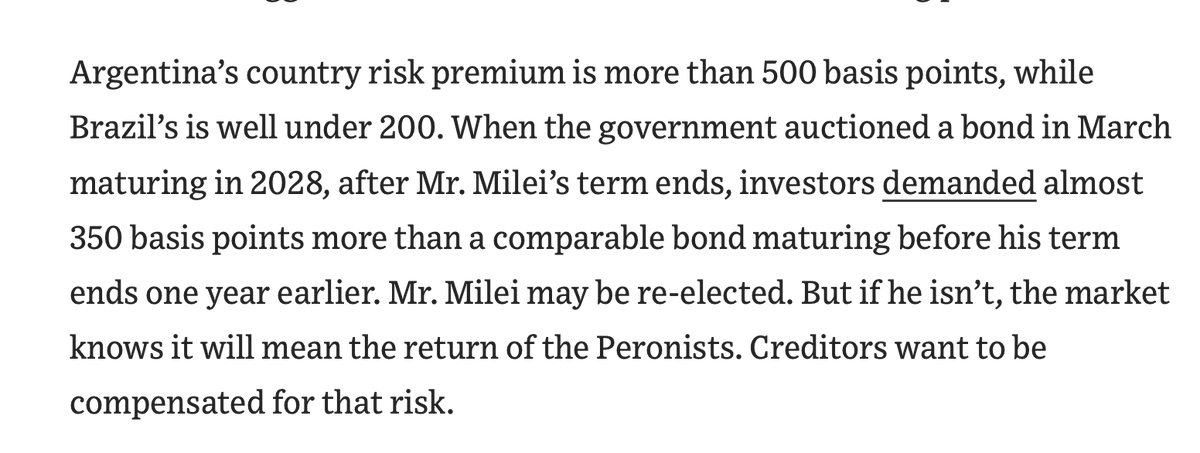
Argentina can borrow in dollars until October 2027 at about 5.02% annual yield.
To borrow just one year longer, until October 2028, investors demanded 8.5%.
Why the difference?
Argentina has a presidential election in 2027. .
In plain English: investors are much more confident Argentina will pay while Milei is in office than they are after a possible Peronist/Kirchnerist return.
Tip: Don’t elect people the bond market thinks are less likely to pay their debts. They're not going to do good things for your country.
This man says, “let me get this straight.
When White people move into an area, it’s called “colonizing” or “gentrification”,
which is bad.
But if people of a high melanin count move into an area, that’s “cultural enrichment” and “diversity is our strength”,
which is good.
But then if those same White people don’t want any more “cultural enrichment” or are tired of “diversity” being their strength, that’s called “White Flight”,
which is bad.
So they don’t want White people to come or to go.
It’s almost as if they don’t want them (whites) to exist at all.”
He’s figuring it out.