Orthopedic Truths:
Tennis Elbow
Stupid name
Most people who have it don't play tennis.
Nearly every person will get it.
The most common cause of lateral elbow/upper forearm pain.
It will resolve almost everyone on its own.
Without "treatment".
But it might take 6-12 months.
Yep, 6-12 months.
It may not resolve in some people.
Some people have minimal symptoms.
Some have severe pain.
Some people deal with pain well.
Some don't.
Most people are in our office because they're afraid of hurting themselves or they have a fear of the unknown.
If you tell them the proper story about tennis elbow, most are relieved and will go on to live their active lives without needing anything.
The pain when lifting with your palm facing down is real.
It also will amaze you how often the outside of your elbow contacts doors, etc.
Lift with your palm up... no pain.
The examination is straightforward.
The diagnosis is straightforward.
MRI imaging isn't needed.
It always says, "partial thickness tears.... yada, yada, yada...."
MRI findings are rarely a reason to have surgery.
Basically... there's very little reason to operate on these at all.
Besides... there are plenty of surgeries described to manage this... most involve releasing/removing the offending tendon-- the ECRB... so why would a tear need to be "fixed" 😂
It can be super annoying... I'll agree to that.
It's worse in people who lift a lot for work.
Some people might insist that something be done.
That's fine...
But far, far, far too many are offered injections as a first-line treatment.
Steroid injections are not kind to tendons.
They're not kind to the lateral ligaments, either.
If not appropriately placed, steroids dissolve the fat under your skin.
That pale dimple with veins running through it is unsightly.
Tendons really don't like steroid injections.
A steroid injection might feel great for a few weeks or months... but the pain often returns.
Not in everyone, though.
So... it might have worked for you.
But it made many others worse.
PRP injections, anyone??
Maybe
It won't cause harm.
You should never pay > $500-1000.
It could work...
Then again...
so do placebos
I'm not calling PRP injections placebos...
But, you know, maybe???
Physical therapy?
Meh...
But anything that distracts you while nature runs its course is valuable.
Braces?
Meh...
That damn placebo effect again
Try it... no harm, no foul.
Red light, laser, blue/purple pulsed lights... whatever.
Shockwave therapy... maybe.
Hard to find... and it hurts... but it might help.
This very common yet annoying ailment is so prevalent.
Most everyone is going to get it.
Carry on...
No need to rest or stop activities unless the pain is too spicy.
Everyone on IG has a cure: save your money, and if you can move on, wait it out.
As usual... it's always far more complex than most people think.
📢UK Physiotherapists📢
If you have experience of treating shoulder osteoarthritis please consider completing this survey:
https://t.co/46idggNvMH
It should take less than 10 mins and no personally identifiable data will be collected.
Please feel free to share far and wide.
Finally, our investigations also suggests that the rotator cable may become thicker with the development of degenerative changes to the rotator cuff, which is in accordance with the MRI study of Choo et Al
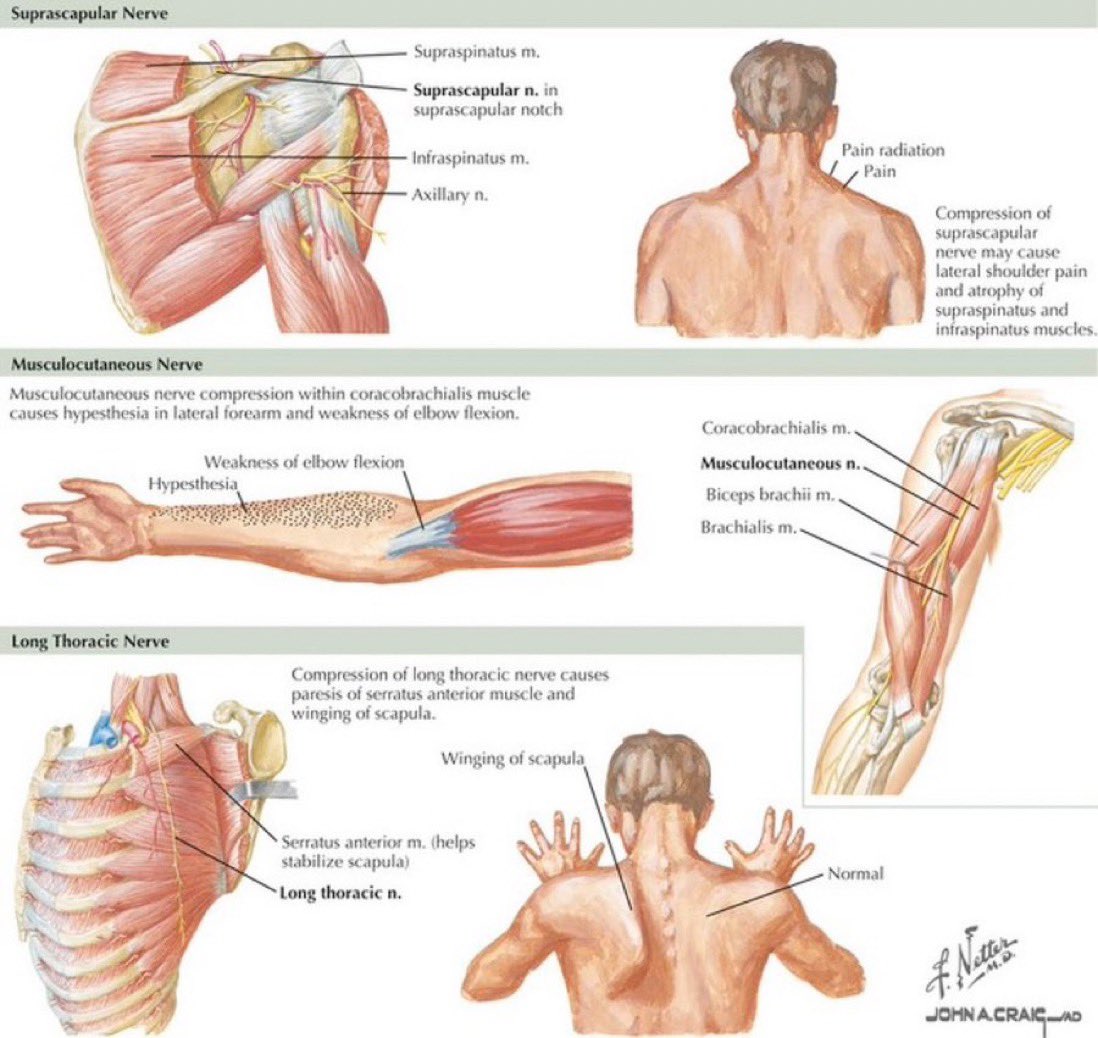
Neuropathies around shoulder
Suprascapular nerve👉lateral shoulder pain & atrophy of supraspinatus/infraspinatus
Musculocutaneous nerve👉weakness of forearm flexion/supination & sensory loss of lateral forearm
Long Thoracic nerve👉Winging of scapula
https://t.co/RsP5yrfaS8
Being in the top 5% of V02 Max for the population means you are 5 times less likely to die over a 10-year time horizon compared to someone in the bottom 25%.
There is almost nothing medicine that offers that kind of survival advantage.
Once we suspect a FzSh, the most important thing we can do is to inject the GHJ. Whether it's just an injection or a hydrodilation is debatable. But this can improve pain and shorten the disease course. Once the inflam episode burns out, it's too late to inject them.
Fear of injury is the most common reason why people don't return to sport after shoulder stabilisation
Psychological Factors That Affect Return to Sport After Surgical Intervention for Shoulder Instability: A Systematic ... https://t.co/6eZ1LHeahb
Do you know the differences between your disc bulges & your herniations? How they classified?
I've been playing about with some illustrations for my 'Navigating Painful Radiculopathy course in 2024. So here we go.
If you remember, once in a while we review the anatomy of the specific parts of the body! Today we are going to briefly review the anatomy & injuries (a few injuries) of the shoulder 👍