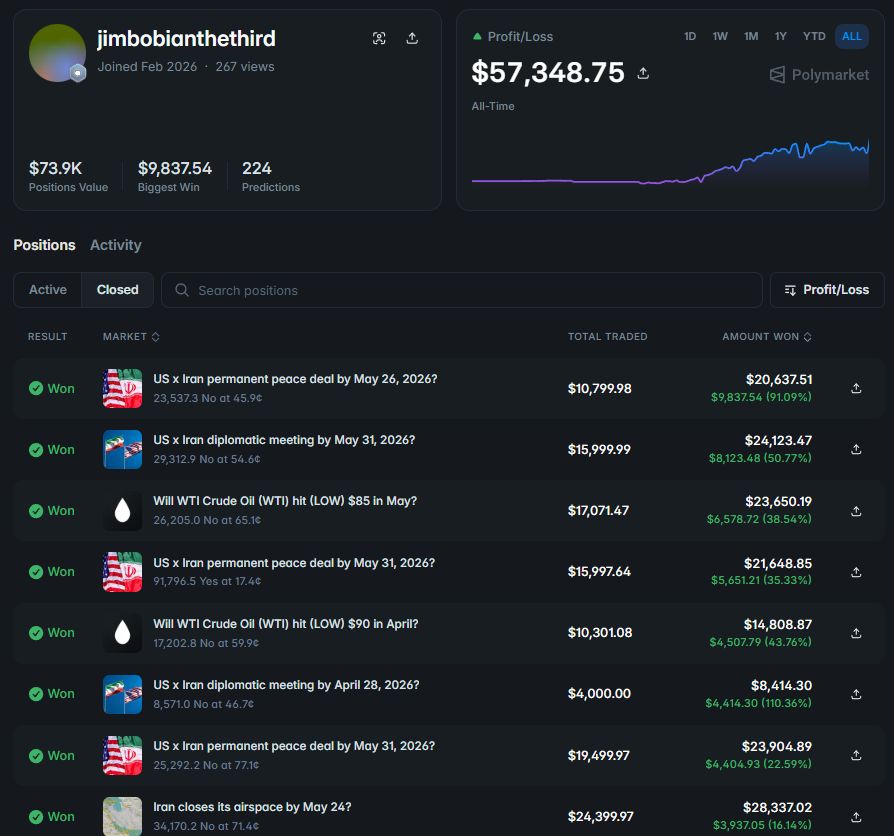
A Polymarket wallet started with $46 in February. By June it had $57,000 in profit and $2.1 million in trading volume.
Trader: https://t.co/Kq2OaisQJp
> 200+ positions across macro, commodities, crypto, and politics
> 58.5% win rate held over 4 months - sustained, not one trade
> sized into commodity brackets, currency markets, primary races, Bitcoin moves
> never blew up on a single conviction - built P&L through dozens of mid-sized positions
> wallet is public, every entry and exit visible on chain
Most retail wallets are gone within 30 days. This one is still adding positions weekly.
The edge here isn't a secret. It's discipline applied 200 times in a row across markets nobody else thinks to look at together.
Prediction markets aren't won by being right once. They're won by staying in the seat long enough that 58% turns into a 1500x return.
You will NEVER build a real market maker bot.
Stop believing highlights.
I'll save you what it cost me to learn that the hard way.
But you can still be the house at a small scale.
Here's how to manufacture liquidity out of nothing:
The pro market maker dream is a FIFO war you will NOT win.
24 hour early ladder fights, sub millisecond queue battles, getting left naked-long when the trend reverses.
Skip all of it.
There's a smaller version of being the house that actually works for a solo dev.
Here's the problem it solves:
You found a perfect entry, but there's no liquidity.
No shares to buy at your price.
You can manufacture your own, two ways.
First trick - naked sells.
You do not need to own a share to sell it.
Buying one side is the same as selling the other.
If the side you want is empty but the opposite side has depth, just sell the opposite.
Second trick - split shares, and this one is stronger.
You can split $1 into one up share and one down share at any time.
Say you want the up share at 60c, but the book is empty there.
When the window opens, you pre-split some shares, and now they're sitting in your wallet.
You list down shares for sale at 40c.
If they fill, you're left holding the up share you wanted all along.
Effective entry, 60c.
BTC market is a perfect target for it: <https://t.co/vWbyhZhLXo>
Manufactured from nothing, no liquidity required.
You're not predicting anything here.
You're creating the position the order book refused to hand you.
Leaving my full bot-building guide quoted below, every common mistake covered.
Good luck.
🚨 MUST READ FOR BOT BUILDERS:
Your bot gave two different answers to the exact same market.
You think that's a bug.
But it's the whole reason you're losing.
Here's what nobody tells you about trading on AI-written code:
Trading is deterministic.
Same input must always produce the same output.
Always.
A coin flip is allowed to be random.
Your execution logic is not.
LLMs are the opposite of that.
Ask the same question twice, get two answers.
That's fine for chat but it's poison for a bot.
When AI writes your decision logic, it quietly slips in fuzzy choices:
> Loose thresholds
> Retries that fire differently
> State that was never pinned down
The symptom is brutal and confusing:
Same window, same data, two different trades.
You can't debug it because you can't reproduce it.
And if you can't reproduce it, you can't backtest it, so every number you ever got was fiction.
The fix:
> Pin everything.
Whole-number thresholds, fixed sizing rules.
No "about" or "roughly" anywhere in the logic.
> Backtest everything
I use this tool: <https://t.co/crzsdhL1YE>
PolyBackTest created the best conditions for builders.
Run tests and save your money on losses.
> Make AI write config and state into TOML files.
MD drifts, JSON gets messy, TOML holds the line.
Kills most of the drift.
> Log input, output, and decision reason at every boundary.
If you can't replay a trade exactly, you don't have a strategy yet.
> Keep randomness away from execution.
The only thing allowed to be random is the market.
A real bot is boring.
Same input, same output, every single time.
I run 10+ live bots and every one is fully reproducible.
My sweeper bot example (24k PnL): <https://t.co/yCsjRsOAXJ>
If yours surprises you, it will surprise your PnL too so make sure to fix it before going live.
Leaving a full guide on how to create such bot below.
This trader built a bot with Claude.
A few weeks later:
+$63,000 on Polymarket.
Public wallet:https://t.co/F6QZZsp4ws
Copytrade: https://t.co/IPY41UFgnZ
The interesting part?
He's not trying to predict Bitcoin.
He's exploiting market inefficiencies.
The strategy is surprisingly simple:
• Finds mispriced odds before the market corrects them
• Buys undervalued outcomes
• Takes near-certain positions when edge still exists
• Accumulates cheap tail-risk bets before volatility spikes
Sometimes the bot even buys both sides of the same market.
Why?
Because it's not betting on direction.
It's betting on pricing mistakes.
Most traders need to be right.
This bot only needs the market to be wrong.
Again.
And again.
And again.
The result is a small edge of roughly 2.5% per trade cycle.
Not impressive once.
Powerful when repeated thousands of times.
That's how small inefficiencies become a steadily rising equity curve.
This bot made +$206,000 over the last month on 5-minute markets!
Account: https://t.co/ptIcWBdbsw
+$42,000 last week.
+$7,000/day!
Strategy: volatility arbitrage.
Example:
> buys Down at 44.5¢ for $1,534
> buys Up at 38.8¢ for $1,343
This creates an Up + Down < $1 setup.
A volatility spike created the arbitrage opportunity.
Down ended up winning.
Gross profit: +$573.
Total fees: $105 - 44% (Diamond tier rebate) = $58.
Net profit: +$515.
Main risks of this strategy:
> execution risk
> latency
> low liquidity & slippage
> taker fees
Despite all these risks, the bot continues to generate thousands of dollars in profit every day.
This Hong Kong trader made $11.2M in just one week
his profit rate is a fantastic 100%
welcome "GarretBullish_hl"
> joined June 2026
> 467 trades
> 100% profit rate
> $11.24M total profit this week
> $45.75M in open positions right now
recent results:
- ZEC short 3x -> +$83,495.95 (+92.0%)
COPY TRADING ON @Markets_xyz IS ACTUALLY INSANE
-> already compounding
-> you don't need to find traders like him manually
-> open the app, set copy trade and forget about it
-> the top traders do the work
-> you collect
Join and try now: https://t.co/MmhjRxtGYJ
THIS GUY CONNECTED CLAUDE TO TRADINGVIEW AND CUT 200+ HOURS OF MANUAL CHART WORK
40 trades a week used to mean the same loop: open the chart, check RSI, compare EMA, write notes and wait for the next setup
now Claude reads TradingView 24/7, tracks volume, indicators and price conditions while he is not even at the desk
this is not a $20k trading terminal and not a quant fund setup, just one laptop, one chart and one strategy written in plain English
the crazy part is not that Claude predicts the market, it is that a regular trader can remove the boring human loop from every setup ↓
I found 12 free GitHub repos for trading on Polymarket…
Here is everything you need to automate and make your trading easier:
1. The largest Polymarket dataset with over 36 GB of real trading data, based on more than 72 million trades, analyzed by a Coinbase developer.
GitHub: https://t.co/qkoF6TyjJQ
2. A backtesting simulator that lets you test your own trading ideas and strategies on real historical markets to see your potential win rate and all possible risks.
GitHub: https://t.co/fmzzTgXAUl
3. This bot automatically manages your limit orders on Polymarket to maximize liquidity rewards.
GitHub: https://t.co/nvb96dTIwx
4. This tool analyzes any Polymarket trader’s behaviour, finds repeated patterns in his trades, shows which strategies he uses and how you can adapt them to your own trading.
GitHub: https://t.co/SzdjHtASLt
5. A tool that lets you pull historical data for any market that has ever existed with detailed statistics and charts.
GitHub: https://t.co/5c5WwUVvVi
6. A bot with 118 ready to use tools and strategies for trading on Polymarket, including Binance-Polymarket latency, Momentum, Smart Routing, Penny Clipper, Expiry Fade, DCA bots and more.
GitHub: https://t.co/2MCzD8iZG7
7. An AI trading terminal that lets Claude connect to Polymarket, analyze markets in real time, track prices, suggest possible trades and even trade for you.
GitHub: https://t.co/5kFPrvOY3E
8. A bot that finds arbitrage opportunities between Polymarket and Kalshi.
GitHub: https://t.co/icWBTLTeVg
9. A weather bot that checks forecasts, airport data and aviation observations (like METAR + SPECI) to create a detailed weather report for a specific city and day.
GitHub: https://t.co/No3sBcqMg1
10. A trading dashboard where multiple AI agents analyze markets from different angles (news, price movement, technical indicators and possible risks) and suggest the best trading decisions.
GitHub: https://t.co/02iWujLbxe
11. A tool that analyzes what happened on the web over the last 30 days and finds useful patterns, connections and recent context around the selected topic. Very useful before trading.
GitHub: https://t.co/yETdyU8jT7
12. The largest public collection of 120 useful tools and services for prediction markets, including analytics dashboards, AI agents, trading bots, educational resources and more.
GitHub: https://t.co/jqvVR9106v
All of these repos come with a step by step setup and usage guides in English.
> be the chinese girl
> no quant degree, no bloomberg terminal, no fund
> open claude code on a laptop
> ship a 5-instrument bot in a weekend
> mean reversion on indices, breakouts on bitcoin, trend on commodities
> ATR sizing, 1% hard stop, correlation filter
> bot does a 10-person quant team's job
> two notifications a day: 7am read, 9pm P&L
> doesn't sleep, doesn't tilt, doesn't revenge trade at 2am
> earns your monthly salary in 48 hours
> citadel still pays $200k a seat for a bloomberg terminal
> your friend still drawing trendlines in the red
> different game.
full guide below
I'm quitting my job to go full-in on Claude.
Just asked it to:
Analyze mispriced Polymarket markets for arbitrage opportunities and find wallets using it to copy.
Turned $2K into $12K overnight.
Monitored 1,000+ wallets.
I realized something fast.
There are arbitrage bots I can't beat without code knowledge.
But I can find them. And copy them.
Claude built a monitoring terminal and connected it to a Telegram copytrading bot.
It's not a script. Not even a bot.
It's an AI agent that improves with every wallet it finds.
Fetches wallet behavior. How it trades. Arbitrage patterns. Position sizing. Timing.
70% win rate.
7 wallets copytrading right now from 500+ monitored.
Bot never pauses. Never gambles. Just math and profit.
The edge:
→ Most people try to build strategies from scratch
→ Claude finds proven wallets already making money
→ Copies their exact moves in real-time
→ Scales across multiple profitable patterns simultaneously
You don't need to code.
You don't need to predict markets.
You just need to find who's winning and mirror them before the edge compresses.
You only need Claude + device + 1 hour/day.
Giving this free for 24 hours.
To get it:
1. Comment "cash"
2. Like and retweet this
3. Follow me @codewithimanshu so I can DM you
Save this post. Deploy the monitoring system this weekend. Start with $500. Scale on evidence.
Risk quant in Singapore got walked out on January 8th for "unauthorized models"
11 days later he had no job, no reference, and a $400 deposit. By April that $400 was $479,401.
Wallet link, you can check right now: https://t.co/XG4jwgG5dg
The firm that fired him for building models off the clock now watches a bot run his model 24/7.
The crowd thinks Bitcoin mean-reverts. The microstructure says it doesn't. That gap is the whole edge.
Here's the actual stack.
Every 5 minutes, a candle closes. Hermes agent feeds it into a pattern net - price, momentum, volume in; BOS, order block, FVG neurons firing.
When one lights up past 0.91 confidence, it doesn't guess. It runs a Monte Carlo: 500 price paths, 5-minute horizon.
If 73%+ of those paths cross the target before the stop, the dominance cone tilts UP and the agent sizes the position by Kelly.
Then it presses one button.
That's it. Read the candle. Fire the net. Simulate 500 futures. Take the trade the math already won.
The "lag-exploit" is just being 2.7 seconds faster than a crowd that's still arguing about direction.
They fired him for running models without permission.
Now his bot doesn't ask permission. It doesn't need a desk, a reference, or a risk committee. It just reads two endpoints and presses a button - 1408 times.
Save the post so you don’t lose the article and can actually study it later.
Or just stop overthinking and act right now - copy his wallet address, paste it in this bot, and start copy every single trade he makes: https://t.co/vbDZyVbI3v
A former Binance scalper disappeared in March and came back with a Polymarket Quant Bot printing $13,721 a day
60 days later his wallet was up $822,440 PnL
Trading only “BTC Up or Down” 5-15min markets over and over again
Over 40,000 predictions. 59% win rate.
His wallet: https://t.co/ZJLNt7aawz
One playbook repeated thousands of times
Top wins:
$358 -> $12,265 - BTC UP May 15
$390 -> $6,346 - BTC DOWN May 18
$820 -> $7,280 - BTC UP May 8
Here’s how it actually works:
when $BTC breaks up and “UP” is still too cheap, it buys “UP”
when $BTC breaks down and “DOWN” is still too cheap, it buys “DOWN”
{ “UP” + “DOWN” < 100¢ }
It’s latency arbitrage inside prediction markets
Price feed -> Polymarket order book -> mispriced side -> limit order -> hedge -> repeat
when the opposite side gets mispriced, it can hedge instead of holding naked direction
Save this post if you want the full breakdown
Everyone is talking about AI content.
But almost nobody is talking about AI agents making real trading decisions based on live onchain behavior.
This is one of the craziest use cases I’ve seen so far.
A guy used Claude to build an AI monitoring system for Polymarket arbitrage opportunities.
Not a simple script. Not a basic trading bot.
An actual AI agent that:
• Tracks 1000+ wallets
• Detects arbitrage patterns • Studies wallet behavior
• Analyzes entries, exits, timing & size
• Filters profitable traders automatically
• Improves itself after each new wallet discovered
Instead of competing against profitable bots… He started finding them and copytrading them.
Result? $2K turned into $12K overnight.
The most interesting part: The system doesn’t “gamble.” It follows data, probability, timing, and behavior patterns.
70% win rate with only 7 selected wallets being copytraded from hundreds monitored is honestly insane.
This is where AI is heading: Not just generating content… But discovering edges humans can’t manually track at scale.
You probably don’t even need coding skills anymore. Just the right workflow + AI + consistency.
Free access for 24H: https://t.co/K6GcDbabYN
A Korean ML PhD student at Seoul National University turned $2,000 into $52,268 in seven days. 2600% profit in one week.
Want to know what the math was? The twelve quant funds that just rejected him built their entire desks around it.
His wallet: https://t.co/sDeoXN6Tpq
Spent two years on a thesis about Bayesian signal fusion.
Applied to twelve quant funds: DE Shaw, Citadel, Jane Street, the whole Tokyo-Hong Kong-Singapore circuit - got rejected by every single one.
On May 18th, after the last "thanks but no thanks," he deposited $2,000 of his graduate stipend onto a Polygon wallet and pointed his thesis at Polymarket.
92% of Polymarket traders lose money. Only 7.6% are profitable. Almost all the winners are bots.
His isn't just a trading bot. It's a PolyBench-grade microstructure engine that fuses five live BTC signals - RSI, momentum, VWAP, SMA cross, order-book skew into a single Bayesian probability.
The bot doesn't predict Bitcoin. It scores it.
The thesis taught him one thing - five weak signals blended Bayesian-style beat any single strong one.
Claude Opus 4.7 runs the PolyBench benchmark nightly and surfaces the 5-min windows where convergence ≥ 4/5 holds. Hermes Agent executes.
Every midnight, Opus reads the trade journal, recalibrates the Bayesian weights.
His version has rewritten itself 89 times in 7 days.
The twelve funds that rejected him couldn't ban him from Polymarket. The bot doesn't sit in a colo. It doesn't need a Stanford pedigree. It just reads five signals and blends them.
Save this post - if you want to build your own.
Or go against the system just like this student - and start copying every single one of his trades in just 10 minutes: https://t.co/vbDZyVbI3v
My uncle told me to get a real job instead of "playing with crypto"
He's been at the same company for 14 years.
I didn't argue.
I showed him my screen without saying a word.
He read the numbers twice.
"That's fake"
30 days. $300 in. $24,200 out. 73% win rate.
He looked up.
"What is this"
https://t.co/Xih0tk6bxi
86 million on-chain trades. Every wallet that ever touched Polymarket. All public.
One Claude prompt. 14,000 wallets ranked by profit. 4 minutes. 47 targets returned.
Top 20 made more than the bottom 13,000 combined.
"That's a cheat code"
https://t.co/zm2ifgjABQ
73 terminal screens. Whale tracking. Insider detection. Cross-platform arb vs Kalshi. Wash trade detection. Never touches your keys.
https://t.co/DlTWAuJIiQ
ML catches fresh wallets entering low-liquidity markets before anything moves. January: flagged a wallet that turned $35K into $442K before the event resolved.
https://t.co/TY2P9bH4lO
Three agents. No shared memory. Two agree - full size. One alone - half. Disagree - no trade.
One rule. 40% fewer losing trades overnight.
"How much does all this cost"
$25 a month.
He's been at the same desk for 14 years. Same salary. Same commute. Same everything.
Didn't say anything for a while.
"I've been doing it wrong this whole time"
Maybe.
Everything is public. Everything is free.
The only thing that costs you is waiting.
A 53-year-old woman from Thailand earned $869,000
and all from the 5-minute BTC markets
while most traders her age were too scared to touch crypto
she built a bot that trades faster than any human ever could
This’s her wallet: https://t.co/hOB5ZKIfQs
28,000+ trades, zero emotions, pure systematic execution
every 5 minutes the market resets and her bot is already positioned
here's how it works:
> exclusively 5-minute and 15-minute BTC/ETH markets
> bot catches micro-arbitrage when YES + NO price drops below $1
> high-frequency execution, no hesitation, no panic
> $869,000 net from pure speed advantage over manual traders
she doesn't predict where BTC goes
she exploits the gap between what the market prices and what math says
28,000 trades later the edge is still there
because most people still trade with emotions
bookmarked and learn
A Brazilian college dropout moved back into his parents’ garage…
…and built a Polymarket trading bot using an open-source AI agent framework.
14 months later:
+$794,000.
The craziest part?
He barely wrote any code himself.
Most of the system was written by Claude Opus.
The framework behind it is called Hermes — an open-source agent framework created by Nous Research and backed by Paradigm.
Wallet:
https://t.co/WAw9JswMjD
Name:
Bonereaper.
40,266 trades.
Estimated system cost:
~$10/month.
The bot mainly trades BTC up/down 5-minute markets on Polymarket.
288 windows per day.
On average:
1 trade every 81 seconds.
But here’s the important part:
It doesn’t try to “predict” BTC.
Instead, it uses Markov chains to detect when price enters a statistically persistent state.
In simple terms:
If BTC enters a strong enough upward trend state, the probability that the next candle also closes green can mathematically increase.
If the model estimates the probability exceeds a certain threshold — for example 87% — while the market hasn’t repriced yet…
the bot enters automatically.
No news.
No emotions.
No influencer signals.
Just tiny probability inefficiencies before the market fully reacts.
The architecture itself is surprisingly simple:
• Claude Opus reads signals
• Hermes agents execute trades
• a cheap VPS runs it 24/7
• Telegram sends trade alerts and daily reports
And every night the system reviews itself automatically.
At midnight:
Claude reads the day’s trade logs,
identifies what worked,
what failed,
which market states were most profitable…
then automatically adjusts parameters.
If yesterday’s threshold was 87%,
tomorrow it might become 89%.
If markets become harder,
maybe 91%.
Meaning this is not a static rule-based bot.
It evolves every single day from new data.
After 50 trades,
it’s already smarter than when it started.
After 500,
it may no longer resemble the original system.
That’s the real shift happening right now.
Most people still use AI as a chatbot.
Others are turning it into a fully autonomous trading engineer.
An Anthropic engineer literally stopped me at a coffee shop because of what was on my screen.
I was sitting at Sightglass running my Polymarket bot.
He looked over once.
Then again.
“That’s not a normal trading setup.”
I told him the entire stack runs on:
• Claude Code
• 4 open-source repos
• ~$25/month
That’s it.
He immediately sat down.
“I’m on the agent team at Anthropic,” he said.
“We test Claude on workflows exactly like this.”
Then I showed him what the system was doing.
86 MILLION trades analyzed.
Every wallet.
Every entry.
Every exit.
One prompt:
“Find wallets with 100+ trades and 70%+ win rate. Rank by profit.”
Claude scanned 14,000 wallets in minutes.
Copy it here:https://t.co/IPY41UFgnZ
Returned 47.
The top wallets outperformed almost everyone else combined.
He looked at the terminal and said:
“That’s not analysis.
That’s infrastructure.”
Then I showed him the second layer.
A Rust CLI scraping hundreds of live Polymarket markets.
Claude automatically filtered:
• spread inefficiencies
• liquidity depth
• timing windows
• whale behavior
Hundreds of markets became a few high-probability setups.
Then a trade closed live.
+$84.
He asked:
“How does it decide when to enter?”
Three independent AI agents:
• arbitrage
• convergence
• whale-copying
2 agree → full size
1 agrees → reduced size
No agreement → skip
That consensus layer removed a huge amount of bad trades.
Then he asked:
“What about exits?”
That’s where it gets interesting.
Most profitable wallets don’t hold to settlement.
They exit early.
So the bot exits before they do.
Profit targets:
• expected move reached
or
• abnormal volume spike
In other words:
It copies smart money
then front-runs their exits.
He stared at the screen for a while.
“How much did you start with?”
$200.
27 days ago.
Current balance:
$14,300.
271 trades.
74% win rate.
Fully automated.
Before leaving he said:
“This looks very close to scenarios our internal teams simulate.”
Next morning I got an email:
“Would you be open to speaking with our policy team?”
I replied:
“The article already explains everything.”
The craziest part?
This entire stack costs less than Netflix.
Comment “Claude” if you want the framework.
This Claude bot on Polymarket made $78,083 in 5 days.
Nobody built it to be smart.
They built it to be fast.
$7 → $3,595
$30 → $11,063
$142 → $13,356
$1,205 → $37,939
I found this wallet three days ago.
Spent 48 hours reverse engineering every trade.
Same markets.
Same logic.
Over and over.
Watch BTC price.
Compare to Polymarket odds.
Enter when they don’t match.
Exit when they do.
While you were analyzing charts — this bot was already in and out.
While you were deciding — it was compounding.
While you were sleeping — it was printing.
Most traders try to be right.
This bot just tries to be faster.
$78,000 in 5 days.
Just Claude. Running a loop.
I don’t know who built this.
But I know how they did it.
And it’s all in the article below.
Copytrade my finds → https://t.co/2sJ6B0kdE7
Giving This Free for 24 hours.
To get it:
1. Comment the word 'Claude'
2. Like and Retweet this post
3. Follow me @marryevan999
🤯🤯🤯🚨🚨🚨🚨
A Chinese student built an AI tool trained to predict prediction markets.
In just 2 months, he turned $0.90 into $408,000 using it.
The AI scans inefficiencies, sentiment shifts, and market reactions in real time.
No team. No hedge fund. Just one student + AI.