@RolandN Everyone has an urge to create. It can take a myriad of forms and most don’t acknowledge or fulfil the urge. Seeing your posts makes me smile & reminds me to foster the creativity inside myself
“Read books. Travel when you can. Learn how to cook one meal exceptionally well. Sit in old bars and talk to strangers. Wear your best jacket to dinner. Appreciate good wine, good music, and good conversation. Do the right thing, even when no one is watching. Set the example for younger men who are watching you. Call your parents. Take long walks. Leave your phone behind sometimes. Become the kind of man people feel better after being around. Life is short, so live it well.”
-J.B. Lloyd
@JohnTierney_@AboutEG I generally agree with the comments on here, but for the sake of accuracy they could be RAF saluting like this. I wore both the flat hat and combat helmets, but considering the other images, this might be more by luck than design
The international rule of law is under sustained assault by the very powers who were supposed to be its guarantors.
Now is the moment for global leaders to renew their commitment to the UN Charter and to a world where rights, sovereignty and peace are upheld equally for all.
A los 30 años, borracho y sin trabajo, me senté en el borde de la cama y pensé: "Anthony, no puedes seguir así".
Había llegado a Londres desde Gales con un sueño: ser actor. Pero el sueño se convirtió en pesadilla. El alcohol me controlaba. Perdía papeles, mi mujer me dejó, mis amigos me abandonaron. Pasaba los días en bares oscuros y las noches en camerinos vacíos.
Una noche, en 1967, entré en una reunión de Alcohólicos Anónimos. Tenía miedo. No del alcohol, sino de mí mismo. De la debilidad que sentía al pedir ayuda.
No bebí un solo trago en 57 años.
Después llegó la sobriedad. Y con ella, el trabajo. "El hombre elefante", "Los restos del día", "El Silencio de los Corderos... un Oscar y muchos premios. Una carrera que todavía hoy continúa.
Pero la fama no curó las heridas. Tuve que aprender a vivir conmigo mismo a aceptar mi pasado y a perdonarme.
Hace unos años, durante la pandemia, grabé un video que se hizo viral. Hablaba de no rendirse. Hablaba de la vejez, de la soledad, del valor de seguir adelante. No lo hice por fama. Lo hice porque aquel chico de 30 años necesitaba oír esas palabras.
Si hoy te sientes perdido, si el alcohol o cualquier otra droga te está destruyendo, pide ayuda. Yo lo hice. Y aquí estoy, medio siglo después, sobrio y contándotelo.
No hay vergüenza en caer. La hay en no levantarse.
Anthony Hopkins🇬🇧
The older I get, the more I believe happiness lives in the ordinary. Pets. Plants. A quiet morning coffee. Blue sky. Cotton clouds. Birds singing. The gentle breeze through the trees. A clean, cosy house. Good food. Good hearted simple poeple. So much of life’s beauty is quiet, gentle, and already here. And somehow, one of the sweetest feelings is knowing I get to wake up and meet it all again tomorrow.
@Andy18Smith@2147mill I was thinking of recommending Applied Nutrition. I've been using their products for a few months, bought some shares, and then they got a mention in Money Weekly.
My investment was based on the quality of their product, though, rather than a deep understanding of their business
Winston Churchill fought his depression with bricks. He'd lay them for hours at his country home in Kent. He joined the bricklayers' union. And in 1921 he wrote about why it worked. It took psychology another 75 years to catch up.
He called his depression the "Black Dog." It followed him for decades. His method for fighting it back was as basic as it sounds: laying brick after brick, hour after hour.
Churchill spelled out his theory in a long essay for The Strand Magazine. People who think for a living, he wrote, can't fix a tired brain just by resting it. They have to use a different part of themselves. The part that moves the eyes and the hands. Woodworking, chemistry, bookbinding, bricklaying, painting. Anything that drags the body into a problem the mind can't solve by itself.
Modern psychology now calls this behavioral activation. It's one of the most-studied depression treatments out there. Depression sets a behavior trap. You feel bad, so you stop doing things, and doing less means less to feel good about. Feeling worse makes you do even less. The loop tightens until you can't breathe inside it.
Behavioral activation breaks the loop from the action side. You schedule the activity first, even when every part of you doesn't want to. Doing it produces small rewards: a wall gets straighter, a painting fills in, a messy room gets clean. Those small rewards slowly rewire the brain. Action comes first, and the feeling follows.
Researchers at the University of Washington put this to the test in 2006. They studied 241 adults with major depression and compared three treatments: behavioral activation, regular talk therapy, and antidepressants. For the people who were most severely depressed, behavioral activation matched the drugs. It beat the talk therapy. A 2014 review of more than 1,500 patients across 26 trials backed up the result.
Physical work like bricklaying does something extra on top of this. It crowds out rumination, the looping bad thoughts that grind people down during the worst stretches of depression. Bricklaying needs both hands and gives feedback brick by brick: each one is straight or crooked. After an hour you can see exactly how much wall you built. No room left for the mental chewing.
The line George Mack used in his post, "depression hates a moving target," is good poetry. The science behind it is sharper. Depression hates a brain that has somewhere else to be.
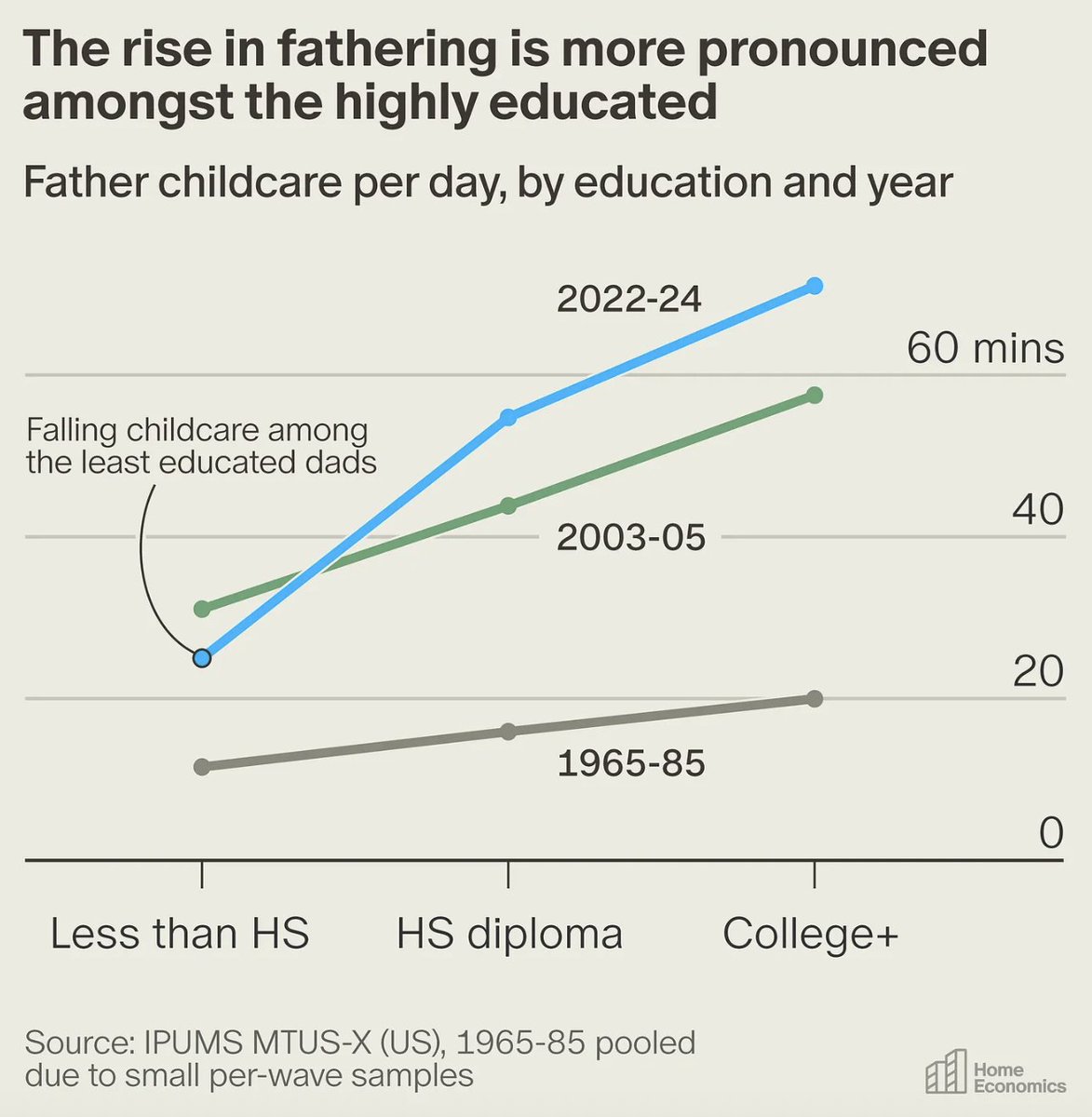
New newsletter: MODERN FATHERHOOD WOULD BE UNRECOGNIZABLE TO A 1950'S DAD
Compared to their Boomer parents, childcare time among Millennial dads has more than doubled.
Compared to their Silent Generation grandparents, it’s nearly quadrupled.
You will be hard-pressed to find any part of day-to-day modern life that has changed more in the last half-century than the way today’s parents—and fathers, in particular—spend their time.
The new American dad is more present and more exhausted—but also, more satisfied with life. What's behind this half-century transformation? Today's piece combines history, economic analysis, and gorgeous charts galore from @AzizSunderji
"Eat at a local restaurant tonight. Get the cream sauce. Have a cold pint at 4 o’clock in a mostly empty bar. Go somewhere you’ve never been. Listen to someone you think may have nothing in common with you. Order the steak rare. Eat an oyster. Have a negroni. Have two. Be open to a world where you may not understand or agree with the person next to you, but have a drink with them anyways. Eat slowly. Tip your server. Check in on your friends. Check in on yourself. Enjoy the ride."
-Anthony Bourdain
Life is too short to worry about little things. Have fun. Fall in love. Regret nothing, and don't let people bring you down. Study, think, create, and grow. Teach yourself and teach others.