Dr. Russell Barkley’s liberating truth for parents: Your child is not a blank slate you can engineer — they’re born with 400+ psychological traits that have nothing to do with you.
In this 5:26 clip he dismantles the myth of total parental control:
- Genetics and peer groups shape personality, IQ, and behavior far more than parenting.
- Parenting influence peaks before age 7, drops sharply by 12, is only 6% in teens, and hits 0% after age 21.
- Adopted kids show zero correlation on psychological traits with adoptive parents — proof parenting doesn’t “design” the child.
- You’re not an engineer sculpting clay — you’re a shepherd. Pick the pastures (environment, opportunities, community), protect from harm, nourish them — but you don’t get to turn a sheep into a dog.
This frees you from crushing guilt (“I caused the ADHD”) and false credit.
You design the environment — not the child.
Then sit back, enjoy the unique fireworks, and watch them grow.
Short of abuse, neglect, or malnutrition, most of what happens is out of your hands — and that’s profoundly freeing.
Which part of this parenting shift feels most relieving to you?
ADHD medication may increase a person’s willingness to do boring things than to increase attention span overall. This makes sense as those with ADHD often have hyper focus on activities they are interested in.
https://t.co/v84Z3KIRSW
Dr. Russell Barkley shatters ADHD myths in one clear, no-nonsense explanation:
ADHD is not a different species of human.
It’s not a gift, a hunter brain, or a superpower.
It is a developmental delay in two critical traits:
self-inhibition (stopping yourself before acting) and emotional regulation.
The child follows the exact same developmental path as everyone else—just much slower and never fully catches up.
By early 30s the gap is permanent but stable.
The difference is quantitative (like height, athleticism, or writing ability), not qualitative.
Calling it “from another planet” or “alien wiring” stigmatizes and confuses people.
Hyperactivity fades sharply with age (nearly gone in adulthood); what endures is weak inhibition across behavior, speech, thoughts—and especially emotions (the part most diagnostic criteria and popular books ignored).
This isn’t opinion. It’s decades of research.
If you live with or love someone with ADHD, which part of this explanation finally clicked for you—and which myth did it finally put to rest?
Disclaimer: This summarizes Barkley’s clinical perspective from the clip—not diagnostic advice. ADHD assessment and treatment should always involve qualified professionals.
Yuval Noah Harari warns that AI will most easily replace the narrow cognitive skills society has long prized in education—math, engineering, word-based tasks, numbers, charts, technical drawings.
The skills likely to remain valuable in 5–10 years are those that combine intelligence with physical body/motor coordination, real human social interaction, and emotional depth.
His example: martial arts.
It demands mental training, physical conditioning, and actual human opponents—elements AI cannot authentically replicate.
Anything purely intellectual and narrow? Vulnerable.
Anything whole-body, emotionally rich, and socially embedded? Much harder to automate.
Which skill do you believe will still be distinctly human and valuable in 2035?
Dr. Russell Barkley, leading ADHD expert, explains the heartbreaking reality many parents face: A child with ADHD can play video games for hours without issue... but struggle to do homework for even a few minutes.
Why? Video games deliver constant, immediate, 100% external consequences and feedback—every action gets instant reward or response. Homework? Nothing happens when a problem is solved. Consequences are delayed (or invisible), so the brain's motivation system flatlines.
This isn't laziness, willpower failure, or "they could if they wanted." It's a neurogenetic executive function deficit: ADHD impairs self-motivation. Without external structure, immediate cues, and consequences, the work simply won't get done—no matter the goals or good intentions.
Put an ADHD brain in a low-consequence environment, and failure follows. It's not a choice; it's how the wiring works.
The takeaway? Stop blaming the person. Build environments with external motivators: timers, immediate rewards, gamified tasks, accountability.
Parents/teachers: What's one external structure (timer, reward chart, body doubling) that's helped an ADHD kid bridge that motivation gap?
"No one likes that idea"
Jordan Peterson: IQ is largely unitary, highly heritable, and brutally unfair.
It predicts long-term success in complex jobs better than almost anything. Smart parents → smart kids (but regression to mean pulls toward average 100).
Identical twins separated at birth? By age 60, IQs so similar it's like testing the same person—environment barely diverges them.
You can't train general IQ up with games/puzzles (task gains don't transfer). But cardio + weights help maintain it as you age; early nutrition (breastfeeding adds ~3-4 points per year) + stimulation matter in childhood.
No one's figured out how to meaningfully raise it—yet.
This 3:58 clip confronts why the "cards aren't dealt equally."
Does knowing IQ is mostly genetic change how you view opportunity, merit, or inequality?
I have a dear friend who lost her baby at 12 days old. As a single mother it wasn’t until her other children had become independent that she could focus on herself, and make decisions that gave her joy. Could she have moved past her grief earlier if she had had more daily help?
“Whether you’re ready for it or not, the pain of losing a child eases over time. It just does.” Here’s why that’s a good thing—even when it doesn’t seem like it. https://t.co/B0jSxZMqG3
My son just got diagnosed with ADD. Took us by surprise but it it’s useful having the diagnosis.
#adhd#ADHD#spectrum#AutismAwareness
What’s really behind the ADHD epidemic? https://t.co/XjYaX98I2O
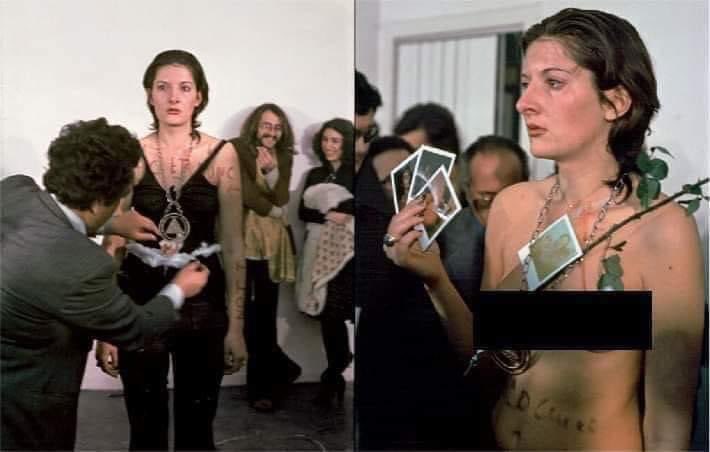
In a performance in 1974, Marina Abramović told visitors she wouldn't move for six hours, whatever they did to her. She made 72 items available on a table on her side that could be used to please or destroy her, She invited visitors to use the items on it as they wish.
Initially, guests were kind and brought her a flower or a kiss. The performance began calmly, however, at some point her performance became physical and a participant moved her body, shoved her hands in the air, and even cut off her clothes using sharp blades.
By the third hour, she had endured a series of sexual assaults from those who took advantage of her performance to harm her body. In the fourth hour, the same blade used to pry off her clothes was used to cut her neck so that the person could suck her blood.
Toward the end of the performance, a fight broke out between spectators after Abramović’s life was threatened. According to reports, a loaded gun was held to Marina’s head with the participant manipulating Marina’s own finger around the trigger.