Moving abroad is usually told as a success story. New job, new city, new start.
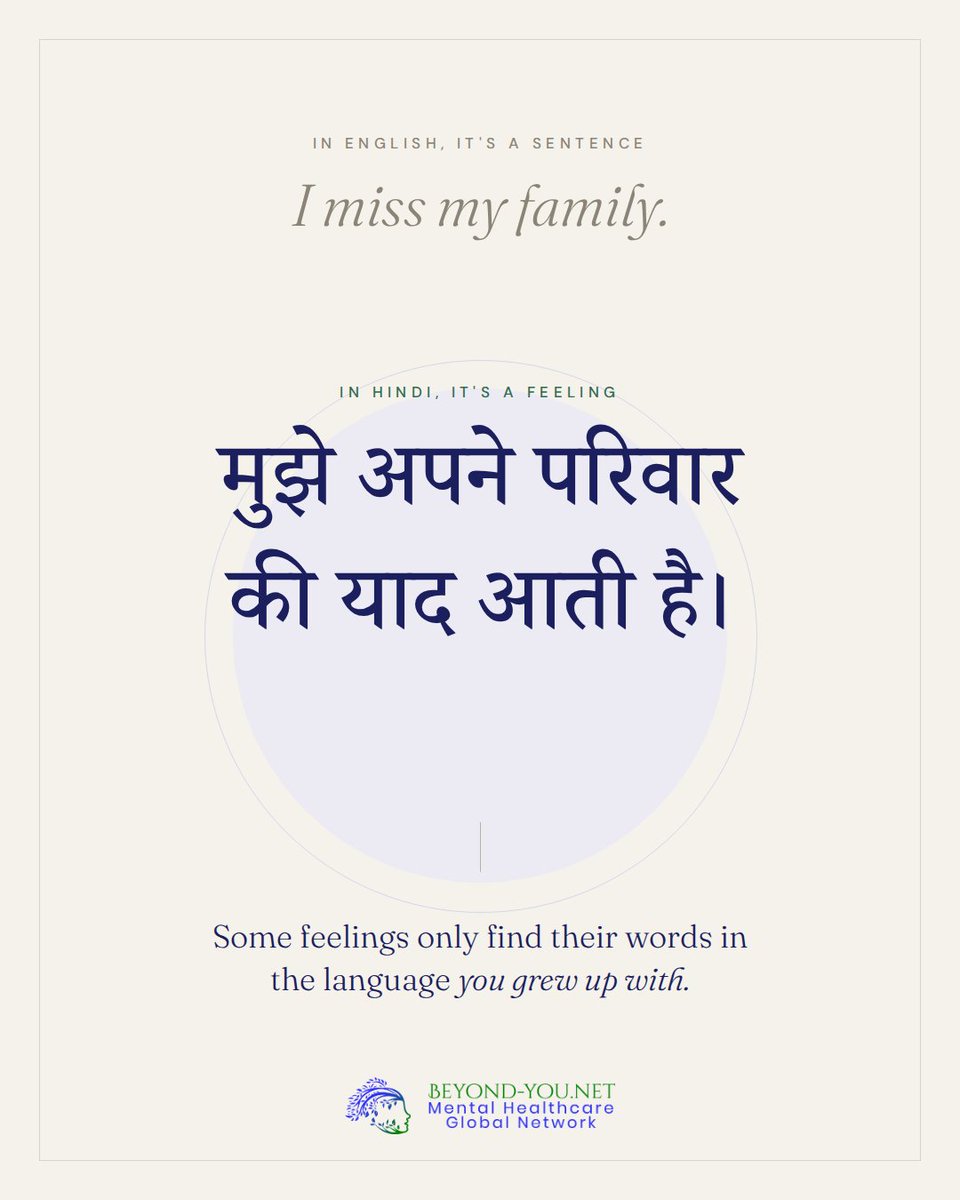
What's told less often: feeling misunderstood. By colleagues who read your politeness as distance. By friends who don't get why one call home can weigh on your whole week. Sometimes even by yourself, because some feelings only find their words in the language you grew up with.
Think of a software developer from India, three years in the UK. His English works perfectly at the office. But explaining the pressure from his family, the questions about marriage, the feeling of being the one who has to make it? That's easier in Hindi. With someone who knows how families there work, without having to explain everything first.
That's why Beyond You exists: psychological counseling and coaching in people's mother tongue, with a focus on culturally sensitive support.
If this sounds familiar, you're not alone.
A benefit can be offered to everyone without being equally accessible to everyone.
The benefit may be the same.
But employees can face very different barriers to using it.
Language, cultural expectations or familiarity with the available support can all influence how accessible a benefit feels.
Equal availability does not necessarily mean equal accessibility.
“Native language” can be too narrow.
For international employees, access to psychological support can start with having a choice of language — while taking cultural context into account.
That’s the gap we’re building Beyond You to address.
The more international a workforce becomes, the less useful the “average employee” becomes as a design assumption.
An average can simplify planning.
But it can also hide meaningful differences in how employees access and experience benefits.
For global HR, the question isn't whether every employee needs something different.
It's whether the benefit still works when the workforce becomes more diverse.
Here's a question every international HR team should be able to answer:
Who isn't using our mental health benefits — and why?
Utilization data can tell you what happened.
It doesn't necessarily tell you what happened underneath.
Global benefits strategies are built to work at scale.
That often means selecting a defined set of providers and support options across the workforce.
But international workforces introduce another variable:
Different employees may need different providers, languages or forms of support to make the same benefit genuinely usable.
That creates an important design question:
How much choice should a global benefits strategy provide?
Benefit utilization can be easy to look at too late.
If utilization is low, the first question shouldn't always be:
“Do employees need this?”
It can also be:
“What might be preventing employees from using it?”
For an international workforce, that question can include factors such as language and cultural context.
A mental health benefit can exist on paper and still be difficult to use.
Language matters.
Cultural context matters.
Choice matters.
At Beyond You, we’re making psychological support more accessible to international employees — in their preferred language, taking cultural context into account.
International hiring changes more than your talent pool.
It changes the assumptions behind your employee experience.
Different languages, cultural backgrounds and expectations enter the workforce.
Benefits strategy needs to account for that reality, too.
Native language isn’t always the right way to think about mental health support.
People should be able to choose psychological support in their preferred language — taking cultural context into account.
That’s how we think about access at Beyond You. 🌍
Everyone has access to mental health support.
It sounds reassuring.
But what does “access” actually mean?
A mental health benefit can be available to everyone and still be difficult for some employees to use.
Availability and accessibility are not the same thing.
And for international employees, language and cultural context can be part of that difference.
Beyond You doesn’t sell another mental-health benefit. It closes the accessibility gap within existing mental-health benefits for international employees — because receiving psychological support in a non-native language can create an additional barrier to using those services.
We’re joining the ZEBRA Accelerator with @beyond_you_net! 🦓
Excited to help employers close language gaps, make support more accessible for individuals and turn ambition into progress together.
Thanks @BrainergyP and Startup Village Jülich for believing in us!
Raising a €500K pre-seed for @beyond_you_net to accelerate tech and go-to-market.
Culturally sensitive psychological counseling: how someone explains what they’re going through shapes what helps. Psychologists and coaches who adapt to that — in the client’s language.
DMs open.
Better Mental Health, Stronger Organizations
Mental health at work is shaped by many factors.
Personal circumstances matter. But when mental health challenges become widespread across teams, it often points to something bigger: workload, leadership, psychological safety, workplace culture, and whether support is available before people reach crisis point.
The latest workplace data makes this hard to ignore.
The 2026 NAMI-Ipsos Workplace Mental Health Poll found that 53% of full-time employees surveyed felt burned out because of their job.
35% said their productivity suffered because of their mental health.
26% considered quitting because of work’s impact on their mental health.
And 6% said they had resigned or quit because of work’s demands on their mental health.
In the UK, stress, depression and anxiety accounted for 22.1 million working days lost in 2024/25.
But the cost is not only visible in absence.
It also shows up in presenteeism: when people are at work, but not fully able to work effectively because they are struggling.
Deloitte estimated that poor mental health costs UK employers around £51bn per year, with presenteeism alone accounting for around £24bn.
The message is clear:
Mental health at work affects productivity, absence, retention risk, presenteeism, and whether people feel able to do their best work.
At the same time, taking workplace mental health seriously does not mean organizations need to know which individual employee is struggling.
Many employees will not want to disclose that.
And they should not have to.
The point is not to monitor people.
The point is to create confidential, trusted, and accessible support before problems escalate.
That is why mental health at work cannot be separated from leadership, culture, workforce capacity, or performance.
The organizations that understand this will not wait until people reach crisis point.
They will build cultures where people feel safe, supported, connected, and able to do their best work.
Because better mental health builds stronger organizations.
#MentalHealth #WorkplaceCulture #EmployeeWellbeing #Leadership #FutureOfWork #PsychologicalSafety #EmployeeEngagement
Growth Doesn't Always Look Like Progress 💚
Sometimes it's quieter. A shift in perspective. A boundary you finally set. A conversation you had differently. A moment where you chose yourself.
Not every win is visible. But every win counts.
🌱 #MentalWellness#PersonalGrowth #Resilience #SelfCompassion #InvisibleProgress #YouAreEnough #BeyondYou #MentalHealth #Authenticity #Healing
At 25, I stood at a friend’s wedding. They’d been together 10 years. Up until then, I had only been in a long-term relationship for several months — and she had left me.
I felt so behind.
That’s when I realized: I’m not living other people’s lives.