Everyone says a few hundred pounds doesn't matter in a crash.
RAV4: 3,865 lb. CR-V: 3,635 lb. That's 230 lb apart, about 6%.
We ran them head-on in the sim at 35 mph each. The RAV4's speed changes by 34 mph. The CR-V's changes by 36.
Hit a wall at 35 mph instead, and either one takes the same hit as a drop from about 41 ft. Roughly a four-story building.
Does 2 mph change which one you'd buy?
Seat height and how far you sit from the windshield change sight lines as much as the body does. Where the steel can't move, 360° cameras fill the gaps.
Try any two SUVs yourself, free 👇
https://t.co/rh6xv7iwBi
Sit in the driver's seat. How much of the road right in front of your bumper can you actually see?
We ran the test in 3D. Volvo XC90: 44% of the ground ahead. BMW X5: 37%.
Same class, same job, noticeably different view. Here's why 🧵
Hood height and the beltline (where the side windows start) decide how close to the car you can see the ground.
A tall, flat hood looks tough, but it hides kids and curbs.
Wet road, 30 mph, one second to react, hazard 90 ft ahead.
In our sim, the Tesla Model S needs 92 ft to stop and is still doing 7 mph when it reaches the hazard. The Porsche Macan Electric stops in 85 ft, 5 ft short.
@CARandDRIVER@MotorTrend@ConsumerReports, does that 7 ft gap match what you see in your wet braking tests?
Context: Tesla showed the Roadster prototype with SpaceX thrusters at the McGregor, Texas site last week (Washington Post, Oct 16). People are still arguing over whether the bridge clip is real footage.
A Roadster drives off the Golden Gate Bridge, fires thrusters and climbs back up. That's the clip everyone's arguing about today.
Real or edit? I can't tell you. But I can tell you what it would take.
A falling car picks up about 22 mph of downward speed every second. Just to stop the fall, the thrusters have to push harder than the whole car weighs. Climbing back up takes even more, and every extra second of falling makes the job bigger.
Your brakes do the same math sideways, with four patches of rubber instead of rockets.
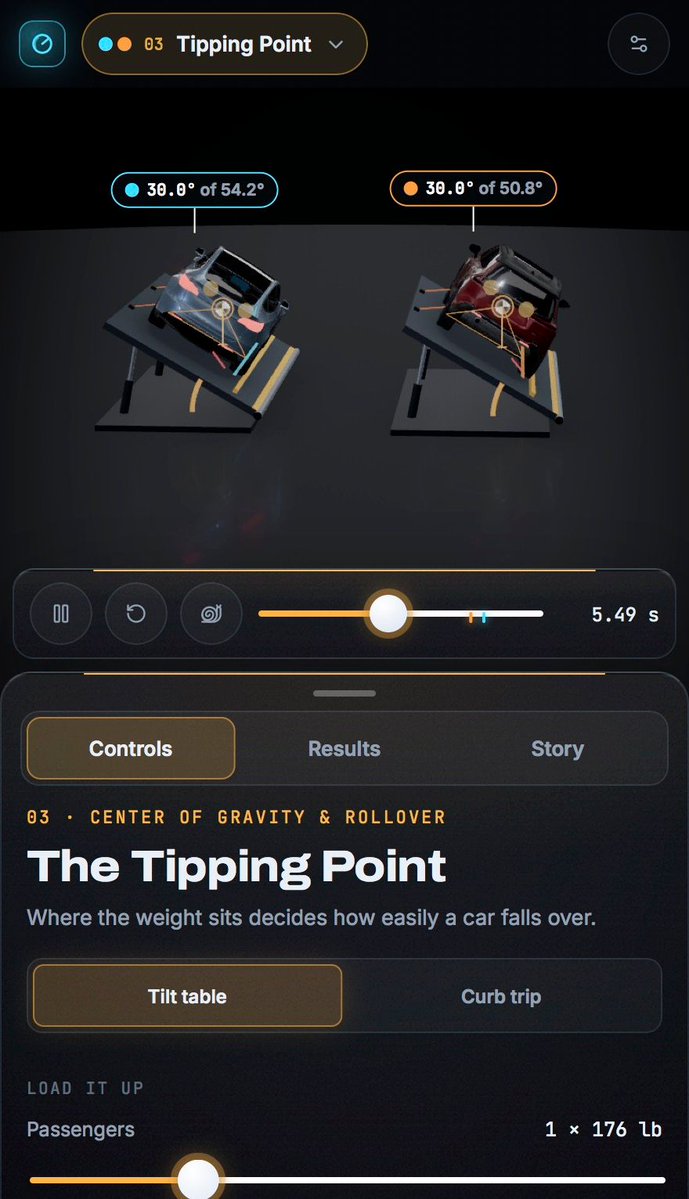
Model Y holds to 54.2°. RAV4 goes at 50.8°. Height alone doesn't decide it. A car tips when its center of gravity swings past the outside wheels, so what matters is how wide the wheels are compared with how high the weight sits. A battery pack under the floor pulls the weight down.
Tilt table. Model Y on one side, RAV4 on the other, one 176 lb passenger in each. We raise the ramp slowly.
One car tips at 50.8°. The other hangs on until 54.2°.
Guess which before you scroll.
Sources: Washington Post https://t.co/5pqOZ5g7zr and Fortune https://t.co/nT36c9WKrJ. If you want to see a normal car's grip budget drawn out: https://t.co/F0XWrc5Rbr
Tesla's new Roadster parked itself on an upside-down ramp last week. Not drove. Parked.
At speed, a loop is easy physics: go fast enough and the curve pins you to the track.
Parked, speed gives you nothing. Tesla says the road version uses a fan-driven suction system. To hang there, that suction has to pull harder than the car's entire weight.
Your car has no fans. Its grip is just tires times weight. That's the whole budget, and braking and turning both spend it.
Model Y: 65 dBA at 70 mph.
RAV4: 69 dBA.
4 dB sounds like nothing. But decibels are logarithmic, so 4 dB is roughly 2.5x the sound energy hitting your ears.
On a 2-hour highway drive, would you feel it?
@RyanSael@RyanSael very impressive and fan of your work. Taking some inspiration from you, I built https://t.co/52OMbzn0kV, when you have a moment please do checkout and share your feedback.
Ok F-150 vs Silverado, same 35 mph crash. The F-150 got 5 stars from NHTSA and the Silverado got 4, which honestly surprised me.
Which one's in your driveway? 👀
Everyone's arguing about whether robotaxis are safer. Here's the physics part nobody mentions.
At 30 mph you cover 44 feet every second. Before your foot even touches the brake, a typical 1.5 second reaction has already used up 66 feet.
A computer doesn't skip physics. It just skips the hesitation.
How long do you think your reaction time is?