$CEPL headline numbers were a miss, but the outlook has massively improved. For the first time, management gave detailed sales pipeline information (page 12 of the earnings presentation). An edge compute deal is highly likely to be signed in the next month or two, according to this slide and Vince’s voiceover during the call. Assuming 20mw and $2mm/mw pricing, this single agreement alone will bump revenues by 40% for FY27.
There is a lot of noise around margins given the high share of oil and gas rentals in Capstone’s revenue mix. I would expect margins on this potential $40mm deal to be around the 30% number the company realized for equipment sales and rentals last quarter (it isn’t clear to me whether the edge developer is buying energy as a service or turbines outright, but margins should be in that ballpark in either case). This would add around $10-12mm of ebitda to FY27.
The key part is that this is only one deal. Between the rest of the DC pipeline (another 2.45GW), ports (110 mw), and grid resilience (239m mw), the company has a line of site to nearly $6 billion of new revenue. Haircut that by 60% and it is still massive when compared to the $100-125mm of revenues the company has been realizing in recent years.
The quality of this revenue is much better as well. O&G rentals are unstable due to commodity pricing and geopolitics. On the other hand, data centers and grid resiliency will not get turned off and on every quarter. The stability of these revenues (remember that these larger deployments will also come with high margin service agreements) may also help rerate the stock higher.
I believe that $CEPL will be off to the races once the first >20mw deal is signed. The evidence points towards this happening in the next month or two. It has been a longer than expected road to get there, but I think the inflection point is in sight and I look forward to being along for the ride.
Can you give any insight as to why the benchmarks are averages since 1979? What do the drawdown metrics look like against other lookback periods? Do regime shifts with respect to GDP composition shifts, Fed balance sheet shifts, and other exogenous factors matter in forecasting a fair baseline earnings multiple going forward?
My major takeaway from the election on the data center build going forward is that <50mw and no impact on retail power prices means that behind the meter becomes increasingly important. Time to power, noise, and emissions point towards $CEPL. $BE is sold out through 2030, so fuel cells are off the table. $CEPL can have 50mw installed in 1h27.
$CEPL getting more interesting.
Two bullish developments:
1. In yesterday’s 13D, Monarch disclosed it is actively discussing the upcoming debt refinancing and could participate financially — potentially removing a major near-term overhang.
2. Monarch just put Brandon Schwertner on the board — former Priority Power CEO with deep experience in microgrids, large-load interconnections and power infrastructure.
Increased engagement from Monarch is an important signal for $CEPL.
I think they end up partnering with someone for financing. Capstone’s cost of capital would be higher than most partners, so it likely won’t make sense.
I also think the discussion in itself is bullish - you don’t need financing on 10mw or less because the ticket is pretty small (customer can use their own working capital/lines of credit). This supports the 25mw+ thesis.
Great job by Vince from $CEPL at the LD Micro Conference today. I highly recommend anyone interested in $CEPL read the transcript at https://t.co/zaEbQgAPea.
Key Points:
1. $CEPL is in active discussions with a Georgia data center. Vince described the bureaucratic challenges pretty succinctly:
"I'll give you a quick example. We're working with one in Georgia, and they sign their contract, they've got the end user, they've got the tenant, they've got a date, then all of a sudden the permitting agency says, "Well, I can't give you an exemption on temporary power." "Well, what do you mean?" "Nope. You've got to file your full permit." "But I got these diesel generators, and then I've got to put this on-site generation because the utility can only give me 3 MW." You've got to coordinate all of that. Then you have to do it to make sure you're doing it and delivering it by date certain, otherwise you're paying LDs. Unless you've got a good tenant that understands that some things can't be controlled and you can extend out. It's tough."
This reinforces the idea that a $CEPL data center deal is a question of when, not if.
2. $CEPL has to get more involved in DC financing than I had originally thought. Do I think that an industrials company should be leaning this hard into financing? Absolutely not. This is where the Monarch relationship becomes important. Who better to gameplan customer financing options than a specialty credit fund?
"Then you layer on the financing side. This is something that we've had to learn, and we ask harder questions now. Because so many folks say, "I've got land, I've got gas, I'm building a data center." "Well, where's your financing? Do you have it lined up?" The financers will say, "Well, who are your end users? Is it an LOI or is it a signed agreement? If it's a signed agreement, what's the timing on it, and what's the ready for service date? Then what are the LDs?" So there's so much that goes into this. That's why part of the reason is they have to move with speed, because you have to line all of these things up."
3. $CEPL can win even without a data center deal.
"I can't tell you the number of conversations I've had with investors and customers who have said, "I'm glad you're not just focused on data centers." We believe that the electrification of ports is a problem that needs to be solved, and we have some really cool, unique situations for mobile power, temporary power, and permanent power to help the ports solve their problems there. The other major growth market on this list is what we call the utility microgrid. To me, that's the big sleeper."
4. $CEPL customers understand the competitive advantages of micro turbines vs $BE fuel cells. Fuel cells serve an important baseload purpose (great for constant training runs), but quick micro turbine spinup/spindown is more important for variable inference runs.
"When it comes to fuel cells, and I'm a big fan of fuel cells, I have a fuel cell car. But there is big differences in fuel cells, and they have a place to play in the data centers when you're 100% load and you can't change. They're your base load, if you will. Very low emissions, but the power density is pretty tough. That's why Bloom is stacking units at this point. Where our advantage is we have that flexibility, we have the redundancy. We can ramp up and ramp down. We can go from a megawatt down to zero in 90 seconds. That's part of the advantage."
Takeaway:
$CEPL has suffered with the great AI infra complex and neocloud financing troubles, but now is trading <1x EV/EBITDA. The company is making progress with data center sales and feels close to a signed deal in Georgia. $CEPL technology is competitive for both data centers and other high TAM areas where electrons are needed yesterday. An incremental 50mw order would double FY 2027 revenue, increase margins, and open the door to further data center sales.
I have added to $CEPL on the way down and have faith in Vince and the company to close a deal.
@AnnaEconomist - great work on diffusion. Of the two categories that did meaningfully go up - used cars and shelter - we have alternative realtime data from Manheim and Zillow much lower than BLS's measurement. Do you have any thoughts around BLS measurement error and potential future revisions?
French bonds (#oats) have massively cheapened against German bunds in the government bond selloff. I think it is time to take a stab at some longs:
1. The cheapening has been driven by hedge fund stops. These flows are close to over and positioning is much cleaner.
2. The spread is the highest since 2012 and carry the best it has ever been.
3. You can win 2 ways on the trade. Either european government bonds rally and #oats are pulled with the market, or rates don't move, vol drops, and the spread tightens back.
4. In any case, carry is high enough that you have some protection from being early.
#OAT futures are easy to buy in ibkr. This could be a good trade to bet on a sooner conclusion to the war.
#rates #macro #bonds
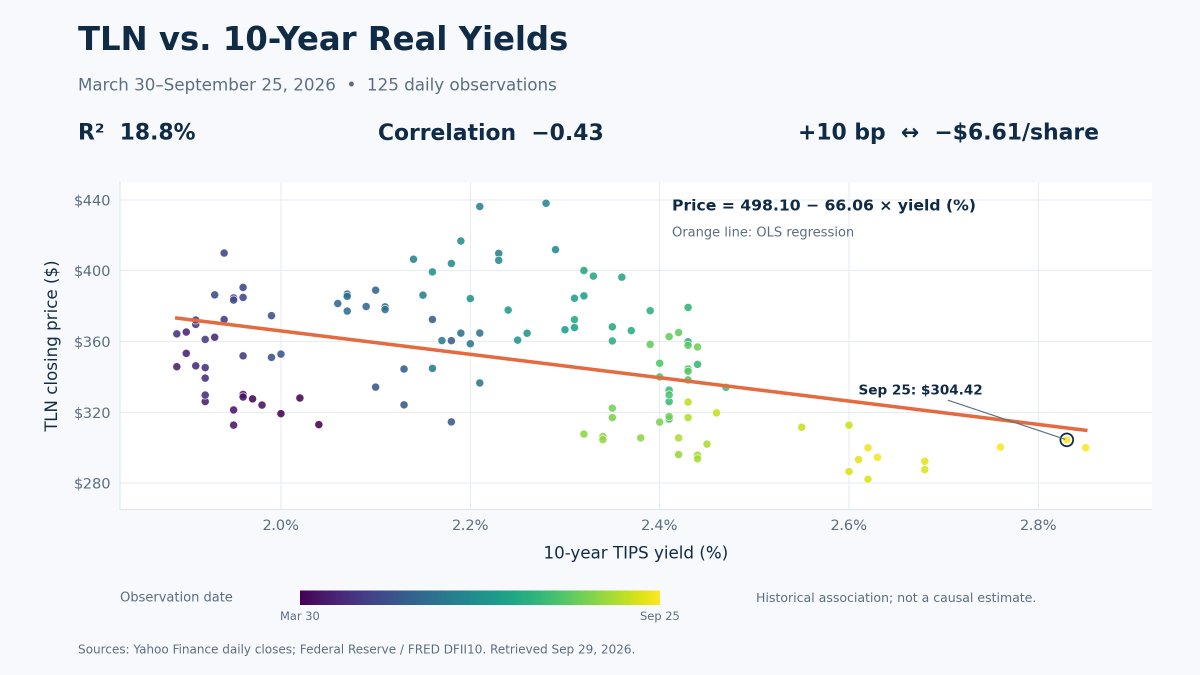
$TLN and other IPP have gotten hurt this year due to PJM cost of living/regulation concerns. However, they have also been hurt because of rising real yield. With rates starting to relax (hf almost done blowing up, flow through SoH back to 90% of prewar, reds well above the dots), we could start to see some recovery in these names. Combine the macro with power supply/demand only going one way over the next decade, and $TLN can benefit from several themes.
$TLN $VST $CEG
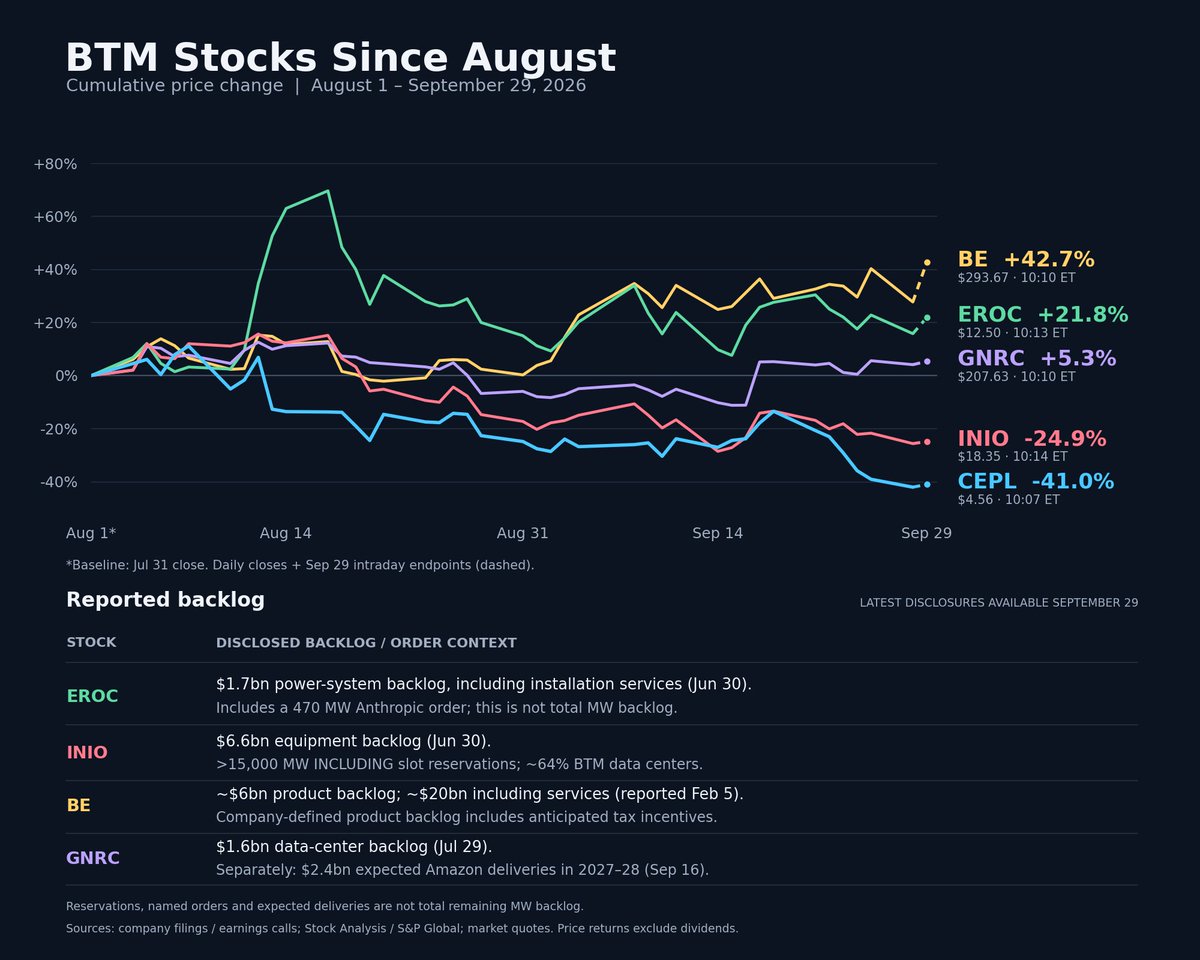
$CEPL has gotten crushed over the last two months, both outright and against BTM competitors. The big difference is that the competitors have a disclosed backlog (though as we have seen with Boom, an LoI may not be worth that much).
$CEPL microturbines have many benefits and competitive advantages vs reciprocating engines. At this point, I think none of those advantages matter relative to the primary advantage of Time To Power.
$CEPL can output 7mw/week at current staffing levels and factory layout. It is only a matter of time before a DC developer weights TTP over any other concerns and signs a contract. A powered B200 now is worth more than a B200 sitting in a warehouse or unpowered DC.
From a valuation perspective, $CEPL now assigns 0 option value to a DC order. An announcement should meaningfully rerate the stock. Even if it doesn't hit $EROC, or let alone $BE, multiples, the upside is there. And if a multi-hundred mw backlog is announced, watch out...
@northfront_1 And potentially lower in multiple depending on how large the order with the $3.7mm deposit is. Ignore data centers and the company is still cheap.
@NickTimiraos A majority of global AI inference demand is served from US based data centers. The other physical infra buildouts mostly only impacted US GDP. It's not clear to me the denominator for each should be US GDP as other countries are outsourcing (and partially funding) AI infra.
$SPCX is unlocking a significant number of shares relative to the traceable float over the next month. Including the IPO, green shoe, and previous unlocks, there are ~2.25b tradable shares at the moment. Over the next month, slightly less than 1b additional shares will unlock, nearly 50% of the current tradable shares.
The current environment is very different from 2022, when 2021 SPACs and IPOs unlocked and shares got hammered into a tech bear market. However, I wouldn't be surprised to see some weakness over the next month as the market rebalances through any selling.
$SPCX's beta has been unstable since the IPO, but good finger in the air number to $QQQ is around 2.5. I'm happy to short a smaller amount of $SPCX as a portfolio hedge over the next month.