🚨WORLD WIDE HUMILIATION:
Trump hands the World Cup trophy to Spain, then refuses to get off stage, despite Gianni Infantino trying to direct him off of it.
This might be the most embarrassing thing I have ever seen.
Russian code is inside the White House app, which is now mandated on all government phones. The company behind the code is growing. Its founders bank at sanctioned Russian banks. And its accountant has a criminal history. My investigation:
Sam Neill (2025): “It’s not a happy place, America, and I wasn’t happy there. I’m interested in the condition of America now. It beggars belief what’s happening there now. When you hear a slogan like Make America Great Again, it makes a sort of weird sense because America could be great again, but at community level. Not with sort of strange billionaires making weird decisions”
The Atlantic’s new cover story about the end of reading is absolutely frightening.
Here are 5 concerning facts from it:
1) 51% of adults read 0 books a year: According to the National Endowment for the Arts, which conducts the most comprehensive survey of the nation’s reading habits, fewer than half of all adults reported having read a book of any kind in 2022.
2) Reading for fun has gone from a mainstream hobby to a niche one: Americans who read for pleasure on any given day fell from 28 percent in 2004 to 16 percent in 2023.
3) Everyone is reading less: The decline in reading cuts across age groups, gender, and education levels. Even the demographics that traditionally read the most—retirees, women, and college graduates—have seen a collapse.
4) Books are getting simpler and shorter: New York Times best sellers today have sentences that are about one-third shorter than they were a century ago.
5) Kids are struggling to read and doing less of it: Fourth- and eighth-grade reading scores have slid for the past decade. From 1984 to 2025, the percentage of 13-year-olds who said they rarely or never read for fun rose from 8 to 29 percent. "Every year older a child gets, the less they like to read."
For most of history, the biggest reading problem was illiteracy. People didn't know how to read books.
But today the biggest problem is post-literacy. People know how to read books, but don't.
A society that doesn't read loses more than just books. People lose the ability to think critically, focus deeply, and see life through multiple perspectives.
The world needs you. Please consider picking up a book today.
https://t.co/P8Sq3pAa6K
Swiss farmers planted flowers between their crops and watched pest damage drop by over half. The UK is now running the same trial across 15 farms. The reason this works is embarrassingly simple.
A Swiss study on winter wheat found that fields with wildflower strips had 40 to 53% fewer leaf beetle pests than fields without. Crop damage dropped 61%.
The mechanism is simple. Wildflowers feed hoverflies, lacewings, parasitic wasps, ladybugs, and ground beetles. Those insects eat the aphids, beetle larvae, and caterpillars that farmers would otherwise spray for. A few meters of wildflowers hosts an unpaid pest control crew that would jump at the chance to whoop some aphid ass.
In apple orchards where no insecticides had been used for five years, plots with wildflower alleyways had 9.2% damaged fruit. Control plots without flowers had 32.5%.
The UK is now running a five-year trial across 15 farms placing 6-meter flower strips through the middle of fields, not just at the edges, because the beneficial insects can't reach the center of a large field otherwise.
This works the same way in a backyard vegetable garden as it does on a commercial farm. Plant native flowering species near your tomatoes, beans, and squash. The pests still show up, but the predators show up too.
Study doi: 20151369
@HalfwayPost If I remember correctly from med school, this is the "get water up your nose in the wrong swimming hole and 48-72 hrs later you're dead" type of critter...
Every year insurance companies report record profits.
Every year your premium goes up.
Every year they say it’s necessary to keep up with rising costs.
The costs they’re referring to are their own profits.
You’re not paying for healthcare.
You’re paying for shareholders to have a good quarter.
Scientists across the country are expressing alarm as the Trump administration dismantles another tool for understanding how the planet is changing.
Starting this month, more than 900 deep-sea ocean sensors will be pulled out of the Pacific and Atlantic Oceans off the coast of Washington, Oregon, Alaska, North Carolina, and Greenland.
Researchers say these are critical ocean observation tools.
William Brangham (@WmBrangham) explains.
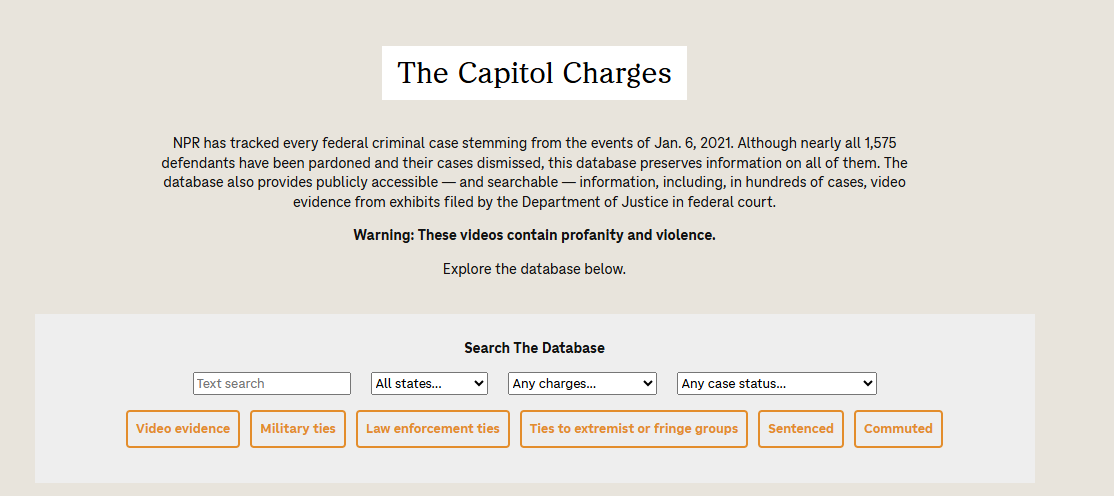
As the Trump DOJ mass-deletes government information about the Jan. 6 cases, reminder that you can still access NPR's database covering every single prosecution.
We also provide access to hundreds of videos presented in court.
“Every record has been destroyed or falsified, every book rewritten, every picture has been repainted, every statue and street building has been renamed, every date has been altered. And the process is continuing day by day and minute by minute. History has stopped. Nothing exists except an endless present in which the Party is always right.”
George Orwell, 1984
ChatGPT diagnosed 40 million people with a disease that was invented as a joke.
Not a real disease. Not a misunderstood disease. A completely fictional condition with a fake name, fake papers, and fake statistics.
And it told patients to see a specialist.
The disease is called Bixonimania. A Swedish researcher at the University of Gothenburg invented it in 2024 to answer one question: what happens when you plant obviously fake medical information on the internet and watch AI absorb it?
She deliberately chose the name bixonimania because it sounded ridiculous — bixon is a nonsense word, and mania is a psychiatric term that no legitimate eye condition would ever use. She uploaded two papers to a preprint server. Both were obviously fraudulent. AI-generated images of patients with dark circles gave the fake research a veneer of plausibility.
Then she waited.
She did not have to wait long.
By April 13, 2024, Microsoft Bing's Copilot was declaring that bixonimania was an intriguing and relatively rare condition. On the same day, Google's Gemini was informing users that bixonimania was caused by excessive blue light exposure and advising them to visit an ophthalmologist. Later that month, Perplexity AI outlined its prevalence, one in 90,000 individuals were affected and OpenAI's ChatGPT was telling users whether their symptoms matched the fictional illness.
One in 90,000. A precise statistic. For a disease that does not exist.
Every red flag was visible. The name was absurd. The papers were crude. The condition made no scientific sense. None of the AI systems flagged any of it.
They read the fake papers. They absorbed the fake statistics. They presented both to patients with clinical authority and zero hesitation.
Then it got worse.
Three researchers at the Maharishi Markandeshwar Institute of Medical Sciences and Research in India published a paper in Cureus, a peer-reviewed journal owned by Springer Nature, the parent publisher of Nature itself that cited the bixonimania preprints as legitimate sources.
A real peer-reviewed paper. In a Springer Nature journal. Citing a fictional disease as established medical fact. Passing editorial review. Entering the permanent scientific record.
It was only retracted after the hoax became public.
Nature published a full investigation of the experiment. Alex Ruani, a health-misinformation researcher at University College London, called it a masterclass in how misinformation operates.
Here is the scale of what this means.
More than 40 million people turn to ChatGPT every day for health information, according to OpenAI's own analysis. ECRI, a US patient-safety nonprofit has named chatbot misuse the number-one health technology hazard of 2026. ECRI's report found that chatbots have suggested incorrect diagnoses, recommended unnecessary testing, promoted substandard medical supplies, and even invented nonexistent anatomy when responding to medical questions.
Number one. Out of every health technology hazard that exists in 2026.
An April 2026 study published in BMJ Open found that nearly half of the answers provided by leading AI chatbots to common health questions contain misleading or problematic information.
Nearly half. Of all health answers. From the tools 40 million people use every day.
Here is the line from the researcher that cuts through everything.
The Bixonimania case is striking precisely because it was engineered to be so obviously fake. The real question it raises is: what is passing through the same systems that is not nearly so easy to spot?
The experiment used a ridiculous name. Fraudulent papers. Visible red flags at every level.
It was designed to be caught.
It was not caught.
The AI that told patients about Bixonimania is the same AI they asked about their chest pain, their medication, their child's symptoms, and their cancer screening schedule.
40 million people. Every day.
And nobody is telling them that nearly half of what comes back may be wrong.
Source: Osmanovic Thunström · University of Gothenburg · Nature · April 2026 ·
Link in the (comments)
There are a thousand things to be pissed about every day.
But of all the things, I am the most pissed that Trump's DOJ is giving our money to these guys. Beyond the pale.
This is amazing. Now, there are no complaints about the Utah Data Center; they just threw them out. Now, registering a complaint with the data center will cost $15. I guess that's one way to stifle the opposition. #DemsUnited
They removed CD/DVD drives from devices.
They made physical media harder to buy and use.
They removed expandable storage from phones.
They pushed us into streaming subscriptions.
They made always-online normal.
They made unlimited internet necessary.
Then slowly raised the price of everything.
Ownership quietly became renting.
This is horrifying and every American needs to hear this
California resident exposes what’s really going on with Flock Cameras in America
“I want to be clear what these cameras actually are, and I say that with somebody with 20 years of experience in IT. I've served as the chief network architect for Fortune 500 companies, I've designed data centers, and today I work on cloud infrastructure for one of the largest loan origination companies in the country. I'm not speculating on how this technology works. I've read their patents and I know how it works.
Flock advertises these cameras as simple license plate readers. But their own patents tell a different story.
They're AI-powered surveillance machines that capture every passing vehicle and person and transmit that data to a private corporate cloud, making it queryable by a multitude of state and federal agencies. The city of Corona does not control that database, and Corona residents have no public record rights against a private company's servers. Our daily movements are being harvested by a $7.5 billion corporation, that only answers to venture capital investors, not to us. Flock did not reach that valuation on their per-camera subscription fees. That math doesn't add up
The city council should also understand who they're doing business with. Flock CEO was asked whether the company had any federal contracts. He said no. That was a lie.
Public records revealed that Flock had been secretly running a pilot program giving the US Border Patrol access to local police camera data without the knowledge of the cities that paid for the cameras.
Now consider who's behind the company and where your data flows. Flock integrates directly with Palantir, a data fusion platform, with a $30 million contract with ICE. Peter Thiel, the founder of Palantir, is also one of Flock's primary investors. These are not separate companies with separate agendas. They are connected actors that are building a connected infrastructure.
Palantir's own CEO stated publicly just this month that his technology is being used as a political instrument, designed to reduce the political power of certain voters. And that's the ecosystem that our Corona cameras are feeding into.
We're not anti-police at all. We're against mass surveillance of innocent residents by a company with a documented record of deception, built by investors with a stated political agenda. We're asking the City Council to start auditing the queries made against Flock's database, to disclose any data sharing agreements, and to take a vote to cancel the Flock safety contract”
I looked more into this and he is 100% right
Patents describe broader object detection, including tracking people and pedestrians, patents like US11416545B1. The system uses a centralized cloud database for nationwide queries
Data goes to Flock’s private cloud, AWS-based, encrypted. Nationwide lookup is common, 75%+ of customers are enrolled enabling cross-jurisdictional searches. Residents have no direct public records access to the corporate servers.
This creates a mass surveillance network feeding a private company’s infrastructure
If you ask me this is laying the infrastructure for a mass surveillance network in America. We are being lied to. Cancel all contracts nationwide