No Plates. No Ancient Text. No Proof.
The foundation of the LDS Church: The issue is whether Joseph Smith’s extra-biblical revelations are true. A restored doctrine, origin story, or scripture must be proved the same way the biblical text is proved: by ancient, comparable evidence - not by a 19th-century paper trail.
The KJV is a 1611 English translation of the Hebrew Masoretic Old Testament and the Greek Textus Receptus New Testament. Behind those printed sources is an older textual tradition, independently attested by the Dead Sea Scrolls, the great Masoretic codices, about 5,800 Greek New Testament manuscripts, early papyri such as P52, and thousands of ancient translations in other languages. The KJV is English, but its underlying manuscripts are ancient and robustly attest its text.
Biblical preservation is public. The Old and New Testament texts were copied, translated, and quoted across centuries and countries. That leaves a trail that can be compared: Hebrew, Greek, and ancient translations that do not depend on one modern prophet. A line that vanished from every stream would have to vanish everywhere. The distinctive Smith doctrines do not appear in that surviving record. Smith’s extra-biblical record does not have that preservation. The plates are not here. The first 116 pages are gone. There is no ancient Book of Mormon copied in a known language, dated, and spread through independent scribes. What remains is English dictation from 1829, plus later church papers. That is not how the biblical text survived. That is how a 19th-century claim was written down.
Joseph Smith’s later system has no such attestation. His distinctive claims - new scripture from gold plates, the 1820 First Vision as now canonized, 1829 angelic priesthood, an embodied once-mortal Father, men becoming gods, premortal spirit children, temple sealing and proxy baptism as saving law, the Book of Abraham as a translation of the papyri, Zion in Independence - arrive as 19th-century revelations.
What exists is an LDS Church paper trail: the 1829 dictation, the Printer’s Manuscript, Doctrine and Covenants, affidavits, later official histories. What does not exist is the ancient backup. No plates. No “reformed Egyptian” manuscript family. The first 116 pages, the Book of Lehi, were lost in 1828 and that text is gone. About 28 percent of the original Book of Mormon manuscript remains - modern English, not Nephite autographs. The surviving Abraham papyri are funerary texts; they do not read as the book Smith published.
Smith’s chosen witnesses and a spiritual testimony are evidence that people believed the Smith claim. They are not ancient manuscripts of the claim. Until that ancient evidence is produced, the Smith restoration claim is unproven. A false belief can continue. The verdict on the evidence does not change: the required ancient proof for Smith’s claims has never been produced.
What the Book of Mormon and the system built on it actually teach:
2 Nephi 25:23: “it is by grace that we are saved, after all we can do.” That clause has been used for generations to condition grace on human effort.
Official LDS teaching and practice still require baptism by proper authority, endowment, sealing, Word of Wisdom, tithing, and temple covenants for exaltation - the actual goal, not mere immortality in a lesser kingdom. That is not Paul’s gospel. It is the Galatian error with extra steps. Add the rest that comes with the restoration claim:
God the Father has a body of flesh and bones (D&C 130:22). The Book of Mormon itself sometimes speaks of God as spirit (Alma 31:15). Both cannot be true.
Men can become gods.
The New Testament church fell into complete apostasy so that new apostles and new scripture were required directly contradicting Jesus’ promise that the gates of hell would not prevail against His church (Matt 16:18) and the New Testament’s picture of a once-for-all delivered faith (Jude 3).
Those are not “appendages.” They change who God is, what Christ accomplished, and how a person is justified. The LDS system is another gospel. An angel delivering it does not make it the same gospel. It makes Galatians 1:8 apply exactly as written.
THE RECORD
Luke 24:49: What Jesus promised
Jesus promised the Holy Spirit, not a later LDS temple ordinance. Luke 24:49 has been used to support an LDS endowment that the verse does not teach. The text and Luke’s own sequel close the question.
The verse
“And, behold, I send the promise of my Father upon you: but tarry ye in the city of Jerusalem, until ye be endued with power from on high.” (Luke 24:49)
“Endued” is older English for clothed. The Greek verb is endyō: to put on, as one puts on a garment. Jesus used a figure of speech. He told the disciples to wait in Jerusalem until heaven clothed them with power.
What Jesus identified
He called the gift “the promise of my Father.” Luke wrote both the Gospel and Acts. In Acts he names that promise.
Acts 1:4-5: wait for “the promise of the Father.” Jesus then says, “ye shall be baptized with the Holy Ghost not many days hence.”
Acts 1:8: “ye shall receive power, after that the Holy Ghost is come upon you: and ye shall be witnesses unto me.”
Acts 2:1-4: the Spirit comes at Pentecost. The disciples speak and preach. The public mission begins.
Luke’s own sequel settles the meaning. The clothing is the Holy Spirit. The power is for witness. The place is Jerusalem. The fulfillment is Pentecost.
What the verse does not say
Luke 24:49 does not mention a temple house, washings, anointings, sacred clothing, signs and tokens, or covenants of obedience, sacrifice, chastity, or consecration. Those LDS items are not in the sentence Jesus spoke as Luke recorded it. They are not in Acts 1 or Acts 2 either.
The later move
LDS teaching often places Luke 24:49 beside Doctrine and Covenants language about being “endowed with power from on high” and beside the later temple ordinance called an endowment. That is a later Joseph Smith system using King James wording. It is not Luke explaining Luke.
Appeals to Pentecost plus a later ordinance do not rescue the claim. Luke already defined the promise in this verse as the Holy Spirit poured out at Pentecost. A later Smith book can create a ceremony; it cannot turn Luke 24:49 into that ceremony.
The word endyō means clothe. Luke then says what they were to be clothed with: power from on high, identified as the Holy Spirit. A later LDS ceremony that includes clothing does not become the meaning of the verb in this verse.
The fact
Jesus told the disciples to stay in Jerusalem until the Father’s promised Spirit clothed them with power to witness. Luke records that this happened at Pentecost. Luke 24:49 teaches the coming of the Holy Spirit. It does not teach LDS temple ordinances.
The Verdict
Joseph Smith took a King James phrase whose meaning Luke had already established and used it to authorize a new system. Doctrine and Covenants 95:8-9 tells the Saints to “tarry, even as mine apostles at Jerusalem,” then attaches that wait to a house and an endowment of Smith’s making. The LDS Church repeats the same move: place Luke 24:49 next to the temple ceremony and let the shared words do the work the text will not do. That is not recovering Jesus. It is dressing a later ordinance in biblical language so it sounds like something Christ already promised.
Luke 24 and Acts 1-2 still say what they say. The promise was the Holy Spirit at Pentecost. Treating that promise as the LDS endowment is a twist of Scripture, not an explanation of it. Do not be deceived.
Another Gospel According to Joseph
The LDS Church claims to be Christian while teaching that the Bible Christians already have is corrupted and incomplete. The LDS Eighth Article of Faith states the point without disguise: the Bible is the word of God “as far as it is translated correctly.” The Book of Mormon receives no such qualifier.
Smith’s own words make the charge plainer still. He said “many important points touching the salvation of men had been taken from the Bible, or lost before it was compiled.” Ignorant translators, careless transcribers, and “designing and corrupt priests” committed many errors. 1 Nephi 13 then supplies the story: a “great and abominable church” stripped the gospel of “plain and precious” parts and covenants, leaving multitudes to stumble. On that account the Book of Mormon and Smith’s Bible revision exist to restore what was removed.
The issue follows at once. It is a claim that the received Scriptures are insufficient for salvation.
Against that claim the King James Bible answers Smith in its own words.
Deuteronomy 4:2: “Ye shall not add unto the word which I command you, neither shall ye diminish ought from it.”
Deuteronomy 12:32: “What thing soever I command you, observe to do it: thou shalt not add thereto, nor diminish from it.”
Proverbs 30:5-6: “Every word of God is pure… Add thou not unto his words, lest he reprove thee, and thou be found a liar.”
2 Peter 3:16: men “wrest… the other scriptures, unto their own destruction.”
2 Peter 2:1: false teachers “bring upon themselves swift destruction.”
2 Tim. 3:16-17. “All scripture is given by inspiration of God, and is profitable for doctrine, for reproof, for correction, for instruction in righteousness: That the man of God may be perfect, throughly furnished unto all good works.”
Gal. 1:8-9. “But though we, or an angel from heaven, preach any other gospel unto you than that which we have preached unto you, let him be accursed.”
Jesus spoke with the same finality. He treated the word He received as enduring: not one jot or tittle would pass (Matt. 5:18). Heaven and earth will pass; His words will not (Luke 21:33). “If ye continue in my word, then are ye my disciples indeed” (John 8:31).
He also warned the church what to do with men who come later with another word.
“Beware of false prophets” (Matt. 7:15). “For many shall come in my name, saying, I am Christ; and shall deceive many.” False prophets will arise and, if possible, deceive the elect (Matt. 24:5, 24). “Not every one that saith unto me, Lord, Lord, shall enter into the kingdom of heaven.” “And then will I profess unto them, I never knew you: depart from me, ye that work iniquity” (Matt. 7:21, 23).
The verdict from those texts is this. A church that demotes the Bible, adds another gospel after the apostolic deposit, and revises the book of the Lamb cannot keep the historic name Christian without emptying it. Those words of Jesus therefore judge Joseph Smith Jr. and the church that follows him. Smith treated the received Bible as insufficient. By the test Christ gave, that choice is decisive.
Scripture then states the end of that path. The warning is not confined to one closing page of the New Testament.
“Ye shall not add unto the word which I command you, neither shall ye diminish ought from it” (Deut. 4:2). “Add thou not unto his words, lest he reprove thee, and thou be found a liar” (Prov. 30:6). “They that are unlearned and unstable wrest, as they do also the other scriptures, unto their own destruction” (2 Pet. 3:16). “There shall be false teachers among you, who privily shall bring in damnable heresies… and bring upon themselves swift destruction” (2 Pet. 2:1).
That is the future the KJV assigns to Joseph Smith Jr., to the church that carries his revisions, and to every other teacher who adds to, takes from, or twists the Word already given.
Footnote: LDS say Proverbs 30:5-6 cannot bar later books, since the New Testament came later. The verse does not date-stamp the canon. It forbids treating God’s word as impure or incomplete: “Add thou not unto his words.” The New Testament declares that Christ fulfills the Scriptures already given (Matt. 5:17-18).
Smith does the reverse: he says saving points were taken from the Bible and offers new books to repair it. That is the addition Proverbs condemns. Galatians 1:8-9 then forbids any other gospel, even from an angel.
No named denomination is in the KJV. Christ’s church is those who repent, believe the gospel, are baptized, and continue in the apostles’ doctrine (Acts 2:38-47; 1 Cor. 12:13, 27). Today that is congregations that teach the Bible as God’s word, without later books.
What is offered a family: forgiveness, peace with God, the Holy Ghost, resurrection, and being forever with the Lord (Acts 2:38; Rom. 5:1; 8:11; 1 Thess. 4:16-17). Christ died for our sins, was buried, and rose again the third day (1 Cor. 15:3-4). Salvation is by grace through faith, not of works (Eph. 2:8-9).
Marriage after death: No. “In the resurrection they neither marry, nor are given in marriage, but are as the angels of God in heaven” (Matt. 22:30; Mark 12:25; Luke 20:34-36).
Parents and children: The saved are together with the Lord (John 14:2-3; 1 Thess. 4:17). David said of his dead infant, “I shall go to him, but he shall not return to me” (2 Sam. 12:23). The patriarchs were “gathered to their people” (Gen. 25:8; 35:29; 49:33). That is reunion with the Lord and His people, not a restored husband-wife-children covenant.
Those who never heard of Christ: Creation leaves them without excuse (Rom. 1:18-20). God judges by Jesus Christ according to the light they had and the law written in the heart (Rom. 2:12-16). Salvation is only in Christ (John 14:6; Acts 4:12). The KJV does not teach a later gospel chance after death for all the unevangelized.
1 Peter 3:19; 4:6: Christ preached to the spirits in prison who were disobedient in Noah’s day (3:19-20). The gospel was preached to them that are dead so they might live according to God in the spirit (4:6). Neither verse commands rites for all the dead.
1 Corinthians 15:29: Paul asks why some are baptized for the dead if the dead rise not. That chapter already says the dead rise: Christ is “the first fruits of them that slept,” “in Christ shall all be made alive,” and “the dead shall be raised incorruptible” (1 Cor. 15:20, 22, 52).
The just and the unjust both rise (John 5:28-29; Acts 24:15). Those who reject Christ are condemned already, and after death comes judgment, not a later ordinance that undoes unbelief (John 3:18, 36; Heb. 9:27; 2 Thess. 1:7-9). If there is no resurrection, baptism for the dead is vain (1 Cor. 15:12-19, 29-32). Paul does not command it, and a church bound to this word does not baptize for the dead.
Who authorized ministers? Christ gave apostles, prophets, evangelists, pastors and teachers (Eph. 4:11-13). Churches appoint elders and deacons by 1 Timothy 3 and Titus 1. Authority is Christ’s word, not a later priesthood line.
What became of apostles and prophets? Christ’s church is built on that foundation, Jesus Christ the chief corner stone (Eph. 2:20). The text does not say that founding office is repeated in every generation.
Does God still give new scripture? God spoke in time past by the prophets, but “hath in these last days spoken unto us by his Son” (Heb. 1:1-2). The faith was “once delivered unto the saints” (Jude 3). All scripture is given by inspiration of God, and is profitable for doctrine, for reproof, for correction, for instruction in righteousness: that the man of God may be perfect, throughly furnished unto all good works (2 Tim. 3:16-17).
Who closed the canon? Hebrews 1:1-2 places God’s final speech in the Son. Adding to or taking from God’s words is forbidden (Deut. 4:2; 12:32; Prov. 30:6). No verse authorizes later books as Scripture, or as superior to it.
A joint-heir with Christ inherits glorification with Him, the redemption of the body, the kingdom, and eternal life (Rom. 8:17-23, 29-30; Matt. 25:34; Titus 3:7), not a sealed earthly marriage. That is what the KJV says, without a hat, extra books, proxy baptism, or a marriage that survives Matthew 22:30.
LDS Masonic Practices vs. the Public Christ
A brief, not a Church handbook. Joseph Smith’s closed endowment versus Christ’s open gospel.
Sources are the LDS Church’s published recommend questions, public descriptions of the endowment, Nauvoo lodge and history records, Kimball’s June 17, 1842 letter, and the King James text.
LDS Sunday meetings are public. Dedicated temples are not. A living endowment requires a temple recommend after two interviews, one with a bishopric member and one with a member of the stake presidency. The Church publishes the interview questions. In summary they ask for faith in God the Eternal Father, Jesus Christ, and the Holy Ghost; a testimony of Christ’s Atonement and of the Restoration; sustaining the living Church President as prophet, seer, and revelator and as the only person on earth authorized to exercise all priesthood keys; sustaining the First Presidency, the Twelve, other general authorities, and local leaders; striving for moral cleanliness and obedience to the law of chastity; following Church teachings in public and private, including with family; no support or promotion of teachings, practices, or doctrine contrary to the Church; striving to keep the Sabbath, attend meetings, and partake of the sacrament; honest conduct; a full tithe; and understanding and obeying the Word of Wisdom, commonly applied as no alcohol, coffee, tea, or tobacco. The Church teaches the law of chastity as sexual relations only within a legal marriage between a man and a woman.
Serious sins must be resolved with priesthood leaders first. Endowed members are also asked whether they keep their temple covenants and honor the privilege of wearing the garment as instructed in the endowment. The ordinary rule is that a person who is not a full-tithe payer does not receive an endowment recommend. No recommend, no endowment.
Inside, the main adult rite is the endowment: a symbolic washing and anointing, instruction to wear the temple garment, a presentation on creation and return to God (filmed in most temples), and five covenants the Church now names in public teaching. Those covenants are the law of obedience, the law of sacrifice, the law of the gospel of Jesus Christ, the law of chastity, and the law of consecration. A new name is given. Signs and tokens are taught.
Those particular symbols are not to be described outside the temple. LDS leaders often say the rite is “sacred, not secret.” Calling it sacred does not change the facts: the tokens stay unpublished, the doors stay shut, and the public cannot watch a dedicated endowment session. That is a closed ordinance. Jesus taught publicly in synagogues, temple courts, and in the open. He did not teach a handshake that must be hidden behind a recommend.
A token, in this rite, is taught as a sacred clasp of hands, a set way of joining hands, with a matching gesture called a sign and with an associated name. That is a description from form and from historical comparison. The Church does not publish the tokens. Brigham Young taught that the endowment prepares a person to pass angels who stand as sentinels by means of key words, signs, and tokens.
Critics and many historians compare those handclasps to Masonic grips: proof of initiation, not a sermon that can be preached from a housetop. That comparison rests on matching ritual form: temple tokens and signs resemble Masonic grips and signs, and both rites used secrecy, penalties, and related emblems. It does not rest on any official Nauvoo Lodge minute that records the lodge transferring those grips into the endowment. The Church now publishes the titles of the five covenants. It still does not publish the tokens.
March 15 and 16, 1842: Joseph Smith is initiated as an Entered Apprentice and, the next day, passed Fellow Craft and raised Master Mason. Nauvoo Lodge minutes and period histories record it. In that season the lodge used the upper room of his Red Brick Store in Nauvoo, a room also used as his office and described as the lodge room where the Masonic fraternity met. May 4, 1842: on that same upper floor, Joseph Smith administers washings, anointings, endowments, and priesthood keys. Standard accounts say he instructed a first company usually counted as nine men. Contemporary and later LDS accounts treat that first company as men tied to the Nauvoo lodge. Historians describe most of them as Masons.
June 17, 1842: Heber C. Kimball writes Parley P. Pratt that the new priesthood things “are not to be written,” that “there is a similarity of priesthood in masonry,” and that “Brother Joseph says masonry was taken from priesthood but has become degenerated.” The wording here follows the sense of the letter as commonly cited; the original is spelled phonetically. LDS FAIR cites that letter. The nineteenth-century endowment used ritual forms also used in the lodge: certain grips, secrecy penalties, the five points of fellowship, square and compass marks, and stock ritual phrases.
The Church later removed or softened the parts that looked most like the lodge. In 1990 the penalty oaths and the five points of fellowship were dropped, and women no longer covenanted to obey a husband. In 2005 the initiatory was made fully clothed and more symbolic. In 2019 and 2023 the session was shortened, wording was revised, the five covenants were listed at the start, and patron-to-patron touching during the tokens was reduced. A recommend, garments, a new name, and tokens that may not be described outside still remain. Titles of covenants are public. Tokens are not.
Matthew 10:27 is not permission for a permanent secret. The King James text says: “What I tell you in darkness, that speak ye in light: and what ye hear in the ear, that preach ye upon the housetops.” The Greek skotia (“darkness”) means a private setting, the quiet classroom, not a doctrine under a gag order. Verse 26 says nothing covered stays covered. The whisper is ordered onto the roof. That reading is an application of the text to a closed handshake.
John 18:20: “I spake openly to the world… in secret have I said nothing.”
Matthew 5:34, 37: “Swear not at all… let your communication be, Yea, yea; Nay, nay.”
James 5:12: “Swear not… lest ye fall into condemnation.”
Luke 8:17: “Nothing is secret, that shall not be made manifest.”
Ephesians 5:11-12: “Have no fellowship with the unfruitful works of darkness… it is a shame even to speak of those things which are done of them in secret.”
1 Timothy 2:5: “One mediator between God and men, the man Christ Jesus.”
Hebrews 10:19-20 says believers enter “by the blood of Jesus, by a new and living way… through the veil.”
Galatians 1:8: “Though we, or an angel from heaven, preach any other gospel… let him be accursed.”
FAIR will say Masonry was a catalyst, not a copy; that the theology differs; that Kirtland already had washings. Those claims do not cancel March 15 and 16, May 4, the lodge room, Kimball’s letter, or the King James text.
Scripture applied: The King James Bible never names Joseph Smith. Read on its own terms, it names a pattern and forbids it: open speech, not lodge silence; yea and nay, not ritual oaths; one Mediator and a torn veil, not tokens behind a recommend; another gospel accursed.
John 18:20 records Jesus telling the high priest that his teaching was public. Using that verse against a closed handshake is an application of the text. The same is true of Ephesians 5:11-12 when it is set beside tokens that still may not be described outside an LDS temple. Paul warns against fellowship with works of darkness and says it is a shame even to speak of things done in secret.
The brief makes that application on purpose. Smith’s endowment, given seven weeks after he was made a Mason, fits the other pattern. The LDS Church softened the packaging. It did not make the ordinance match John 18:20.
The standard is Jesus, not Nauvoo. Jesus’ ministry was public: synagogues, temple courts, housetops. Calling a closed handshake “sacred” does not make it Christian. The Christian measure is the open Christ, not Joseph Smith’s secret tokens.
Joseph Smith Jr. was a practicing Mason in a secret fraternity. He took lodge forms into a closed endowment and preached that package as restored priesthood gospel. Galatians 1:8 names that other gospel. On that measure Smith was an accursed deceiver.
THE 116 PAGES
No Second Reading
If the stone gave the words, he could have given them again.
Joseph Smith taught that the Book of Mormon’s English was not a story he invented. He said the words were given as he used the spectacle stones he called interpreters, later called the Urim and Thummim, or a seer stone in a hat, while a scribe wrote them down. Emma Smith and Martin Harris described that method. David Whitmer described it later. If the English was being read, it could be read again. That is the claim.
In 1828 the claim met a test.
From about April 12 to June 14, Martin Harris wrote as Smith dictated. They produced about 116 manuscript pages. That is the number Smith later gave. Smith later called this the Book of Lehi: Mormon’s abridgment of early Nephite history down toward King Benjamin. There was one copy. There was no backup.
On June 14, after refusing twice, Smith let Harris take that only copy to Palmyra. Harris was to show it to a short list of relatives, including his wife, Lucy Harris, who opposed the work. The pages disappeared. They were never printed. They were never produced in court. They were never seen again.
Smith then spoke in the name of God. A revelation now called Doctrine and Covenants 3 rebuked him for yielding to Harris. He said the plates and translation tools were taken from him. His mother, Lucy Mack Smith, later wrote that they were returned on September 22, 1828.
The decisive statement is Doctrine and Covenants 10. It says he must not translate those pages again. “Wicked men” have the manuscript. They will change the words. Then, when a second translation appears, they will hold up both copies and cry fraud. So he is to publish a different record of the same period, the small plates of Nephi, instead of the Book of Lehi.
He kept that rule. With Oliver Cowdery, from April 7 to late June 1829, he finished the Book of Mormon without redoing the Book of Lehi. He replaced the lost opening with the small-plates account now printed as 1 Nephi through Omni. Words of Mormon is the seam between that account and the rest of the book. The 1830 preface says the same thing in Smith’s own voice: the first account was stolen, and it would not be translated again.
Those sentences close the case he opened.
Smith said he must not translate the lost pages again. He said enemies had those pages and would change them. Then they would hold up their copy next to a new translation and say the words did not match. But if the stone gave the same words twice, a new translation would expose their changes. He never made that new translation.
This also reverses the burden of proof. A second dictation would not have to match a forged sheet.
If thieves stole the 116 pages and altered them, that pile of paper is not the original reading. It is a tampered copy. Ink, handwriting, erasures, and squeezed-in words leave marks. The honest test is not “Does Joseph match the thieves?” The honest test is “Does the stone give the same English it gave before?”
If God showed the words in 1828, God can show them in 1829. A new manuscript can be written in front of witnesses. If enemies then wave a different version, the answer is plain: you changed your copy; here is a new reading, done the same way as the first.
A forged sheet cannot win that fight unless Joseph never produces the second reading. Doctrine and Covenants 10 makes sure he never does. It treats the missing paper as the standard he must beat. It forbids the comparison itself.
That is the con, in his own terms.
Defenders say God was teaching humility. A rebuke can be a lesson. A ban on repeating a reading is something else. Defenders say translation is not a photocopy, so the words might come out different. Then the “wicked men” plan collapses. You cannot warn of a deadly mismatch and also say the two versions were never supposed to match.
Defenders say Lucy Harris burned the pages. That story appears decades later and is not required. She was blamed at the time. The pages vanished. Lehi was not dictated again. Those are the facts that matter.
Defenders say the small plates were prepared anciently for this loss. That is a claim inside the book. It does not change the 1828 fact: the only English of that opening disappeared, and Smith did not reproduce it.
Defenders say the 1829 dictation was too fast to invent. Speed is a different argument. It does not explain why the 1828 pages were retired instead of read again.
A man who can read the same ancient text twice has no need of that ban. A man who cannot repeat a long dictated narrative has every need of it.
By his own plain words, the seer-stone method, the warning that a mismatch would expose him, and the command not to produce the 116 pages again, Joseph Smith Jr. defined his gift so it could not be checked after the only checkable pages disappeared.
The verdict the timeline forces is this.
That is not the conduct of a translator with a stable text. It is the conduct of a man protecting a story he could not tell the same way twice. Joseph Smith Jr., deceiver.
Folks, let’s cut through the fog. Joseph Smith Jr. wasn’t some quiet Sunday school teacher. He was born in Vermont in 1805, then raised in a farming family in upstate New York. He said God, angels, and gold plates gave him the real story on the Bible, the one the rest of Christianity had been reading wrong for centuries.
His claim was straightforward and audacious. The Bible is the word of God “as far as it is translated correctly.” Ignorant translators, careless scribes, and corrupt priests had stripped out “plain and precious things.” So Smith, by his own account, went to work. He began the project in June 1830 and finished the main dictation in July 1833. That work later became known as the Joseph Smith Translation. He did not work from Hebrew or Greek manuscripts. He used a printed King James Bible, marked insertion points in it, and dictated revisions and long new passages to scribes. He changed about 3,600 verses and added roughly 10,000 words with no counterpart in any known ancient biblical manuscript. The largest new blocks include an expanded Enoch narrative and the early Genesis material now printed as the Book of Moses.
He also recast passages to fit his doctrine, including John 1:18, which he revised to say that no man has seen God at any time except he has borne record of the Son. He taught that the Christian gospel was known from Adam forward. That was his restored version. He also inserted a long addition into Genesis 50. In that added text, Joseph of Egypt is made to prophesy that God would raise up a latter-day seer “and his name shall be called Joseph, and it shall be after the name of his father.” Smith and his followers identified that seer as Joseph Smith Jr., son of Joseph Smith Sr. No Hebrew manuscript of Genesis contains that prophecy.
The same restoration produced a different God and a different Christ than historic Christianity reads out of the received Bible. On April 2, 1843, Smith recorded that “the Father has a body of flesh and bones as tangible as man’s.” On April 7, 1844, in the King Follett sermon as reported by those who took notes, he taught that God himself was once a man and is now an exalted man. The Book of Moses, which came out of the Genesis revision, and the Book of Abraham describe a premortal council involving the Father, the Beloved Son, and Satan. From those texts Smith’s church taught that Jesus and Lucifer are spirit sons of the Father, and that Lucifer is the spirit brother of Jesus who rebelled and fell. Those doctrines are not the reading of the biblical manuscripts. They are Smith’s reading.
The other pillar was the Book of Mormon, presented as another testament of Jesus Christ that confirmed and completed the Bible. Ancient American prophets, gold plates buried in a hill in New York, translated by the gift and power of God. Eleven men signed statements. Three said an angel showed them the plates and they heard a divine voice confirm the translation. Eight said Joseph Smith showed them the plates, they handled the leaves, and saw the engravings. Those affidavits have been printed in every edition of the book since 1830. Those eleven were Smith’s inner circle: scribes, backers, Whitmers, and Smiths. No outside scientific examination of the plates was made. That’s the proof Smith offered the world.
Now look at what actually happened.
The plates are gone. Smith said he returned them to the angel. Mainstream archaeology has not produced a gold plate, a reformed Egyptian inscription, or a city accepted as Nephite that matches the narrative. Mainstream archaeology also finds no horses, steel swords, wheat, chariots, or elephants in the pre-Columbian Americas during the periods the book describes. Genetic studies of Native American populations point to Asian origins, not Israelite ones. The Book of Mormon itself contains long stretches of King James English, including translation artifacts that did not exist in 600 B.C. Jerusalem.
On the Bible revision itself, the manuscript evidence went the other way. After Smith’s death, the Dead Sea Scrolls and thousands of additional New Testament manuscripts showed that the biblical text was transmitted with far more stability than Smith claimed. Those witnesses have variants. They do not contain the large restored sections Smith added. His changes look, to scholars outside the faith, like 19th-century theological expansions rather than recovered originals. Putting a seer named Joseph, after his father, into Genesis is part of that pattern. So is teaching that God is an exalted man of flesh and bones and that Jesus and Lucifer are spirit brothers.
Some of the witnesses later left the church. None of the eleven issued a public recantation of seeing plates, but the translation method itself, Smith looking at a seer stone in a hat while the plates were often covered or not even present, raises obvious questions about what was actually being “translated.”
That’s the record. A young man with little formal schooling produced a new Bible and a new scripture, backed by signed witness statements and personal revelation. One hundred ninety-six years later the physical artifacts are missing, the archaeology does not line up, and the textual history of the Bible does not support the scale of corruption Smith described.
You can believe the plates were real and the angel took them back. You can believe Smith was a prophet restoring lost truth. Or you can look at the evidence that exists and the evidence that does not. That’s the investigation.
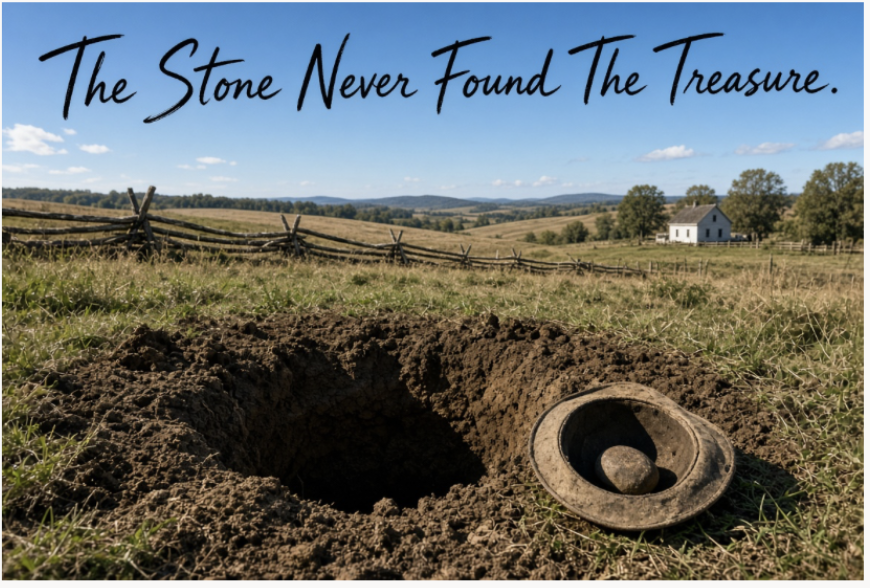
The Stone Never Found The Treasure
Joseph Smith Jr. first used a seer stone to report what others could not see. Josiah Stowell hired him for that work. The 1826 Bainbridge examination exists because of it. Associates later described the same stone-and-hat method in the production of the Book of Mormon. The LDS Church acknowledges the seer stone. The question is not what he intended. The question is whether the checkable claims held up.
1. Independence temple (1832)
Doctrine and Covenants 84 said a temple would be built in Independence, Missouri, in “this generation.” The Saints were driven out. No temple went up there among the people then alive.
2. David Patten’s mission (1838)
Doctrine and Covenants 114 told Patten to prepare for a mission “next spring.” He was killed in October 1838. Spring came. The mission did not.
3. Fifty-six years (1835)
At the 14 February 1835 meeting recorded in History of the Church 2:182, Smith said the coming of the Lord was nigh and that fifty-six years should wind up the scene. That points to 1891. The year passed. It did not happen.
4. The United States overthrown (1843)
History of the Church 5:394 records his prophecy that if Missouri’s wrongs were not redressed, the government would in a few years be “utterly overthrown and wasted.” There was no redress. The government was not overthrown.
5. Treasure in Salem (1836)
Smith went to Salem after a report of hidden money. Doctrine and Covenants 111 spoke of “much treasure” there and of power to pay debts. No buried money was found on that trip.
6. The Civil War text (1832)
Doctrine and Covenants 87 said war would begin in South Carolina. It did, in 1861. The same text said war would then be poured out on all nations until a “full end of all nations.” That war did not become that end.
7. The Book of Abraham
Smith published it as a translation of records in his possession. The surviving Joseph Smith Papyri are Egyptian funerary texts. The printed facsimiles are burial scenes, not the scenes he labeled. The papyri we have do not say what he said they said.
8. The Book of Mormon as American history
Smith offered the book as an ancient record of Israelite-descended peoples in the Americas. For generations the LDS Church’s official introduction taught those peoples as the “principal ancestors” of the American Indians. That heading was later changed. Genetics traces Native American ancestry to Siberia and East Asia. Mainstream archaeology does not confirm the civilizations the book describes at that scale.
Those claims were offered as knowledge other people could not check at the time. They can be checked now. A statement about the future or about a text is verified only if the future and the text agree. In the instances above, they did not.
What Jesus said
“Beware of false prophets, which come to you in sheep’s clothing, but inwardly they are ravening wolves.” (Matthew 7:15, KJV)
“And many false prophets shall rise, and shall deceive many.” (Matthew 24:11, KJV)
“For there shall arise false Christs, and false prophets, and shall shew great signs and wonders; insomuch that, if it were possible, they shall deceive the very elect.” (Matthew 24:24, KJV)
1830-1844: The Fourteen-Year Trail of New Scripture
Joseph Smith Jr.: Operator, seer, and the record beneath the Icon...
History is not a morality play written by later admirers, but a ledger of what men actually did when money was short, authority was contested, and the next revelation had to be produced before the creditors or the mob arrived. Applied to Joseph Smith Jr., that standard yields an uncomfortable portrait. The founder of the Latter-day Saint movement was neither a simple rustic mystic nor a cartoon villain. He was a gifted organizer who fused folk magic, biblical restorationism, land speculation, and secret domestic arrangements into a new American religion. His methods were those of a frontier operator who understood that sacred claims, once believed, become capital.
The early record is not obscure. Before the gold plates, Smith was known in Palmyra and Manchester as a treasure seer. He used a stone in a hat to locate buried caches that never materialized in paying quantities. In March 1826 he was brought before a justice in South Bainbridge as “the Glass Looker.” The proceeding is best described as an examination rather than a fully documented criminal trial; the disposition remains disputed among historians. Josiah Stowell testified to Smith’s gift; the nephew who initiated the complaint did not. Smith later allowed that money-digging “was never a very profitable job.” The same stone, and the same darkened-hat method, reappeared in the dictation of the Book of Mormon. Witnesses - Emma Smith, David Whitmer, Martin Harris - described the plates often covered or absent while the words came. The official artwork of later generations preferred spectacles and open plates. The contemporary accounts did not.
The folk pattern did not stop when his church was organized. In 1836, with Kirtland debts mounting, they went to Salem, Massachusetts, on word of valuables hidden in a house. Doctrine and Covenants 111 told them not to concern themselves about their debts, promised power to pay them, and spoke of “much treasure” in Salem, including people to gather and, “in due time,” the city’s gold and silver. They returned without a hidden cache. The seer of Palmyra and the prophet of Kirtland was the same Joseph Smith, using the same hunt.
Smith was not an unmarked saint in body either. At seven he underwent surgery for a leg-bone infection and thereafter walked with a slight limp. In March 1832 a mob dragged him from the John Johnson house in Hiram, Ohio, beat him, tore out a patch of hair that never grew back, tried to force nitric acid into his mouth, and damaged a front tooth. He preached the next day with tar still on his skin and spoke thereafter with a whistle. These are the marks of a man who lived by collision as much as by vision.
Publication of the Book of Mormon required other men’s property. Martin Harris mortgaged his farm for the three-thousand-dollar printing bill. Sales were slow. Smith held the copyright and at one point sought to sell it in Canada. He did not thereafter take a regular wage-paying occupation. He dictated revelations, organized gatherings, bought and sold lots as converts arrived, ran partnership stores in Kirtland and later the Red Brick Store in Nauvoo, and served as trustee-in-trust because Illinois law limited how much real estate a church could hold in its own name. Personal and ecclesiastical ledgers were routinely mixed. Land bought cheap near Commerce was platted and sold to incoming Saints at prices far above the raw-acre cost. He also served as guardian of the Lawrence sisters’ estate and was sealed to Maria and Sarah Lawrence - an overlap of fiduciary duty and plural sealing that would draw scrutiny in any other ledgers.
The Kirtland Safety Society collapsed in the Panic of 1837; Smith had invested heavily and left Ohio amid lawsuits. Across his career he was party to a very large number of civil and criminal actions and was arrested repeatedly; he was never convicted of a felony. In Nauvoo the municipal court, backed by a generous city charter and by Smith as mayor, used habeas corpus to contest writs from outside officers. That was legal hardball, not only martyrdom. In 1842 he listed roughly seventy-three thousand dollars in obligations and sought the new federal bankruptcy statute. After his death the estate was auctioned in pieces. The United States recovered about $7,870 on the steamboat Nauvoo debt. Emma received about $1,809 as her widow’s share and used it to repurchase family houses. Most private creditors received nothing. This is not the balance sheet of a man who lived by ordinary labor.
After the Book of Mormon appeared in March 1830, Smith continued producing new claims in the same manner he had produced the book. He dictated revelations, usually in the first person as the voice of God - “Verily thus saith the Lord…” - while a scribe wrote them down. Early on he sometimes still used a seer stone; later he more often described the process as inquiring of the Lord and then speaking by the Spirit. The texts were copied into manuscript books, edited, and published first as the Book of Commandments (1833) and then as the Doctrine and Covenants (1835), with wording changes along the way. He also produced multiple firsthand accounts of the First Vision (1832, 1835, 1838, 1842). They differ in the number of personages, his age, and whether the purpose was forgiveness of sins or a command to join no existing church. Later official telling preferred the 1838 narrative.
Not every dated prophecy promise landed as written. An 1832 revelation (D&C 84) placed a temple at Independence in “this generation.” No such temple was built. Believers read the text as conditional on obedience. Skeptics read the calendar. Both readings are now part of the argument; the unmet face of the words is not.
The restorations arrived in stages. In 1830 - 1831 came church organization, the command to gather to Ohio, Zion at Independence, and consecration. From 1831 to 1836 followed the high priesthood, the Kirtland Temple, and the claimed appearances of Moses, Elias, and Elijah (D&C 110). From 1835 onward he announced a “translation” of purchased Egyptian papyri as the Book of Abraham. Surviving fragments are standard funerary documents; they do not yield the Abraham narrative by ordinary Egyptology. The Church now allows that the papyri may have been a catalyst for revelation rather than a conventional crib. The original public claim was translation. In 1843 the Kinderhook plates were presented to him; they were later exposed as a modern hoax. Contemporary notices had Smith speaking of them as ancient. How much he purported to render from them is debated. That a seer-translator treated a planted hoax as genuine is not.
In March 1842 he was initiated as a Mason; in May he administered the first endowment ordinances. The sequence is clear. How much the temple rite borrowed from Masonry, and how much it recast older restoration themes, remains a matter of historical argument. In July 1843 he recorded the revelation on eternal and plural marriage now known as D&C 132. The 1835 Doctrine and Covenants had still carried a public article on monogamy.
Sidney Rigdon, a former Campbellite preacher who joined in late 1830, became especially useful. He served as scribe, counselor, and theological collaborator. He and Smith jointly reported the 1832 vision of three degrees of glory.
The original inner circle that made the first claims publicly credible was indispensable - and replaceable. Oliver Cowdery, the Whitmers, Martin Harris, and Smith’s brothers recorded revelations, signed testimonies of the plates, provided money and housing, and lent the infant church its first respectable names. That circle broke in the 1837 - 1838 Kirtland collapse.
Cowdery was excommunicated in April 1838. He objected to Smith’s financial dealings, growing temporal power, and the relationship with Fanny Alger, a teenage household helper in Kirtland, which Cowdery contemporaneously treated as adultery. The fuller story of Emma’s discovery and Fanny’s expulsion is reconstructed mainly from later reminiscences; the rupture with Cowdery is not.
Cowdery never denied seeing the plates. He was rebaptized in 1848, shortly before his death. David Whitmer and most of the Whitmer family left or were cut off in 1838. Whitmer later said God told him to separate from the Saints; he spent the rest of his life affirming the plates while insisting the church had gone astray. He never returned. Martin Harris distanced himself and later moved among other restoration groups.
Rigdon lasted longer, then soured in Nauvoo. Smith tried to drop him as counselor in 1843; members voted to keep him. After Smith’s death Rigdon claimed to be “guardian” of the church, was rejected by the Twelve, and was excommunicated in September 1844. By 1838 the original New York witnesses were largely gone. The method - dictated revelation plus claimed heavenly visitations continued until Carthage without them.
Smith had eloped with Emma Hale in 1827 against Isaac Hale’s wishes. They had nine biological children, several stillborn or dead in infancy, and adopted twins; one adopted child died the night of the 1832 mobbing. Emma opposed plural marriage. Between the mid-1830s and 1844 Smith was sealed to some thirty to forty women. Several already had living husbands and generally continued to live with them. Helen Mar Kimball was sealed at fourteen. The evidence does not establish sexual relations with the youngest wives. Smith denied the practice in public. Some wives later testified to sexual relations; published DNA studies have not confirmed children from those unions.
After 1844 Emma denied that Joseph had lived as a polygamist. She stayed in the Midwest, declined the Utah succession under Brigham Young, and in 1860 supported their eldest surviving son, Joseph Smith III, when Midwestern dissenters who rejected polygamy and Young’s leadership sustained him at Amboy, Illinois, as president of what became the Reorganized Church of Jesus Christ of Latter Day Saints (later Community of Christ). Joseph III taught that his father had never practiced plural marriage - a position Emma repeated to her sons. That church made anti-polygamy a defining tenet. The widow’s story and the Utah story diverged, and they hardened into two institutions.
When the Nauvoo Expositor published accusations of polygamy and theocratic ambition, Smith, as mayor, ordered the press destroyed. Riot charges followed, then the Carthage jail. He had organized the Nauvoo Legion, a city militia authorized by the 1840 Illinois charter, attached to the state militia and also subject to the mayor for enforcing city law and defending Nauvoo after the Missouri expulsions. Smith held the rank of lieutenant general. At its height the Legion numbered about two to three thousand men. Neighbors read the drills and the unusual rank as a private army; the Saints read them as legal self-defense. He had also announced a presidential campaign and convened the Council of Fifty. In the jail a smuggled pepperbox pistol was fired by Smith as the mob came up the stairs. That fact does not justify the killing. It does mean Joseph Smith did not die as a helpless, unresisting martyr of the kind later shown in LDS church art and manuals. He fired back.
None of this requires denying Smith’s intelligence, stamina, or hold on followers. He built cities out of swamps and kept a movement intact through expulsion. Religious founders are rarely tidy. What the record will not support is the claim that his character and methods were those of a straightforward, transparent man of regular occupation and open dealing.
He lived by the loyalty of believers, the appreciation of land, the utility of secret ordinances, municipal process when it served, and the continuous production of new invented scripture. When the original close circle of witnesses and the first wife objected, he replaced the circle and continued. That is a recognizable American type - the prophetic entrepreneur - more than it is the figure of Sunday-school portraits. History is under no obligation to keep the picture.
Smith Promised the Original - He Published His Own.
Joseph Smith Called It Restoration. The Evidence Calls It Invention. This tests one claim. Smith said lost biblical text had been taken from the Bible and that his English restored what the original writers penned. It does not settle every LDS doctrine. It asks whether he recovered the ancient text.
“Invention” means origin. These English texts begin with Smith in the 1820s-1840s. They are not recovered from pre-1830 Hebrew, Greek, Egyptian, or the earliest versions.
Wentworth Letter, 1 March 1842 (Article of Faith 8): “We believe the Bible to be the word of God, as far as it is translated correctly; we also believe the Book of Mormon to be the word of God.” He limited the Bible. He did not limit the Book of Mormon. By “translated” he meant lost and altered content, not only English wording. Commentary is not “the pen of the original writers,” and it is not material “taken away from the book.”
15 October 1843 (Joseph Smith Papers; History of the Church 6:57-58): “I believe the Bible as it read when it came from the pen of the original writers.” He changed Genesis 6:6 so Noah, not the Lord, “repented,” and he inserted “not” before “leaving” in Hebrews 6:1. Genesis 6:6 Hebrew is wayyinnahem YHWH: the Lord was grieved, or relented, and pained at heart, not a sinner repenting.
KJV Hebrews 6:1: “Therefore leaving the principles of the doctrine of Christ, let us go on unto perfection…” Smith’s correction (15 October 1843 and the JST): “Therefore not leaving the principles of the doctrine of Christ, let us go on unto perfection…” He added one word: not. He did it because he read “leaving” as “abandoning the gospel.” He said, in effect: if a man leaves the principles of Christ, how can he be saved? So he treated the verse as a contradiction and rewrote it.
That is not what the Greek says. The verb is ἀφέντες (aphentes), “leaving” in the sense of moving on from a starting point. Verses 1-2 list that starting point: repentance, faith, baptisms, resurrection, eternal judgment. The next phrase already guards the meaning: “not laying again the foundation.” The writer’s point is: stop staying in first grade; build on the foundation you already have. Every known Greek manuscript of Hebrews 6:1 has “leaving,” not “not leaving.” Smith did not recover a lost reading. He patched the King James English to match a problem he thought was there.
1 Nephi 13:26, 28: “plain and most precious” parts were “taken away from the book” after it passed through “the great and abominable church.” He never produced a pre-purge Bible, a named council, or a biblical manuscript that once held his restorations. History of the Church 1:245: points of salvation “had been taken from the Bible, or lost before it was compiled.”
He offered as recovered text the Book of Mormon’s lost witnesses (Zenos, Zenock, Neum, Ezias exist only there); the Joseph Smith Translation, June 1830 to 2 July 1833, “a branch of my calling” (History of the Church 1:238-239); a latter-day seer Joseph in JST Genesis 50 and 2 Nephi 3; the Book of Moses; the Book of Abraham, “written by his own hand, upon papyrus”; and Doctrine and Covenants 7 as a parchment of John.
The JST revises King James English and was finished before his Hebrew study in 1835-1836. That order cannot yield autographs. Some JST wording matches Adam Clarke. Clarke is not a Greek manuscript.
About 5,800 Greek New Testament manuscripts, plus versions and the early Christian fathers (Clement, Ignatius, Irenaeus, Tertullian), quote the same core gospel we have, not Smith’s restorations. 1 Corinthians 15 says the buried body is perishable and the raised body is not. It does not teach the three kingdoms of Doctrine and Covenants 76.
1 Nephi 13 dates the purge after a Gentile church exists (after about A.D. 30-33). The Dead Sea Scrolls are Jewish copies from about 250 B.C. to A.D. 68 (Great Isaiah Scroll often about 125 B.C.). Isaiah already has 66 chapters in the same order. Qumran Genesis is Genesis, not Moses 1, Moses 6-7, or JST Genesis 50. Extra books such as 1 Enoch survive as themselves, not as Zenos or the Book of Moses. If Smith’s blocks had stood in Genesis or Isaiah then, they should be on those scrolls. They do not. They appear first in the 1830s, in English.
The Abraham papyri are late funerary texts (Book of Breathings; Book of the Dead), Ptolemaic to Roman. Facsimile 1 is a lion-couch scene with Anubis. Facsimile 2 is a hypocephalus. Smith’s labels do not match the Egyptian signs. The Church’s Gospel Topics essay grants the surviving fragments are funerary and do not contain the Book of Abraham. “Missing roll” and “catalyst” abandon the claim that he translated the records he held.
No single church could delete chapters from every copy in Egypt, Syria, Rome, and Asia Minor. “Prove all things” (1 Thessalonians 5:21). The Bereans tested teaching by Scripture (Acts 17:11). Even an angel is accursed if he brings another gospel (Galatians 1:8). If biblical manuscripts cannot overrule Smith where they exist, Article of Faith 8 is Smith’s shield against evidence. It is a rule that the Bible must yield whenever it crosses Smith.
On this claim, the restorations originate with him. Where they can be checked, they replace “the pen of the original writers.” Test Smith by the word already given. Salvation remains through faith in Christ Jesus (2 Timothy 3:15), not through Smith’s invented restorations.
Joseph Smith Jr.’s Claims: A Documentary Timeline, 1822-1844
Joseph Smith used a brown seer stone to hunt buried treasure. Then, according to David Whitmer, Emma Smith, and Martin Harris, he put a dark stone in a hat, shut out the light, and dictated the Book of Mormon. The Three Witnesses and Eight Witnesses signed statements that they saw plates. That is affidavit, not science. No gold plates were assayed, or sent to an independent scientific laboratory for investigation. No archive outside Smith’s movement attests “Reformed Egyptian” as a known language.
No Book of Mormon manuscript - complete, or of 1 Nephi, Alma, or Ether - exists from before Joseph Smith’s 1828-1829 dictation. The 1829 Original and Printer’s manuscripts are that dictation. They are not an independent, pre-Smith text. The first printed edition is March 1830. Zero ancient dated manuscripts exist for the Book of Mormon.
1822: The Chase well stone
About 1822, Willard Chase said a brown, egg-shaped stone came from a well on his family’s land while he employed Alvin and Joseph Smith. Chase’s 1833 affidavit states that after about twenty feet they found a “singularly appearing stone”; Joseph put it in his hat, put his face in the hat, and the next morning asked for it because he could “see in it.” Chase said he would only lend it. Joseph used that stone to claim sight of buried chests and mines. No controlled test ever showed that the stone found metal.
September 21-22, 1823 and September 22, 1827
Smith dated a heavenly angel visitor to the night of September 21-22, 1823 and said he took gold plates on September 22, 1827. The history printed in the Times and Seasons on April 15, 1842 named that messenger “Nephi.” Official LDS use later settled on Moroni. A typeset name is not an ancient manuscript.
October-November 1825: Stowell and the Harmony agreement
In October 1825 Josiah Stowell hired Smith to find a rumored Spanish silver mine near Harmony, Pennsylvania. On November 1, 1825, articles of agreement were signed in Harmony Township. The document divided any “valuable mine of either Gold or Silver” and “coined money and bars or ingots.” Joseph Smith Sr. and Joseph Smith Jr. were assigned two-elevenths. The mine was not found.
“The Glass looker”
On March 20, 1826, Smith was examined in South Bainbridge, Chenango County, New York, after Peter G. Bridgeman complained that he was a disorderly person and an impostor. Justice Albert Neely’s county bill lists the case as “Joseph Smith The Glass looker,” a misdemeanor examination. Smith admitted he had a stone he had “occasionally looked at to determine where hidden treasures” were. Stowell believed him and testified for him. Belief is not silver in the hand.
In July 1838 the Elders’ Journal answered the question “Was not Jo Smith a money digger?” with: “Yes, but it was never a very profitable job to him, as he only got fourteen dollars a month for it.”
July 1835 and after: the papyri
In July 1835 Smith bought Egyptian papyri and mummies from Michael Chandler in Kirtland and said one roll contained the writings of Abraham. Fragments returned to the LDS Church in 1967 are Egyptian funerary texts. Egyptologists identify the piece tied to Facsimile 1 as a Book of Breathings - the Document of Breathings Made by Isis - for a Theban priest named Hor. It is not Abraham.
Mid-1830s-July 12, 1843: Fanny Alger and D&C 132
In Kirtland in the mid-1830s, Smith was linked to Fanny Alger, a young woman in his household. On January 21, 1838, Oliver Cowdery wrote of “a dirty, nasty, filthy affair of his and Fanny Alger’s.” Cowdery was excommunicated in April 1838. The written revelation now printed as Doctrine and Covenants 132 was dictated July 12, 1843. It commands plural marriage and threatens Emma Smith with destruction if she refuses. By then Smith had already been sealed in Nauvoo to many women, including women who already had living husbands, and in May 1843 to Helen Mar Kimball, age fourteen.
November 1836-1837: Kirtland Safety Society
On November 2, 1836, church leaders organized the Kirtland Safety Society. Ohio would not charter it as a bank. On January 2, 1837, they reorganized it as the Kirtland Safety Society Anti-Banking Company and issued notes anyway. The notes collapsed in 1837.
April-May 1843: Kinderhook plates
On April 23, 1843, six bell-shaped brass plates were “found” near Kinderhook, Illinois. They were a hoax. The LDS Ensign conceded that in August 1981. William Clayton’s journal, May 1, 1843, records that Smith “translated a portion” and said the buried man was “a descendant of Ham through the loins of Pharaoh, king of Egypt.”
April 7, 1844: King Follett sermon
On April 7, 1844, at the Nauvoo general conference, Smith preached the King Follett sermon. He taught that God the Father “was once as we are now, and is an exalted man,” that God “dwelt on an earth, the same as Jesus Christ Himself did,” and that men must learn to become gods. That sermon is not in the Bible and not in the four LDS standard works. It was still preached from the conference pulpit.
Official LDS teaching has presented Jesus and Lucifer as spirit children of the same Father. Older editions of Gospel Principles said it in plain words: “Two of our brothers offered to help,” naming Jesus and Lucifer. Later manuals often drop the word “brothers” and keep the same parentage. Either wording makes them spirit siblings. Genesis through Revelation does not.
June 10, 1844: Nauvoo Expositor
On June 7, 1844, the Nauvoo Expositor printed its only issue. On June 10, as mayor, Smith ordered the marshal to destroy the press, pie the type in the street, and burn the papers. The marshal reported it done that night.
What can be tested of Smith failed. What the Bible rests on, exists.
Genesis-Malachi and Matthew-Revelation do not teach a hat-stone method of scripture, Smith’s 1844 exalted-man God, or Jesus and Lucifer as spirit brothers.
The Bible stands on dated manuscript copies.
Qumran left about 930 manuscripts. About 210-230 of them are biblical. The most copied books there include Psalms (about 35-37 copies), Deuteronomy (about 28-35), Isaiah (21), and Genesis (about 20-24). The Great Isaiah Scroll from Cave 1 (1QIsaᵃ) is a nearly complete Isaiah from about the second century B.C. Esther is missing from the Qumran biblical finds.
The oldest complete Hebrew Bible codex is the Leningrad Codex, copied in 1008/1009. The Aleppo Codex, written about 920–930, is older but incomplete after 1947 damage; about 294 leaves survive.
The Greek New Testament corpus in Münster’s INTF Kurzgefasste Liste stands at about 5,700 catalogued witnesses (later counts run near 5,800–5,900 as numbers are added): about 140 papyri, more than 320 majuscules, about 2,900 minuscules, and more than 2,300 lectionaries. Only about 20-25 of those manuscripts contain the entire New Testament. Latin Vulgate New Testament copies number in the thousands-commonly more than 8,000, often cited as 10,000 or more. Greek Old Testament/Septuagint manuscripts number more than 2,000.
Against that pile, Smith’s gold plates have no independent laboratory file. Reformed Egyptian has no external inscription corpus. Again - The Book of Mormon has no ancient pre-1830 manuscript copies. The papyri that can be read are Hor’s funerary text. King Follett is an 1844 conference sermon, not canon. The Jesus-Lucifer pairing is LDS premortal doctrine, not the biblical text.
Jesus said: “Beware of false prophets… Ye shall know them by their fruits.” Then: “Many will say to me in that day, Lord, Lord, have we not prophesied in thy name?… And then will I profess unto them, I never knew you: depart from me.” (Matthew 7:15-16, 22-23)
Smith’s corrupt fruits are the Chase stone used to hunt treasure; the 1825 Harmony contract on a mine that was never opened; the 1826 glass-looker examination; gold plates no lab ever tested; papyri that are not Abraham; the Kirtland Safety Society notes that failed in 1837; a mid-1830s entanglement with Fanny Alger that Cowdery called filthy; D&C 132 on July 12, 1843, after Nauvoo plural sealings, including Helen Mar Kimball at fourteen and women who already had husbands; a “translation” of the hoax Kinderhook plates in 1843; the April 7, 1844 discourse that God was once a man; official teaching that Jesus and Lucifer are spirit brothers of one Father; and the June 10, 1844 order, as mayor, to smash the Nauvoo Expositor.
Smith’s false prophecies stand under Deuteronomy 18:22: “When a prophet speaketh in the name of the Lord, if the thing follow not, nor come to pass, that is the thing which the Lord hath not spoken.”
Sept. 22-23, 1832 (D&C 84:4-5): Zion’s Missouri temple “shall be reared in this generation”; “this generation shall not all pass away” until the Lord’s house stands there under a cloud of glory. That generation is dead. The lot is still empty.
Aug. 6, 1836 (D&C 111): Salem’s “gold and silver shall be yours,” and power to pay the debts. No treasure. Debts remained.
April 11, 1838 (D&C 114): David W. Patten to take a mission “next spring.” Patten was killed Oct. 25, 1838.
May 18, 1843: unless the United States redressed Missouri, “in a few years the government will be utterly overthrown and wasted,” not “so much as a potsherd left.”
Dec. 16, 1843: if Congress refused protection, it would be “broken up as a government,” “not even a grease spot.” Congress refused. The government remained.
Saying “Lord, Lord” does not cancel Smith’s fruit. It does not cancel Smith’s prophecies that did not come to pass.
Sources
Willard Chase affidavit, 1833. Articles of Agreement, Harmony, Nov. 1, 1825. Justice Albert Neely bill, People v. Joseph Smith (“The Glass looker”), March 20, 1826. Elders’ Journal 1.3 (July 1838): 43. Times and Seasons, April 15, 1842 (history naming “Nephi”). Oliver Cowdery to Warren Cowdery, Jan. 21, 1838. High council / Cowdery excommunication, April 1838. D&C 84:4-5 (Sept. 22-23, 1832). D&C 111 (Aug. 6, 1836). Kirtland Safety Society constitution, Nov. 2, 1836; Articles of Agreement, Jan. 2, 1837. D&C 114 (April 11, 1838); David W. Patten death, Oct. 25, 1838. D&C 132, dictated July 12, 1843 (William Clayton). William Clayton journal, May 1, 1843 (Kinderhook). Stanley B. Kimball, Ensign, Aug. 1981. History of the Church 5:394 (May 18, 1843); 6:116 (Dec. 16, 1843). King Follett sermon, April 7, 1844 (Bullock, Clayton, Richards, Woodruff notes). Mayor’s order to Nauvoo marshal, June 10, 1844; Smith journal, same date. Joseph Smith papyri identifications: Klaus Baer; Richard Parker; Robert Ritner (Hor Book of Breathings). Gospel Principles, earlier editions, premortal council chapter. Dead Sea Scrolls counts: standard Qumran catalogues (c. 930 total; c. 210-230 biblical). INTF Kurzgefasste Liste / NTVMR (c. 5,700 Greek NT entries). Leningrad Codex colophon, 1008/1009; Aleppo Codex, c. 930.
How the LDS System Survives Every Hit
Watch the move. It is an old one. A salesman holds up the signed warranty, reads it out loud, then after the engine fails says those printed words were only a starting point and the company now has a new policy.
Joseph Smith Jr. and the institution that followed him perfected a modern version of the same tactic. Make a hard claim. Meet the evidence. Change the claim. Keep the authority. Then treat disbelief as a spiritual defect.
Quoting a verse often fails because the method was designed so the living LDS prophet cannot be wrong. The pattern repeats with almost liturgical regularity.
Assert a hard claim. Joseph Smith translated the Book of Abraham from Egyptian papyri he purchased in 1835 and presented the characters as Abraham’s own record. Two personages appeared in the grove in 1820, the Father introducing the Son. There was no polygamy in Nauvoo; Joseph had only one wife. The eighth Article of Faith states: “We believe the Bible to be the word of God as far as it is translated correctly; we also believe the Book of Mormon to be the word of God.” That clause functions as a standing LDS reservation of interpretive power.
Meet contrary evidence. The surviving papyri, examined by Egyptologists after their rediscovery in 1967, are standard late-period funerary texts, not an Abrahamic narrative. Joseph also published Facsimile 1 as a drawing of Abraham on an altar. Egyptologists identify the same vignette as a funerary scene for a priest named Hor, not Abraham. Joseph’s earliest First Vision account, written in his own hand in 1832, speaks of “the Lord” who forgave his sins. It does not describe two distinct personages with the Father introducing the Son, a scene that appears in the later, canonized 1838 version. For decades members were taught the one 1838 story as if it were the only record.
Journals, affidavits, and the 1843 revelation now printed as Doctrine and Covenants 132 show Joseph practicing and authorizing plural marriage while public statements and Times and Seasons articles issued carefully worded denials of “polygamy” and “spiritual wifery.” The Kinderhook plates, a nineteenth-century hoax, produced a reported partial reading linking the find to Ham and Pharaoh. That reading tracks Joseph’s own Egyptian Alphabet rather than any ancient text.
Greek and Hebrew Bible manuscripts do not teach Smith’s later restoration doctrines of a plurality of formed gods or temple exaltation.
The same collision sits inside his restoration scripture. Jacob 2:24, 27 says David and Solomon’s many wives and concubines were “abominable” and commands, “there shall not any man among you have save it be one wife; and concubines he shall have none.” Jacob 2:30 leaves only a narrow exception: God may “command” otherwise to raise up seed. Doctrine and Covenants 132 later commands plural marriage and reverses the judgment on the same kings. D&C 132:1, 34, 38 say Abraham, Isaac, Jacob, Moses, David, and Solomon were given many wives and were justified, except David in the case of Uriah. The earlier text is not allowed to judge the later revelation.
Change the claim, keep the authority. The papyri become a “catalyst,” not a translation in the ordinary sense. Joseph’s study of them is said to have prompted a revelation about Abraham even if the characters themselves say something else. The published facsimile is left standing as scripture while its Egyptian meaning is set aside. The 1832 vision is assigned a different audience, more personal, less institutional. Joseph “only meant” civil or unauthorized marriage when he denied polygamy; celestial plural marriage is treated as another category. The Bible remains true “as far as it is translated correctly,” a phrase that lets Smith and later LDS prophets decide which verses survive intact. The Church’s Gospel Topics essays now concede the hard documents, offer new theories, and leave the prophet’s office untouched.
The LDS prophet’s office is never surrendered. Only the content of the original assertion is quietly retired.
Make disbelief a spiritual defect. If the new explanation does not satisfy you, you lack a testimony. You were never truly converted. You have allowed “the philosophies of men” to spoil you. The living LDS oracle remains the standard. The biblical text is allowed to lose.
The LDS Church can always produce a reply. It cannot produce the original Egyptian Abraham, a First Vision account from 1832 that already contains the later Godhead scene, a Kinderhook text that is ancient, or a King James Bible that teaches a plurality of formed gods and a gospel of temple exaltation. Those things are not missing because critics hid them. They are missing because they were never there.
The Bible already named this method:
“Howbeit in vain do they worship me, teaching for doctrines the commandments of men.” (Mark 7:7)
“Making the word of God of none effect through your tradition.” (Mark 7:13)
“Beware lest any man spoil you through philosophy and vain deceit, after the tradition of men.” (Colossians 2:8)
Jesus’ move is the opposite of Smith’s restoration hierarchy. Biblical scripture judges tradition. Isaiah 8:20 says, “To the law and to the testimony: if they speak not according to this word, it is because there is no light in them.” The Bereans in Acts 17:11 tested even apostolic preaching by the scriptures daily. Galatians 1:8 binds an apostle, and even an angel, to the gospel already delivered. Living LDS authority does not get to empty a verse and keep the verse’s prestige.
The KJV biblical witness confronting the LDS Church is not only a contest over grammar. It is a contest over who is allowed to be wrong.
When a Bible verse and an LDS prophet contradict, which one is allowed to be wrong?
Prime example:
Isaiah 43:10 in the KJV: “Ye are my witnesses, saith the LORD, and my servant whom I have chosen: that ye may know and believe me, and understand that I am he: before me there was no God formed, neither shall there be after me.”
Set that against Joseph Smith’s King Follett teaching and later restoration doctrine that God was once a man, that other gods were formed, and that faithful men may themselves become gods. The Bible verse is not permitted to stand as written. Joseph Smith’s later word is.
Peep Stone Prophet
The public record does not show Joseph Smith Jr. as a man whose extraordinary claims were independently verified. It shows a repeating method: a brown stone, a darkened hat or private vision, dictated words that only he could see, and later texts that were edited or that failed when an actual artifact could be checked. That method began before the Book of Mormon and continued after it.
The instrument and the early trade:
Before his church existed, Smith used a seer stone to look for buried treasure for paying clients. Neighbors and later court-related testimony from the mid-1820s describe the same physical act later used for scripture: stone in a hat, face in the hat, claims of seeing what others could not. The 1826 Bainbridge, New York, examination treated him as a “glass looker” hired to locate lost goods.
Whatever the exact legal outcome, the occupation is not disputed in the contemporary record. The brown stone he later used for most of the Book of Mormon dictation is the same class of object he had already used as a paid finder. Continuity of method is the fact. “New prophetic office” is the later label.
How the Book of Mormon was produced:
After the first 116 pages were lost, the dominant eyewitness description is not Smith studying gold plates character by character. Emma Smith, David Whitmer, Martin Harris, Joseph Knight, and others said he put the stone in a hat, excluded light, and dictated English that he said appeared. The plates were frequently covered or not in the room. Scribes wrote what he spoke. He offered no external check: no second reader of “reformed Egyptian,” no surviving source text, no independent linguist.
Authority rested on Smith’s word that the words in the hat were God’s. That is assertion, not corroboration.
The Three and Eight Witnesses were family and close associates. Their statements are affidavits of loyalty and shared religious experience, not laboratory confirmation of plates or language. Several later broke with Smith on other matters while still affirming they had seen something. That does not convert a closed circle into public proof.
When a real ancient document survived, the translation did not:
In 1835 Smith obtained Egyptian papyri and announced that they included Abraham’s own handwriting. He published the Book of Abraham and labeled facsimiles with identifications such as Kolob, priesthood, and Pharaoh. Fragments of those papyri were recovered in 1967. Egyptologists across institutions identified the surviving pieces as standard late Egyptian funerary texts: the Breathing Permit of Hôr and Book of the Dead material. Abraham’s name is not in those texts. The scenes are ordinary mortuary vignettes. Smith’s “Egyptian Alphabet and Grammar” does not map onto real Egyptian.
The pieces that can be matched to his facsimiles and translation manuscripts still exist, including the scene published as Facsimile 1. They are funerary documents. They do not contain an Abraham book. No such Abraham text is on those papyri. The Book of Abraham is Smith’s composition, not an Egyptian original recovered from the matched fragments. That is a failed test of the same revelatory-translation claim (Ritner, The Joseph Smith Egyptian Papyri: A Complete Edition, 2013).
Early revelations printed in the 1833 Book of Commandments were rewritten for the 1835 Doctrine and Covenants. Passages on priesthood, Smith’s gifts, and later angelic restorations were expanded or altered. David Whitmer, a Book of Mormon witness, publicly objected that meanings had been changed. Whether one calls the revisions inspired updates or editorial control, they show the texts were adjustable after the moment Smith said God spoke them. A God who dictates verbatim English in a hat does not need a publication committee to insert new offices two years later unless the process was human from the start.
Kinderhook: another artifact, same pattern:
In 1843 forged brass plates from Kinderhook were brought to Nauvoo. They were a contemporary hoax, later admitted and confirmed by metal analysis. Contemporaries attributed to Smith a “portion” reading that identified the buried man as a descendant of Ham through Pharaoh. That wording matches an entry already sitting in his Kirtland Egyptian papers. He did not publish a full book from them. He treated fake 1843 characters as ancient long enough for that reading to be recorded.
Again: private competence claimed, artifact later proven a 19th-century fake.
Smith’s Bible-corruption charge uses the identical untestable standard:
Smith said “many important points touching the salvation of men had been taken from the Bible, or lost before it was compiled,” and that “ignorant translators, careless transcribers, or designing and corrupt priests have committed many errors.” His cited backup was “sundry revelations” plus 1 Nephi 13, a text he had already published.
He named no manuscript, no council minutes, no recovered autograph containing the missing “plain and precious” covenants. Article of Faith 8 puts a qualifier on the Bible (“as far as it is translated correctly”) and none on the Book of Mormon. That is not caution about a few English renderings. It is the rule that his later books may overrule the Bible whenever they disagree.
Dead Sea Scrolls and early New Testament papyri, unknown to him, do not show the coordinated doctrinal amputation he described. The Joseph Smith Translation additions have no ancient textual home. The claim stands only if one already accepts the seer.
What the pattern actually is:
1. A stone and a hat, or an equivalent private vision, that only Smith could read.
2. Dictation to dependents and believers.
3. Later editorial control of the written product.
4. Collapse or mismatch whenever an independent object (papyri, Kinderhook brass, the actual biblical manuscript tradition) could be examined.
5. No parallel control: no second seer reading the same stone, no recovered source language that checks out, no prediction that uniquely survived contact with later evidence.
Failed Smith prophecies that can be dated:
1. Independence temple in “this generation.” D&C 84:2-5 (1832) said the New Jerusalem temple at Independence would be reared before that generation all passed away, and that the glory of the Lord would fill the house. That generation is gone. No temple stands on the appointed lot.
2. David W. Patten’s mission. D&C 114:1 (17 April 1838) said Patten should settle his business and go on a mission “next spring.” Patten was killed at Crooked River on 25 October 1838. He never went.
3. The winding-up scene. On 14 February 1835 Smith said even 56 years should wind up the scene (History of the Church 2:182). Fifty-six years from 1835 ended in 1891. The predicted close of the work did not arrive.
That is not “beyond doubt” in a courtroom sense about every sentence he ever spoke. It is the documented career method. Treasure clients paid for seeing. Church members accepted seeing as scripture. When seeing met a surviving Egyptian text or a planted hoax, seeing did not recover the truth of the object. A man who repeatedly presents unverifiable private images as public fact, then revises the written “word of the Lord,” and fails the translation that can be scored against matched original papyri, is not operating as a transparent reporter of history. He is operating as the sole gate of the information. That is the record.
What Jesus said, and the fruits on the record:
Jesus tested prophets by their fruits and by whether they kept the word already given, not by private visions or new books added beside the Bible’s 66 books of scripture.
“Beware of false prophets, which come to you in sheep’s clothing, but inwardly they are ravening wolves. Ye shall know them by their fruits.” (Matthew 7:15-16)
“For there shall arise false Christs, and false prophets, and shall shew great signs and wonders; insomuch that, if it were possible, they shall deceive the very elect.” (Matthew 24:24)
“Not every one that saith unto me, Lord, Lord, shall enter into the kingdom of heaven; but he that doeth the will of my Father which is in heaven. Many will say to me in that day, Lord, Lord, have we not prophesied in thy name? … And then will I profess unto them, I never knew you: depart from me, ye that work iniquity.” (Matthew 7:21-23)
Smith’s documented fruits match the warning:
He used a peep stone first to take pay for treasure-seeking, then to dictate scripture no one else could check. He called Egyptian funeral papyri the writings of Abraham. They are not. He rewrote printed “revelations.” He read forged Kinderhook plates as ancient. Article of Faith 8 puts a qualifier on the Bible and none on the Book of Mormon. That is the rule that later revelation may overrule the older book. He practiced secret plural marriage, including other men’s wives and mid-teen girls, while publicly denying it. When the Nauvoo Expositor printed that fact (7 June 1844), he helped destroy the press. That act led to Carthage and his death (27 June 1844). The Kirtland Safety Society he promoted collapsed and cost note-holders their money. Dated prophecies failed in public: the Independence temple was to rise in “this generation” (D&C 84:2-5), David Patten was to go on a mission the next spring (D&C 114:1) and died instead, and the “winding up” within 56 years of 1835 did not come.
Jesus said the tree is known by its fruit, and “Lord, Lord” is not a defense. The 66 books of the Bible do not need a peep stone prophet.
LDS Article 8: Smith Overrules the Bible
The LDS Church Article of Faith 8 is not a cautious remark about translation. It is arrogance with a
footnote.
It is a fabricated veto over the Bible so that Joseph Smith’s later books can overrule it. That is how the
LDS Church itself uses it. Official wording:
“We believe the Bible to be the word of God as far as it is translated correctly; we also believe the
Book of Mormon to be the word of God.”
Notice the asymmetry. The Bible gets a qualifier. The Book of Mormon does not. That is the whole
point of the sentence.
1. Smith did not mean “a few awkward English renderings”
He used “translated” to cover compilation, copying, priesthood, and alleged wholesale deletion of
doctrine. He said: “From sundry revelations which had been received, it was apparent that many important points touching the salvation of men, had been taken from the Bible, or lost before it was compiled.” “I believe the Bible as it read when it came from the pen of the original writers. Ignorant translators, careless transcribers, or designing and corrupt priests have committed many errors.”
The Book of Mormon supplies the conspiracy theory behind Article 8. In 1 Nephi 13 an angel says the
Jewish record went forth “in purity,” then that after the apostolic witness a “great and abominable
church” took away “many parts which are plain and most precious” and “many covenants,” so that “an
exceedingly great number” stumble.
That is a charge that historic Christianity mutilated Scripture on purpose. LDS children’s material still teaches the same thing in plain language: people “changed or left out some important parts.” That is the official reading.
In practice the LDS Church does not first
test a biblical passage by the ancient biblical manuscripts. It measures the Bible by the Book of
Mormon and by Smith’s fabricated revelation. Article 8 is that rule in creed form.
2. Smith then “fixed” the Bible without Hebrew or Greek
From 1830-1833 he revised the King James Bible by dictation. He called it a translation. He never
finished it. He was not restoring autographs from manuscripts. He was rewriting English KJV by
claimed revelation. The LDS Church never canonized that full revision. Only portions (the Book of
Moses and Joseph Smith-Matthew) are canon. A “restored Bible” that the restorer did not finish, and
that the Church will not bind as the Bible, is not a recovered autograph.
The scale of the rewrite is not minor. In printed JST/Inspired Version editions, about 3,410 verses
differ from the KJV when the JST’s own verse numbering is used - the standard Matthews count. Later BYU work on the manuscripts puts the figure at about 3,600 biblical verses revised, roughly 12 percent of the KJV, plus about 10,000 words of new text with no biblical counterpart.
The verse count understates the rewrite: JST verses are often longer than KJV verses, and the heaviest expansions (especially Genesis / Moses) are new blocks, not one-for-one replacements.
Smith did not recover a lost Hebrew verse. He dictated a new block into his English KJV revision (JST
Genesis 50:24-38) that names a latter-day seer “Joseph,” after his father. The LDS Church reads that
seer as Joseph Smith Jr.
Deuteronomy 4:2 and Revelation 22:18-19 warn against adding to or taking from the word God has given. Smith added a seer named Joseph to Genesis and struck Song of Songs.
That is not recovering what Smith claims scribes deleted. If “plain and precious things” were ripped out of the ancient text, those restorations should show up somewhere in the actual manuscript tradition. They do not.
JST Genesis 50’s new block is absent from Hebrew Genesis. Separately, even Isaiah, which the Book of Mormon copies at length, is already stable at Qumran. The Great Isaiah Scroll (about a thousand years older than the medieval Masoretic copies) matches the traditional Hebrew of Isaiah with striking closeness.
Smith’s distinctive JST expansions and doctrinal inserts are not there. They are 19th-century English revisions of a 1611 Protestant Bible. That is the empirical test. Article 8 predicts massive lost content. The Dead Sea
Scrolls and the Greek New Testament papyri show a stable core text with ordinary scribal variation.
The ancient biblical scrolls and papyri bury Smith’s fabricated restorations. They are not in the ancient text. They exist only in his rewrite.
3. The New Testament is the best-attested book in the ancient world
We have on the order of 5,700 to 5,800 Greek New Testament manuscripts, plus thousands of Latin
and other versions, plus so many patristic quotations that the NT could be reconstructed from the
fathers alone. No other ancient work is close. No cardinal Christian doctrine (the deity of Christ, his
death and resurrection, salvation by the cross, one God) hangs on a disputed reading. That is the
standard conclusion of textual critics across the theological spectrum, including people who are not
inerrantists.
So the Article 8 picture (“corrupt priests stripped the gospel out of the book after the apostles”) does
not describe the transmission we actually have. Early papyri from the second and third centuries, including P52 of John from around the second century, already attest the same Christ and the same apostolic gospel Smith said had been gutted.
4. The Book of Mormon undercuts its own charge
Large Isaiah blocks in the Book of Mormon track the King James wording, including KJV translation
choices and features that belong to a 17th-century English Bible, not to a gold-plate record from 600
B.C.
Even LDS-adjacent discussion admits KJV translation artifacts in the Book of Mormon. If the Bible is
the damaged book and the Book of Mormon is the clean restoration, the restored book should not be
leaning on the damaged English translation. It does.
Meanwhile the LDS canon itself has been edited:
thousands of Book of Mormon wording changes after 1830, including some doctrinal wording; Lectures on Faith removed from the Doctrine and Covenants; the Book of Abraham colliding with the actual Egyptian papyri, which are funerary texts, not Abraham’s autobiography.
Smith again called English dictation a translation of an ancient record. The pattern is the same. Article 8 puts the warning label only on the Bible. That is a rigged rule: the Bible is treated as corrupt wherever it contradicts Joseph Smith, while Smith’s own books get a free
pass.
5. Jesus and the apostles did not treat Scripture the way Smith did
Jesus’ formula is “it is written.” He argues from the existing Law, Prophets, and Psalms as binding.
“Scripture cannot be broken” (John 10:35). Paul says the sacred writings Timothy had known from childhood were able to make him “wise unto salvation” (2 Timothy 3:15-17).
That is the Jewish Bible already in use in the first century, not a future American revision of the KJV.
Smith’s project requires the opposite: the Bible as insufficient, incomplete, and doctrinally unsafe until
Smith repairs it.
That is why Article 8 exists. It is the doctrinal “permission slip” for the Book of Mormon, the JST, the Doctrine and Covenants, and later LDS teaching to win whenever they collide with the received biblical text.
Res judicata: the claim is already judged. Same parties, same issue, no second trial. Smith’s “lost Bible” charge was tested against the ancient biblical manuscripts. It lost. If “translated correctly” means ordinary translation work, every serious Christian already agrees we should use good manuscripts and good languages. That does not need a new church.
If it means what Smith and 1 Nephi 13 actually taught (lost salvation doctrines, priestly deletion, a ruined Bible), then the claim is falsified by the manuscript mountain we have, by the Dead Sea Scrolls, and by the fact that Smith’s “restorations” appear in no ancient witness and only in his own 1830s English rewrite.
LDS Article 8 is therefore not a humble footnote. It is a rule that the Bible is God’s word only where it
does not obstruct Joseph Smith. The evidence of how the Bible was actually copied and preserved
does not support that rule.
Smith’s Article 8 is the lie that props up the rest: the Bible is God’s Word only where it does not contradict Joseph Smith. He did not recover a mutilated autograph. He rewrote the King James text, inserted a latter-day seer named Joseph after his father, and called the result
restoration. That is not translation. That is Smith’s outright self-canonization lie.
The deceived:
The LDS Church’s own latest total is 17,887,212 members worldwide as of December 31, 2025.
The LDS Rule That Makes the Bible Lose Every Time
Before you argue a single verse with a Latter-day Saint, notice the trap. Article of Faith 8 lets Joseph Smith veto any text that convicts him. If the Bible is only true “as far as it is translated correctly,” no verse can ever win.
That sentence is not a footnote. It is a rule of evidence. Once it stands, any verse that threatens Joseph’s restoration authority can be marked incomplete, mistranslated, or unfinished until a living LDS prophet explains it. The Bible then becomes holy when it helps Joseph, and damaged when it blocks him.
The KJV Bible does not grant that rule.
“The words of the LORD are pure words: as silver tried in a furnace of earth, purified seven times. Thou shalt keep them, O LORD, thou shalt preserve them from this generation for ever.” (Psalm 12:6-7)
“For ever, O LORD, thy word is settled in heaven.” (Psalm 119:89)
“The grass withereth, the flower fadeth: but the word of our God shall stand for ever.” (Isaiah 40:8)
“Heaven and earth shall pass away, but my words shall not pass away.” (Matthew 24:35)
All scripture is given by inspiration of God, and is profitable… That the man of God may be perfect, throughly furnished unto all good works.” (2 Timothy 3:16-17)
“Every word of God is pure… Add thou not unto his words, lest he reprove thee, and thou be found a liar.” (Proverbs 30:5-6)
“If they hear not Moses and the prophets, neither will they be persuaded, though one rose from the dead.” (Luke 16:31)
The Bereans were called noble because they tested teaching by Scripture, not by a later founder (Acts 17:11). The same Bible forbids treating God’s word as a draft to be enlarged or reduced by a later founder: “Ye shall not add unto the word which I command you, neither shall ye diminish ought from it” (Deuteronomy 4:2); “What thing soever I command you, observe to do it: thou shalt not add thereto, nor diminish from it” (Deuteronomy 12:32); Revelation 22:18-19 warns against adding and taking away.
If Scripture already makes a man of God perfect and throughly furnished, a 19th-century restoration of “lost” doctrines is unnecessary. If God’s words do not pass away, the claim that Jesus’ church lost the gospel for 1,700 years is a charge against God’s keeping, not only against scribes.
Joseph’s own standard works still quote and depend on the Bible. You cannot use the Bible as your proof-text for Christ, Israel, and apostles, then declare it unreliable wherever it blocks your new doctrine. That is not interpretation. That is a stacked deck.
The first deception is methodological: treat the Bible as the word of God until it contradicts Joseph, then treat it as a damaged junior partner. Pin the method first. Ask whether any biblical sentence is allowed to mean what it says if Joseph disagrees. If no, the Bible is not the judge. It is an exhibit.
When 2 Timothy 3:17 says Scripture leaves a man of God ‘throughly furnished,’ and Joseph says the gospel was lost, which sentence is false?
The Closed Offices: Why Apostolic and Priesthood Authority Cannot Be Restored
The New Testament treats both the Twelve Apostles and the Aaronic/Melchizedek priesthoods as finished works, not offices later generations can reopen by angelic visit or new quorum.
Joseph Smith’s claims invent what Scripture itself closes. Jesus chose twelve specific eyewitnesses of His ministry and resurrection (Matthew 10; Mark 3:14; Acts 1:21-22). After Judas, Matthias restored the number once under that same historical requirement. James was later killed; no replacement followed. The group was not a rotating vacancy.
Paul was an additional apostle “born out of due time,” accepted by the pillars but never counted among the original Twelve (1 Corinthians 15:8; Galatians 2:9).
Jesus' church is “built upon the foundation of the apostles and prophets, Jesus Christ himself being the chief corner stone” (Ephesians 2:20). A foundation is laid once.
Revelation 21:14 still lists only “the names of the twelve apostles of the Lamb.”The Levitical priesthood was temporary, tied to the old covenant and repeated sacrifices that could make nothing perfect (Hebrews 7:18–19). A change of priesthood required a change of law (Hebrews 7:12).
Christ alone is high priest forever after the order of Melchizedek - unchangeable, because He continues forever and offered Himself once (Psalm 110:4; Hebrews 7:17, 24–27). No succession of mortal holders is authorized.
Believers now form a royal priesthood with direct access through the one Mediator (1 Peter 2:5, 9; 1 Timothy 2:5; Revelation 1:6). Ongoing church order is ordinary elders/overseers and deacons chosen for character and sound doctrine (Acts 14:23; 20:17, 28; Titus 1:5-7; 1 Timothy 3; 1 Peter 5:1-2).
The New Testament contains no prophecy that the apostolic office or these priesthoods would vanish and require later heavenly restoration. Passages on “falling away” describe false teachers and doctrinal decline, not disappearance of keys (2 Thessalonians 2:3; Acts 20:29-30; 2 Timothy 4:3-4).
It does warn against those who “say they are apostles, and are not” (Revelation 2:2; 2 Corinthians 11:13-14) and against even an angel preaching another gospel (Galatians 1:8). The faith was “once delivered unto the saints” (Jude 3); Scripture thoroughly furnishes the man of God (2 Timothy 3:16-17).
Smith’s claimed ordinations by John the Baptist and by Peter, James, and John, plus the resulting ranked quorums and keys, manufacture hierarchical systems foreign to the finished Twelve, the unique priesthood of Christ, and the simple pattern of elders left by the apostles. The door is shut.
The Ancient Biblical Record vs. Joseph Smith’s Doctrines
Civilizations that tell the truth about God leave a paper trail: clay, papyrus, leather, and citations from men who died before Constantine. The Old and New Testaments stand on that trail. Joseph Smith’s distinctive later books do not.
A Library Versus a Nineteenth-Century File
The Hebrew Scriptures are not a Palmyra invention. The Dead Sea Scrolls, copied from the third century before Christ into the first century after Him, pull the Hebrew text a millennium closer to the Bible’s prophets. They preserve the Law, the Prophets, and the Psalms in multiple copies, including several of Isaiah and many of the Psalms; Esther is absent. What they do prove is not in dispute: Israel’s Scriptures were already old, copied, and stable in substance long before Joseph Smith. The Greek Septuagint was already circulating when Christ’s apostles quoted it. The Samaritan Pentateuch and the later great Hebrew codices do not create Moses. They transmit him.
The New Testament is the most heavily attested work of the Greco-Roman world. Approximately five thousand eight hundred Greek manuscripts survive. Early versions in Latin, Coptic, Syriac, and Armenian multiply the witness. Papyrus 52, a fragment of John’s Gospel, is commonly dated to the first half of the second century. The Chester Beatty and Bodmer papyri carry large stretches of the Gospels and Paul from the second and third centuries. Vaticanus and Sinaiticus stand in the fourth. The second-century fathers quote the New Testament with such density that large stretches of the text can be recovered from their pages. Homer has a trickle of copies. Thucydides has a trickle. Christ’s apostles have a flood.
Now set Joseph Smith’s distinctive books on the same scale. There are nineteenth-century papers: a printer’s manuscript of the Book of Mormon, revelation texts later gathered as the Doctrine and Covenants, and Egyptian papyri purchased in Kirtland. None of those papers is an ancient witness to the ancient content Smith claimed. There are no gold plates available for inspection. There is no pre-modern corpus of reformed Egyptian. There is no Book of Mormon text older than the late 1820s. The Book of Mormon enters print in 1830. The Doctrine and Covenants is a file of nineteenth-century revelations. The Book of Abraham was presented as a translation of Egyptian papyri. Those surviving papyri, read by Egyptologists, are late Egyptian funerary texts, including the Breathing Permit of Hôr, not the autobiography of Abraham. The issue is not that Smith left no paper. The issue is that he left no ancient manuscript that supports the ancient books he said he restored.
On that ground two teachings must be tried.
The Great Secret: A God Who Used to Be a Man
On April 7, 1844 Joseph Smith preached the King Follett sermon and announced “the great secret”: God Himself was once as we are now and is an exalted man. He said men had imagined God was God from all eternity, and he would refute that idea. He taught that the Father dwelt on an earth as Jesus did. Lorenzo Snow later compressed it: “As man now is, God once was; as God now is, man may become.” Multiple scribes recorded the sermon. The LDS Church published it. It is not in the four standard works. It has never been formally repudiated. Later leaders sometimes muted the first half of the couplet. The Church continued to teach exaltation. The historical fact remains: the founding prophet taught a once-mortal Father as prophetic truth.
What the Bible Will Not Bend
The Bible answers that claim in full:
“From everlasting to everlasting, thou art God” (Psalm 90:2).
“I am the Lord, I change not” (Malachi 3:6).
“Before me there was no God formed, neither shall there be after me” (Isaiah 43:10).
“I am the first, and I am the last; and beside me there is no God” (Isaiah 44:6).
“God is a Spirit” (John 4:24).
“with whom is no variableness, neither shadow of turning” (James 1:17).
Numbers 23:19 adds that God is not a man that He should lie or repent. The point of that verse is God’s truthfulness, not a full treatise on His nature. Even so, it sits with the rest: the God who named Himself I AM (Exodus 3:14) is not a graduate of a prior world.
Smith’s Own Keystone Book Closes the Door
The Book of Mormon, which he called the most correct of any book on earth, says God is unchanging: “God is the same yesterday, today, and forever, and in him there is no variableness neither shadow of changing… if ye have imagined up unto yourselves a god who doth vary… then have ye imagined up unto yourselves a god who is not a God of miracles” (Mormon 9:9-10). “he is unchangeable from all eternity to all eternity” (Moroni 8:18).
The same book also shuts the door on a ladder of gods. Zeezrom asked Amulek, “Is there more than one God?” Amulek answered, “No” (Alma 11:28-29). Nephi called the Father, the Son, and the Holy Ghost “one God, without end” (2 Nephi 31:21). A once-mortal Father who was himself exalted, with room for other gods after him, is not the God those verses describe. Smith’s later sermon does not merely strain Isaiah. It contradicts the book he called the most correct on earth at the very point he later called the great secret.
A God who was once a man is a changeable being. Mormon 9 and Moroni 8 forbid that being. Calling King Follett “not canon” does not make Mormon 9 un-canon. The later sermon breaks the book Smith called the keystone.
The LDS Premortal Sibling Claim
Older editions of LDS Gospel Principles taught that Jesus was the first spirit born to Heavenly Father and Lucifer another of those spirit children. The June 1986 Ensign stated it plainly: the scriptures and the prophets affirm that Jesus Christ and Lucifer are offspring of our Heavenly Father and therefore spirit brothers; as the Firstborn, Jesus was Lucifer’s older brother. Abraham 3 and Moses 4 supply the council scene. Softer LDS modern language does not erase the premortal sibling claim.
Christ’s Apostles Did Not Teach a Sibling Christ
“In the beginning was the Word, and the Word was with God, and the Word was God… All things were made by him” (John 1:1, 3).
“By him were all things created… whether they be thrones, or dominions, or principalities, or powers” (Colossians 1:16).
Lucifer belongs among the things made. The Word is the Maker. Hebrews 1 drives that difference home: the Father never said to any angel, “Thou art my Son.” Angels are created servants. The Son is the heir through whom God made the worlds, the exact imprint of His nature, not one more spirit in the same rank as Lucifer.
Two Greek Words That Will Not Stretch
Keep two Greek words distinct. Monogenes (“only begotten” in John 1:14, 1:18, 3:16) means the unique, one-of-a-kind Son who shares the Father’s nature as no creature does, not the first child in a premortal household. Prototokos (“firstborn” in Colossians 1:15) is Israel’s idiom for the heir who ranks above the estate (see Psalm 89:27). Paul immediately explains it: all things were created by him and for him.
Firstborn there is supremacy, not a premortal birth certificate. Using “firstborn” as birth order among spirit siblings is an LDS category error. That is like calling the starting quarterback the oldest brother on the team. In Colossians, firstborn is theological rank: Christ stands over all creation as its heir and Lord. It is not a report that He was born first in a premortal family that also included Lucifer.
To place Christ in the same spirit class as Satan is not a harmless family metaphor. It trades the unique Son for one more participant in a Smith premortal council.
The Usual Replies Do Not Arise From the Texts
“King Follett is not canon.”
True, and irrelevant. Smith presented it as the first principle of the gospel and a refutation of God’s eternity. The Church printed it and taught the couplet. A later hesitation is not the same as showing that Isaiah 43, Psalm 90, James 1, Mormon 9, and Moroni 8 permit a once-mortal God.
“We do not make Jesus and Satan moral equals.”
Cain and Abel were both creatures. The New Testament claim is that the Son made all things, including the powers in heaven. The issue is not that one brother fell. The issue with the LDS is that the Creator and the rebel angel share a Father in the same premortal sense.
“The Bible lost plain and precious truths.”
That is not a reading of Isaiah. It is a license to override Isaiah. It also collapses when the later Smith teaching contradicts his Book of Mormon itself.
“Paul calls God the Father of all.”
The Father of all is the Maker of all. The Son is the unique Only Begotten, not the first of billions who chose correctly in an LDS premortal assembly.
The Test Jesus Already Gave
Joseph Smith asked the modern world to set a God documented in the Bible across empires, languages, and centuries beside a God announced in a Nauvoo funeral sermon, and to set the Maker of angels beside a premortal spirit sibling of Lucifer.
The Bible has a physical library of confirming ancient manuscripts. The LDS Church has zero ancient physical manuscripts that support the ancient books Smith claimed. It has Joseph Smith’s sermon, a couplet, and later books without ancient manuscript support. It also has to step over Mormon 9 to survive.
Jesus already gave the test that applies to every prophet afterward, including Joseph Smith Jr. and those who follow his teachings.
“Beware of false prophets, which come to you in sheep’s clothing, but inwardly they are ravening wolves” (Matthew 7:15).
Matthew 7:23 remains Jesus’ own warning to those who work iniquity: “I never knew you: depart from me.” It is His verdict on false profession.
The question the texts force is simpler: does the prophet match the God already named from everlasting to everlasting, and the Son who made all things, including the powers that fell? On that test the later Smith doctrines do not stand. Those who give Joseph Smith Jr. equal authority with the biblical record have been deceived. The Protestant rule of faith is the 66 books of the Bible alone. Smith’s books do not belong on that shelf.
Sources
King Follett sermon, 7 April 1844 (reports of Richards, Woodruff, Bullock, Clayton); Times and Seasons and later Church collections. Lorenzo Snow couplet. Jess L. Christensen, “I Have a Question,” Ensign, June 1986. Older Gospel Principles editions. Abraham 3 and Moses 4. Standard New Testament manuscript counts. Published Egyptological readings of the Joseph Smith papyri (Breathing Permit of Hôr).
The Once Delivered Faith
The King James Bible never records a clerk, a king, or a council declaring the Word closed. It records God speaking, and then forbidding men to enlarge or shrink what He has spoken. That is the whole matter. Joseph Smith Jr. asked the nineteenth century to treat his voice as a new Sinai. The biblical text will not bear it.
Deuteronomy 4:2: “Ye shall not add unto the word which I command you, neither shall ye diminish ought from it.”
Deuteronomy 12:32: “Thou shalt not add thereto, nor diminish from it.”
Proverbs 30:5-6: “Every word of God is pure… Add thou not unto his words, lest he reprove thee, and thou be found a liar.”
Jude 3: contend “for the faith which was once delivered unto the saints.”
Hebrews 1:1-2: God “spake in time past unto the fathers by the prophets,” and “hath in these last days spoken unto us by his Son.”
Revelation 22:18-19: if any man add to “the words of the prophecy of this book,” the plagues written therein are added to him; if he take away, his part is taken from the book of life.
These are not ornamental verses. They are rules of war. A people that lives by the received biblical word cannot survive a later man who claims the right to rewrite the terms.
What the biblical text settles
First, revelation has a climax. Hebrews does not leave a vacant office for a New York seer equal to the Son. The former ages belong to the prophets. These last days are defined by God’s speech in His Son. Smith’s “Restoration” is a rival chronology of authority.
Second, the biblical faith is a deposit, not a construction site. Jude’s “once” is a finished handing over. Christ’s church is told to contend for what it already has, not to wait until the gospel vanishes and returns on gold plates.
Third, the test of a later nineteenth-century voice is the earlier biblical Word. Isaiah 8:20. Galatians 1:8. Deuteronomy 13:1-5. An angel is not an argument. A vision is not a credential. If the message corrects the biblical apostles, it is another gospel.
Galatians 1:8:
“But though we, or an angel from heaven, preach any other gospel unto you than that which we have preached unto you, let him be accursed.
Deuteronomy 13:1-5:
“If there arise among you a prophet, or a dreamer of dreams, and giveth thee a sign or a wonder,
And the sign or the wonder come to pass, whereof he spake unto thee, saying, Let us go after other gods, which thou hast not known, and let us serve them;
Thou shalt not hearken unto the words of that prophet, or that dreamer of dreams: for the LORD your God proveth you, to know whether ye love the LORD your God with all your heart and with all your soul.
Ye shall walk after the LORD your God, and fear him, and keep his commandments, and obey his voice, and ye shall serve him, and cleave unto him.
And that prophet, or that dreamer of dreams, shall be put to death; because he hath spoken to turn you away from the LORD your God, which brought you out of the land of Egypt, and redeemed you out of the house of bondage, to thrust thee out of the way which the LORD thy God commanded thee to walk in. So shalt thou put the evil away from the midst of thee.”
Fourth, Revelation 22 is the last of the same warnings, set at the end of the last book Christ’s church received. Even if John’s sentence names his own prophecy, Smith still fails it. His Inspired Version altered the text of Revelation itself. That is a man putting his hand on the book whose closing lines forbid the hand. Proverbs 30:6 has already named him: “Add thou not unto his words, lest he reprove thee, and thou be found a liar.” That man, Joseph Smith Jr., is a liar.
The LDS FAIR defenses, answered
FAIR says Revelation 22 protects only John’s book, not a later bound Bible. Grant the grammar. It does not save Smith. He is not judged by a printer’s order. He is judged because he preaches another God, another priesthood, and another path of glory, then calls the invention a restoration.
FAIR says no man may add, but God may add through a prophet. Every false prophet used that door. Proverbs 30:6 anticipates it. The question is not whether heaven could speak. It is whether Smith spoke as heaven already had spoken. He did not.
FAIR reads Jude’s “once” as “previously,” then invents a total apostasy so the gospel may be delivered again. Jude’s danger is false teachers creeping in, not a vanished church. Smith needs a dead church. Christ said otherwise: “the gates of hell shall not prevail against it” (Matthew 16:18). The risen Lord sent His church to teach the nations, “and, lo, I am with you alway, even unto the end of the world” (Matthew 28:19-20).
FAIR notes that the canon was not yet bound when John wrote. True, and beside the point. Paul already said scripture could furnish the man of God “unto all good works” (2 Timothy 3:16-17). A word that furnishes all good works does not wait for Joseph Smith Jr. in the nineteenth century.
FAIR calls the system a restoration. Restoration that changes the doctrine of God is conquest. The KJV knows one God (Deuteronomy 6:4; Isaiah 43:10; 44:6-8), the eternal Word made flesh (John 1:1-14; Hebrews 1), salvation by grace (Ephesians 2:8-9; Titus 3:5), and Christ’s once-for-all priesthood (Hebrews 7-10). Smith’s later teaching moves toward a plurality of gods, graded exaltation, new priesthood lines, temple covenants unknown to the biblical apostles, and Doctrine and Covenants 132 on plural marriage, still canon after public policy changed. That is another religion in biblical diction.
The historical record
A prophet may lack schooling. He may not rewrite his founding vision, edit “thus saith the Lord” after publication, or produce an ancient American record in the cadences of the King James Bible.
Smith’s 1832 First Vision account centers on the Lord and forgiveness. Later accounts add two personages, a blanket condemnation of the churches, and a revival setting that sits uneasily with the Palmyra record. That record is the surviving newspapers, church rolls, and ministerial reports from Palmyra and adjoining Manchester, New York. Smith’s 1838 history dates the First Vision to spring 1820 and ties it to an “unusual excitement” on religion in that place. The local record of a large, multi-church revival that matches that description is 1824-1825, not 1820. That dating gap is the problem. When the number of divine beings and the purpose of the prayer change, the founding miracle has been rewritten.
The Book of Mormon carries long stretches of King James prose. To say God supplied that wording “after the manner of their language” is to concede the observable source.
The Book of Commandments of 1833 and the Doctrine and Covenants of 1835 are not the same in every material place. A word revised by its own mouthpiece is not the word of Deuteronomy 18. “The prophet, which shall presume to speak a word in my name, which I have not commanded him to speak… even that prophet shall die” (Deuteronomy 18:20). “If the thing follow not, nor come to pass… the prophet hath spoken it presumptuously” (Deuteronomy 18:22). Multiple witnesses describe dictation with a seer stone in a hat. That is not rumor from enemies. It is the method reported by those who sat in the room. History records it. FAIR special pleading cannot unwrite it.
These are the papers the Latter-day Saints now publish and rename “development.” After a bad campaign the dispatch is amended. The defeat is called a phase.
The faith that needs no supplement
The biblical apostles delivered a public gospel: the one God of Abraham; the Son who died for sins and rose the third day according to the scriptures (1 Corinthians 15:1-4); repentance and faith; a church that proclaims Christ until He comes. That faith is complete. It does not require a seer stone, a new Zion, or a later law of marriage to become true.
Joseph Smith asked to reopen heaven. The KJV answers that heaven has already spoken by the Son, that the saints already have the faith, and that the man who adds to God’s words is found a liar. Smith did not say what the biblical apostles said. He repaired a Bible that did not ask for repair, restored a church Christ said would not fail, and taught what the biblical prophets had already ruled out.
Jesus Himself said:
Matthew 7:15
“Beware of false prophets, which come to you in sheep’s clothing, but inwardly they are ravening wolves.”
Matthew 7:22-23
“Many will say to me in that day, Lord, Lord, have we not prophesied in thy name? and in thy name have cast out devils? and in thy name done many wonderful works? And then will I profess unto them, I never knew you: depart from me, ye that work iniquity.”
Matthew 24:24
“For there shall arise false Christs, and false prophets, and shall shew great signs and wonders; insomuch that, if it were possible, they shall deceive the very elect.”
Christ’s own words have already judged the case. He warned of prophets in sheep’s clothing, of men who would prophesy in His name and hear “depart from me,” and of signs that would, if it were possible, deceive the very elect. Those words warn and condemn Joseph Smith Jr., and they condemn every allegiance that follows him instead of the biblical faith once delivered.
“If all you’re doing is accusing Joseph Smith of crimes, your church is irrelevant.”
The poster’s point is that a crime charge, by itself, does not settle the religion. That would be true if the only issue were a bank case. It is not. Joseph Smith also claimed angels, gold plates, and that the Book of Abraham was a translation of Abraham’s own writings from Egyptian papyri. Those claims still have to be weighed on their own evidence.
“But once you say my religion is false and people should leave it, your alternative matters.”
That does not follow. Whether Smith’s translation matches the papyri does not depend on whether the critic offers another account of religious truth. The surviving fragments are ordinary Egyptian funerary texts. Their characters do not match the text he published. That is a problem for the translation claim. It is not solved by asking what the critic believes instead.
“You’re not just calling out “bank fraud.”
Correct: the critique is not only the bank. Smith and Sidney Rigdon were found guilty and fined for issuing notes from an unchartered bank. That is one recorded fact. The papyri claim is a separate fact. Going from the first to the second does not require the critic to produce a rival theology.
“You’re claiming to know where religious truth is.”
No. “The surviving fragments do not match the published translation” is not a claim to know the true religion. It is a claim about these artifacts. “Where is religious truth?” is a different question.
“So yes, show your work.”
The work that belongs here is the published Book of Abraham, the surviving fragments, and the 1837 fine. Asking the critic to state the critic’s own religious truth is not that work. It changes the subject.
That is the LDS gymnastic. When Joseph Smith’s artifacts can be checked, stop checking them. Hand the critic a new assignment: produce another religion. Joseph Smith is then defended without ever having to match the papyri that survive.