It seems both the US and Mexico Administrations want to end 321, for different reasons, but with a common result. Ecommerce fulfillment from Mexico to the US will get disrupted and could be permanently impaired.
AI is transforming transportation.
Meight is the latest example of an AI-powered startup targeting the trucking sector. They are automating workflow for small European carriers. And they just raised $4M led by Cusp Capital. Europe is slow to adopt new transportation tech, but could this be a stepping stone for something bigger?
https://t.co/lWeupotMMt
Dude is a moron and an attention whore.
But let’s play the game.
If freight brokers were regulated by agency like every other commodity market, it would be the CFTC, not the SEC.
The SEC is over securities, not commodities. Freight is not a security, freight is a commodity.
The CFTC actually loves organizations like FreightWaves because we make the industry more transparent, not less. I know this because they told me in multiple meetings at their DC offices in 2017.
We built our SONAR data under IOSCO principals, which requires the highest level of market transparency and encouraged by the CFTC. It meets the gold standard of regulatory scrutiny, which regulates the data indices that are used to trade trillions of dollars worth of commodities, every single day.
And for avoidance of doubt, I am one of the few people to have gone through the CFTC regulatory process to get trucking futures approved. FreightWaves is also the only company to ever launch a futures contract based on trucking spot rates.
Ecommerce logistics is scaling up globally.
In the Mideast, Locad just raised $9 million to expand in Saudi Arabia and the UAE. It was led by Global Ventures and ReefKNoT Investments. And the financing will enable Locad to scale up in AI-driven logistics services, including ecommerce fulfillment, warehousing and inventory management.
In logistics, we've seen the success of global consolidators like XPO. Will we see someone take a similar approach in supply chain technology?
https://t.co/Chn9HuceYI
Congratulations to Schneider on its acquisition of Cowan Systems for $390 million. The deal gives Schneider a much denser network East of the Mississippi in dedicated transport. With an additional $381M of dedicated revenue, Schneider should now have over $2B of dedicated contract trucking. In addition, Schneider gains a breadth of asset-light supply chain services including drayage, brokerage, and warehousing.
Expect to see more consolidation in transportation in 2025!
Is Roadrunner poised for a successful turnaround?
Judging from chairman Chris Jamroz's move to buy control, the answer is likely yes!
Chris is a smart and talented leader. I would not bet against him!
#supplychain#investment
https://t.co/D9t8hpdPhB
Electric trucks are coming to the freight industry, and Nevoya is spearheading this next generation of growth.
In 2020-2021, we witnessed the first wave of hype in electric trucking. Several companies went public via SPACs. Unfortunately, many of them failed, primarily because they lacked a compelling economic case for their customers.
But as is often the case, after a boom-bust cycle, smart entrepreneurs find a better way to solve the underlying problem.
That's exactly what we are seeing now. Sami Khan founded Nevoya to bring electric trucks to LA, where traffic congestion and government regulation create a real need.
Nevoya is focused on becoming the “first zero-emissions technology and trucking platform” in the US. And they are gaining real traction.
It's exciting to see Nevoya's growth, punctuated by its seed round led by Third Sphere, RedBlue Capital, Necessary Ventures, Ciri Ventures, and Never Lift.
In the short run, adoption will focus on niche markets like the LA ports, as well as Fortune 500 customers seeking to reduce their carbon footprint. In the long run, the superior unit economics of EV trucks will win out in high-density markets.
Where do you see adoption opportunities for electric vehicles?
#supplychain #electrictruck #investment
https://t.co/W47KAu4Isl
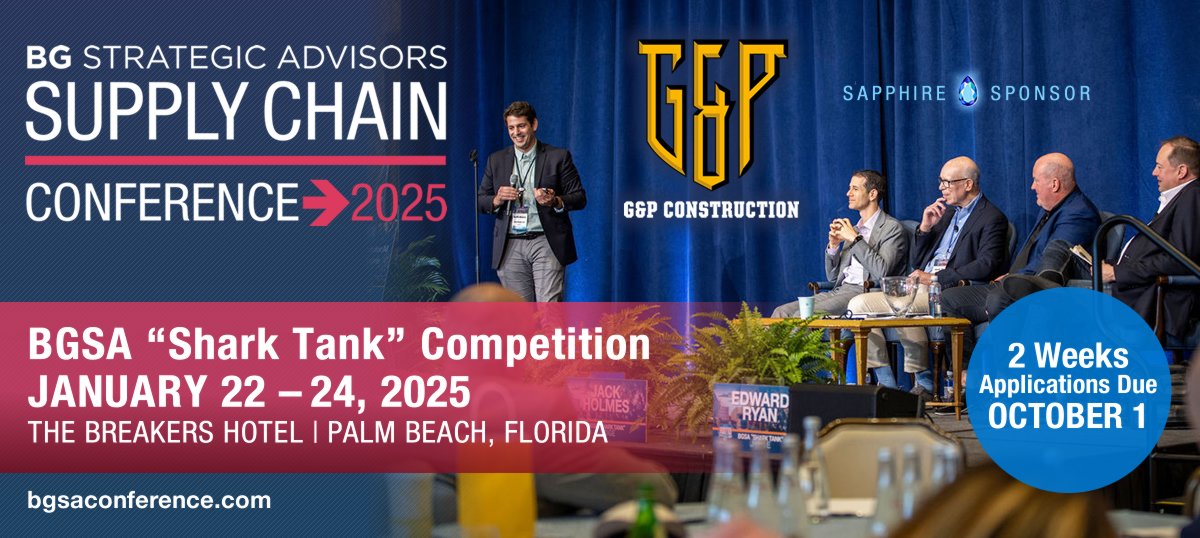
📷 Only a few days left to apply for Shark Tank! Don’t miss out—https://t.co/2hhRVO8G9v
#BGSAconference hashtag #SupplyChain hashtag #StartUps hashtag #Innovation hashtag#SharkTank hashtag#Opportunity hashtag#BusinessGrowth
CALLING ALL STARTUPS IN THE SUPPLY CHAIN SECTOR! Get ready to take the stage at the BGSA Supply Chain “Shark Tank” competition, proudly sponsored by G&P Construction! This is your golden opportunity to gain massive visibility, secure deals, and drive revenue for your startup.
Fellow supply chain executives: what are the biggest challenges you see?
From my perspective, here are 3 key issues for supply chain leaders:
1. We are drowning in data, and yet short on insights. How can we cut through all the information to focus on the things that matter most, and that generate the highest impact?
2. ROI and proof of results. There are tons of supply chain products and services. Which ones produce the most value?
3. Making decisions faster amidst imperfect information. Speaking for myself, at @CambCapital we know we have valuable tools in our portfolio, whether in post-purchase (@ParcelPerform), tracking/visibility, fulfillment (@getbyrd), last mile (@bringg and @DeliveryCircle), returns (@reverselogix), or elsewhere. How do we help companies make decisions to move forward, knowing the solutions are better than the status quo?
A good analogy is driverless cars. Tesla has been getting a lot of unwelcome attention for the fatalities caused by their driverless technology. On the one hand, they deserve the scrutiny. On the other hand, if driverless technology leads to 1,000 deaths, and human error leads to 50,000 deaths, are we better off accelerating adoption? Isn't the right question not "is it perfect" but "is it better than the status quo?"
This is the key framework for many decisions in #supplychain.
Join our CEO Benjamin Gordon at Trimble Insight
Experience the Future of Transportation Technology
September 15 - 17, 2024 | Las Vegas, Nevada
https://t.co/DnMrjadboC
“This study thoroughly examines the issues surrounding the infrastructure buildout necessary to electrify commercial vehicles it clearly shows how the heavy- duty vehicle industry's needs are different not just from other sectors of our economy but from each other”CFC J. Mullen
Who will win the battle between ride-hailing apps and incumbent taxis? For the last decade @Uber and @Lyft have generated tremendous visibility, raised close to $30 billion, and gained material market share. Will the taxis find a way to fight back?
@inDrive just announced a $150 million raise, led by General Catalyst, to allow passengers to bid for cab prices.
Will this model enable incumbents to compete more effectively?
#transportation #technology #investment
https://t.co/jcSEcbmfxe
Supply chain #volatility continues to increase.
Will the International Longshoreman's Association (ILA) launch a #strike on East Coast ports? Will we see more disruptions in the Red Sea and the Panama Canal?
As @FreightWaves noted, "If the ILA does strike, it will be the first major labor disruption on the East Coast since 1977. That strike lasted almost two months. The threat of a West Coast ILWU strike resulted in a hemorrhage of trade moving to the East Coast. How much East Coast trade we will see revert to the West Coast is ongoing."
#logistics #supplychain
https://t.co/aJiWd98oHV
Excellent @AEI analysis of how military supply chains matter. The US has created dependence on Taiwanese supply chains. As a result, China has made Taiwan a hostage. China can now use Taiwan to exact military and economic concessions from the US.
The solution is to change the US government's global supply chain strategy. We need to create resilient supply chains, via increased inventory, new sources, and redesign. And we should rebuild manufacturing and sourcing for crucial military production, e.g. F-35 jets.
https://t.co/ng4fweLKzo