@mashable GTA V came out in 2013 and had years of updates and bug fixes. GTA 6 is still new. You're comparing an optimized game with a fresh release. They'll improve the quality, fix bugs, boost FPS with updates.
Don't be fooled by the "One guy did X in 5 days for only 300$!"
The topic doesn't matter. It always comes down to the same 80/20 rule.
Making a prototype is always cheap. Polishing it is what's expensive.
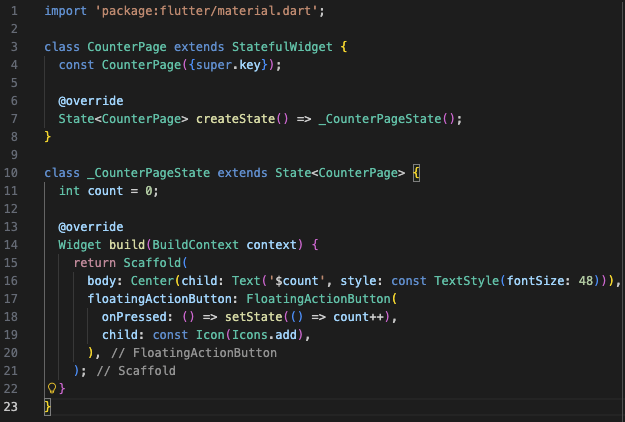
@felangelov setState Version:
Or go even simpler with pure Flutter setState - 23 lines
No packages needed:
- StatefulWidget
- Local state
- setState(() => count++)
Sometimes the simplest solution is the best one. Choose the right tool for the job
Just released nexa_ai_flutter
Flutter plugin for on-device AI on Android. LLMs, vision models, embeddings, ASR, more.
- 6 model types
- NPU/GPU/CPU acceleration
- Built-in downloader
Built on @nexa_ai SDK
https://t.co/jmKVmfDyfx
#Flutter#OnDeviceAI
@nexa_ai@nexa_ai Built a Flutter wrapper for your Android SDK.
Brings all 6 model types (LLM, VLM, embeddings, ASR, reranker, CV) to Flutter developers with full NPU support.
If you're building Flutter apps and want on-device AI, give it a try:
https://t.co/jmKVmfDyfx
My brain broke when I read this paper.
A tiny 7 Million parameter model just beat DeepSeek-R1, Gemini 2.5 pro, and o3-mini at reasoning on both ARG-AGI 1 and ARC-AGI 2.
It's called Tiny Recursive Model (TRM) from Samsung.
How can a model 10,000x smaller be smarter?
Here's how it works:
1. Draft an Initial Answer: Unlike an LLM that writes word-by-word, TRM first generates a quick, complete "draft" of the solution. Think of this as its first rough guess.
2. Create a "Scratchpad": It then creates a separate space for its internal thoughts, a latent reasoning "scratchpad." This is where the real magic happens.
3. Intensely Self-Critique: The model enters an intense inner loop. It compares its draft answer to the original problem and refines its reasoning on the scratchpad over and over (6 times in a row), asking itself, "Does my logic hold up? Where are the errors?"
4. Revise the Answer: After this focused "thinking," it uses the improved logic from its scratchpad to create a brand new, much better draft of the final answer.
5. Repeat until Confident: The entire process, draft, think, revise, is repeated up to 16 times. Each cycle pushes the model closer to a correct, logically sound solution.
Why this matters:
Business Leaders: This is what algorithmic advantage looks like. While competitors are paying massive inference costs for brute-force scale, a smarter, more efficient model can deliver superior performance for a tiny fraction of the cost.
Researchers: This is a major validation for neuro-symbolic ideas. The model's ability to recursively "think" before "acting" demonstrates that architecture, not just scale, can be a primary driver of reasoning ability.
Practitioners: SOTA reasoning is no longer gated behind billion-dollar GPU clusters. This paper provides a highly efficient, parameter-light blueprint for building specialized reasoners that can run anywhere.
This isn't just scaling down; it's a completely different, more deliberate way of solving problems.
My first Google major open-source contribution - PR to tensorflow/flutter-tflite
Prepping Android 16KB support.
- Upgraded build infra
- Migrated 14 example apps
- 100% backward compatible
PR: https://t.co/jBcjDoaB97
#Flutter#Android#TensorFlow
I developed CodeConcat, a VS Code extension that merges multiple files into one tab (perfect for sharing code with LLMs & debugging).
VS Code: https://t.co/bLhlSLnXad
Cursor AI / Windsurf: https://t.co/8KWfNraD9F
#vscode#devtools#CursorAI#Windsurf