The CI/CD Pipeline I Built Helped Me Understand DevOps End-to-End
One of the most valuable projects in my DevOps learning journey was building an end-to-end CI/CD pipeline on AWS.
It wasn't just about deploying an application it was about understanding how every stage contributes to a reliable software delivery process.
Project Workflow:
Developer pushes code to GitHub
⬇️
Jenkins triggers the pipeline
⬇️
Build & Unit Tests
⬇️
SonarQube checks code quality
⬇️
OWASP Dependency Check scans third-party libraries
⬇️
Docker image is built
⬇️
Trivy scans the container image for known vulnerabilities (CVEs)
⬇️
Image is pushed to Amazon ECR
⬇️
Helm values.yaml is updated with the new image tag
⬇️
Argo CD detects the Git change and synchronizes the Kubernetes cluster
⬇️
Application is deployed to Kubernetes
What I Learned:
Building the pipeline taught me that DevOps isn't just about deployment.
It's about automation | security | observability | reliability | repeatability.
Best Practices
✅ Automate every deployment.
✅ Fail the pipeline early when quality or security checks fail.
✅ Store infrastructure and deployment configuration in Git.
Question
Which stage do you think adds the most value in a CI/CD pipeline?
Stop memorizing CI/CD commands. Understand the workflow instead.
Most people try to memorize hundreds of DevOps commands.The best DevOps engineers understand how everything connects.
This handwritten cheat sheet covers the complete CI/CD flow:
✅ Git
✅ Jenkins
✅ Docker
✅ Terraform
✅ Kubernetes
✅ AWS
Learn the flow, not just the commands. Save this for your next deployment or DevOps interview, and share it with someone preparing for DevOps.
This is the exact GitHub Actions pipeline I set up for every new .NET project.
No Jenkins. No paid platform. No DevOps needed.
Just one YAML file that lives next to your code, gets reviewed in pull requests like everything else, and takes a commit all the way to a published Docker image.
Here's the full path, job by job:
1. Build and test on every push
2. Real Integration test with TestContainers
3. Publish Nuget only on green
4. Build a Docker image that tests itself
5. Push to register and maintaining secrets
I wrote the complete guide - every workflow, the full Dockerfile, and the secrets setup - here:
👉 https://t.co/VWWkazxCCt
This guide will be useful for any deployment setup: VPS on Premise, Azure Web App, or Kubernetes cluster to pull.
---
📌 AI Writes the Code. You Make the Decisions.
25,000 developers are reading my free weekly Newsletter to get real-world architecture judgment, production trade-offs, and .NET depth — the things AI can't teach you.
This is for developers who already ship production .NET — no beginner basics.
Read in 5 minutes, apply it the same day to your production applications.
Join us, it's free.
——
𝗕𝗲𝘀𝘁 𝘁𝗼𝗼𝗹𝘀 𝗼𝗳 𝘁𝗵𝗲 𝘄𝗲𝗲𝗸:
AI needs context. Your database architecture matters, and split data won't cut it. Here is what you need: https://t.co/Zn0i3QTHNY
AI coding agents are writing code faster than any review process was designed to handle. Here is how to make this process better: https://t.co/05np3MkPyC
——
♻️ Repost to help other .NET developers ship with confidence
➕ Follow me ( @AntonMartyniuk ) to improve your .NET and Architecture skills
🧵 7 Python Libraries Every Developer Should Know 🐍🚀
If you're serious about Python, these 7 libraries will save you hours of work and make you a far more productive developer.
Here's the list every Python programmer should know 👇
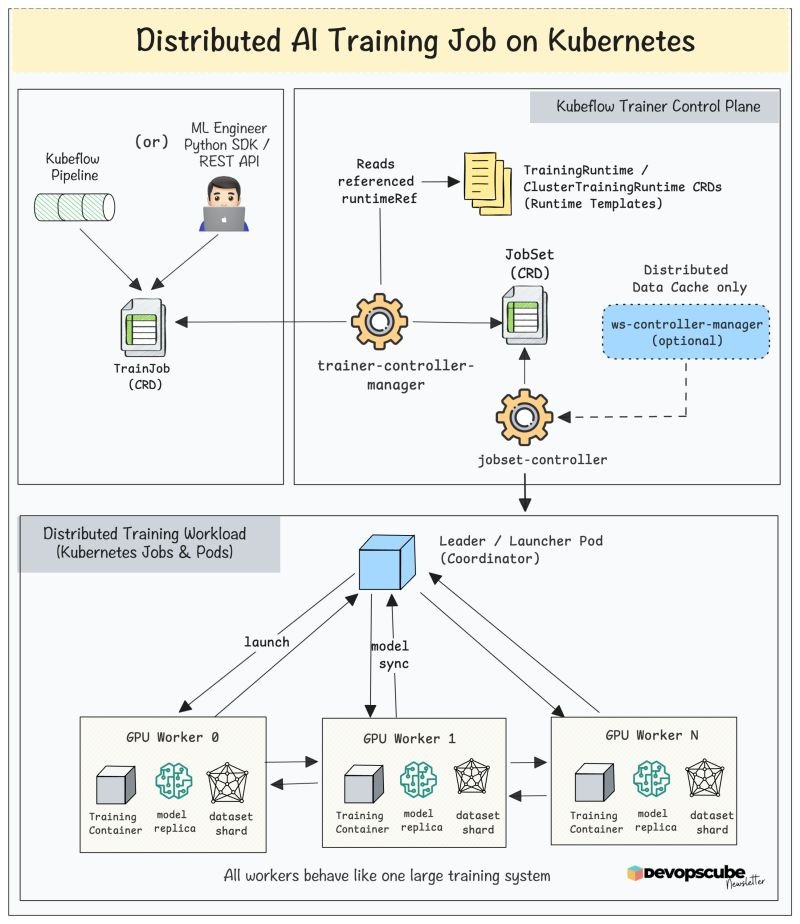
Running distributed AI training on Kubernetes is more than just adding GPUs.
In the Kubeflow pipeline edition,
We explained that the training step in the pipeline is usually delegated to Kubeflow Trainer.
Here is why.
Some ML training and LLM fine-tuning workloads need multiple GPUs running across multiple Kubernetes nodes.
For this, you need the following.
- Create and manage multiple worker pods
- Assigning GPU resources
- Configuring communication between workers
- Tracking training job status and more..
Kubeflow Trainer helps in doing all these in Kubernetes-native way (CRD's) and abstracts away all the complexities.
In our recent MLOps newsletter edition, we covered the following.
- A look into distributed training
- Kubeflow Trainer architecture (TrainJob, Runtimes, JobSet)
- Install Trainer and run your first distributed TrainJob (on CPU nodes)
- How to run ML Training Jobs on GPU Nodes
- Which Models Actually Need GPUs
𝗥𝗲𝗮𝗱 𝗶𝘁 𝗵𝗲𝗿𝗲: https://t.co/tPnYBmPpFC
♻️ If you find it useful, share it with fellow DevOps and Cloud Engineers.
#kubernetes #devops #mlops
Can you explain these without Googling?
• Load Balancer
• API Gateway
• Caching
• Message Queue
• Idempotency
• Circuit Breaker
• Event Sourcing
• CAP Theorem
If not...
Here's a visual guide covering 40 backend concepts every engineer should know.
👇
https://t.co/ZT1XF8h8PH
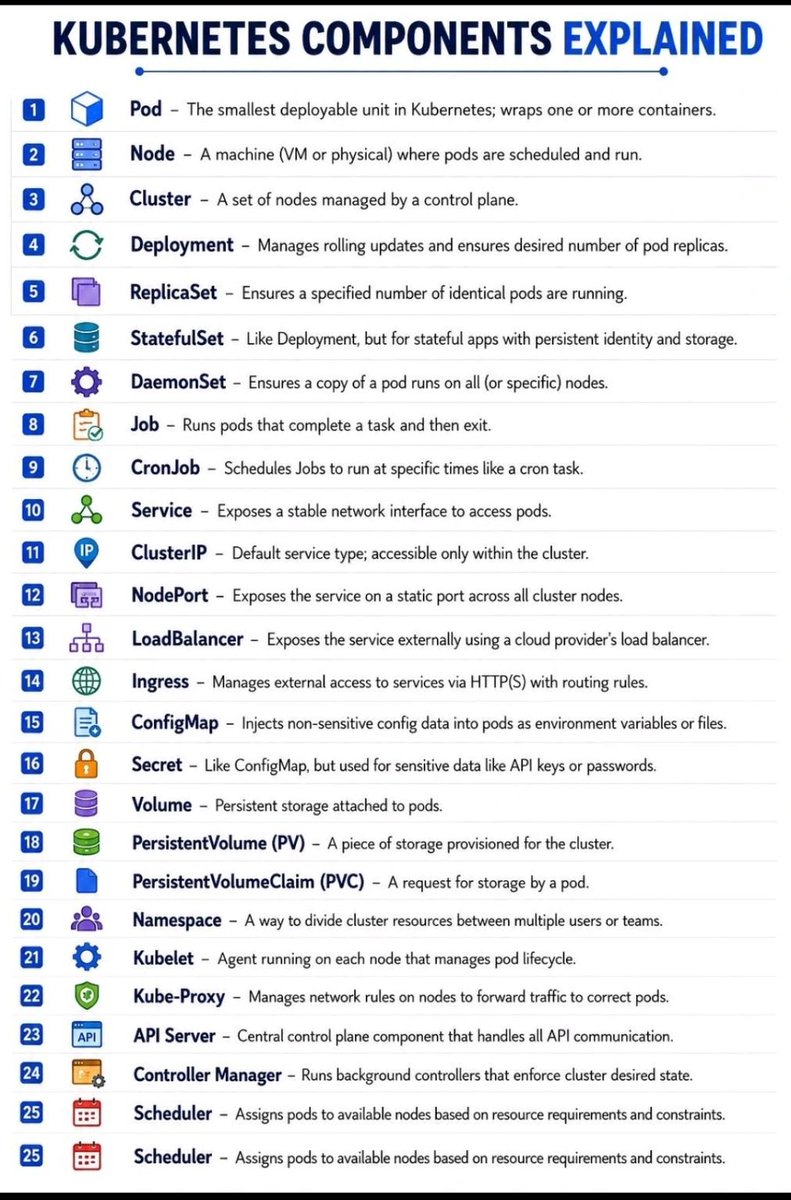
Kubernetes Components explanation:
📦 Pods → Where your application runs
🖥️ Nodes → Machines that host Pods
🌐 Cluster → Collection of Nodes managed together
🔄 Deployment → Ensures your application stays updated and available
👥 ReplicaSet → Maintains the desired number of Pods
💾 StatefulSet → Designed for databases and stateful applications
⚙️ DaemonSet → Runs one Pod on every Node (great for monitoring/logging agents)
✅ Job & CronJob → One-time and scheduled tasks
🌍 Service → Gives Pods a stable network identity
🚪 Ingress → Routes external traffic to your applications
🔐 ConfigMap & Secret → Manage configuration and sensitive data securely
💽 PV & PVC → Persistent storage for applications
🏷️ Namespace → Organize workloads across teams or environments
🤖 Kubelet → Agent running on every Node
🔀 Kube-Proxy → Handles networking between services and Pods
🎯 Scheduler → Decides where Pods should run
🧠 API Server → The heart of Kubernetes communication
⚡ Controller Manager → Continuously keeps the cluster in its desired state
💡 Think of Kubernetes like a city:
🏙️ Cluster = City
🏢 Nodes = Buildings
🏠 Pods = Apartments
👨💼 Deployment = Property Manager
🚦 Service = Reception Desk
🛣️ Ingress = Main Entrance Gate
📦 PV/PVC = Storage Room
Not a joke, many DevOps Engineers don’t fully understand how to structure a GitOps repo.
Here, I’ve made this to help you better understand.
49K+ read my DevOps and Cloud newsletter: https://t.co/WBucLdwdsb
What do we cover:
DevOps, Cloud, Kubernetes, FinOps, IaC, GitOps, MLOps
🔁 Consider a repost if this is helpful.
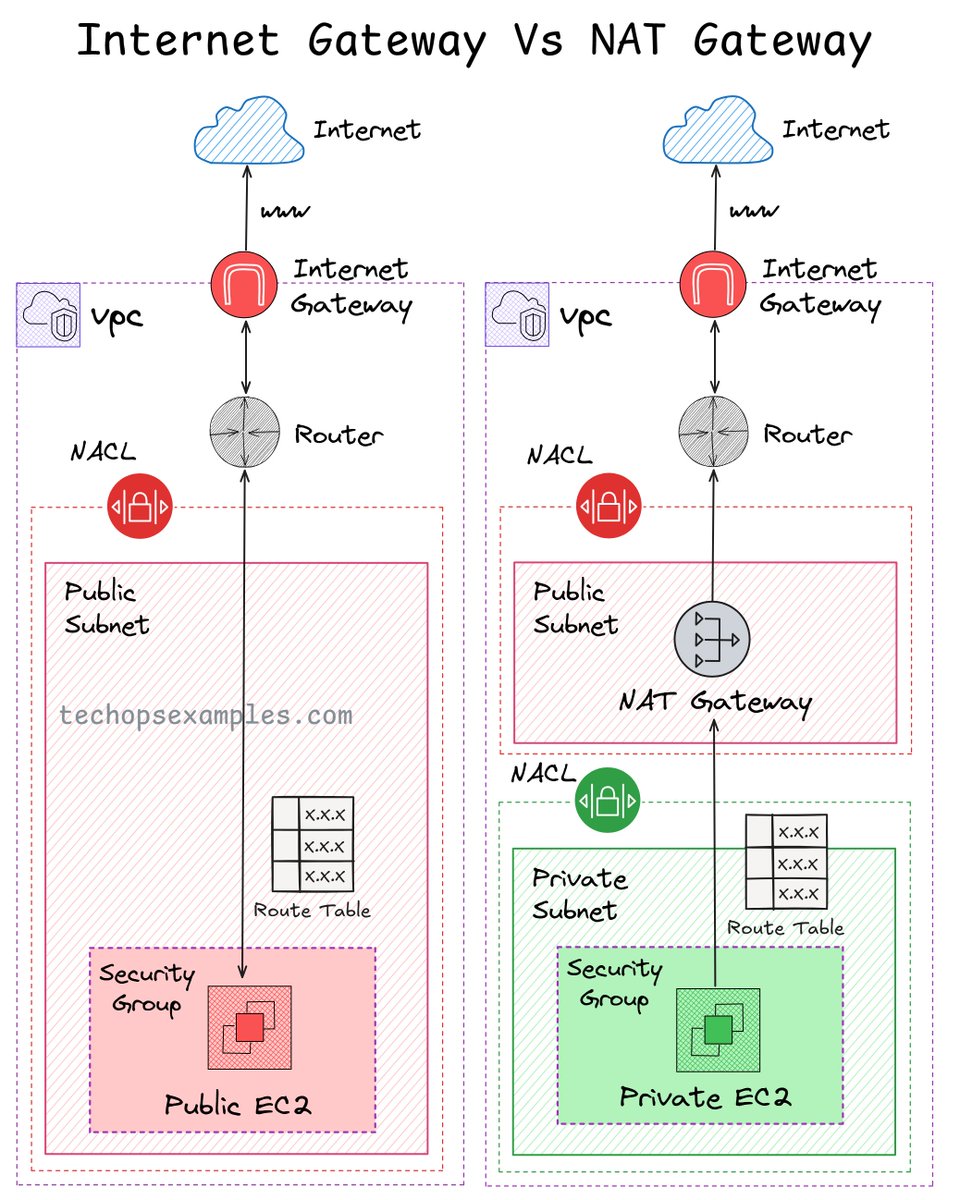
Not a joke, many Cloud Engineers don’t fully understand Internet and NAT Gateway differences or their implications.
Here, I’ve made this to help you better understand.
49K+ read my DevOps and Cloud newsletter: https://t.co/WBucLdwdsb
What do we cover:
DevOps, Cloud, Kubernetes, IaC, GitOps, MLOps
🔁 Consider a Repost if this is helpful
@Rajafaisall@Shaikh4537 Pakistan kept afghans and what they did? In Karachi mostly mobile snatchers were afghans… even in living a good life in Pakistan they use to curse Pakistan. Anyway… namak haram kom … your woman goes to other countries and feel relieved because you guys treat them like dirt